
Choosing Wisely Between Shopify Email and Klaviyo
Why Your Email Platform Choice Matters for Ecommerce Growth
Choosing the right email marketing platform is a critical decision for any online business, and the choice between Shopify email vs Klaviyo is one that many growing brands face. For mid-sized online retailers aiming to boost sales and streamline operations, this decision can open up significant growth. After all, experts predict online sales will soar from $6 trillion to over $8 trillion by 2026, and a strong email strategy is key to capturing a piece of that growth. Studies show that 55% of online shoppers still prefer email communication, making it a vital channel for customer connection.
So, which one is right for you?
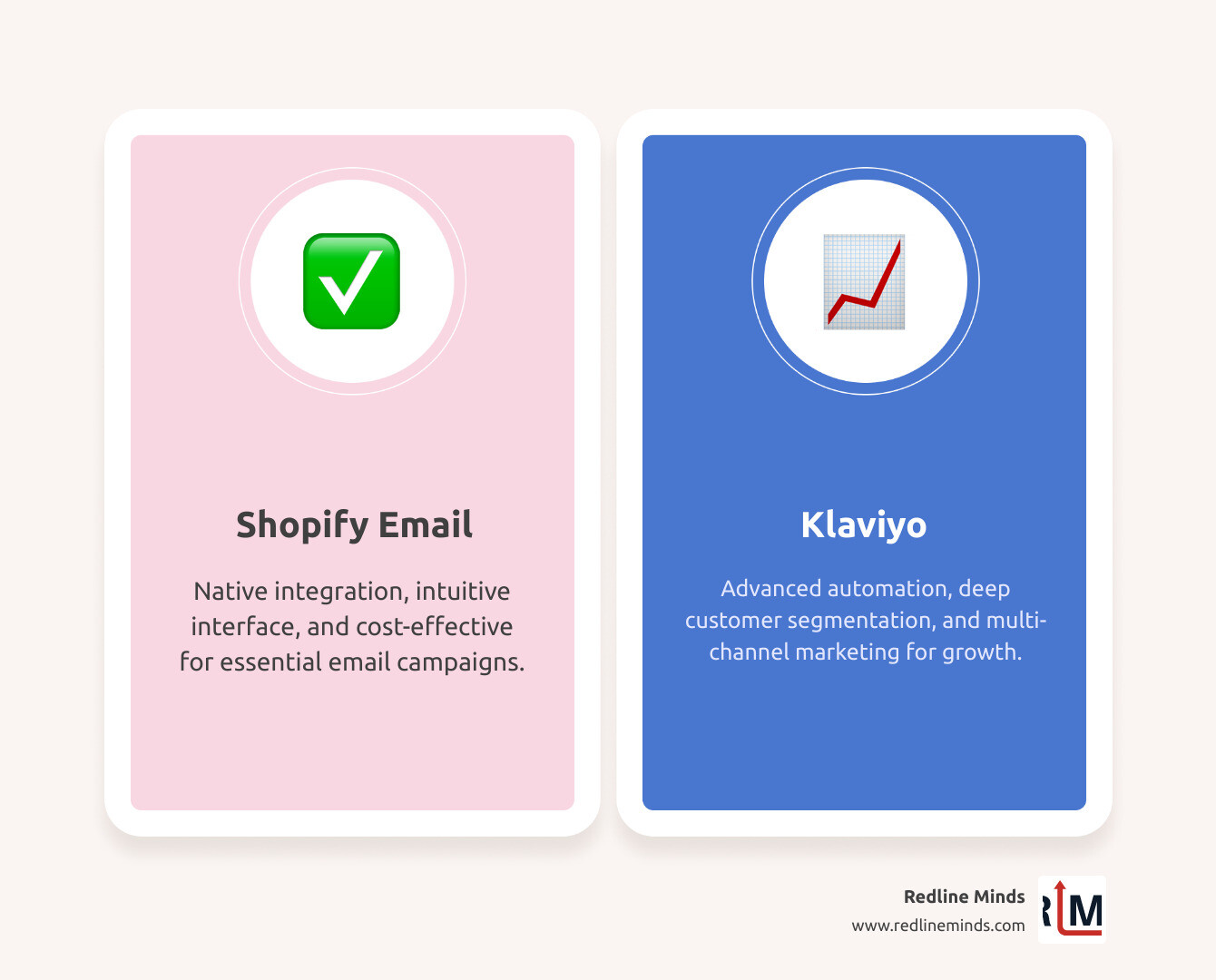
- Shopify Email: Best for simplicity, ease of use, and fundamental email marketing directly within your Shopify dashboard. It’s great for getting started.
- Klaviyo: Ideal for advanced automation, deep customer segmentation, and maximizing customer lifetime value. It’s built for serious growth.
Shopify Email offers a native, integrated solution, familiar to anyone already using the Shopify platform. On the other hand, Klaviyo stands as a powerhouse, renowned for its sophisticated features designed specifically for e-commerce success. This article will provide a clear, head-to-head comparison to help you make a strategic decision that aligns with your business goals.
Shopify Email vs Klaviyo: A Head-to-Head Feature Breakdown
This section compares the core functionalities of both platforms to see how they stack up in day-to-day use. We’ll dig into everything from how easy they are to use to their advanced capabilities.
User Interface and Ease of Use
When we look at the user experience, we find that Shopify Email and Klaviyo approach it from different angles.
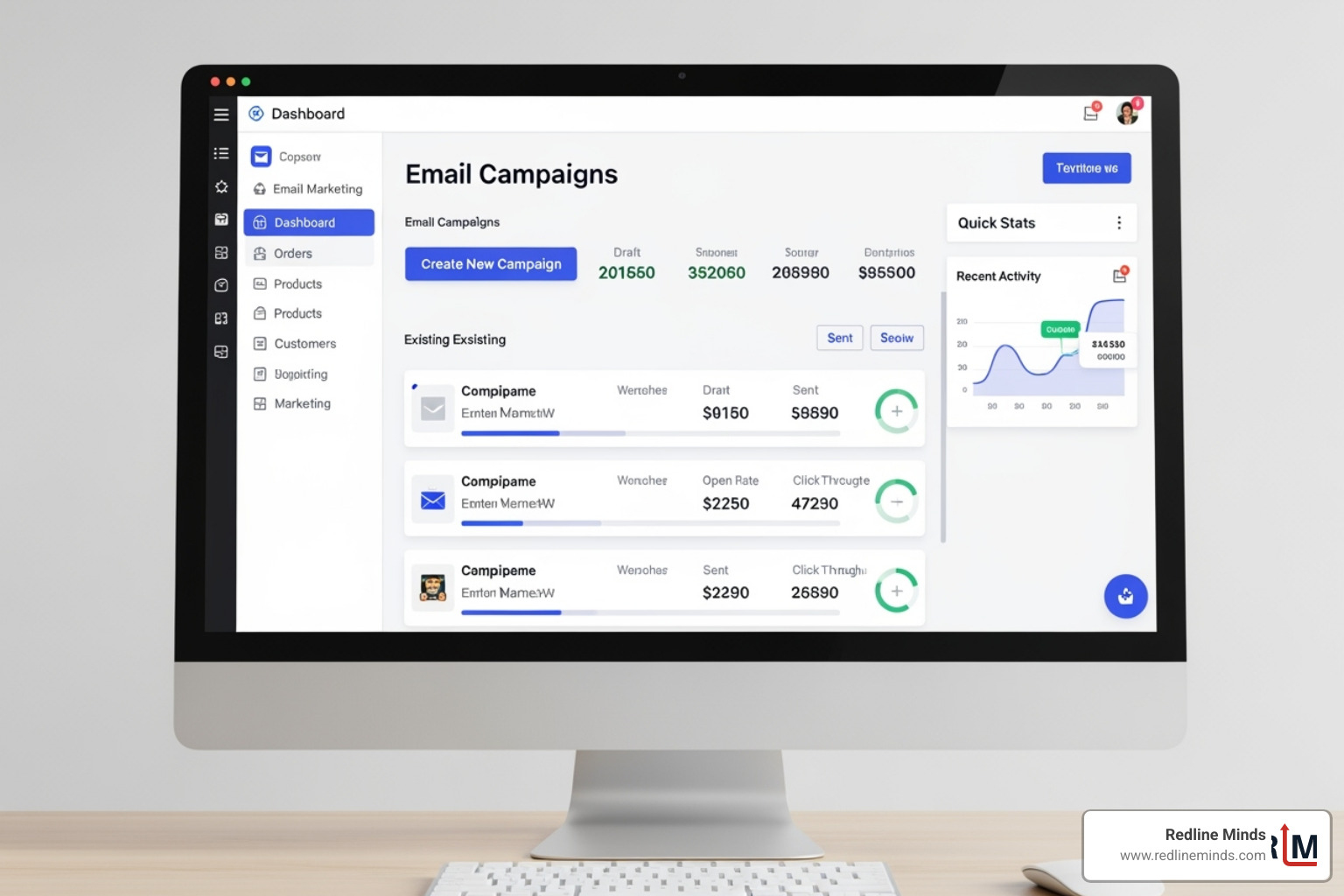
Shopify Email shines in its simplicity and seamless integration. It’s a built-in email marketing tool designed to keep things easy for Shopify store owners. You won’t need extra logins, separate dashboards, or complex setups—it’s all managed right inside your Shopify admin panel. This means if you’re already comfortable navigating your Shopify store, you’ll find its user interface familiar and intuitive, leading to a very low learning curve. It truly wins for simplicity and speed, making it an excellent choice for beginners.
Klaviyo, on the other hand, operates as a separate platform, requiring a separate login. While this might seem like an extra step, it opens the door to a much richer, feature-packed dashboard. Klaviyo is renowned for its extensive functionality, which, naturally, comes with a steeper learning curve compared to Shopify Email. However, this complexity is a trade-off that often pays off in powerful results for businesses aiming for highly personalized and automated campaigns. While it might take a bit more time to master, the depth of features available in Klaviyo makes the effort worthwhile for many.
Email Design and Customization
Crafting beautiful and effective emails is central to any marketing strategy. Both platforms offer tools for this, but with varying degrees of sophistication.
Shopify Email boasts a large library of pre-built email templates that are highly configurable. One of its key advantages is its ability to automatically pull your store’s branding elements, such as colors, fonts, and logos, ensuring consistency without extra effort. It features a simple drag-and-drop editor that makes creating professional-looking emails straightforward. With 46 pre-built templates, it’s designed to get your campaigns out quickly and efficiently, directly from your Shopify account.
Klaviyo takes email design to a more advanced level. While Shopify Email automatically matches branding, Klaviyo requires some manual setup for brand elements, but in return, it offers a much larger template library, with over 250 pre-built options. Its strength lies in advanced customization and the ability to use dynamic content blocks. This means you can show different products to different recipients based on their behavior, allowing for truly personalized email content. Klaviyo’s dynamic product feeds allow you to insert products directly into emails that users have added to their carts or browsed, enhancing relevance. Additionally, its “Saved Sections” feature lets you reuse specific content blocks across different emails, streamlining your design process for consistency and efficiency.
Automation and Workflows
Automated email campaigns are the backbone of effective e-commerce marketing, allowing you to engage customers at critical points in their journey.
Shopify Email offers basic automation capabilities with over 15 built-in automation templates covering essentials like abandoned cart reminders, welcome emails, and thank-you notes. However, for more sophisticated automation, most of these require an additional app called “Shopify Flow.” While Shopify Email provides a simpler, faster setup process for these basic automations, it currently lacks the robust, built-in automated workflows found in more dedicated platforms.
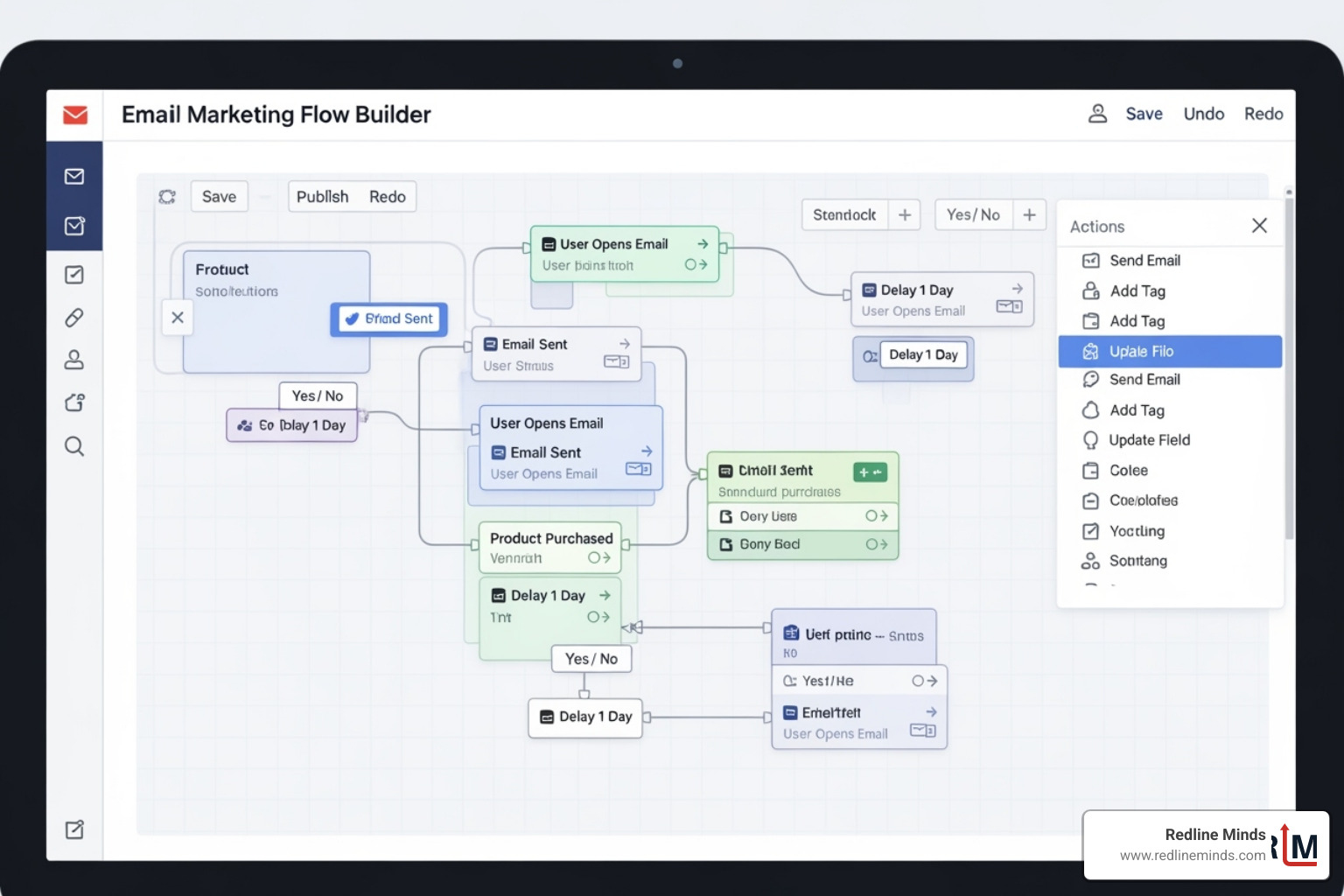
Klaviyo is truly where automation shines. It offers a powerful, visual flow builder that allows e-commerce shop owners to create highly intelligent automated email sequences, known as “flows.” Klaviyo boasts an extensive library of over 60 pre-built automation flows, designed to engage customers based on complex behavioral triggers. Its data-driven automation capabilities mean you can use real-time data to activate flows, ensuring timely and relevant communication. Klaviyo also leverages AI-powered predictive automation, allowing you to send emails at the exact moment a customer is most likely to purchase or engage, optimizing for conversions. Examples of Klaviyo flows include:
- Welcome Series Flow: Engaging new subscribers and introducing them to your brand, often with a first-time discount.
- Browse Abandonment Flow: Reminding customers about products they viewed but didn’t add to their cart.
- Shopping Cart Abandonment Flow: Recovering lost sales by reminding customers about items left in their carts.
- Post-Purchase Flow: Enhancing customer experience with order confirmations, delivery updates, review requests, and personalized product recommendations.
- VIP Customer Flow: Rewarding high-spending customers with exclusive perks and early access.
- Win-back flows: Re-engaging lapsed customers with special offers.
- Back-in-stock flows: Alerting shoppers when previously unavailable items return to inventory.
- Replenishment flows: Reminding buyers to repurchase consumable products.
These robust automation features are why 57% of marketers report a return on their investment when using automated email marketing campaigns.
Segmentation and Personalization
Sending the right message to the right person at the right time is the goal of email marketing, and this relies heavily on segmentation and personalization.
Shopify Email provides segmentation capabilities for sending branded emails directly from your store. It automatically categorizes customers based on predefined criteria such as new clients, returning customers, VIP clients, and local shoppers. While this offers basic filtering and allows for targeted campaigns, it’s generally simpler to use and has pre-built segmentation templates that simplify the process for smaller businesses.
Klaviyo offers advanced segmentation capabilities that are incredibly powerful, though some users might jokingly say they’d “need a computer science degree to set them up” due to their depth. Klaviyo allows for unlimited segmentation conditions based on a vast array of behavioral and transactional data. This includes purchase frequency, conversions, website behaviors, preferences, and items bought. It also leverages predictive analytics for forecasting shopper behavior, such as customer lifetime value (CLV) and churn risk, allowing for incredibly deep personalization. This means you can segment your master subscriber list into highly specific groups to send truly relevant and personalized content, even down to showing different products to different recipients based on their past interactions.
Analytics, Reporting, and A/B Testing
Understanding how your campaigns perform is crucial for optimization and growth.
Shopify Email provides basic analytics monitoring due to its direct connection with your store data. You can track key metrics like email open rates, clicks, and sales attributed to your campaigns. However, a significant limitation is its lack of native A/B testing features. To conduct tests, users might need to manually randomize segments or rely on third-party apps, which adds a layer of complexity.
Klaviyo offers comprehensive analytics and reporting tools that go far beyond basic metrics. Its in-depth reporting dashboards provide insights into email open rates, clicks, revenue attribution, and real-time performance tracking. Klaviyo also offers performance benchmarking, allowing you to compare your results against industry averages. Its advanced data science tools include predictive analytics, offering deeper insights into customer behavior and campaign effectiveness. Crucially, Klaviyo has built-in A/B testing capabilities for both individual emails and entire flows, enabling continuous optimization of your marketing efforts. Its reporting is generally considered more comprehensive than what Shopify Email provides.
Multi-Channel Capabilities and Integrations
Modern marketing often extends beyond just email, and integration with your e-commerce platform is non-negotiable.
Shopify Email is, as its name suggests, an email-only solution. Its strength lies in its seamless, native integration with the Shopify platform. Since it was designed specifically for Shopify, there’s no question that it perfectly integrates with your e-commerce store, directly accessible via the dedicated Shopify Email app.
Klaviyo offers multi-channel marketing capabilities, extending beyond email to include SMS marketing and push notifications. This allows you to create a unified marketing ecosystem across different touchpoints. Klaviyo boasts an extensive app ecosystem, integrating with over 350 apps, including major e-commerce platforms like Shopify, WooCommerce, BigCommerce, and Magento. It has a dedicated Shopify app for easy integration, allowing for deep data synchronization between your store and Klaviyo, powering its advanced segmentation and automation features. This broad integration capability allows for highly targeted and relevant email, Facebook, and Instagram marketing campaigns to your Shopify store customers.
Pricing and Value: Calculating the True Cost and ROI
Understanding the pricing models is crucial, as the “cheapest” option isn’t always the one that provides the best value or return on investment. We understand that budget is a significant factor for many businesses, and we aim to help you make an informed decision without getting bogged down in specific numbers.
Shopify Email’s Cost-Effective Model
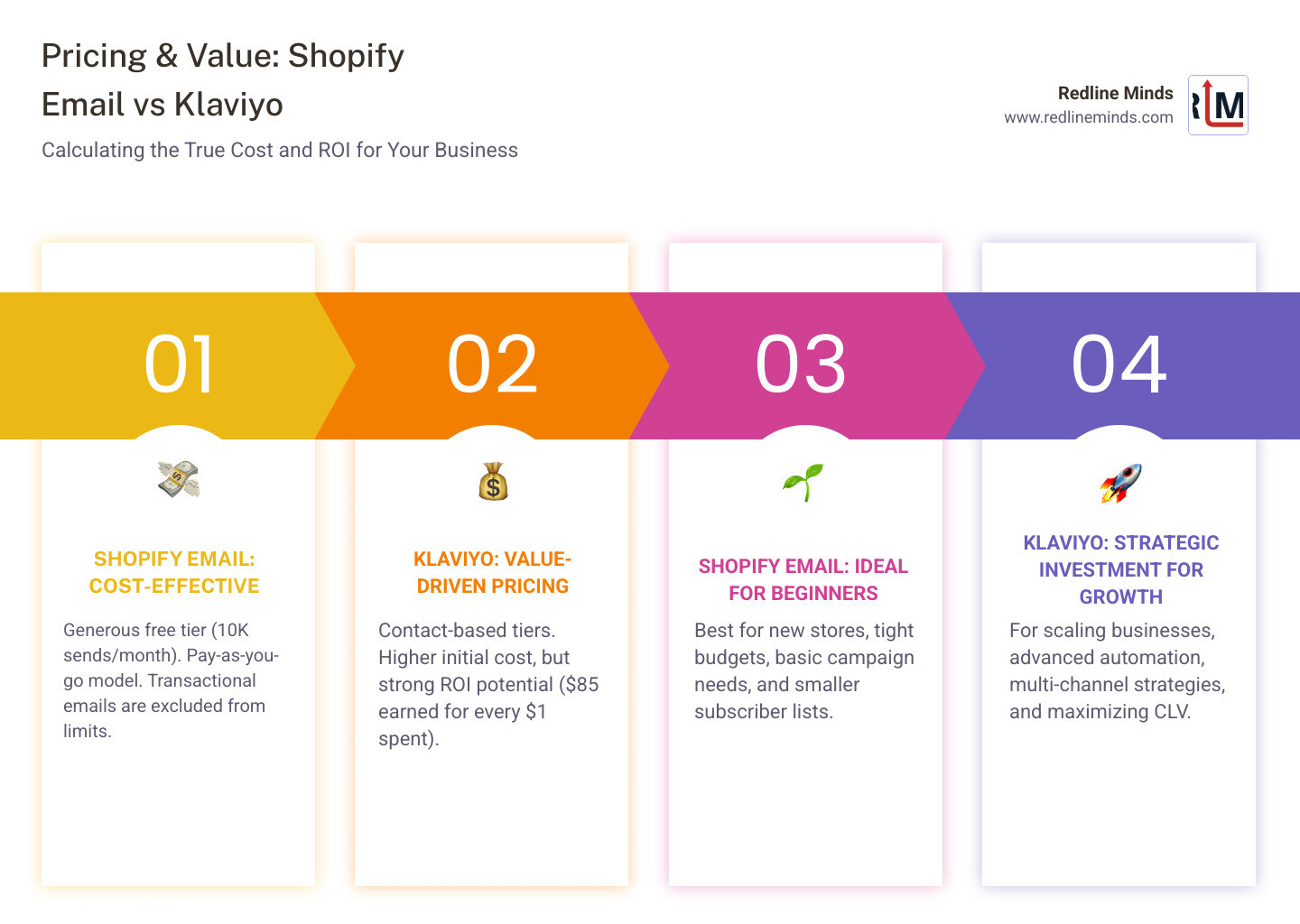
Shopify Email offers a highly cost-effective model, especially appealing to new and smaller businesses. It’s free to start and allows for a generous volume of emails per month at no extra cost, as it’s included with your Shopify subscription. Beyond this initial complimentary tier, it operates on a pay-as-you-go system, meaning you pay a small fee for every additional thousand emails you send. This model ensures there are no monthly fees for the service itself, making it considerably cheaper than many other services. A significant advantage for e-commerce stores is that transactional emails, such as order confirmations and shipping updates, do not count towards your monthly send limit. This can add up quickly for busy stores! This makes Shopify Email a high-value option for beginners and businesses with limited budgets. You can find More on Shopify Email pricing details directly from Shopify.
Klaviyo’s Value-Based Pricing
Klaviyo’s pricing structure is based on the number of contacts in your email list, with costs increasing as your subscriber count grows. It offers a limited free plan for a small number of subscribers, allowing you to test its capabilities before committing. While Klaviyo generally has a higher initial cost compared to Shopify Email, especially for larger lists, its value proposition lies in its powerful features and potential for high ROI. Many businesses find that Klaviyo’s advanced automation, segmentation, and personalization capabilities lead to significant revenue growth. In fact, studies suggest that Shopify stores typically earn $85 for every $1 spent on Klaviyo. This indicates that while the upfront investment might be higher, the strategic advantages and revenue-generating potential often make it a worthwhile investment for growing businesses. Klaviyo’s pricing adapts as your business grows, ensuring that you’re paying for the features and scale you need.
The Strategic Decision: Which Platform Aligns with Your Business Goals?
The right choice depends entirely on your business’s current stage, resources, and future ambitions. Think about where your business is now and where you want it to be in the next few years.
Who Should Choose Shopify Email?
Shopify Email is an excellent fit for several types of businesses:
- Beginners and new stores: If you’re just starting your e-commerce journey and building your initial customer base, Shopify Email provides a straightforward, integrated solution.
- Small businesses on a tight budget: With its generous complimentary email sends and pay-as-you-go model, it’s a highly affordable option that helps keep marketing costs low.
- Merchants prioritizing simplicity: For those who prefer to manage everything within the familiar Shopify dashboard without complex setups or integrations, Shopify Email offers a no-fuss experience.
- Basic campaign needs: If your primary requirements are sending promotional emails, welcome sequences, and basic abandoned cart reminders, Shopify Email likely has you covered.
- Stores with a small subscriber list: The cost-effectiveness is particularly noticeable for businesses with a limited number of contacts, as you might stay within the free send limits for a long time.
If you need a simple, intuitive, and budget-friendly email marketing solution that integrates seamlessly with your Shopify store, this is a fantastic starting point.
Who Should Choose (or Switch to) Klaviyo?
Klaviyo is designed for businesses ready to take their email marketing to the next level:
- Growing and scaling businesses: As your subscriber list expands and your marketing needs become more sophisticated, Klaviyo’s robust features are built to support significant growth.
- Data-driven marketing teams: If you’re keen on leveraging deep customer insights, predictive analytics, and granular segmentation to inform your strategies, Klaviyo is unparalleled.
- Need for advanced automation: For businesses that require complex automated flows triggered by specific customer behaviors, Klaviyo offers the tools to create highly personalized customer journeys.
- Multi-channel marketing strategies: If you plan to integrate email with SMS and potentially other channels for a cohesive marketing approach, Klaviyo provides these capabilities natively.
- Focus on maximizing customer lifetime value: Klaviyo’s advanced segmentation and personalization tools are designed to nurture customer relationships, encourage repeat purchases, and ultimately increase the long-term value of each customer.
If you want a more robust tool right from the beginning of your e-commerce journey, or if your current basic setup is feeling restrictive, a Shopify-Klaviyo duo could be a good move. Trying the free versions of both tools is always a recommended first step to see which one best fits your unique needs.
Frequently Asked Questions about Shopify Email and Klaviyo
We often hear similar questions from businesses considering these two powerful platforms. Let’s address some of the most common ones.
Can I use both Shopify Email and Klaviyo at the same time?
Yes, it is possible to use both Shopify Email and Klaviyo simultaneously, but we advise a clear strategy to avoid confusion for your customers. Some businesses opt to use Shopify Email for simple, transactional notifications directly related to orders (like order confirmations or shipping updates) due to its native integration. Then, they use Klaviyo for all their marketing campaigns, including promotional emails, abandoned cart sequences, and welcome flows.
The key is to avoid sending marketing emails from both platforms to the same customer base, as this can lead to over-communication, customer frustration, and potentially high unsubscribe rates. We recommend choosing one platform as your primary marketing email sender to maintain consistency and a clear communication strategy.
Does Klaviyo’s integration slow down my Shopify store?
This is a common concern among e-commerce store owners, and it’s a valid one. Klaviyo, like many third-party apps, requires a script to be loaded on your website to track customer behavior and sync data. However, Klaviyo is designed to minimize its impact on page load times. It uses an asynchronous script, meaning it loads independently and does not block other elements of your website from loading.
While any additional script can theoretically add a fraction of a second to your load time, the benefits of Klaviyo’s deep data tracking, advanced segmentation, and powerful automation often far outweigh any minimal performance impact. Proper implementation and regular site performance checks are always key to ensuring your store remains fast and efficient.
Which platform is better for handling transactional emails?
When it comes to transactional emails, there’s a notable difference in how each platform handles them, particularly concerning cost implications.
Shopify Email handles transactional emails natively as part of your Shopify store. A significant advantage here is that these transactional sends (like order confirmations, shipping updates, and refund notifications) do not count against your complimentary monthly email limit. This can be a substantial cost-saver, especially for stores with high order volumes, as these emails can add up quickly.
Klaviyo can also handle transactional emails, and it offers more customization options for these messages. However, any emails sent through Klaviyo, including transactional ones, typically count towards your monthly plan limits. This means if you use Klaviyo for all your email communications, you’ll need a plan that accommodates your total send volume, which could increase your monthly cost. For this reason, many businesses find Shopify Email to be a more cost-effective solution for purely transactional communications.
Conclusion: Aligning Your Tools with Your Ecommerce Strategy

In the dynamic world of e-commerce, choosing the right email marketing platform is more than just a technical decision—it’s a strategic one. We’ve seen that Shopify Email excels in simplicity and cost-effectiveness, offering a seamless experience for beginners and those with more basic email marketing needs. It’s a fantastic way to get started and manage fundamental campaigns directly within your Shopify dashboard.
On the other hand, Klaviyo stands out for its power and scalability. With advanced automation, deep segmentation, multi-channel capabilities, and robust analytics, it’s built for growing businesses that are ready to invest in sophisticated marketing strategies to maximize customer lifetime value. While it may have a steeper learning curve and a different pricing structure, its potential for ROI is significant.
The “best” tool isn’t a one-size-fits-all answer; it’s the one that aligns perfectly with your specific business goals, current stage, and resources. Whether you’re just launching your store or scaling rapidly, understanding the strengths of each platform will empower you to make an informed choice.
At Redline Minds, we specialize in helping e-commerce businesses steer these critical decisions. We believe in developing a marketing technology stack that not only meets your current needs but also supports your long-term growth ambitions.