
Seguno or Klaviyo? Picking Your Shopify Email Marketing Champion

Core Philosophy: Built-In vs. Integrated
When debating Klaviyo vs. Seguno, Shopify merchants face a crucial choice for their email marketing. Both platforms empower e-commerce businesses, but they do it in fundamentally different ways. Here’s a quick overview of their core differences:
- Klaviyo: This is a comprehensive, external marketing automation powerhouse. It’s built for deep data analysis, advanced segmentation, and extensive integrations across many e-commerce platforms. Think of it as a robust, all-encompassing marketing operating system.
- Seguno: This platform is purpose-built inside Shopify. It offers seamless integration with your store’s admin, prioritizing ease of use and streamlined workflows specifically for Shopify merchants. It’s like a specialized tool perfectly fitted for your Shopify workbench.
Email marketing is vital for any online store. It’s how you connect with customers, build loyalty, and drive sales. But picking the right tool can feel overwhelming. You need something that fits your business size, your team’s skills, and your growth goals.
Klaviyo has earned its reputation as a data-driven champion, trusted by over 157,000 businesses. It’s a favorite for brands seeking powerful automation and deep insights from their customer data.
Seguno, on the other hand, is quickly gaining traction with its unique, Shopify-first approach. Merchants love its simplicity and how it makes email marketing feel like a natural extension of their Shopify store. It boasts a 4.8 out of 5-star rating on the Shopify App Store, a testament to its user experience.
This article will break down these two leading platforms. We’ll show you how they compare feature by feature, helping you decide which champion is right for your Shopify business.
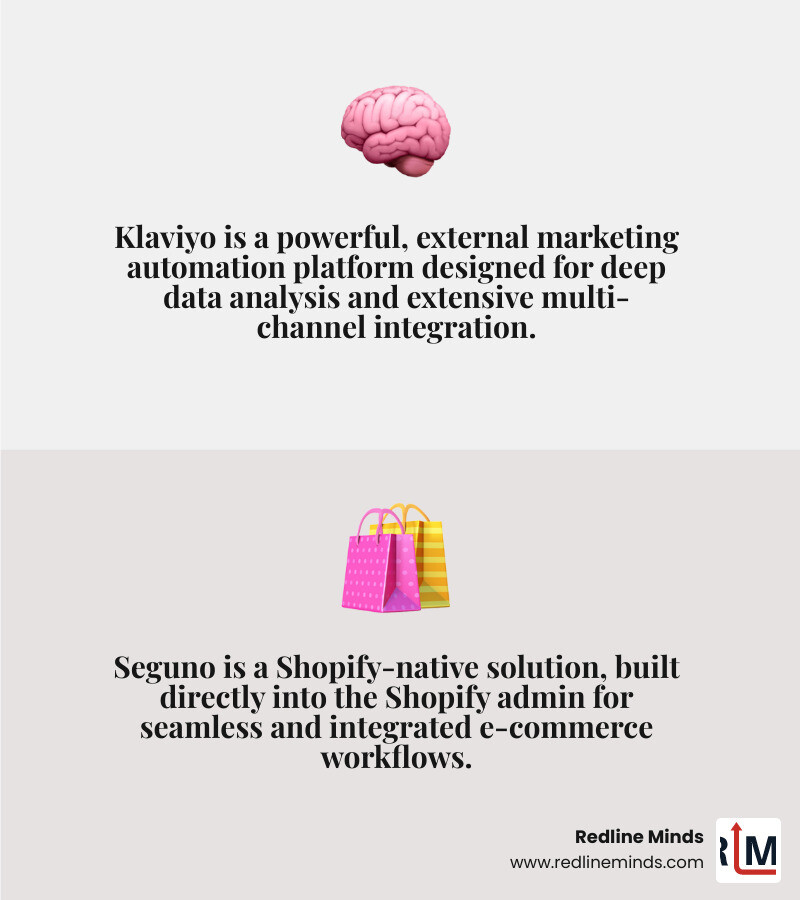
The fundamental architectural difference between Klaviyo and Seguno profoundly impacts the user experience and functionality for Shopify merchants. It’s not just about features; it’s about how deeply intertwined the marketing tool is with your Shopify store. Let’s explore what this means for you.
Klaviyo: The All-in-One Marketing Powerhouse
Klaviyo stands as a formidable external marketing automation platform. It operates as an independent entity that integrates with, rather than lives within, your Shopify store. This distinction is crucial because it allows Klaviyo to be an all-encompassing solution, capable of serving a wide array of e-commerce businesses, including those operating on a headless commerce model.
At its heart, Klaviyo is a data-driven marketing platform. It excels at changing customer data into meaningful, impactful experiences through email, SMS, and web interactions. This focus on data means it’s built for advanced features, offering robust segmentation, predictive analytics, and AI automation to help B2C brands engage customers at every touchpoint and drive revenue growth. For businesses with complex data needs and seasoned marketing teams, Klaviyo provides the horsepower to deeply understand store performance.
With over 350 integrations, Klaviyo can connect with nearly every tool in your tech stack, from payment processors to POS systems. This extensive integration capability means it can pull in vast amounts of customer data, allowing for highly personalized and targeted marketing efforts. It’s ideal for scaling businesses and enterprise-level teams that require a comprehensive solution to orchestrate multi-channel campaigns and analyze performance across various platforms.
Seguno: The Seamless Shopify-Native Solution
In stark contrast to Klaviyo, Seguno is built exclusively for Shopify merchants. It doesn’t just integrate with Shopify; it lives inside your Shopify Admin. This seamless embedding offers an intuitive user experience that feels like a natural extension of the Shopify platform itself. Imagine creating, managing, and tracking your email marketing campaigns without ever leaving your familiar Shopify environment – that’s the Seguno promise.
Seguno prioritizes ease of use and streamlined workflows, making it particularly appealing for lean teams and growth-focused brands. Its one-click automations simplify common e-commerce marketing tasks, allowing merchants to run powerful programs without the complexity often associated with more general marketing automation tools. The fact that Seguno was awarded the 2024 Shopify Build Award for Best App speaks volumes about its native integration and value to the Shopify ecosystem. It’s designed to cut complexity, cut costs, and add revenue, making it a compelling choice for businesses that value simplicity and direct integration.
Feature Face-Off: A Detailed Klaviyo vs Seguno Comparison
When we dig into the nitty-gritty of features, both Klaviyo and Seguno bring powerful tools to the table, but they cater to different needs and scales. Let’s compare their core functionalities side-by-side.
| Feature | Klaviyo | Seguno |
|---|---|---|
| Automation | Complex multi-step journeys, conditional logic, visual flow builder. | Streamlined, one-click automations, pre-built templates. |
| Segmentation | Predictive analytics, AI-powered, behavioral data, real-time updates. | Practical audience grouping, Shopify tag-based, location-based. |
| Usability | Steeper learning curve, powerful but complex. | Intuitive, Shopify-like UI, minimal learning curve. |
| Integrations | 350+ external integrations, robust API. | Native to Shopify, integrates with Shopify ecosystem. |
| Support | 24/7 live chat, email, phone (paid plans), community forums. | Email-based ticket, in-platform messaging, knowledge base. |
Automation and Workflows
When it comes to automation, both platforms aim to save you time and boost sales, but their approaches differ significantly.
Klaviyo’s automation suite is famously robust, featuring what they call “Flows.” These are visual, multi-step journeys that can be triggered by a vast array of customer behaviors, such as viewing a product, adding to cart, or making a purchase. With conditional logic, you can create highly personalized paths for different customer segments. For example, a welcome series might follow different paths depending on which products a new subscriber views after joining your list. If you need to build intricate, branching workflows that adapt dynamically to customer interactions, Klaviyo offers the sophisticated workflow engine to do it.
Seguno, by contrast, focuses on streamlined automations that are incredibly easy to set up. While it might not offer the same depth of conditional logic as Klaviyo, it provides a wealth of pre-built e-commerce templates for essential scenarios. Think welcome series, abandoned cart recovery, post-purchase follow-ups, and win-back campaigns. These are designed for quick deployment, allowing Shopify merchants to activate critical lifecycle marketing campaigns with minimal effort. For a business that needs effective automations without a steep learning curve, Seguno’s practical essentials are a game-changer.
Segmentation and Personalization
Effective segmentation and personalization are the secret sauce to higher engagement and conversions. Both Klaviyo and Seguno enable you to send targeted messages, but their capabilities vary.
Klaviyo truly shines in its segmentation prowess. It leverages predictive analytics and AI-powered insights to help you understand customer behavior and forecast future actions, such as lifetime value and churn probability. Its real-time segmentation continuously recalculates audience membership as data changes, allowing for hyper-targeted communications based on deep behavioral data, purchase history, and demographics. For example, you can segment customers based on specific actions like viewing products but not purchasing, or target high-value customers showing early churn signals with retention offers.
Seguno offers practical audience grouping that is tightly integrated with Shopify. You can segment your customers based on fundamental relationship attributes, purchase history, and even leverage your existing Shopify tag-based segmentation. This means you can use the same organization systems you already have in Shopify to target your emails. Seguno also supports location-based targeting for region-specific promotions. While its segmentation might not reach the predictive depths of Klaviyo, it provides intuitive and effective ways to personalize messages based on readily available Shopify data, making it easy for merchants to create custom groups for special marketing initiatives.
Design, Usability, and Support
The user experience, from email design to getting help, can significantly impact your team’s efficiency and enjoyment.
Klaviyo, while incredibly powerful, is known for having a steeper learning curve. Its comprehensive feature set means there’s a lot to learn, which can be daunting for new users or smaller teams without dedicated marketing personnel. However, once mastered, its drag-and-drop editor and robust design tools offer immense flexibility for creating professional, customizable email templates.
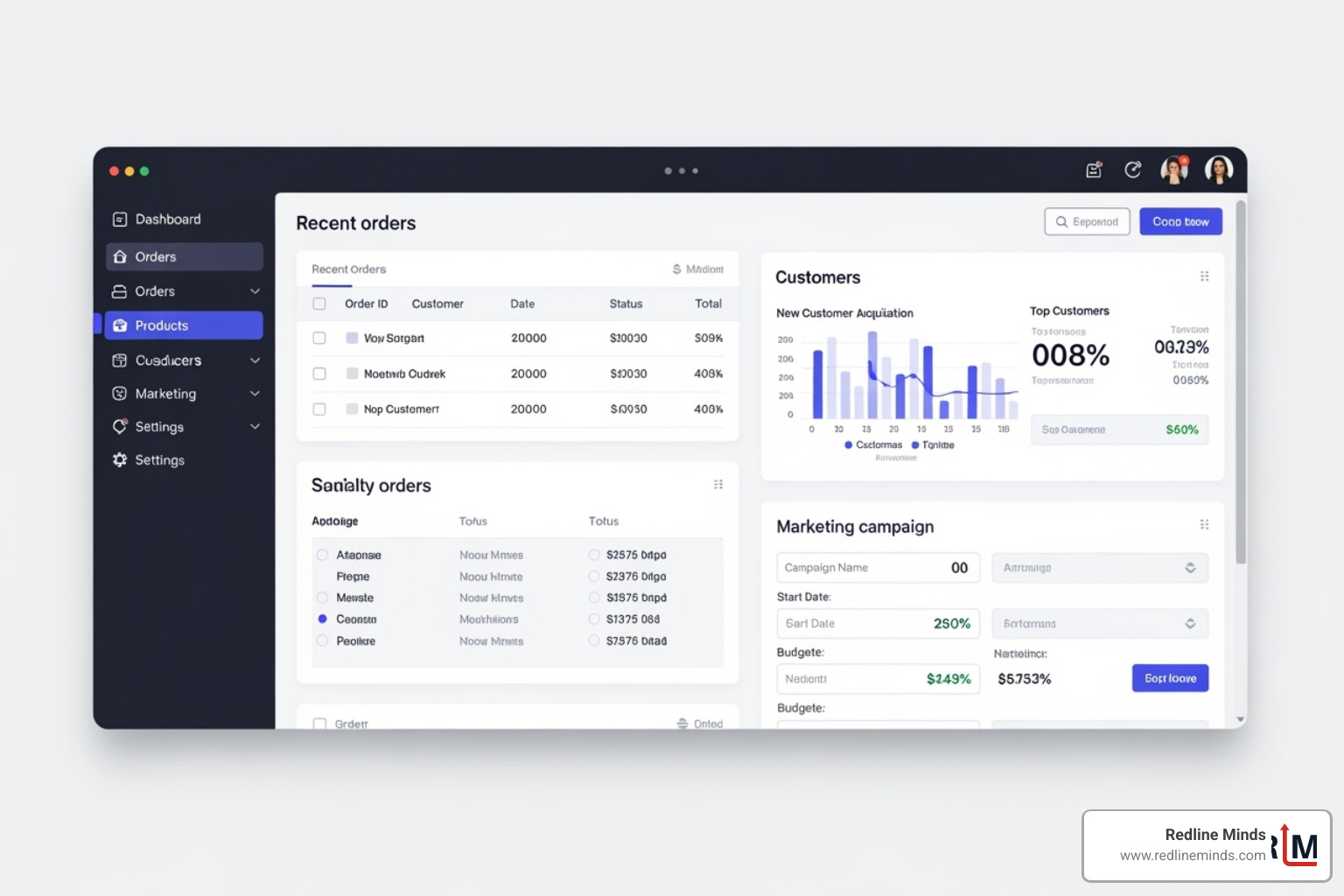
Seguno, on the other hand, prioritizes usability by mirroring the Shopify user interface. Its Shopify-like UI means that if you’re comfortable navigating your Shopify Admin, you’ll feel right at home with Seguno. This native integration creates a streamlined workflow that many merchants appreciate. Seguno also offers a Canva integration, which allows for liftd design directly within the email builder, saving time and simplifying asset creation.
In terms of customer support and community resources, Klaviyo provides extensive options, including 24/7 live chat, email, and phone support for its paid plans, along with an active user community forum, webinars, and rich documentation. Seguno offers email-based ticket support and in-platform messaging, backed by a growing self-serve knowledge base. While Klaviyo’s support is knowledgeable, some users find its accessibility limited compared to Seguno’s prompt and accessible support, especially for lean teams.
The Broader Ecosystem: Extra Tools and Integrations
A marketing platform is rarely a standalone tool; its value is often amplified by its ability to integrate with other services.
Klaviyo boasts an incredibly extensive app marketplace, offering over 350 integrations. This wide array of connections means Klaviyo can serve as a central hub for your entire marketing tech stack, pulling in data from various sources like payment processing, POS software, and advertising platforms. This makes it ideal for businesses with complex multi-channel strategies that need to synchronize data across numerous applications.
Seguno, being built within Shopify, naturally integrates seamlessly with the Shopify ecosystem. While it doesn’t offer hundreds of external integrations like Klaviyo, its strength lies in its deep connection to your Shopify store’s data and functionalities. Furthermore, Seguno improves its offering with a suite of complementary apps that provide significant value. These include a free Popups & Forms app for lead capture, a Product Reviews app to build social proof, and a Dynamic Banners app for on-site promotions. These additional tools, often included with Seguno’s paid plans, provide essential e-commerce marketing functionalities directly within your Shopify Admin, simplifying your tech stack and centralizing your marketing efforts in one familiar place. This integrated ecosystem can be a powerful value-add for Shopify merchants looking for an all-in-one solution that’s easy to manage.
The Bottom Line: Pricing and Attribution Models
Beyond features, the financial implications and how a platform attributes sales are critical considerations for any Shopify merchant. These aspects can significantly impact your profitability and your ability to accurately assess marketing performance.
Klaviyo’s ‘Active Profiles’ vs. Seguno’s ‘Subscribed Contacts’ Billing
One of the most significant differences between these two platforms lies in their billing models, which can have a substantial impact on your overall cost.
Klaviyo’s pricing is based on “active profiles.” An active profile in Klaviyo means any contact in your account that you could potentially send an email or SMS to, regardless of whether they have opted in, opted out, or never even subscribed to your marketing. This includes customers who have made a purchase but haven’t explicitly opted into marketing emails. This model can lead to higher costs, especially for businesses with large customer databases that include many non-marketing contacts. It means you’re paying for everyone Klaviyo tracks, whether they’re actively engaged in your email marketing or not.
Seguno, on the other hand, bases its billing solely on “subscribed contacts.” This means you only pay for the contacts who have explicitly opted in to receive your email marketing communications. This model is often more cost-effective for businesses, as it ensures you’re paying only for your engaged audience, aligning your marketing spend more directly with your active email list. This difference also incentivizes good list hygiene, as you’re not penalized for having a clean, opted-in list.

A Cost Comparison for the Growing Shopify Store
While we won’t dig into specific numbers, understanding the general cost implications is vital. Klaviyo’s pricing scales with the number of active profiles, and as your business grows and your customer database expands, so too will your Klaviyo bill. It can become quite an investment, especially if you have a large number of inactive or unsubscribed profiles that still count towards your active profile count.
Seguno’s pricing, based on subscribed contacts, often presents a more predictable and potentially more affordable cost structure for many Shopify businesses, especially as they scale their opted-in lists. Furthermore, Seguno offers unlimited sending on its paid plans, meaning you don’t have to worry about additional costs for sending more emails, which can be a significant benefit for businesses with frequent campaigns or large audiences. This structure can offer significant value for money, particularly for growth-focused Shopify stores aiming to maximize their email marketing efforts without incurring unexpected costs based on their total customer database size.
Sales Attribution in the Klaviyo vs Seguno Debate
Understanding how each platform attributes sales is crucial for accurate performance measurement and strategic decision-making. This is where the differences can impact how you perceive your marketing ROI.
Klaviyo employs a 5-day attribution window for both email opens and clicks. This means if a customer opens or clicks an email from Klaviyo and then makes a purchase within five days, that sale is attributed to the email campaign. While this can paint a very positive picture of your email marketing’s influence, some argue that it can lead to “inflated attribution.” For instance, if a customer was already planning to buy and happened to open an email within that window, the sale might still be counted as an email conversion.
Seguno, conversely, uses a 5-day attribution window that is based only on clicks. A sale is attributed to Seguno if a customer clicks an email and then converts within five days. This click-only model is often considered more realistic, as it requires a direct interaction (a click) with the email to count as an influence on the purchase. For merchants who prefer a more conservative and directly traceable attribution model, Seguno’s approach provides clearer insights into the direct impact of their email campaigns.
Frequently Asked Questions about Klaviyo and Seguno
When considering a platform change or choosing a new one, many questions arise. Let’s tackle some of the most common ones we hear from Shopify merchants.
When should a Shopify merchant migrate from Seguno to Klaviyo, or vice versa?
The decision to migrate from one platform to another is a significant one, and it usually boils down to your business’s evolving needs and resources.
You might consider migrating from Seguno to Klaviyo if your business:
- Requires advanced segmentation and predictive analytics: You’ve outgrown basic segmentation and need deep insights into customer behavior, predictive purchasing patterns, and AI-powered targeting.
- Needs multi-channel scale beyond email and basic SMS: You’re looking to integrate your email marketing with a broader array of marketing channels and tools, such as sophisticated paid advertising integrations, or more complex SMS strategies.
- Has a dedicated marketing team: You have the internal expertise and resources to manage a more complex platform and leverage its advanced features.
- Operates on a headless commerce model or multiple e-commerce platforms: Klaviyo’s broad integration capabilities become a significant advantage here.
Conversely, you might consider migrating from Klaviyo to Seguno if your business:
- Prioritizes simplicity and ease of use: You find Klaviyo’s interface too complex or time-consuming, and you want a solution that feels like a natural extension of Shopify.
- Aims for cost savings based on subscribed contacts: You’re looking to reduce your marketing spend by only paying for actively opted-in contacts, rather than your entire customer database.
- Is a lean team: You need streamlined workflows and one-click automations that allow you to manage email marketing efficiently without extensive training.
- Is solely focused on Shopify: Seguno’s native integration and Shopify-centric features offer a powerful, yet simplified, experience that perfectly aligns with your platform. Seguno even offers a migration tool to help you transfer your contacts seamlessly.
Key triggers for making a switch often include a change in budget, team size, growth ambitions, or simply a desire for a more intuitive or powerful tool.
Which platform is better for a brand new Shopify store?
For a brand new Shopify store, the choice depends heavily on your budget, technical comfort, and immediate growth plans.
For the absolute beginner or bootstrapped startup: Shopify Email, the native email tool within Shopify, can be a great starting point. It’s free and allows new shops and email novices to get their marketing email footing. It’s perfect for sending your first newsletters and engaging with customers without any additional cost or complex setup.
For the growing business ready to invest slightly more: Seguno is an excellent next logical step. Its seamless integration with Shopify means a minimal learning curve, and its one-click automations and essential e-commerce features allow you to quickly implement effective marketing campaigns. It’s built for growth-focused Shopify brands with lean teams, making it very accessible.
For well-funded startups with aggressive growth plans and a clear data strategy: Klaviyo could be considered from the outset, but be prepared for a steeper learning curve and a potentially higher cost. If you have the resources to invest in comprehensive data analysis and multi-channel marketing from day one, Klaviyo offers the tools to scale rapidly. However, for most new Shopify stores, starting with Seguno provides optimal value and simplicity.
How do the platforms handle data and integrate with Shopify?
The way Klaviyo and Seguno handle data and integrate with Shopify is a core differentiator, reflecting their fundamental philosophies.
Seguno’s integration with Shopify is inherently native. It’s built inside your Shopify Admin. This means it has direct, seamless access to your Shopify store’s data, including product information, collections, discounts, and customer purchase history. For example, Seguno’s Shopify-synchronized product blocks automatically pull current product information, ensuring your emails are always up-to-date. This native access allows for incredibly intuitive workflows, letting you create, manage, and track campaigns without ever leaving the Shopify environment. Data management within Seguno is straightforward, leveraging your existing Shopify organization systems like customer tags.
Klaviyo, on the other hand, integrates with Shopify via a robust API sync. While it lives externally, Klaviyo excels at centralizing subscriber data from all integrated sources – not just Shopify but also CRMs, forms, and other marketing tools. This means Klaviyo can pull in a much broader and deeper set of customer information, allowing for incredibly sophisticated segmentation and personalization based on a holistic view of your customer across various touchpoints. The data management implications are that Klaviyo acts as a powerful customer data platform (CDP), consolidating and enriching profiles. While this offers immense power for advanced marketers, it also means a more involved setup and ongoing management to ensure data flows correctly.
Seguno offers neat simplicity and deep native integration for Shopify-specific data, while Klaviyo provides comprehensive data centralization and advanced analytical power for a wider range of data sources.
Conclusion: Making the Right Choice for Your Business
Choosing the right email marketing champion for your Shopify store, whether it’s Klaviyo vs Seguno, isn’t about finding a one-size-fits-all solution. It’s about aligning the platform with your unique business needs, current growth stage, team resources, and budget. Both are powerful tools, but they excel in different arenas.
To recap, if you’re a Shopify merchant seeking:
- Shopify-native simplicity: Seguno’s seamless integration within your Shopify Admin means creating and managing campaigns feels intuitive and familiar. It’s built for ease of use, with one-click automations and a minimal learning curve.
- Cost-effectiveness based on subscribed contacts: Seguno’s billing model ensures you only pay for your opted-in audience, offering a more predictable and potentially more affordable solution, especially as your customer base grows.
- Streamlined workflows for lean teams: Seguno’s focus on essential e-commerce automations and its suite of complementary apps (Popups & Forms, Product Reviews, Dynamic Banners) provide significant value without unnecessary complexity.
- Realistic sales attribution: Seguno’s click-based attribution model offers a clearer, more conservative view of your email marketing’s direct impact.
On the other hand, you should lean towards Klaviyo if your business demands:
- Advanced data analysis and predictive insights: Klaviyo’s robust segmentation, AI-powered analytics, and ability to centralize data from over 350 integrations provide an unparalleled depth of customer understanding.
- Multi-channel marketing and complex automation: If you need to orchestrate intricate, multi-step customer journeys across email, SMS, and other channels with conditional logic, Klaviyo’s “Flows” are built for that power.
- Enterprise-level scaling: Klaviyo is designed for businesses with extensive customer databases, complex tech stacks, and dedicated marketing teams that require a comprehensive marketing operating system.
- Broad integration capabilities: If your business leverages numerous third-party tools beyond Shopify, Klaviyo’s vast integration ecosystem ensures all your data can flow into one powerful marketing hub.
The best email marketing champion for you is the one that fits your current needs and supports your future growth without overwhelming your team or budget. The right tool is the one you and your team can use effectively to drive results.
We understand that navigating e-commerce platforms and marketing tools can be complex. That’s why we at Redline Minds specialize in helping Shopify merchants like you make informed decisions about your tech stack. We’re here to ensure you pick the right tools to accelerate your online success.
Share this article
Tap into years of experience and turn your site’s visitors into buyers.
Related Posts
-

The Complete Guide to Affiliate App for Shopify
Discover the best affiliate app for Shopify to grow sales, manage referrals, and boost merchant revenue in 2026.
-

The Ultimate Guide to Types of E-Commerce Payment Systems
Learn the types of e commerce payment system to boost sales and reduce cart abandonment in this complete…
-

A Practical Guide to AI Agent Integration Methods
Learn how AI agent integration connects enterprise systems with MCP, Unified APIs, and custom code for secure, real-time…