
How to master e-retailing strategies without losing your mind

Why Every Online Retailer Needs a Clear Sales Strategy Example
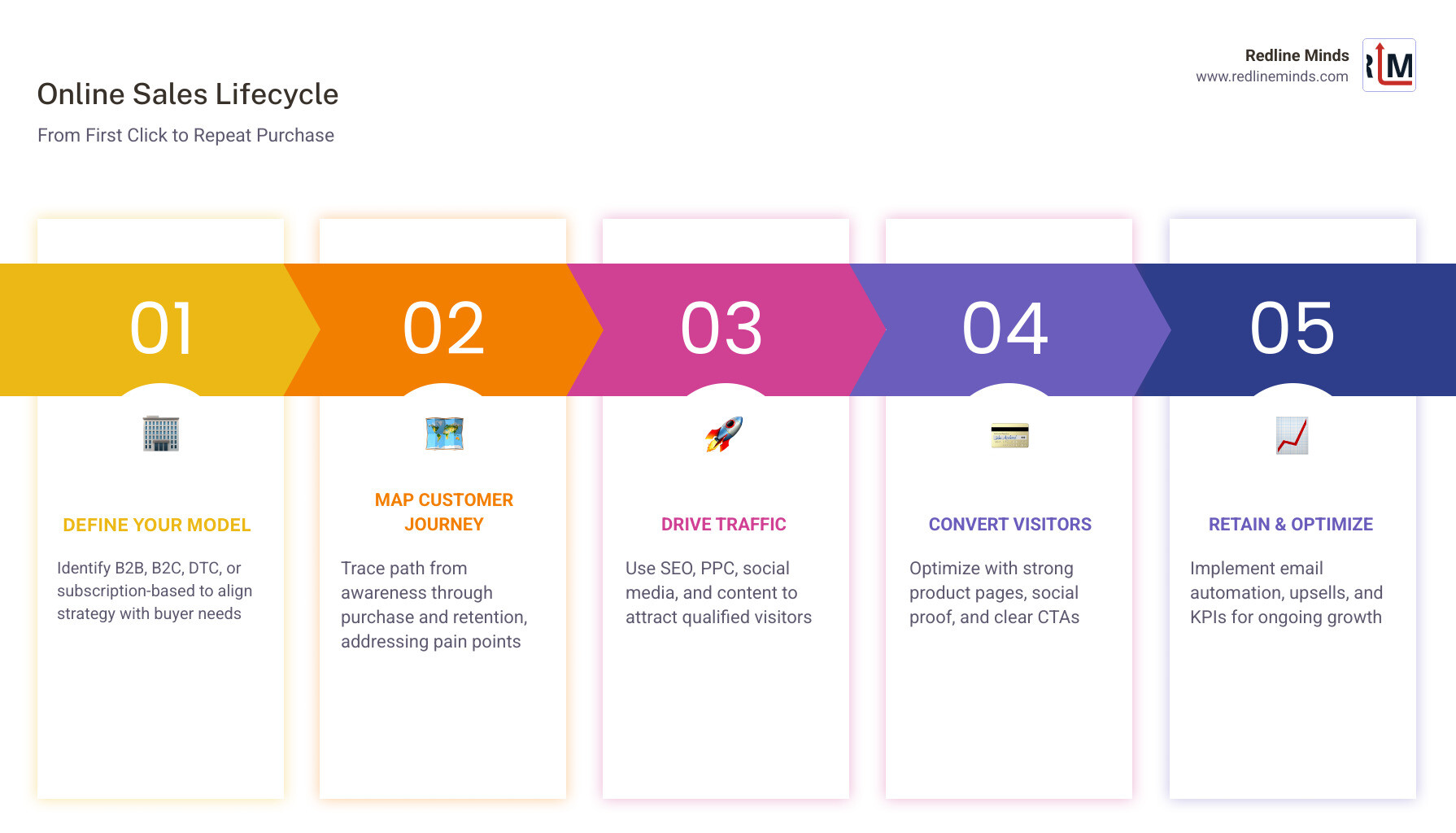
The most effective online sales strategy example combines inbound marketing, customer retention, and data-driven outreach into one cohesive plan. Here’s a quick overview of what that looks like in practice:
- Define your model – Know whether you’re B2B, B2C, DTC, or subscription-based
- Map the customer journey – From first click to repeat purchase
- Drive traffic – Through SEO, PPC, social media, and content marketing
- Convert visitors – With strong product pages, social proof, and clear CTAs
- Retain customers – Via email automation, upsells, and loyalty incentives
- Measure and optimize – Track KPIs and adjust based on real data
Stagnant sales are frustrating — especially when you’re already doing a lot of things right.
You’ve got products people want. You have an online store. You’re putting in the hours. But the numbers aren’t moving the way you need them to.
The problem usually isn’t effort. It’s the lack of a clear, connected strategy.
Most mid-sized online retailers hit a wall somewhere between $1M and $10M in annual revenue. Growth slows. Marketing feels scattered. It’s hard to know what to fix first.
The good news? This is a solved problem. Businesses that shift from gut-feel decisions to structured, data-driven sales strategies consistently outperform those that don’t — and the gap is widening. Research shows that 60% of B2B sales teams are already moving toward data-driven selling, leaving intuition-based operators behind.
This guide walks you through the full picture: what a winning online sales strategy actually looks like, real examples from businesses that got it right, and a step-by-step plan you can start using today.
Foundations of a Winning Online Sales Strategy Example
Before you start throwing money at ads, we need to talk about the “bones” of your business. Every online sales strategy example worth its salt begins with a clear understanding of your business model. Are you selling to other businesses (B2B), directly to the public (B2C), or perhaps you’re a manufacturer going Direct-to-Consumer (DTC)?
At Redline Minds, we often see B2B and hybrid stores (those serving both wholesalers and retail customers) struggle because they try to use a “one-size-fits-all” approach. But a B2B buyer looking for bulk industrial supplies has very different needs than a teenager buying a skateboard.
The Power of the Right Model
Choosing the right model dictates your entire Ecommerce Marketing Funnel. For instance:
- B2B (Business to Business): Focuses on long-term relationships, bulk pricing, and complex decision-making units.
- DTC (Direct to Consumer): Cuts out the middleman, allowing for higher margins and better data on your end users.
- Subscription-based: Provides predictable, recurring revenue. Think of how Dollar Shave Club revolutionized grooming by turning a one-time purchase into a monthly habit.
Investing in digital technologies to support these models isn’t just about looking modern; it’s about the bottom line. Research indicates that using digital technologies increased total cost savings by 8% for many businesses. When you’re operating at scale, that 8% can be the difference between a record year and a mediocre one.

Choosing the Right Platform for Growth
If your website feels like it’s held together by duct tape and prayers, it’s time for an upgrade. A successful online sales strategy example requires a platform that can scale with you. We often look for:
- Scalability: Can it handle a 500% spike in traffic on Black Friday?
- Integration: Does it play nice with your CRM and inventory management?
- Security: Are your customers’ data and your reputation safe?
For high-performing businesses, selecting a robust, enterprise-level platform is essential. You need a solution that stands out as a dynamic force for those needing complex features. Whether you’re in Jefferson City, TN, or selling globally, your platform is the engine of your sales machine. For many, this means looking at how to choose the right ecommerce platform that aligns with long-term goals.
Understanding Your Market Fit
You can’t sell effectively if you don’t know where you stand. We recommend every business conduct a SWOT analysis (Strengths, Weaknesses, Opportunities, and Threats).
Ask yourself:
- What is our unique value proposition (USP)?
- Why should a customer buy from us instead of a giant marketplace?
- Are there internal obstacles (like slow shipping) or external threats (like new competitors) we need to address?
Diagnosing Why Your Ecommerce Store Isn’t Converting
It’s the nightmare scenario: you have traffic, but no one is hitting the “Buy” button. If your conversion rate is hovering in the basement, it’s time for a deep dive into your analytics.
Common culprits include:
- Subpar Website Design: If your site looks like it was designed in 2005, customers won’t trust you with their credit card info.
- Slow Performance: Every second of load time can cost you thousands in lost sales.
- Lack of Social Proof: People want to see that others have bought and loved your products.
- Poor Search Visibility: If they can’t find you, they can’t buy from you.
This is where Conversion Rate Optimization (CRO) comes in. It’s the process of fine-tuning your site to turn more “lookers” into “bookers.”
Mapping the End-to-End Customer Journey
To fix a leaky funnel, you have to walk in your customer’s shoes. We use buyer personas to represent our ideal customers.
- What are their pain points?
- Where do they hang out online?
- What makes them hesitate?
Mapping the journey helps you identify where people are dropping off. Maybe your checkout process is too long, or perhaps you don’t offer enough payment options. Every friction point you remove is a win for your sales numbers.
The High Cost of Ignoring Existing Customers
Here is a stat that should make you sit up straight: it is about five times more expensive to acquire a new customer than it is to sell to an existing one.
Yet, so many businesses spend 90% of their budget on “new” traffic. A winning online sales strategy example prioritizes retention. 76% of sales professionals report that prioritizing existing customers is essential to their revenue.
How do you keep them coming back?
- Upselling and Cross-selling: “People who bought this also loved…”
- Email Marketing: Use our Ecommerce Email Marketing Guide to build automated flows that nurture customers after their first purchase.
- Loyalty Programs: Reward your best customers so they become brand ambassadors.
High-Impact Tactics for Small and Growing Businesses
You don’t need a Fortune 500 budget to see massive growth. You just need to be smarter with the resources you have. For small businesses in Tennessee and beyond, focus on these high-impact areas:
Setting SMART Goals
“I want more sales” is a wish, not a goal. A SMART goal is:
- Specific: Increase organic revenue by 20%.
- Measurable: Tracked via Google Analytics.
- Attainable: Based on last year’s 15% growth.
- Relevant: Aligns with our goal to expand our wholesale line.
- Time-bound: By the end of Q4.
Mastering Your Sales Cadence
Did you know that five follow-ups is the minimum number required to close 80% of sales? Most people give up after one or two. By using sales cadence tools, you can automate this process so no lead falls through the cracks. Whether it’s a personalized email, a LinkedIn message, or a quick phone call, consistency is the key to closing.
Leveraging an Inbound Online Sales Strategy Example
Inbound is about attracting customers through value. Instead of shouting at them with ads, you’re providing answers to their questions.
- SEO: Optimize your store so you show up when people search for your products.
- Content Marketing: Write guides that solve customer problems.
- Social Engagement: Use Facebook Groups for Business to build a community around your brand. It’s a great way to get direct feedback and build trust.
Mastering the Outbound Online Sales Strategy Example
Sometimes you have to go out and get the business. This is especially true for B2B and hybrid stores.
- Cold Outreach: Use prospecting tools to find decision-makers at companies that need your products.
- PPC Advertising: Pay-per-click (like Google Ads) can put you in front of buyers exactly when they are looking to purchase.
- Social Selling: Engaging with prospects on LinkedIn or Quora to establish yourself as an expert.
Proven Methodologies and Real-World Success Stories
When it comes to the actual “selling” part of your online sales strategy example, various methodologies can guide your team.
| Methodology | Best For… | Key Focus |
|---|---|---|
| SPIN Selling | Complex B2B sales | Asking Situation, Problem, Implication, and Need-payoff questions. |
| Consultative Selling | High-trust relationships | Acting as an advisor rather than a “vendor.” |
| Challenger Selling | Disruptive products | Teaching the customer something new about their own business. |
| Value-Based Selling | Premium products | Focusing on the ROI and long-term value rather than just price. |
Using the right methodology can lead to incredible results. For instance, Clari’s platform delivered an ROI of 448% over three years by helping teams move to a more data-driven, value-based approach.
Lessons from Flash Sales and Promotions
Flash sales are a fantastic way to inject cash into your business quickly, but they require precision. A famous 236% revenue boost case study showed that timing is everything. By analyzing when their visitors were most active (often late in the evening), the brand was able to launch a 12-hour sale that maximized conversion.
Pro Tip: Combine your flash sale with the Anatomy of a Great Social Contest to build buzz and grow your email list at the same time.
The Hybrid Manufacturer-Retailer Model
If you’re a manufacturer, selling directly online can cause “channel conflict” with your retailers. A brilliant manufacturer website strategy lift demonstrated how to solve this.
Instead of competing with their retailers, the manufacturer added links on their product pages that showed where customers could buy the item locally or at major retailers like Amazon or Walmart. This “any sale is a good sale” philosophy led to a 26.3% lift in conversions because it empowered the customer to choose their preferred buying method.
Building Your Sales Stack and Action Plan
To execute these strategies, you need the right tools. A “sales stack” is simply the collection of software you use to manage your sales process.
Essential Tools for Your Stack
- CRM (Customer Relationship Management): Tools like HubSpot or Pipedrive to track every interaction.
- Sales Automation: For follow-ups and lead nurturing.
- Analytics: To see what’s working (and what isn’t).
- CRO Tools: Check out these 27 Conversion Optimization Tools to help you find and fix site issues.
Setting Your Sales Budget and KPIs
You need to know your numbers. For example, BambooHR increased its cost-per-lead efficiency by more than 40% by focusing on highly targeted LinkedIn ads.
Track these KPIs religiously:
- CAC (Customer Acquisition Cost): How much does it cost to get one new customer?
- LTV (Lifetime Value): How much is a customer worth over their entire relationship with you?
- Conversion Rate: What percentage of visitors actually buy?
Implementing Automation for Scalability
Automation isn’t about being “robotic”; it’s about being efficient.
- Email Verification: Use email verification tools to keep your list clean and ensure your messages actually reach the inbox.
- SMS Marketing: Great for urgent alerts or flash sales.
- Automated Follow-ups: Ensures that every lead gets the five touches they need to convert.
Frequently Asked Questions about Online Sales
What is the difference between a sales strategy and a sales process?
Think of the sales strategy as your map and the sales process as the actual steps you take to drive the car. The strategy is the high-level plan (who are we selling to, what is our USP?), while the process is the repeatable sequence of actions your team takes to close a deal (prospecting, discovery call, proposal, closing).
How do I choose the best ecommerce platform for a B2B business?
B2B is a different beast. You need a platform that supports:
- Customized pricing for different customer groups.
- Bulk ordering and “quick add” features.
- Account hierarchies (multiple users under one company account).
- Integration with ERP systems. Advanced enterprise-grade platforms are often preferred for these complex requirements.
Why is five follow-ups considered the minimum for closing sales?
It’s all about timing and psychology. Your first or second email might arrive when the prospect is busy or not yet ready to commit. By the fifth touch, you’ve demonstrated persistence, built familiarity, and increased the chances of catching them at the exact moment their “need” becomes urgent.
Conclusion
Mastering your online sales doesn’t have to be a source of constant stress. By moving away from “random acts of marketing” and toward a structured online sales strategy example, you can create a predictable, scalable revenue engine.
At Redline Minds, we live and breathe this stuff. Based right here in Jefferson City, TN, we specialize in helping B2B and hybrid stores navigate the complexities of digital commerce. Whether you need a total platform overhaul or a more effective marketing strategy, we’re here to help you grow without losing your mind.
Ready to see what a custom strategy could do for your business? Let’s get to work.