
How to build a B2B empire with custom solutions and bulk ordering
The $2 Trillion Shift: Why Custom B2B Ecommerce Solutions Are Reshaping How Businesses Sell
Custom B2B ecommerce solutions are purpose-built digital platforms designed to handle the complex workflows, pricing structures, and integrations that standard off-the-shelf tools simply can’t support.
Here’s a quick look at what they include and who needs them:
| Feature | Why It Matters |
|---|---|
| Customer-specific pricing | Different buyers get different rates automatically |
| ERP/CRM integration | Real-time sync between your store and back-office systems |
| Self-service portals | Buyers place orders 24/7 without calling a sales rep |
| Advanced catalog management | Control what each buyer sees and at what price |
| Multi-tier approval workflows | Supports complex purchasing chains inside large organizations |
| Bulk ordering and net terms | Core requirements for most B2B transactions |
If your current platform forces you to work around it instead of with it, a custom solution is likely worth a serious look.
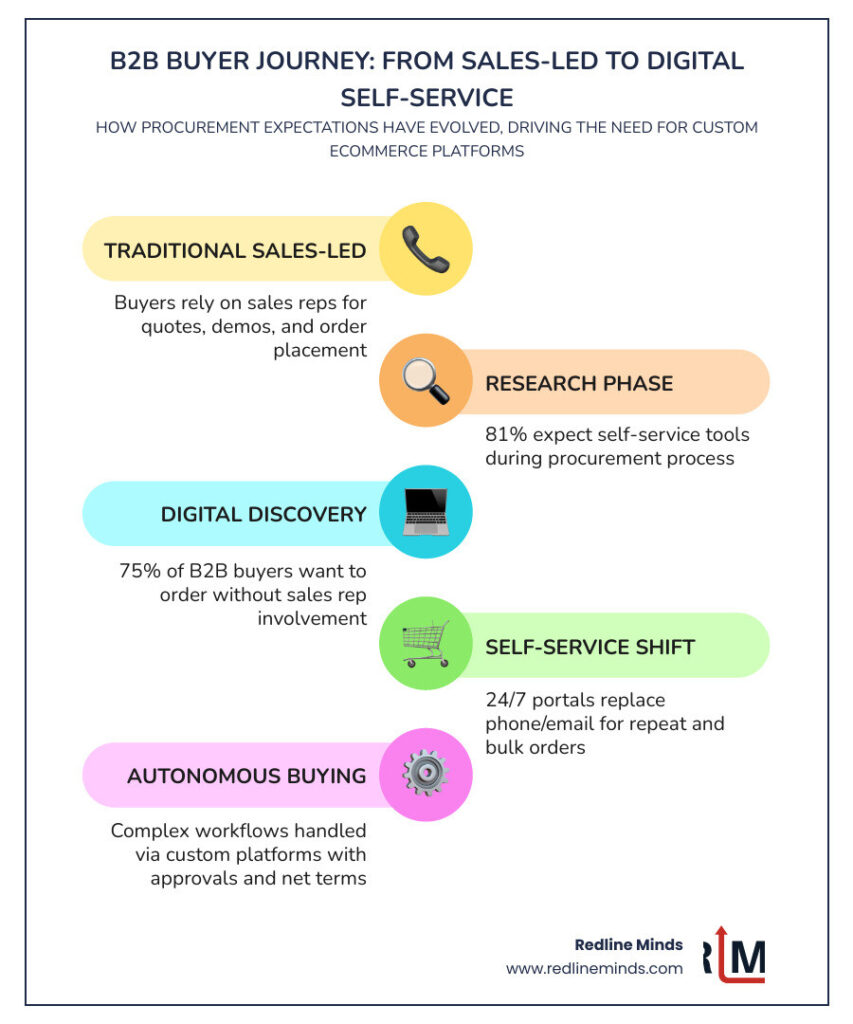
B2B ecommerce is no longer a “nice to have.” The market is expected to surpass $2 trillion in 2024, and buyer expectations have fundamentally changed. According to Gartner, 75% of B2B buyers now want to place orders without going through a sales rep. Another 81% expect self-service tools during the procurement process.
That’s a massive shift. And it’s happening fast.
Yet many mid-sized businesses — especially those doing $1M to $10M in annual revenue — are still running on platforms built for retail consumers. The result? Clunky checkout flows, manual order entry, disconnected inventory data, and stalled growth.
The businesses pulling ahead aren’t necessarily spending more. They’re building smarter — with platforms designed specifically for the way B2B actually works.
Defining Custom B2B Ecommerce Solutions for Modern Growth
When we talk about custom B2B ecommerce solutions, we aren’t necessarily talking about building a website from scratch in a dark basement. In the modern era, “custom” usually means taking a high-performance core and tailoring it until it fits your business like a glove.
Think of it like an architect-designed home versus a cookie-cutter model. Both have walls and a roof, but the custom home is built specifically for the way you live. In business terms, this means your technology adapts to your proprietary logic, rather than you changing your operations to fit a software’s limitations.
The B2B ecommerce market growth we are seeing today is driven by a need for business resilience. Companies that rely on phone calls and spreadsheets are finding it harder to scale. Why? Because manual processes are expensive and prone to error. A customized platform allows you to handle thousands of SKUs and complex dealer networks with the same headcount you have now.
Furthermore, we’re seeing a massive “consumerization” of B2B. Your buyers are people who shop on Amazon in their spare time. They expect that same ease of use — fast search, mobile responsiveness, and intuitive navigation — even when they are buying industrial valves or bulk textiles. Custom B2B ecommerce solutions bridge the gap between B2C-style user experience and B2B-style operational complexity.
Key Features of a High-Performance B2B Platform
If you want to build a B2B empire, your platform needs to do more than just show a “Buy Now” button. It needs to act as a digital sales assistant that never sleeps.
The most successful platforms we see include features like:
- Bulk Ordering Tools: High-volume buyers don’t want to click “add to cart” 500 times. They need “quick order” forms where they can upload a CSV or type in SKUs and quantities directly.
- Request for Quote (RFQ) Engines: For many manufacturers, “Add to Cart” isn’t enough. Sometimes a product page is just the start of a negotiation. An integrated RFQ system allows buyers to submit specs and get a custom quote back in hours, not days.
- Net Terms and Credit Management: B2B runs on credit. Your platform should allow trusted customers to buy on “Net 30” or “Net 60” terms, automatically tracking their credit limits. You can explore more about this in our guide on Ecommerce Payment Options.
- Multi-Tier Approvals: In big companies, a junior buyer might place the order, but a manager needs to approve it. Your platform should support these internal hierarchies natively.
Advanced Pricing and Catalog Management in Custom B2B Ecommerce Solutions
One of the biggest headaches in B2B is pricing. You might have five different price lists for five different types of customers. Or perhaps you have a “Gold” tier customer who gets 20% off everything except for specific clearance items.
Managing this in a standard retail platform is a nightmare. Custom B2B ecommerce solutions use advanced logic to ensure that when a buyer logs in, they see only the products they are authorized to buy at the exact price you negotiated with them.
This aligns perfectly with the B2B buying journey insights provided by Gartner, which show that buyers value transparency and speed. If a buyer has to call you just to find out their “real” price, they might just go to a competitor who shows it to them instantly online. Volume-based rules (e.g., “Buy 10 cases, get 5% off; buy 50 cases, get 15% off”) should be calculated in real-time, encouraging larger order values without any manual intervention from your team.
Streamlining Operations with ERP and CRM Integration
We often tell our clients that your ecommerce site is just the “tip of the iceberg.” The real magic happens underwater, where your site connects to your back-office systems.
When you implement custom B2B ecommerce solutions, integration is the priority.
- ERP Integration: Your Enterprise Resource Planning system is the “single source of truth.” When a customer places an order online, it should flow directly into your ERP for fulfillment. When you receive new stock in the warehouse, the website should update instantly.
- CRM Connectivity: By linking your Ecommerce CRM, your sales team can see exactly what their accounts are doing online. If a major client hasn’t placed an order in 30 days, the CRM can trigger an alert for a salesperson to reach out.
This level of automation reduces the “cost per order” significantly. Research shows that optimized custom solutions can reduce cost per order by about 6%. Every minute your staff spends re-keying data from an email into your accounting software is a minute they aren’t spent growing the business. Check out our Ecommerce Inventory Control Options for more on keeping your data accurate.
Custom Development vs. Pre-built Platforms: A Strategic Framework
Choosing between a pre-built platform (like Shopify Plus or BigCommerce) and a fully custom build is one of the most critical decisions you’ll make. It’s not a binary choice; it’s a spectrum.
| Feature | Pre-built Platforms | Custom B2B Solutions |
|---|---|---|
| Time to Market | Fast (2-4 months) | Slower (6-12 months) |
| Initial Cost | Lower | Higher |
| Flexibility | Moderate (limited by API/Core) | Infinite |
| Maintenance | Handled by the provider (SaaS) | Handled by your team/agency |
| Scalability | Good for most | Best for extreme complexity |
For many businesses, a “Platform-First” customization approach is the sweet spot. This means using a robust platform like BigCommerce as the foundation but building custom “middle-tier” services to handle your unique logic. This keeps your Ecommerce Website Design flexible while ensuring you aren’t reinventing the wheel for things like security and checkout.
The danger of “pure custom” from-scratch builds is technical debt. If you build everything yourself, you are responsible for every security patch and update. However, if you have legacy systems that simply won’t talk to modern SaaS tools, a custom-built adapter or a headless approach might be your only path forward.
Maximizing ROI through Personalization and Self-Service
The return on investment for custom B2B ecommerce solutions doesn’t just come from more sales; it comes from higher efficiency.
According to Deloitte research on B2B buyer expectations, 37% of B2B buyers are actually willing to pay a premium if the digital experience is smoother. They value their time. If your portal allows them to re-order their “usual” in two clicks, they are much less likely to shop around.
Self-service portals empower your customers to:
- Download invoices and tax documents.
- Track shipments in real-time.
- Manage their own company users and permissions.
- View real-time stock levels across different regional warehouses.
This shifts your sales team’s role from “order takers” to “relationship builders.” Instead of spending all day confirming if a part is in stock, they can focus on identifying new opportunities and helping clients solve complex problems.
Future-Proofing with Headless Architecture and Custom B2B Ecommerce Solutions
If you want to stay ahead of the curve, you should look into headless architecture. In a “headless” setup, the frontend (what the customer sees) is separated from the backend (the commerce engine).
This is the foundation of “composable commerce.” It allows you to use a Headless CMS technology for your blog and marketing pages while using a specialized engine for your B2B checkout.
Why does this matter?
- Speed: Headless sites are often much faster, which is a key Google ranking factor.
- Omnichannel Consistency: You can push the same product data and pricing to a web store, a mobile app, and even an in-store kiosk simultaneously.
- Agility: You can change your “look and feel” without touching your complex backend integrations.
As AI begins to play a bigger role in B2B — for things like predictive re-ordering and personalized product recommendations — having a modern, API-first architecture will be the difference between leading the market and being left behind.
Frequently Asked Questions about B2B Ecommerce
How much does a customized B2B ecommerce solution cost?
While we don’t give specific quotes without a discovery session, the total cost of ownership (TCO) is often comparable between high-end platforms and custom solutions over a five-year period. A custom solution has higher upfront costs but often lower ongoing licensing fees. For an enterprise-level project, you should expect to invest a significant amount in development, integration, and training.
How long does it take to implement a custom B2B platform?
A typical implementation for custom B2B ecommerce solutions takes anywhere from 4 to 10 months. A “phased rollout” is usually the best approach. You might launch a “Minimum Viable Product” (MVP) for your top 10% of customers in 4 months, then add complex features like automated RFQs or tiered approvals in later phases.
Can custom solutions integrate with my existing ERP?
Yes! In fact, that is usually the main reason businesses choose custom solutions. Whether you are using SAP, Microsoft Dynamics, NetSuite, or a specialized legacy system, custom APIs and middleware can bridge the gap. The goal is to create a “single source of truth” where data flows seamlessly between your warehouse and your customer’s screen.
Conclusion
Building a B2B empire requires a foundation that is both strong and flexible. At Redline Minds, we specialize in helping businesses navigate this complex landscape. We aren’t just developers; we are ecommerce consultants who understand the strategic side of B2B.
Based in Tennessee, we work with retailers and manufacturers to turn their digital presence into a growth engine. Whether you are looking for a platform-first hybrid model or a highly specialized custom build, we have the expertise in UX/UI design, SEO, and system integration to make it happen.
Ready to stop working around your platform and start scaling? Check out more info about our services and let’s build something that lasts.