
The Definitive Guide to Virtual Ecommerce Directors

What Is a Virtual Ecommerce Director (And Do You Need One)?
A virtual ecommerce director is a senior-level remote executive who owns the strategy, growth, and operations of your online store — without sitting in your office.
If you’re looking for a quick answer, here’s what you need to know:
- What they do: Lead ecommerce strategy, manage P&L, oversee marketing funnels, and drive revenue growth — all remotely
- Who they’re for: Online retailers doing $1M–$10M+ in annual sales who need expert leadership, not just task support
- How they differ from a VA: A virtual assistant executes tasks; a virtual ecommerce director makes strategic decisions and leads teams
- Where to find one: Specialized agencies, LinkedIn, industry job boards, and direct outreach (beyond saturated platforms like Fiverr or Upwork)
- What it costs: Typically structured as a monthly retainer or fractional leadership arrangement
Running a mid-sized online store is hard. Sales plateau. Operations get messy. And hiring a full-time, in-house ecommerce executive at $165,000+ per year isn’t always realistic.
That’s the gap a virtual ecommerce director fills.
Think of it like this: you get the strategic firepower of a seasoned ecommerce leader — someone fluent in Shopify, Klaviyo, Amazon, paid social, and data analytics — without the overhead of a full-time hire.
And the demand is real. There are currently over 3,000 online business manager roles listed in the US alone, with more than 1,200 specifically remote. Businesses are actively looking for this kind of remote leadership.
This guide breaks down exactly what a virtual ecommerce director does, what skills to look for, how to find and hire one, and whether it’s the right move for your business right now.
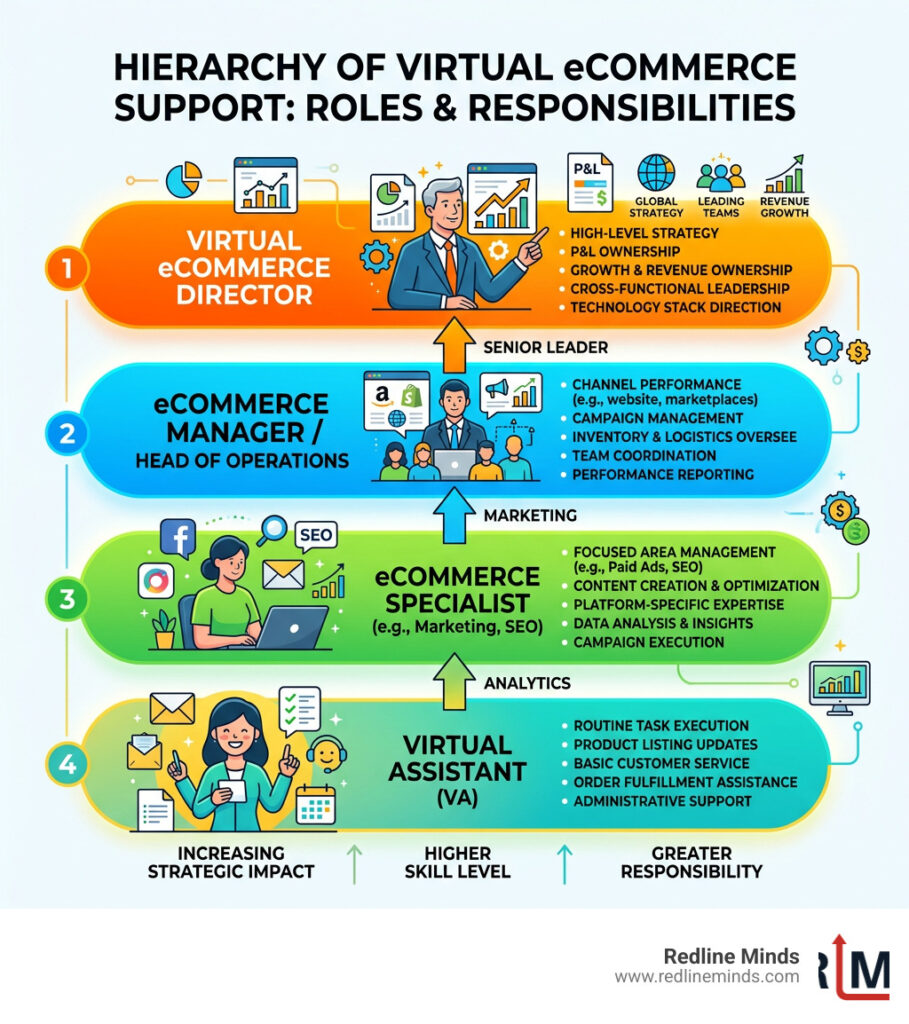
What is a Virtual Ecommerce Director?
When we talk about a virtual ecommerce director, we aren’t talking about someone who just uploads product photos or answers customer emails. We are talking about a high-level strategic partner. By definition, this is a remote executive responsible for the entire digital ecosystem of a brand. They own the Profit and Loss (P&L) statement, meaning they are accountable for the bottom line, not just the top-line revenue.
In a traditional setting, an Ecommerce Director sits in the corporate office, attending in-person meetings and managing a local team. A virtual director performs these same high-stakes functions but utilizes digital communication tools to lead from anywhere. This role often appears in job listings as an Ecommerce Director – VirtualVocations, reflecting a shift toward senior management roles that prioritize output and strategy over physical presence.
Their oversight includes everything from Ecommerce Website Design and user experience to supply chain coordination and multi-channel expansion. They provide the “big picture” vision that keeps a brand competitive in an increasingly crowded digital marketplace.
Key Differences Between a VA and a Virtual Ecommerce Director
It is common for business owners to confuse these two roles, but the distinction is vital for your growth. A Virtual Assistant (VA) is a “doer.” They follow instructions and execute specific, repeatable tasks.
In contrast, a virtual ecommerce director is a “thinker” and a “leader.” While there are many Advantages of a Virtual Assistant for E-commerce for handling daily operations, a director provides the strategic roadmap that the VAs follow.
- Task Execution vs. Strategic Planning: A VA updates a product price; a director analyzes market data to decide what that price should be to maximize margin and volume.
- Decision-Making Authority: Directors have the authority to pivot strategies, reallocate budgets, and hire or fire service providers.
- Long-Term Vision: While a VA focuses on getting through today’s inbox, the director is planning the Black Friday promotion six months in advance.
Skills and Qualifications for High-Level Remote Management
Finding the right leader requires looking for a specific pedigree. This isn’t an entry-level position. Most successful candidates possess:
- 10+ Years of Experience: High-level roles typically require a decade of experience in ecommerce business management, often with at least 5 years of experience specifically managing teams.
- Amazon Operations Expertise: Because Amazon is a beast of its own, a director who understands its unique algorithms and logistics is worth their weight in gold.
- Multi-Channel Fluency: They must be comfortable managing Shopify, TikTok Shop, and wholesale channels simultaneously.
- Data Analytics: They should be able to look at a spreadsheet and see a story. This includes a deep understanding of the SEO Checklist for Ecommerce to ensure organic growth isn’t being left on the table.
- Stakeholder Management: They need to be able to communicate effectively with CEOs, investors, and external vendors to keep everyone aligned with the brand’s goals.
Core Responsibilities and Strategic Impact
The primary goal of a virtual ecommerce director is to move the needle on key performance indicators (KPIs). They don’t just “manage” the store; they optimize it for growth. Their impact is felt across four major pillars: Revenue Growth, Average Order Value (AOV), Conversion Rate (CVR), and Lifetime Value (LTV).
By focusing on Conversion Rate Optimization CRO, they ensure that the traffic you are paying for actually turns into buyers. They also oversee Ecommerce Inventory Control Options to prevent the dreaded “out of stock” message that kills momentum and hurts search rankings.
| Operational Tasks (VA Level) | Strategic Strategy (Director Level) |
|---|---|
| Processing daily orders | Developing a 3-year growth roadmap |
| Updating product descriptions | P&L ownership and budget allocation |
| Responding to support tickets | Implementing high-velocity creative testing |
| Managing reorder alerts | Negotiating vendor and supplier contracts |
| Posting on social media | Building a repeatable DTC growth machine |
Managing the Ecommerce Marketing Funnel Remotely
A director-level professional looks at the Ecommerce Marketing Funnel as a holistic machine. They aren’t just looking at one-off ads; they are looking at how a customer moves from discovery to a loyal, repeat buyer.
They manage paid social strategies on platforms like Meta and TikTok, ensuring the creative testing is rigorous and data-driven. Once a customer is in the ecosystem, the director leverages an Ecommerce Email Marketing Guide to build sophisticated automation. This ensures that retention is high and the cost per acquisition (CPA) is balanced by a strong backend of repeat sales.
Proficiency in Essential Tools and Platforms
A virtual ecommerce director must be a “platform polyglot.” They need to walk into your tech stack and understand how everything connects. We typically look for proficiency in:
- E-commerce Platforms: Expert-level knowledge of Shopify and BigCommerce Services.
- Marketplaces: Deep familiarity with Amazon Seller Central and Walmart Marketplace.
- Marketing & CRM: Mastery of Klaviyo for email and SMS, along with Postscript.
- Analytics: The ability to navigate Google Analytics 4 (GA4) to find attribution gaps.
- SEO: Using Top Ecommerce SEO Tools for Growth to maintain visibility.
- AI Integration: Utilizing generative AI for content at scale and predictive AI for inventory forecasting.
The Business Case for Hiring a Virtual Ecommerce Director
Why go virtual? For most mid-sized businesses, the answer is efficiency. Hiring a top-tier director in a city like Mission Viejo or Jefferson City can be incredibly expensive when you factor in benefits, office space, and recruitment fees. A virtual model allows you to access world-class talent regardless of geography.
The ROI is often staggering. Statistics show that businesses utilizing specialized virtual support can see a 322% increase in growth after bringing on the right professional. Some clients even report a 5x return on investment. By offloading 10–15 hours of daily operational noise to a managed team, the director can focus on the high-value moves that actually scale the business.

Overcoming Challenges in Remote Leadership
We won’t pretend that remote leadership is without its hurdles. To succeed, a virtual ecommerce director must establish strong accountability frameworks.
- Communication: Using Slack, Zoom, and specialized project management tools to ensure no detail is missed.
- Trust: This is built through transparency. A good director provides regular audits and clear reporting.
- Time Zones: While a director can work from anywhere, they must be available during your core business hours to Offer Great Customer Support for Ecommerce and manage team emergencies.
- Security: Implementing strict NDAs and secure access protocols to protect your brand’s data.
Emerging Trends in Virtual Management
The role is evolving quickly. In 2025 and beyond, we are seeing a massive shift toward AI-driven personalization. A director now needs to know how to use AI to create hyper-personalized shopping experiences that were previously only available to giant corporations.
There is also a rise in voice commerce and conversational interfaces. As more people shop via Siri or Alexa, your director must ensure your store is optimized for these new “search” behaviors. Furthermore, the growth of hybrid store models—where B2B and B2C operations live under one roof—requires a leader who understands complex Email Marketing flows and custom wholesale pricing structures.
How to Evaluate and Onboard Your Virtual Leader
Hiring the wrong person for a senior role is an expensive mistake. When evaluating a virtual ecommerce director, look beyond the resume. Ask for a portfolio of brands they have scaled and specific metrics they moved. Did they increase AOV by 20%? Did they reduce customer acquisition costs?
A successful onboarding should follow a structured roadmap. We recommend a 90-day plan:
- Month 1: Deep dive into the tech stack, conduct a full audit of all channels, and identify “quick wins.”
- Month 2: Present a 90-day action plan to the owner and begin implementing A/B tests on the Shopify Services or BigCommerce site.
- Month 3: Establish scalable P&L reporting and begin executing the long-term growth strategy.
Sourcing Talent Beyond Saturated Freelance Platforms
Platforms like Fiverr and Upwork are often saturated with low-cost providers, making it difficult to find a true executive-level leader. To find a quality virtual ecommerce director, you need to look where the professionals hang out.
- Specialized Agencies: Look for agencies that provide managed talent with built-in supervision and quality control.
- LinkedIn Networking: Search for professionals with “Director of Ecommerce” in their titles who have a history of remote work.
- Industry Job Boards: Sites like Talent.com or specialized remote boards often host higher-quality listings.
- Direct Outreach: Don’t be afraid to reach out to leaders in your industry. Sometimes the best talent isn’t actively looking but is open to a fractional or virtual arrangement.
- Wing App: For businesses looking for structured support, you can Sign In to Wing App to explore their dedicated assistant models.
Frequently Asked Questions about Virtual Ecommerce Directors
How much does a virtual eCommerce director cost?
While we don’t list specific prices, these roles are typically structured as monthly retainers. A virtual director is significantly more affordable than a full-time in-house executive, often saving a business 30-50% in total compensation costs. The ROI comes from the revenue they generate, which should far exceed their fee.
Can a virtual director manage B2B and hybrid stores?
Absolutely. In fact, many virtual directors specialize in the complexities of B2B, such as wholesale portals, tiered pricing, and bulk order fulfillment. Managing a hybrid store requires a unique strategy to ensure the B2C side doesn’t cannibalize the B2B relationships, and vice versa.
What is the typical ROI of hiring remote eCommerce leadership?
ROI is measured in both time and money. Beyond the potential for 300%+ revenue growth, business owners often save 15+ hours per week. This allows the founder to focus on product innovation or high-level partnerships while the director handles the digital “engine room.”
Conclusion
The future of ecommerce isn’t just about having a great product; it’s about having the leadership to navigate a complex, multi-platform world. A virtual ecommerce director provides that leadership with the flexibility and cost-efficiency that modern businesses need to thrive.
At Redline Minds, we specialize in helping retailers navigate this digital transformation. Whether you are running a B2B powerhouse or a hybrid DTC brand, our team provides the expert Services needed to establish and scale your online sales channels. From our base in Jefferson City, TN, we bring years of strategic insight to help you turn your online store into a repeatable growth machine.
Ready to stop “managing” and start growing? The right leader is out there — you just have to look in the right place.
Share this article
Tap into years of experience and turn your site’s visitors into buyers.
Related Posts
-

The Complete Guide to Affiliate App for Shopify
Discover the best affiliate app for Shopify to grow sales, manage referrals, and boost merchant revenue in 2026.
-

The Ultimate Guide to Types of E-Commerce Payment Systems
Learn the types of e commerce payment system to boost sales and reduce cart abandonment in this complete…
-

A Practical Guide to AI Agent Integration Methods
Learn how AI agent integration connects enterprise systems with MCP, Unified APIs, and custom code for secure, real-time…