
Why B2B Self Service Portals Are the Future of Wholesale
The Rise of B2B Self-Service Portals in Modern Wholesale
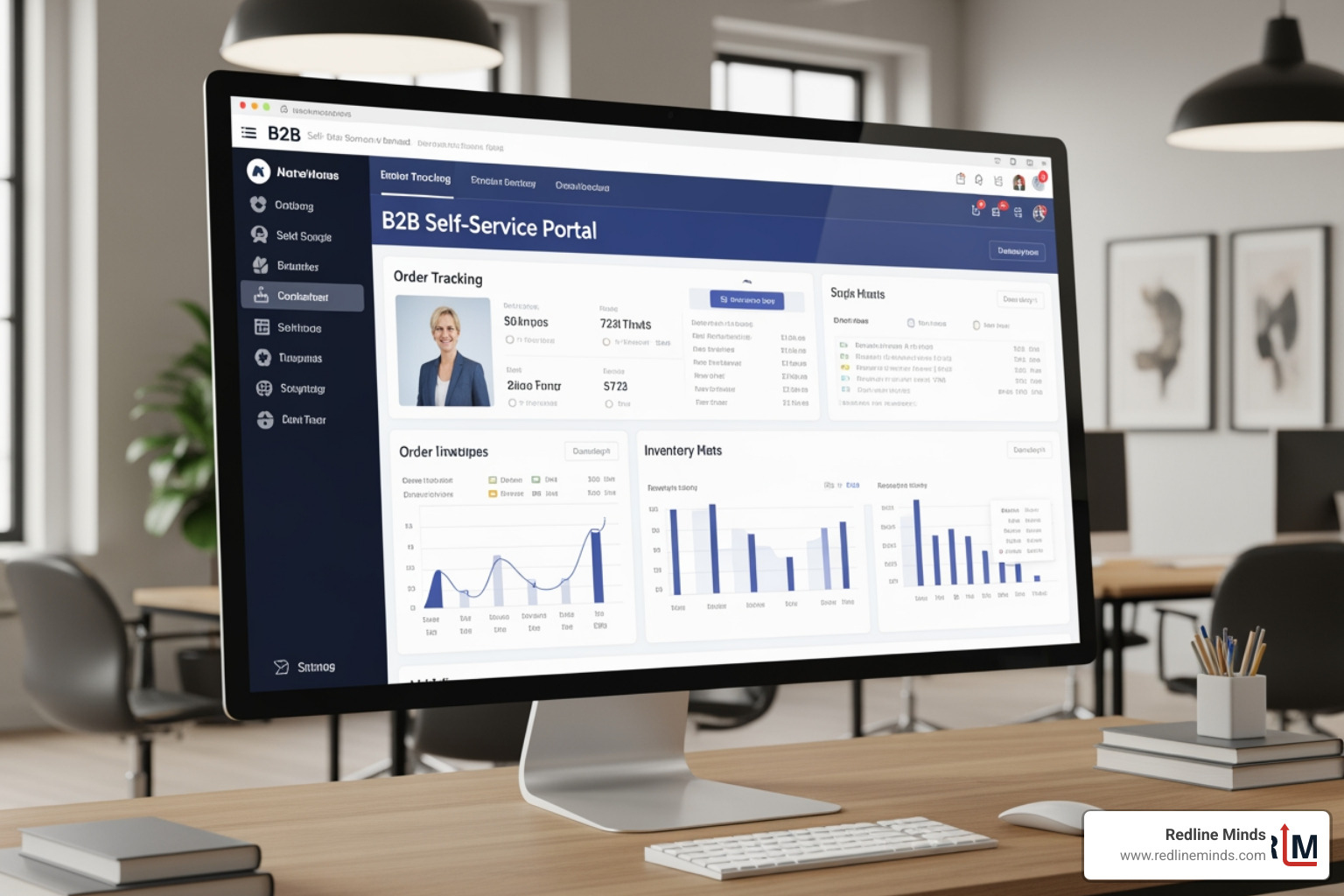
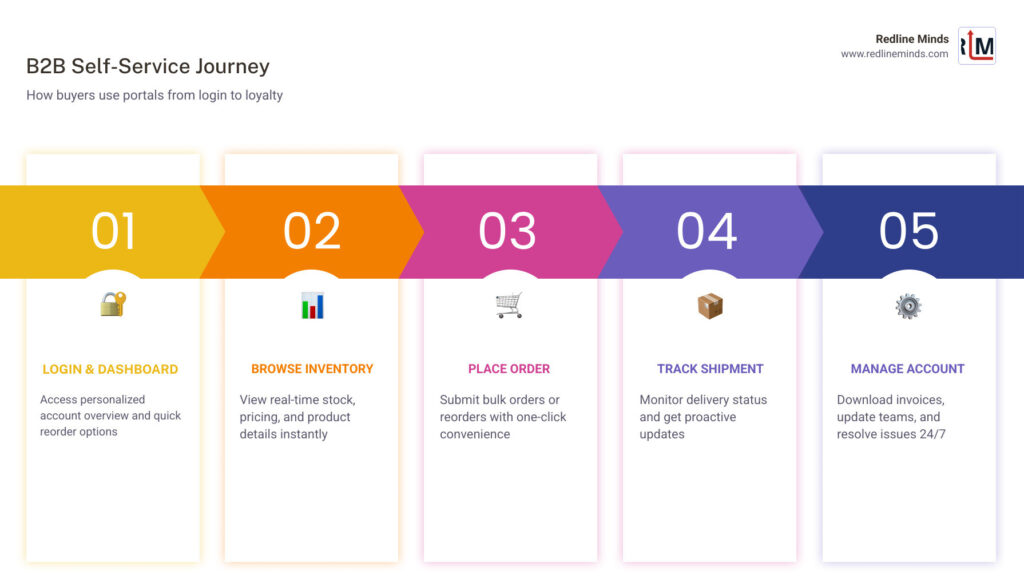
B2B self-service portals are secure online platforms that let your business customers manage their own accounts, place orders, track shipments, download invoices, and get support — without needing to call, email, or wait on a rep.
Here’s a quick look at what they do and why they matter:
| What B2B Self-Service Portals Do | Why It Matters |
|---|---|
| 24/7 order placement and reordering | Buyers shop on their schedule, not yours |
| Real-time inventory and pricing visibility | Fewer errors, fewer disputes |
| Invoice access and online payments | Faster cash collection |
| Order tracking and shipment updates | Fewer “where’s my order?” calls |
| Account and user management | Buyers manage their own teams |
| Knowledge base and support resources | Problems solved without staff involvement |
The wholesale world is changing fast. Your buyers — especially younger, digitally-native purchasing managers — no longer want to pick up the phone to place a repeat order. They expect the same smooth, always-on experience they get as consumers. And if you can’t give it to them, a competitor will.
90% of customers now expect an online self-service portal. That’s not a nice-to-have anymore. It’s the baseline.
For mid-sized wholesalers and online retailers, this shift is both a challenge and a real growth opportunity. The businesses that get this right are cutting support costs, winning customer loyalty, and scaling without hiring an army of customer service reps.
This guide breaks down exactly how B2B self-service portals work, what features drive results, and how to use them to grow your wholesale business.
Why B2B Self Service Portals Are Essential for Modern Wholesale
In the past, B2B sales were built almost entirely on personal relationships and manual “high-touch” service. While relationships still matter, the way buyers want to interact has shifted dramatically. Research from Gartner shows that 75% of B2B customers favor a sales experience without the involvement of a representative.
This isn’t because they don’t like your sales team; it’s because they value their time. Today’s buyers are digital natives. They are used to the speed of Amazon and the convenience of mobile apps. When they need to restock a standard SKU, they don’t want to play phone tag; they want to click a button. In fact, modern buyers spend just 17% of their total purchase journey interacting directly with a sales representative.
Failing to provide these digital tools carries a heavy price. Statistics indicate that over 50% of customers say they have stopped doing business with a company due to poor customer service. In the wholesale world, “poor service” often means being unavailable when the customer is ready to buy or making it difficult to find basic information like order status or invoice history.
By implementing b2b self service portals, we allow our customers to be autonomous. This autonomy leads to higher satisfaction and, more importantly, higher retention. When 86% of B2B buyers prefer using digital channels for repeat purchases, providing a portal isn’t just about efficiency—it’s about competitive differentiation. It allows your business to scale by handling thousands of routine transactions through automation, leaving your sales team free to focus on winning new accounts rather than processing paperwork.
Key Features of a High-Performing B2B Self-Service Portal
A successful portal is more than just a “login” button on your website. It needs to be a functional digital command center. We’ve found that the most effective portals focus on reducing friction at every touchpoint.
Key components include:
- Comprehensive Account Management: Customers should be able to manage their own profiles, add team members with specific roles (like “Buyer” vs. “Accounts Payable”), and update shipping addresses.
- Bulk Ordering and Quick Reorder: B2B buyers often buy the same things repeatedly. Features like “Reorder from History” or CSV upload for bulk orders are essential.
- Custom Pricing and Catalogs: Unlike B2C, B2B pricing is rarely one-size-fits-all. A high-performing portal shows each customer their specific contract pricing and a curated catalog relevant to their industry.
- Real-Time Inventory: There is nothing more frustrating for a buyer than placing an order only to find out later that the item is on backorder. Live inventory visibility builds trust.
To visualize the impact, look at how portal automation transforms the standard ordering process:
| Feature | Manual Ordering (Phone/Email/Fax) | Portal Automation |
|---|---|---|
| Order Entry | CSR manually types data into ERP | Customer enters data; syncs to ERP |
| Inventory Check | CSR checks warehouse; calls buyer back | Real-time visibility during checkout |
| Pricing | CSR looks up price sheets/contracts | Automatic application of contract rates |
| Order Status | Buyer calls for updates | 24/7 self-service tracking |
| Invoicing | Mailed or emailed manually | Downloadable on-demand |
Integrating B2B self service portals with ERP and CRM Systems
For a portal to be truly effective, it cannot exist as an island. It must be the “face” of your backend systems. Integration with your Enterprise Resource Planning (ERP) and Customer Relationship Management (CRM) systems is the foundation of a successful digital strategy.
When we integrate a portal with a system like SAP, Oracle, or Microsoft Dynamics, we create a “single source of truth.” This means when a customer views an invoice in the portal, they are seeing the exact same data your finance team sees in the ERP. This real-time synchronization eliminates data silos and drastically reduces errors.
For example, real-time tracking and invoice access allow customers to solve their own problems. Instead of calling a rep to ask for a PDF of a lost invoice, they simply log in and download it. This automated workflow doesn’t just save time; it ensures that your data remains consistent across every channel, from EDI to mobile app.
How B2B self service portals Enhance Customer Loyalty
Loyalty in B2B is built on reliability and respect for the customer’s time. Forrester research highlights that 73% of individuals say that valuing their time is the most important aspect of customer service.
b2b self service portals enhance loyalty by:
- Providing Personalized Dashboards: Showing buyers exactly what they need to see—past orders, frequently bought items, and credit limits—makes them feel understood.
- Offering 24/7 Support: Business doesn’t always happen between 9 and 5. A portal that offers a knowledge base and FAQ section allows a warehouse manager to solve a technical issue at 10 PM on a Sunday.
- Building Trust Through Transparency: When a customer can see their order moving through the stages of “Processed,” “Picked,” and “Shipped” in real-time, it builds a level of trust that manual updates simply can’t match.
Operational Benefits: Reducing Costs and Boosting Efficiency
The financial argument for self-service is staggering. Studies show that providing self-service resources can reduce support costs by up to 75%. Why? Because the “cost-to-serve” a customer via a phone call is significantly higher than the cost of a digital interaction.
Most routine inquiries—checking a price, verifying stock, or tracking a package—are low-value tasks for your staff but high-priority for your customers. When 81% of individuals prefer attempting to resolve issues on their own before contacting an agent, you aren’t just saving money; you’re giving customers the experience they actually want.
Operational efficiency gains include:
- Resource Reallocation: Your customer service reps can stop being data entry clerks and start being proactive account managers.
- Faster Resolution: Self-service is instant. There is no “on hold” music in a portal.
- Streamlined Payments: By allowing customers to pay invoices online via ACH or credit card, you can significantly improve your Days Sales Outstanding (DSO) and overall cash flow.
Best Practices for Designing and Launching Your Portal
Launching a portal is as much about people and processes as it is about technology. We recommend a user-centric design approach. If the portal is hard to navigate, your customers will simply go back to calling your sales reps.
- Mobile Optimization: Over 50% of B2B buyers now use mobile devices to conduct research or place orders. Your portal must work flawlessly on a tablet in a warehouse or a phone at a job site.
- Incremental Rollouts: You don’t have to launch every feature at once. Start with high-impact tools like order tracking and invoice downloads, then move to full ordering capabilities.
- Customer Onboarding: Don’t just “build it and hope they come.” Create a plan to train your customers. Show them how much time they will save.
- Data Cleansing: Your portal is only as good as the data behind it. Before launching, ensure your ERP data (prices, SKUs, descriptions) is clean and accurate.
- Role-Based Permissions: Ensure your design supports the complexity of B2B organizations. A purchasing manager needs different access than a junior buyer or an accountant.
The Future of B2B Self-Service: AI and Beyond
The next frontier for b2b self service portals involves moving from “reactive” to “predictive” service. Emerging technologies like Artificial Intelligence (AI) and Machine Learning are transforming portals into proactive sales tools.
- Predictive Analytics: Imagine a portal that alerts a customer when they are likely to run out of a specific product based on their past purchase patterns.
- AI Chatbots: Modern chatbots can handle complex queries, such as “What is the lead time on 500 units of SKU-123?” by pulling data directly from the ERP.
- Hyper-Personalization: AI can provide personalized product recommendations, much like B2C sites, but tailored to the specific business needs and industry of the buyer.
- Virtual Reality (VR): For manufacturers of complex machinery, VR integration within the portal can allow buyers to view 3D models or “walk through” a product demonstration before purchasing.
Frequently Asked Questions about B2B Portals
What is the difference between B2B ecommerce and a self-service portal?
While they overlap, B2B ecommerce is typically focused on the “transaction”—finding and buying products. A b2b self service portal is broader; it’s an account management hub. It includes the “after-the-sale” experience, such as managing returns (RMAs), viewing credit limits, downloading tax documents, and accessing technical support.
How long does it take to implement a B2B self-service portal?
Implementation timelines vary depending on the complexity of your ERP integration. A basic portal with standard features can often be launched in a few months, while a fully customized, deeply integrated global solution may take longer. We always recommend an “MVP” (Minimum Viable Product) approach to get you live and generating ROI as quickly as possible.
Can a self-service portal handle complex B2B pricing and contracts?
Absolutely. This is actually one of the primary reasons to use a dedicated B2B portal rather than a basic B2C store. High-quality portals are designed to sync with your ERP’s logic, applying tiered pricing, quantity discounts, and specific contract rates automatically based on the user’s login.
Conclusion
The shift toward digital autonomy is not a trend; it is a fundamental change in how business is done. B2B self service portals have evolved into the “digital command center” for modern wholesale, acting as a bridge between your internal efficiency and your customers’ expectations.
At Redline Minds, we specialize in helping wholesalers and manufacturers navigate this digital transformation. Whether you are looking to reduce your cost-to-serve, improve your customer experience, or scale your operations without adding overhead, a well-designed portal is the key to omnichannel success.
Ready to see how a B2B portal can transform your business? Explore our B2B ecommerce services and let’s build the future of your wholesale operation together.
Share this article
Tap into years of experience and turn your site’s visitors into buyers.
Related Posts
-

The Complete Guide to Affiliate App for Shopify
Discover the best affiliate app for Shopify to grow sales, manage referrals, and boost merchant revenue in 2026.
-

The Ultimate Guide to Types of E-Commerce Payment Systems
Learn the types of e commerce payment system to boost sales and reduce cart abandonment in this complete…
-

A Practical Guide to AI Agent Integration Methods
Learn how AI agent integration connects enterprise systems with MCP, Unified APIs, and custom code for secure, real-time…