
The No-Nonsense Guide to B2B Lead Generation Strategies

Building the Foundation: ICP and Lead Qualification
B2B lead generation strategies are the methods businesses use to attract, identify, and convert other companies into paying customers.
Here are the most effective B2B lead generation strategies for 2026:
- Content marketing – blogs, whitepapers, and case studies that attract buyers during research
- LinkedIn and social selling – direct outreach and organic engagement with decision-makers
- SEO and organic search – ranking for the keywords your buyers actually search
- Webinars and virtual events – high-intent lead capture through education
- Account-based marketing (ABM) – hyper-targeted campaigns aimed at specific companies
- Email nurture sequences – automated follow-up that moves leads through the funnel
- Referral and partner programs – leveraging trust networks for warm introductions
- Paid advertising (PPC + LinkedIn Ads) – immediate visibility with precise targeting
- A/B testing and personalization – optimizing every touchpoint for conversion
- Web visitor identification tools – turning anonymous traffic into actionable leads
Here is the reality most B2B companies face: sales reps spend only 28% of their week actually selling. The rest is wasted on chasing the wrong leads, repeating outreach that doesn’t land, or waiting on marketing to send something useful.
And it’s not just a sales problem. According to research, 93% of B2B buying processes start with an online search — meaning if you’re not showing up where buyers look, you’re invisible before the conversation even starts.
The old playbook — cold calls, bought lists, trade shows — still has a place. But it’s no longer enough on its own. B2B buyers now encounter an average of 13 pieces of content before making a purchase decision. They’re doing their homework. The question is whether your content is part of that research.
This guide cuts through the noise. Whether you’re trying to fill a stagnant pipeline, qualify better leads, or align your sales and marketing teams around what actually works — you’ll find clear, actionable strategies here.
No fluff. No vague advice. Just what works.
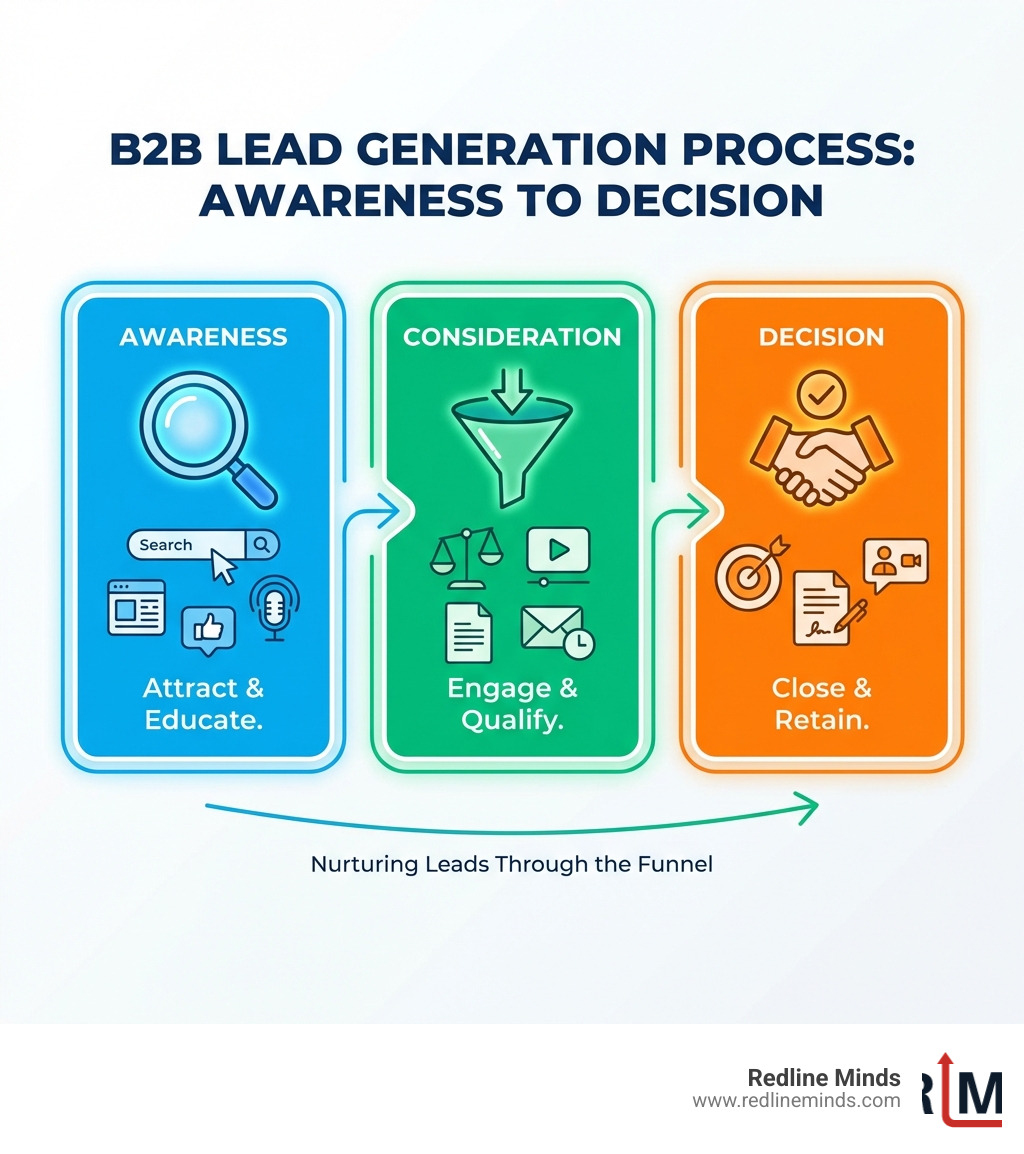
Before we dive into the “how” of b2b lead generation strategies, we have to talk about the “who.” If we try to sell to everyone, we end up selling to no one. In B2B ecommerce, especially for businesses here in Tennessee looking to scale, efficiency is the name of the game.
The bedrock of any successful strategy is the Ideal Customer Profile (ICP). This isn’t just a vague “businesses that need our stuff.” It’s a detailed description of the company that gets the most value from our product and provides the most value to us. We look at firmographics like industry, company size, and revenue, but we also dive into their pain points, tech stack, and decision-making structure.
Once we know who they are, we need a way to sort the “just looking” from the “ready to buy.” This is where lead qualification frameworks come in. Many of our clients find success using the BANT framework:
- Budget: Can they afford our solution?
- Authority: Are we talking to the person who can actually sign the check?
- Need: Do they have a problem we can solve?
- Timing: Is this a priority for them right now?
By applying these criteria early, we ensure our sales team isn’t wasting that precious 28% of their selling time on leads that will never close. We also use lead scoring to assign numerical values to actions—like downloading a whitepaper or visiting a pricing page—and lead grading to measure how well they fit our ICP.
Defining MQLs vs. SQLs
A common point of friction we see in B2B organizations is the handoff between marketing and sales. If marketing sends over every person who downloaded a checklist, sales gets frustrated. If sales ignores high-intent leads, marketing gets frustrated. To fix this, we have to define our lead stages clearly.
| Feature | Marketing Qualified Lead (MQL) | Sales Qualified Lead (SQL) |
|---|---|---|
| Definition | A lead identified as likely to buy based on marketing engagement. | A lead that has been vetted by sales and shows direct intent. |
| Behavior | Subscribed to a newsletter, downloaded a guide, or attended a webinar. | Requested a demo, asked for a quote, or initiated a sales call. |
| Readiness | Needs more nurturing and education. | Ready for a direct sales pitch and closing. |
| Handoff | Stays with marketing until a certain score is reached. | Handed to an Account Executive immediately. |
There is also a third category: Sales Accepted Leads (SALs). This is the critical handoff point where sales agrees the lead meets the criteria and commits to following up. Without this agreement, leads often fall through the cracks. More info about B2B ecommerce strategy can help you align these stages within your own digital storefront.
High-Impact B2B Lead Generation Strategies for 2026
The landscape of b2b lead generation strategies is shifting toward engagement and education. Static landing pages are becoming less effective; in fact, 81 percent of marketers agree that interactive content is more effective at grabbing people’s attention than static content.
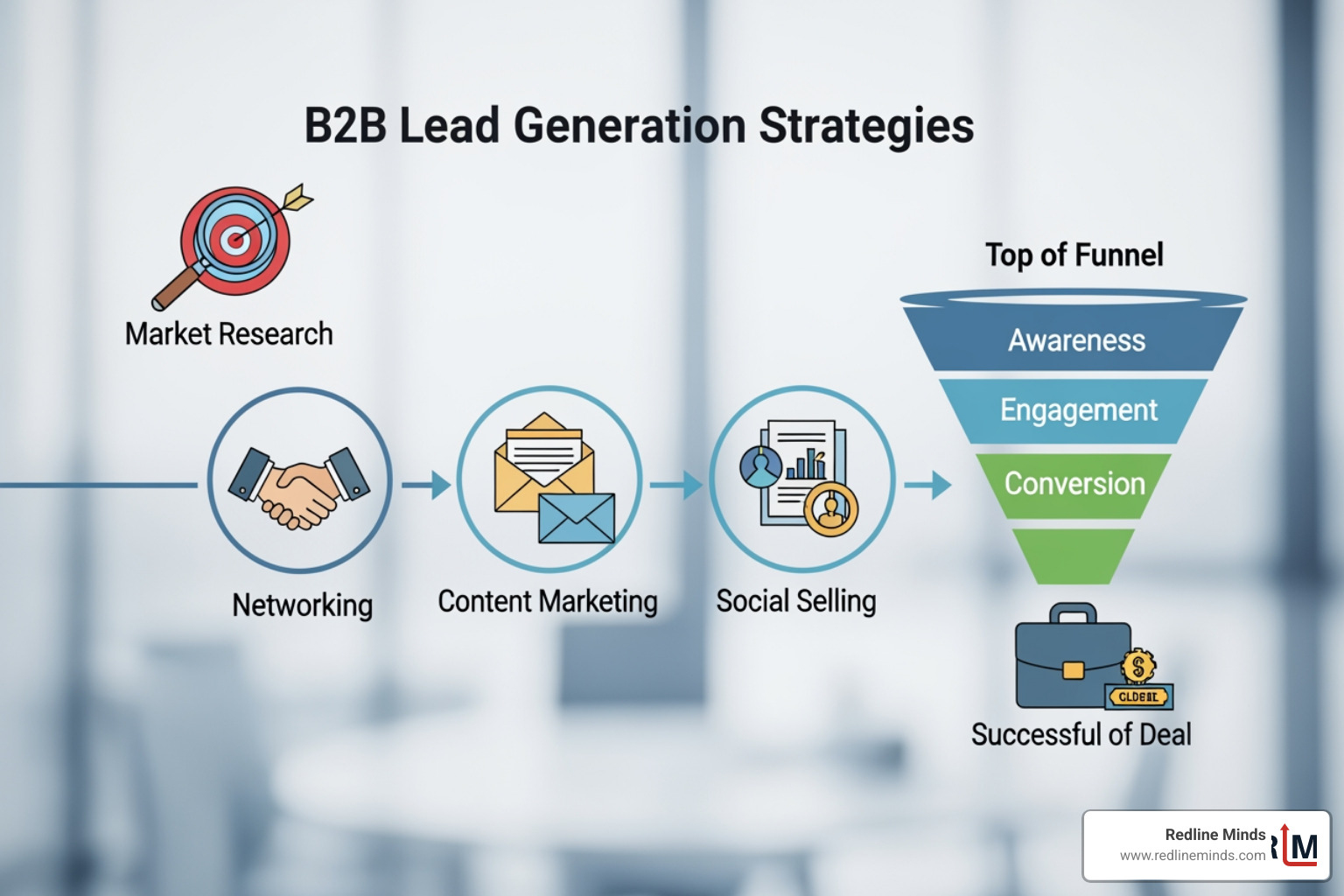
Webinars and virtual events have become a powerhouse for capturing high-intent leads. They allow us to showcase our expertise while interacting with potential buyers in real-time. The data we get from these events—like which questions were asked or how long someone stayed—is a goldmine for qualification.
Another often overlooked strategy is the referral program. Research shows that 92% of consumers trust referrals from friends, and referred customers often have a 16% higher lifetime value. Despite this, only 11 percent of sales professionals actually ask for referrals. We recommend building a formal process to incentivize your happiest customers to spread the word.
Optimizing Content for B2B Lead Generation Strategies
Content is the fuel for your lead generation engine. But not all content is created equal. Case studies now rank third in the top-used content types for B2B sales, trailing only behind email newsletters and blog posts. Buyers want to see proof that we’ve solved problems for companies just like theirs.
When we create content, we focus on:
- Whitepapers and In-Depth Reports: These establish thought leadership and are perfect for “gating” to capture contact information.
- Problem-Solving Blog Posts: Use these to answer the specific questions your ICP is searching for on Google.
- Lead Magnets: Checklists, ROI calculators, and templates provide immediate value in exchange for an email address.
To make sure this content actually gets seen, it must be optimized for search engines. Since 93% of B2B buying processes start with an online search, appearing on the first page of Google isn’t a luxury—it’s a necessity. More info about B2B SEO services can guide you in ranking for those high-intent keywords.
Leveraging LinkedIn for B2B Lead Generation Strategies
If you aren’t active on LinkedIn, you’re missing out on where your buyers live. 55 percent of decision-makers use LinkedIn to vet other companies. It’s not just a place for resumes; it’s a social selling platform.
We leverage LinkedIn by:
- Optimizing Executive Profiles: Ensuring our leadership team’s profiles speak to the value we provide, not just their job history.
- Sharing Expert Content: Posting original research and point-of-view (POV) articles that spark conversation.
- LinkedIn Sales Navigator: Using advanced filters to find and connect with the exact decision-makers in our ICP.
- Sponsored Content: Using LinkedIn Ads to put our best lead magnets in front of a perfectly curated professional audience.
Advanced Conversion Tactics: A/B Testing and Personalization
Once you have traffic coming to your site, the goal is to convert it. More than 70% of B2B marketers are using personalization because it works. In 2026, buyers expect a tailored experience. This is the core of Account-Based Marketing (ABM), where we treat high-value accounts as a “market of one.”
A/B testing is another “no-brainer” that many businesses skip. Even small changes can have a massive impact. For example, a famous A/B test for the Obama campaign’s donation rate by 18.6 percent simply by changing a “Sign Up Now” button to “Learn More.” We should constantly be testing our headlines, CTA colors, and form lengths to see what resonates with our audience.
The Power of Social Proof
In the B2B world, trust is everything. 95 percent of consumers say they read reviews before buying anything, and B2B buyers are no different. They are looking at G2, Capterra, and Google Reviews to see if we’re the real deal.
We can leverage this by:
- Embedding testimonials directly on our landing pages.
- Creating “Customer Success” videos.
- Showcasing logos of well-known brands we’ve worked with.
- Using third-party review badges to build instant credibility.
95 percent of consumers read reviews before making a purchase decision, so making those reviews visible is a critical part of our conversion strategy.
Mobile-First B2B Research
A common mistake we see is assuming B2B buyers only work on desktops. The reality is that 91% of B2B buyer searches occur on a mobile device. If your site is slow or hard to navigate on a phone, you’re in trouble. An alarming 40 percent of consumers will turn to a competitor site after a poor mobile experience.
We ensure our B2B ecommerce sites are:
- Fast: Page load speeds are a major ranking factor and conversion killer.
- Responsive: The layout should be perfect on every screen size.
- Thumb-Friendly: Buttons and forms must be easy to interact with on a mobile device.
More info about UX/UI design can help you audit your current site for mobile-readiness.
The Modern Tech Stack for B2B Growth
To manage b2b lead generation strategies at scale, we need the right tools. We are past the era of spreadsheets. A modern tech stack usually includes:
- CRM Platforms: The “source of truth” for every lead interaction.
- Web Visitor Identification: Tools like Leadfeeder or Dealfront that tell us which companies are visiting our site anonymously.
- Marketing Automation: Software to handle lead scoring and email sequences.
- Sales Intelligence: Tools like LinkedIn Sales Navigator or ZoomInfo to find contact data.
Using these tools allows us to be proactive. If we see a high-value account from our ICP visiting our pricing page, we don’t wait for them to fill out a form. We can reach out with a personalized message because we already know they are interested.
Automating the Sales Funnel
Automation isn’t about being “robotic”—it’s about being timely. Sales reps spend only 28% of their week actually selling, and much of the rest is swallowed by manual data entry or follow-ups.
We use automation to:
- Nurture Leads: If someone downloads a whitepaper, they should automatically receive a series of helpful, non-salesy emails over the next few weeks.
- Trigger Events: If a lead visits our site three times in a week, our sales team should get an automatic alert to reach out.
- Data Enrichment: Automatically pulling in a lead’s company size and industry so sales doesn’t have to hunt for it.
More info about ecommerce web development can help you integrate these automations directly into your ecommerce platform.
Aligning Sales and Marketing for Maximum ROI
The most successful companies we work with have one thing in common: Sales and Marketing alignment. When these two teams work in silos, leads get lost and money is wasted. When they are aligned, companies see significantly higher revenue growth.
Alignment starts with shared goals and a common language. Both teams must agree on what a “Qualified Lead” looks like. We recommend a regular “Smarketing” meeting where both teams review lead quality and discuss which b2b lead generation strategies are actually driving revenue, not just clicks.
Key metrics we track together include:
- Conversion Rate: Percentage of visitors who become leads.
- Cost Per Lead (CPL): How much we spend to acquire one lead.
- Customer Acquisition Cost (CAC): Total sales and marketing spend divided by new customers.
- Sales Cycle Length: How long it takes to go from first touch to closed deal.
- Lead-to-Customer Ratio: How many leads it takes to get one sale.
Tracking Success Metrics
To know if our b2b lead generation strategies are working, we have to look past vanity metrics like “likes” or “page views.” We focus on these KPIs:
- Pipeline Contribution: How much potential revenue did marketing-generated leads add to the sales pipeline?
- MQL to SQL Conversion Rate: Are the leads marketing is finding actually high enough quality for sales to take them?
- Customer Lifetime Value (CLV): Are we attracting leads that stay with us for the long haul?
- ROI per Channel: Which strategy (LinkedIn, SEO, Webinars) is giving us the best return on our investment?
By tracking these, we can “kill” the strategies that aren’t working and double down on the ones that are.
Frequently Asked Questions about B2B Lead Generation
What is the difference between MQL and SQL?
An MQL (Marketing Qualified Lead) is someone who has shown interest through marketing activities, like downloading an ebook, but isn’t necessarily ready to buy. An SQL (Sales Qualified Lead) is someone who has been vetted and shows clear intent to purchase, such as requesting a demo or a quote.
How do you create an Ideal Customer Profile (ICP)?
Start by looking at your most successful current customers. Identify their common traits: industry, revenue, company size, and the specific problems you solve for them. Then, document the key decision-makers within those companies—their job titles, goals, and what keeps them up at night.
Why is mobile optimization critical for B2B leads?
Because 91% of B2B buyer searches occur on mobile. Buyers are researching on their commute, between meetings, and at home. If your site provides a poor mobile experience, 40% of those buyers will go to a competitor.
Conclusion
At Redline Minds, we know that b2b lead generation strategies are not a “set it and forget it” project. They require constant testing, refinement, and a deep understanding of your audience. Whether you are running a pure B2B play or a hybrid store, the goal remains the same: build a predictable engine that brings in high-quality leads and turns them into loyal customers.
From our home base in Jefferson City, TN, we help ecommerce businesses across the state and beyond build the technical and strategic foundations needed for this kind of growth. Don’t let your sales team spend another week chasing the wrong leads. It’s time to modernize your approach.
Explore Redline Minds Services to see how we can help you build a high-growth sales pipeline today.