
Ecommerce Marketing Optimization and Why Your Product Team Needs to Care

Why Ecommerce Marketing Optimization Is the Growth Lever You Can’t Ignore
Ecommerce marketing optimization is the ongoing process of improving every marketing touchpoint — from search visibility and product pages to checkout and post-purchase — to turn more visitors into buyers and more buyers into loyal customers.
Here’s a quick breakdown of what it involves:
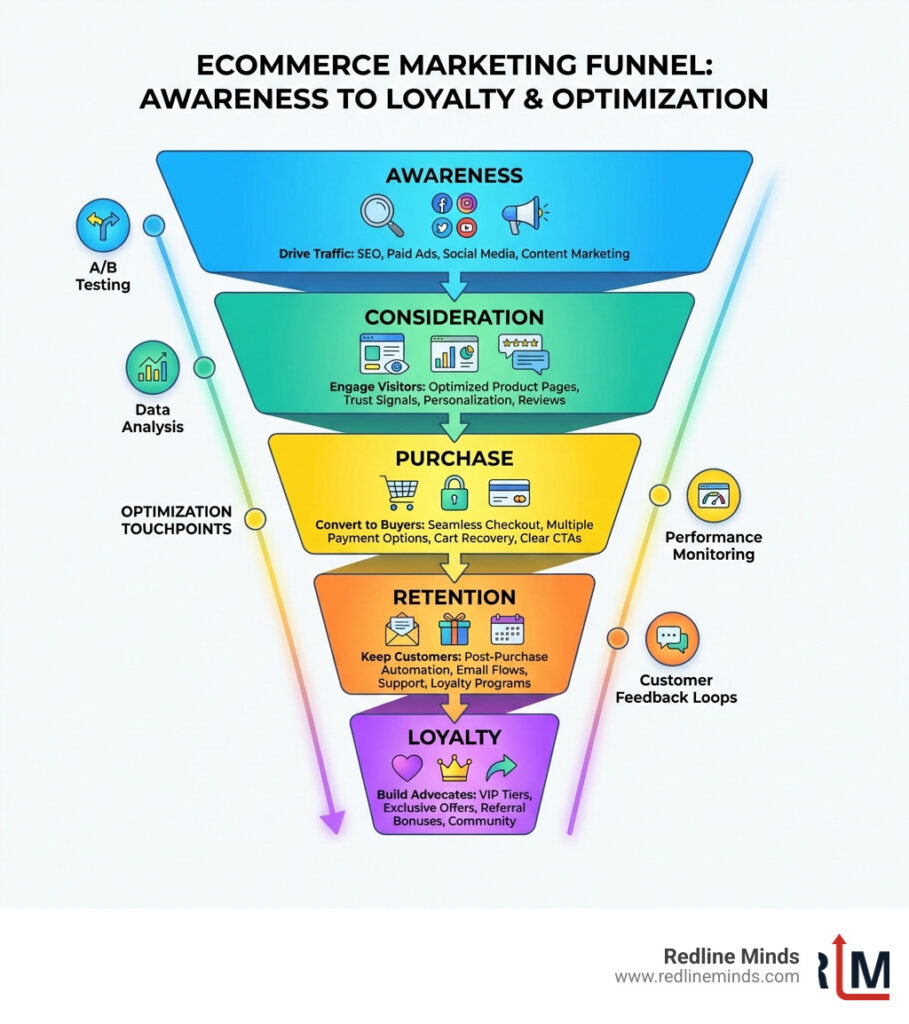
- Drive traffic — SEO, paid ads, social, and content bring the right people to your store
- Convert visitors — optimized product pages, trust signals, and personalization turn browsers into buyers
- Retain customers — email flows, loyalty programs, and post-purchase automation keep them coming back
- Measure and improve — data and A/B testing tell you what’s working and what’s leaking revenue
If you’re running a mid-sized online store doing $1M–$10M in annual revenue, there’s a good chance your marketing is working — just not efficiently. Traffic comes in. Some people buy. But a lot of them don’t, and you’re not sure why.
That’s exactly the problem ecommerce marketing optimization solves.
The challenge isn’t just getting more traffic. It’s making every dollar and every visitor count. Consumers today interact with brands across five or more channels before making a purchase. They expect personalized experiences. They abandon carts at a rate of nearly 70%. And they’ll leave a slow or confusing site without a second thought.
Small, targeted improvements across your marketing funnel — not a single big campaign — are what compound into real revenue growth.
The Core Pillars of Ecommerce Marketing Optimization
To truly master ecommerce marketing optimization, we have to stop looking at marketing as a series of isolated “blasts” and start viewing it as a connected ecosystem. It isn’t just about a pretty website; it’s about using every scrap of data we have to make the journey smoother for the customer.
At Redline Minds, we often see businesses focusing solely on acquisition while ignoring the “leaky bucket” in the middle of their funnel. An effective Ecommerce Marketing Funnel requires a balance of three data types:
- Transactional Data: What are they actually buying, and how much are they spending?
- Behavioral Insights: Where are they clicking? Where are they dropping off? (Hint: If they spend an hour browsing but don’t buy, they might need a nudge).
- Demographic Targeting: Who are they, and where are they located?
Research shows that 65% of customers expect companies to adapt to their changing needs and preferences. If your site looks the same to a first-time visitor as it does to a ten-year loyalist, you’re missing a massive opportunity.
An omnichannel strategy is no longer a luxury; it’s the standard. Business buyers now use an average of ten different channels, and B2C consumers aren’t far behind with eight. By connecting these touchpoints, we move the needle on Customer Lifetime Value (CLTV). Remember: it costs five times more to acquire a new customer than to keep an existing one. Optimization is the key to keeping them.

Search Visibility and SEO for Ecommerce Marketing Optimization
If a tree falls in a forest and no one is there to hear it, does it make a sound? More importantly, if you have a world-class product but you’re on page four of Google, does it make a sale? (Spoiler: No).
SEO is the bedrock of long-term ecommerce marketing optimization. While paid ads are great for instant traffic, organic search is the gift that keeps on giving. We recommend starting with a comprehensive SEO Checklist for Ecommerce to ensure your technical foundation is solid.
Key areas to focus on include:
- Technical SEO: If your site doesn’t load in under two seconds, Google (and your customers) will penalize you. Use tools like WebMaster tools to find crawl errors.
- Product Schema: This helps search engines understand your price, availability, and reviews, allowing them to show “rich snippets” in search results.
- Keyword Research: Move beyond generic terms. Long-tail keywords (e.g., “heavy-duty industrial toner for office printers”) often have higher intent and lower competition.
- Internal Linking: This distributes “link juice” across your site and helps users navigate from educational blog posts to product pages.
Conversion-Centric Product Page Design
Once a visitor lands on a product page, the marketing team’s job isn’t over—it’s just entering a higher-stakes phase. The product page is your digital sales associate.
We’ve found that 4.6% higher conversion rates are common for products with 50 or more reviews. Social proof is the ultimate trust builder in an anonymous digital world. But trust isn’t the only factor; usability is king.
Consider these elements for a “perfect” product page:
- High-Res Imagery and Video: 62% of consumers favor video to learn about new products. Show the product in context—lifestyle shots beat “floating in white space” every time.
- Breadcrumbs: These help shoppers understand the product hierarchy and navigate back to categories easily.
- Benefit-Driven Descriptions: Don’t just list specs. Tell the customer how the product solves their problem.
- Clear CTAs: Your “Add to Cart” button should be the most prominent thing on the page.
For more inspiration on layout and engagement, check out our guide on What Makes a Great Homepage for Ecommerce.
Advanced Personalization and AI Strategies
The “one-size-fits-all” ecommerce experience is officially a relic of the past. Today, 71% of consumers expect companies to deliver personalized interactions. If you aren’t personalizing, you’re leaving money on the table.
Generative AI is transforming how we handle content at scale, from writing product descriptions to creating personalized shopping assistants. On average, commerce professionals using AI save over six hours per week. That’s six hours that can be spent on high-level strategy rather than repetitive tasks.
| Feature | Manual Personalization | AI-Driven Personalization |
|---|---|---|
| Scalability | Limited to broad segments | Individual-level (1:1) |
| Speed | Slow, requires manual updates | Real-time adjustments |
| Accuracy | Based on general assumptions | Based on real-time behavior |
| Conversion Lift | Moderate (approx. 3%) | High (up to 21.57% for popups) |
Predictive analytics can even tell you what a customer is likely to buy next before they even know it themselves. By showing “Recommended for You” blocks based on browsing history, you can drive up to 30% of your total revenue.
Leveraging Data for Ecommerce Marketing Optimization
To make personalization work, you need a clean stream of first-party data. With third-party cookies disappearing, your own database is your most valuable asset. This is where Conversion Rate Optimization CRO meets data science.
Using a Customer Data Platform (CDP), we can unify data from across your business—email, social, and onsite behavior—into a single view. This allows for:
- Segmented Email Flows: Instead of one newsletter, send a “VIP” offer to high-spenders and a “Win-back” sequence to those who haven’t visited in 90 days.
- Behavioral Triggers: If a user looks at a specific category three times, trigger an on-site notification with a relevant discount.
- A/B Testing: Never guess. Test your headlines, button colors, and layouts. Even a small change in CTA color has been shown to lift conversions by 34% in some cases.
For a deeper dive into these tactics, our Ecommerce Email Marketing Guide covers everything from welcome sequences to advanced automation.
Mastering the Checkout and Retention Loop
You’ve done the hard work of getting them to the cart. Don’t trip at the finish line! The 70% abandonment rate seen across the industry is often due to “friction”—surprises like high shipping costs or forced account creation.
Optimization at the checkout level is one of the highest-ROI activities you can perform. For instance, 93% of shoppers are encouraged to buy more when a free shipping option is available.
To slash abandonment, try these “hacks”:
- Guest Checkout: 18% of shoppers abandon because they don’t want to create an account. Let them buy first, then ask them to save their info later.
- Trust Signals: Display security badges and clear return policies right near the “Place Order” button.
- SMS Recovery: While email is great, SMS has nearly a 98% open rate. A friendly text reminder about a forgotten cart can be a game-changer.
- Post-Purchase Automation: The marketing doesn’t stop at the “Thank You” page. Send a follow-up email with care instructions or a “refer-a-friend” discount.
Mobile-First UX and Social Commerce
By 2026, over 70% of mobile traffic will dominate the ecommerce landscape. If your mobile experience is just a “shrunken version” of your desktop site, you’re in trouble. We advocate for a mobile-first UX, utilizing Progressive Web Apps (PWAs) to provide an app-like experience without the heavy download.
Social commerce is the other half of the mobile equation. You can Use Instagram to Drive Product Sales by tagging products in Reels and Stories, allowing for a “one-click” path from discovery to purchase.
User-generated content (UGC) and video commerce are also exploding. Sites featuring UGC see a 90% increase in time spent on site. Why? Because people trust other people more than they trust brands. Short-form video (TikTok, Reels) and influencer partnerships provide the “social proof” that modern shoppers crave.
B2B and Hybrid Store Optimization Nuances
At Redline Minds, we specialize in the unique challenges of B2B and hybrid stores. Optimization here looks a bit different than in B2C. It’s less about “impulse buys” and more about “efficiency and workflows.”
B2B buyers often deal with complex sales cycles and need specific features:
- Contract Pricing: Showing the specific price negotiated for that specific account.
- Bulk Ordering: Quick-add forms where SKU numbers can be uploaded in bulk.
- Inventory Visibility: Real-time data so procurement managers know exactly what’s in stock before they promise it to their own customers.
- Quote-to-Order Workflows: Letting a user build a cart and send it to a manager for approval before the order is finalized.
We also use Live Event Hot Conversion Tools to bridge the gap between offline sales and online portals. Account-based marketing (ABM) allows us to target specific high-value companies with tailored content, making the digital experience feel like a high-touch personal relationship.
Frequently Asked Questions about Ecommerce Marketing Optimization
How do I start optimizing on a budget?
You don’t need a million-dollar tech stack to start. Focus on high-impact, low-cost changes first. Improve your page load speed (it’s free to compress images!), optimize your meta titles for SEO using our checklist, and implement a basic abandoned cart email sequence. Most email platforms offer a free tier for smaller lists.
What are the most common mistakes to avoid?
The biggest “conversion killers” are forcing account creation at checkout, ignoring the mobile user experience, and “batch and blast” emailing. If you treat every customer the same, you’ll eventually lose them to a competitor who treats them like an individual. Also, never ignore your data—if your analytics show a 90% drop-off on the shipping page, you probably have a pricing problem.
How do I measure the success of my optimization efforts?
Track the “Big Four”:
- Conversion Rate (CR): The percentage of visitors who buy.
- Average Order Value (AOV): How much they spend per trip.
- Customer Acquisition Cost (CAC): How much it costs to get them there.
- Return on Ad Spend (ROAS): The revenue generated for every dollar spent on ads.
Use robust analytics like Google Analytics 4 to segment this data by device and traffic source to see where the real wins are happening.
Conclusion
Ecommerce marketing optimization isn’t a “set it and forget it” project; it’s a mindset. It requires a holistic strategy that blends technical SEO, persuasive design, and advanced data intelligence.
At Redline Minds, we’ve spent years helping B2B and hybrid retailers navigate these complexities. Whether you’re looking to refine your Ecommerce Marketing Services or need a complete UX overhaul, the goal is always the same: turn your data into a competitive advantage.
The future of ecommerce belongs to the brands that listen to their data and prioritize the customer journey. If you’re ready to stop guessing and start growing, it’s time to start optimizing.
Share this article
Tap into years of experience and turn your site’s visitors into buyers.
Related Posts
-
Compare Shopify Migration Services: Options Cheat Sheet
Compare Shopify migration services and find the right Shopify migration company for your store, from manual imports to…
-

Ultimate Checklist for Improving B2B Customer Experience
Ultimate Checklist for Improving B2B Customer Experience – Learn about b2b ecommerce customer experience
-

A Practical Guide to What to Sell Online for Profit
A Practical Guide to What to Sell Online for Profit – Learn about i don t know what…