
Best SEO Audit Tools: Ultimate Guide
Why Regular SEO Audits are Essential for Ecommerce in 2026
Finding the best SEO audit website for your ecommerce store can feel overwhelming — there are dozens of tools, each promising to fix your rankings overnight. Here’s a quick look at the top options to help you decide fast:
| Tool | Best For | Standout Feature |
|---|---|---|
| Semrush Site Audit | Agencies & teams | 140+ checks, AI search monitoring |
| Ahrefs Site Audit | Technical depth | 170+ issues, 170k URLs/min crawl |
| SE Ranking | Budget-conscious SMBs | Affordable, 115+ checks, scheduled audits |
| SEOptimer | Agencies & SMBs | White-label PDF reports in 20 seconds |
| Screaming Frog | Technical SEOs | Deep crawl, free up to 500 URLs |
| SEOAudits | GEO/AI visibility | GEO scoring for AI search engines |
| RankAudit | AI-guided fixes | Code-snippet fix guides, 100+ checks |
If your online store is pulling in solid revenue but growth has stalled, the problem is often hiding in plain sight — buried in technical errors, slow pages, or content that search engines simply can’t read.
That’s where an SEO audit tool earns its keep.
Search in 2026 isn’t just Google anymore. AI-powered engines like ChatGPT and Perplexity are sending traffic to sites they can understand and cite. If your site has broken links, missing schema, poor Core Web Vitals, or thin product pages, you’re invisible — not just on Google, but across the entire AI search landscape too.
The right audit tool doesn’t just hand you a list of problems. It tells you what to fix first, how to fix it, and tracks whether your fixes are actually working.
A good audit surfaces issues across six key areas:
- Technical SEO — crawlability, indexability, redirects, sitemaps
- On-page SEO — meta tags, headings, content depth, duplicate pages
- Performance — Core Web Vitals (LCP, CLS, INP), page speed
- Mobile usability — tap targets, viewport, font readability
- AI/GEO visibility — structured data, schema, LLM citability
- Backlinks & authority — domain authority, broken links, anchor text
The tools in this guide were evaluated across all of these dimensions — so you can find the one that fits your business, your team size, and your budget.
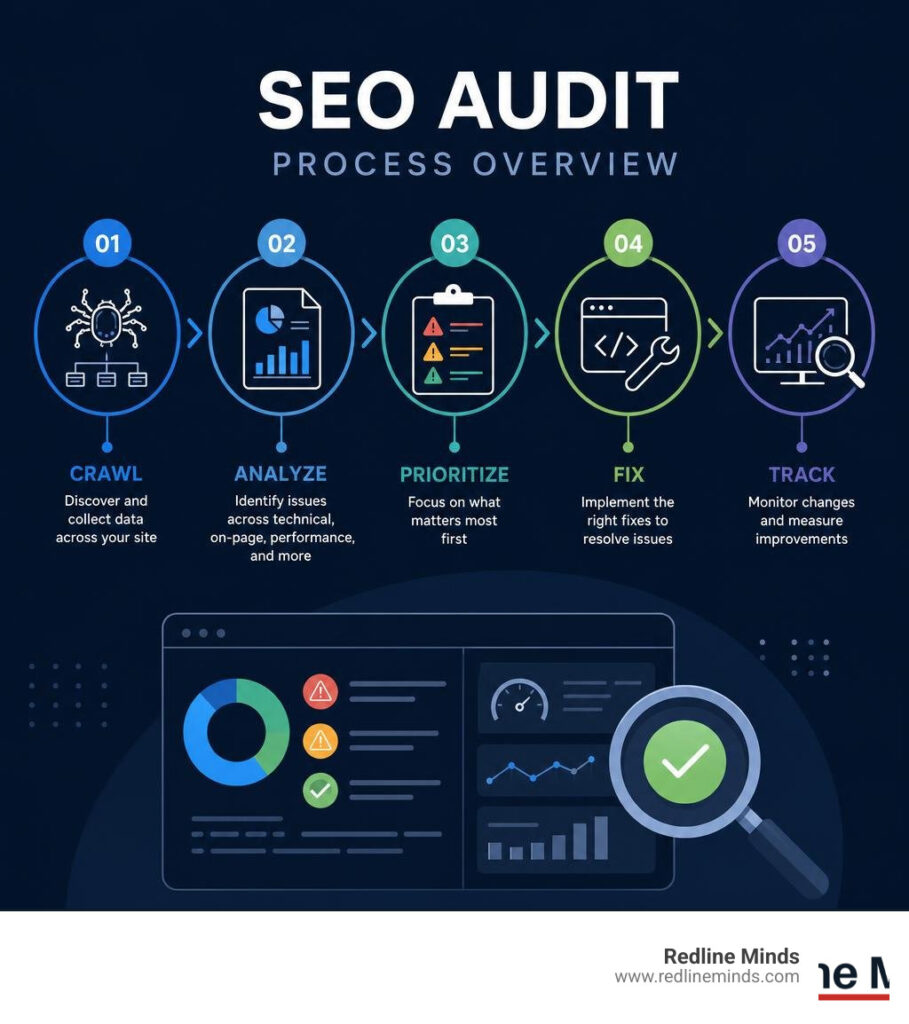
The ecommerce landscape is shifting faster than ever. In 2026, relying on a “set-and-forget” SEO strategy is a recipe for falling behind. Search engines update their algorithms constantly, and a single minor platform update or CMS change can quietly break your site’s canonical tags, sitemaps, or structured data without sending any warning to your inbox.
Regularly utilizing the best seo audit website for your store ensures that you catch these silent revenue-killers before they impact your bottom line. Technical errors eat up your crawl budget, meaning search engine bots might abandon your site before indexing your newest, most profitable products.
Furthermore, as discussed in our guide on E-commerce SEO in 2026 and Beyond to Increase Your Organic Traffic, modern optimization requires a dual approach. You must satisfy both traditional search crawlers and generative AI bots. If you are new to this concept, understanding What is SEO & How to Do SEO for Ecommerce is the perfect place to start.
To help visualize how search engine crawlers and AI bots navigate your online store, consider the standard path they follow:
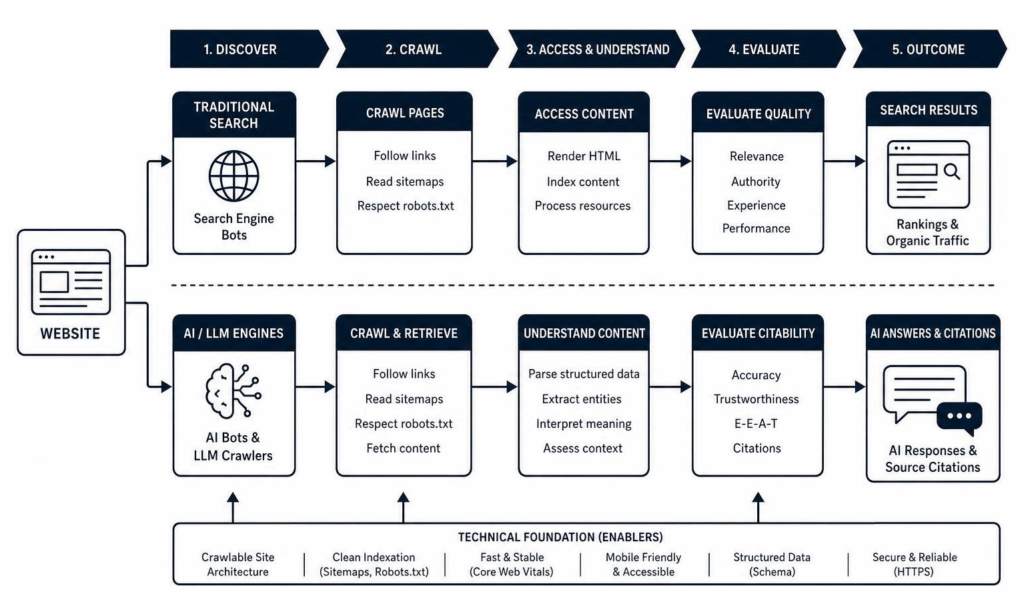
Traditional Search vs. AI and LLM Search Results
Traditional SEO focuses on keywords, backlinks, and search engine results page (SERP) hierarchies. While these metrics still matter, search in 2026 has expanded to include Answer Engine Optimization (AEO) and Generative Engine Optimization (GEO).
Platforms like ChatGPT, Perplexity, and Google’s Gemini do not just display a list of links; they synthesize answers and cite their sources. If your website’s architecture isn’t optimized for Large Language Models (LLMs), these AI engines won’t be able to access or trust your content. To win in this new era, your online store must have:
- LLM-friendly site architecture: A clean, easily readable structure that allows AI agents to extract information quickly.
- Structured data validation: Clear schema markup that explicitly states your product details, prices, and availability.
- Direct, authoritative content: Clear, “answer-first” writing styles that AI engines can easily reference as an expert source.
Core Features to Look For in the Best SEO Audit Website
When searching for the right tool, it is easy to get distracted by flashy dashboards. However, a truly effective auditing platform must have robust technical capabilities.

To get the most value out of your audits, make sure your chosen tool offers:
- Deep Crawl Depth: The ability to scan thousands of pages, which is essential for large ecommerce catalogs.
- Core Web Vitals & Speed Tracking: Real-world performance metrics (LCP, CLS, INP) that directly impact your Google rankings and user experience.
- JavaScript Rendering: Essential for modern frameworks (like React or Angular) to ensure crawlers see what your human visitors see.
- White-Label Reports: Quick, professional PDF generation to share with developers, stakeholders, or clients.
To explore more specialized tools tailored for scaling online stores, review our list of the Top Ecommerce SEO Tools for Growth. For a broader overview of industry standards, you can also read The 10 best website and SEO auditing tools for digital marketing .
How the Best SEO Audit Website Evaluates Technical Infrastructure
A technical audit is the foundation of any successful optimization strategy. The best seo audit website will rigorously evaluate your site’s underlying infrastructure to ensure search engines can discover your pages.
First, it checks indexability and crawl budget efficiency. It looks for issues like incorrect noindex tags, redirect loops, and orphan pages that are isolated from your main site structure. Next, it analyzes your XML sitemaps and robots.txt files to ensure they are pointing to the correct, canonical versions of your URLs.
Even minor CMS updates can accidentally block entire directories. Running automated checks ensures your site’s foundation remains solid. For a step-by-step breakdown of how to audit these elements yourself, check out our SEO Checklist for Ecommerce. For enterprise-level store owners, platforms like An Intelligent SEO Site Audit Tool – seoClarity offer deep, technical site-monitoring capabilities.
Measuring AI and GEO Visibility with the Best SEO Audit Website
To stay competitive in 2026, your audit tool must evaluate how visible your brand is to AI engines. Generative Engine Optimization (GEO) relies heavily on structured data, content formatting, and citability.
Modern audit tools now evaluate your “AI footprint” by scanning for things like:
- llms.txt compliance: Having a dedicated text file that guides AI crawlers on how to read your site.
- Organization and Product Schema: Validating JSON-LD code so AI search engines can confidently pull pricing, ratings, and stock status.
- Brand Authority and Trust Signals: Ensuring your E-E-A-T (Experience, Expertise, Authoritativeness, Trustworthiness) markers are clear and consistent.
Platforms like SEOAudits — AI Autopilot for Technical SEO are leading this space by offering specialized GEO scoring to measure how well your store performs in AI-driven search results.
Technical vs. On-Page: What a Comprehensive Audit Detects
A complete site audit should never focus solely on technical code or on-page content. Instead, it must balance both sides of the SEO coin.
While technical SEO ensures search engines can read your site, on-page SEO ensures they want to rank it. A comprehensive audit platform will scan your pages for metadata alignment, proper heading structures, mobile responsiveness, and schema markup.
For a complete look at how to structure your store’s optimization plan, read The Definitive Guide to Online Store SEO. To automate these checks across hundreds of pages simultaneously, tools like the Website Audit Tool: Automated SEO Audit ⚙ 115+ Checks can save your team hours of manual labor.
Resolving Duplicate Content and Image Issues
Ecommerce stores are particularly vulnerable to two major SEO issues: duplicate product content and unoptimized images.
Duplicate content often occurs when products belong to multiple categories, generating multiple URLs for the exact same page. A quality audit tool will flag these issues and guide you on how to implement proper canonical tags. Additionally, unoptimized images can drastically slow down your page speeds, hurting your Core Web Vitals.
- Duplicate Content: Learn how to identify and resolve these URL conflicts in our guide on How to Fix Duplicate Content on Your Product Pages.
- Image Optimization: Missing alt tags and massive file sizes can ruin your mobile experience. Discover how to streamline your media with The Ultimate Guide to Ecommerce Image Optimization.
Free SEO Checkers vs. Full Site Audit Tools
Many business owners start with free SEO checkers. While these are excellent for quick, single-page checkups, they fall short when trying to manage a growing ecommerce store.
| Feature | Free SEO Checker | Full Site Audit Tool |
|---|---|---|
| Crawl Limit | Usually limited (e.g., up to 3 checks a day or 500 URLs) | Large scale (e.g., up to millions of pages) |
| Historical Tracking | None (one-time snapshot) | Comprehensive progress charts and trends |
| API & Integrations | No | Yes (connects to Looker Studio, GSC, etc.) |
| Automation | Manual runs only | Scheduled weekly or monthly crawls |
| AI Fix Recommendations | Basic tips | Detailed code snippets and AI-guided fixes |
If you are looking to grow your organic visibility without a massive initial investment, check out our Top SEO Tips for Online Stores to maximize your existing resources.
Frequently Asked Questions About SEO Audits
Navigating technical SEO can bring up plenty of questions. Here are some of the most common questions ecommerce merchants ask when choosing and using an auditing tool, along with insights on managing your data as outlined in our guide: Beyond the Numbers: A Guide to Ecommerce SEO Analytics.
How often should an ecommerce site run an SEO audit?
We recommend running a full, comprehensive site audit at least once a month. However, for active ecommerce stores that update inventory, launch new campaigns, or push code changes frequently, running automated weekly audits is ideal. This acts as a continuous regression monitor, catching issues like broken redirects or broken canonical tags before they impact your organic rankings.
Can an SEO audit tool help improve visibility in AI search engines?
Yes! Modern auditing platforms now evaluate elements crucial for Answer Engine Optimization (AEO). They check for proper JSON-LD schema markup, structured FAQ sections, and clean content hierarchies that LLMs use to crawl and cite websites in generative search results.
What is the difference between a free checker and a paid audit tool?
Free checkers typically analyze a single page at a time and focus on basic, on-page factors like meta titles and heading tags. Paid audit tools crawl your entire website, mapping internal links, identifying complex technical issues (like redirect chains and mixed content errors), tracking historical progress, and offering automated scheduling.
Conclusion
Finding the best seo audit website for your business depends entirely on your store’s size, your team’s technical expertise, and your growth goals. Whether you choose the deep analytical power of Semrush and Ahrefs, the automated AI fixes of RankAudit, or the budget-friendly tracking of SE Ranking, the key is consistency. Regular audits keep your technical foundation strong, protect your organic rankings, and prepare your brand for the AI-driven search landscape of 2026.
As an ecommerce consulting agency based in Jefferson City, Tennessee, Redline Minds specializes in helping B2B and hybrid retailers scale their online sales channels. We focus exclusively on ecommerce, providing tailored web development, UX/UI design, and online marketing strategies.
If you are ready to take the guesswork out of your technical optimization and see real search engine growth, explore our curated list of the Best SEO Tools for Ecommerce or contact Redline Minds today to get expert help optimizing your online store.
Share this article
Tap into years of experience and turn your site’s visitors into buyers.
Related Posts
-
Compare Shopify Migration Services: Options Cheat Sheet
Compare Shopify migration services and find the right Shopify migration company for your store, from manual imports to…
-

Ultimate Checklist for Improving B2B Customer Experience
Ultimate Checklist for Improving B2B Customer Experience – Learn about b2b ecommerce customer experience
-

A Practical Guide to What to Sell Online for Profit
A Practical Guide to What to Sell Online for Profit – Learn about i don t know what…