
Don’t Hire a Web Design and Development Company Until You Read This
What to Know Before You Hire a Web Design and Development Company
Choosing the right web design and development company is one of the most important decisions you’ll make for your online business. Get it wrong, and you could waste months and thousands of dollars on a site that doesn’t convert.
Here’s what most growing online retailers need to look for — fast:
- Clear ecommerce expertise — not just pretty portfolios, but proven results in online sales
- SEO built into the process — not added as an afterthought
- Mobile-first development — over 54.25% of web traffic worldwide comes from mobile devices
- Accessible, compliant design — WCAG and AODA standards protect your business and your customers
- Post-launch support — your site needs ongoing maintenance, not just a one-time build
- Transparent process — discovery, design, development, and deployment should all be clearly defined upfront
The best agencies don’t just build websites. They build growth engines.
Here’s the reality most agencies won’t tell you upfront: a beautiful website that doesn’t rank, load fast, or convert is a liability — not an asset.
Users form an opinion about a website in as little as 50 milliseconds. That means your site has less than a blink of an eye to make a strong first impression. For a retailer doing $1M–$10M in annual sales, a slow, confusing, or poorly structured site isn’t just a missed opportunity — it’s actively costing you revenue.
In this guide, we’ll walk you through exactly what to look for, what questions to ask, and what red flags to avoid when evaluating a web design and development company.
Defining Your Goals Before Choosing a Web Design and Development Company
Before you even pick up the phone to call a web design and development company, you need to know what you want to achieve. Are you looking for a simple digital brochure, or do you need a high-octane sales machine? At Redline Minds, we often see businesses rush into design because they want a “fresh look,” but they haven’t defined the business objectives behind that look.
A common mistake is focusing solely on visual aesthetics. While a pretty site is nice, web design must match your objective. If your goal is lead generation, every pixel should be working toward a contact form or a phone call. If it’s ecommerce, the focus shifts to conversion optimization and reducing friction in the checkout process.
Your brand identity should be the North Star of the project. A strategic roadmap ensures that your target audience isn’t just visiting; they are engaging. Without clear goals, you’re just buying a digital paperweight.

Evaluating a Web Design and Development Company Portfolio
When you start vetting agencies, don’t just skim the screenshots. Look for deep case studies that explain the why behind the design. A great agency will show you how they solved a specific problem—like increasing mobile conversion rates or integrating a complex ERP system.
Check for industry experience, but don’t be afraid of an agency that works across sectors if they have a strong grasp of functional complexity. View our portfolio to see how we balance visual appeal with the technical requirements of high-volume ecommerce. You want to see evidence that they can handle more than just “out of the box” templates.
Identifying Your Specific Ecommerce Needs
Not all websites are created equal. If you are a wholesaler, your B2B requirements—such as custom pricing tiers, buyer account management, and bulk ordering—are vastly different from a standard retail shop. Many businesses now operate as hybrid stores, serving both the public and professional contractors from a single platform.
If you are a smaller player, you might look specifically for ecommerce website design for small business that prioritizes agility and cost-effectiveness. However, always keep scalability in mind. You don’t want to build a site today that you’ll outgrow by next Christmas because it lacks integration capabilities with your inventory or shipping software.
Essential Services for a High-Performance Online Presence
A full-service web design and development company should offer a holistic suite of services. It’s not just about the “front-end” (what you see); it’s about the “back-end” architecture that keeps the site secure and fast.
Modern web development involves:
- UI/UX Design: Creating an intuitive journey for the user.
- Front-End Development: Turning designs into responsive, interactive layouts.
- Back-End Architecture: The engine room where data, APIs, and databases live.
- Custom Web Apps: Building specialized tools that off-the-shelf software can’t provide.
Our ecommerce website design services focus on these core pillars to ensure your site is as functional as it is beautiful.
The Role of SEO in Modern Web Design and Development
SEO is not a “plugin” you install at the end of a project. It must be baked into the site’s DNA. Technical SEO involves optimizing site architecture, ensuring clean code, and maintaining fast load speeds.
Following Google SEO best practices from day one is essential. This includes mobile-first indexing, which means Google primarily looks at the mobile version of your site for ranking. If your web design and development company isn’t talking about schema markup, URL structures, and Core Web Vitals during the design phase, they are setting you up for an uphill battle later.
Specialized Ecommerce Solutions and Support
Ecommerce requires a specific set of skills that generalist agencies often lack. You need a partner who understands the nuances of payment gateways, tax calculations, and real-time inventory management.
Whether you need Shopify services for their user-friendly ecosystem or BigCommerce services for their robust out-of-the-box B2B features, the platform must fit your business model. Beyond the platform, product page optimization is where the money is made. Small tweaks to how you display reviews, shipping info, and “Add to Cart” buttons can lead to massive revenue jumps.
Navigating the Web Design Process from Discovery to Deployment
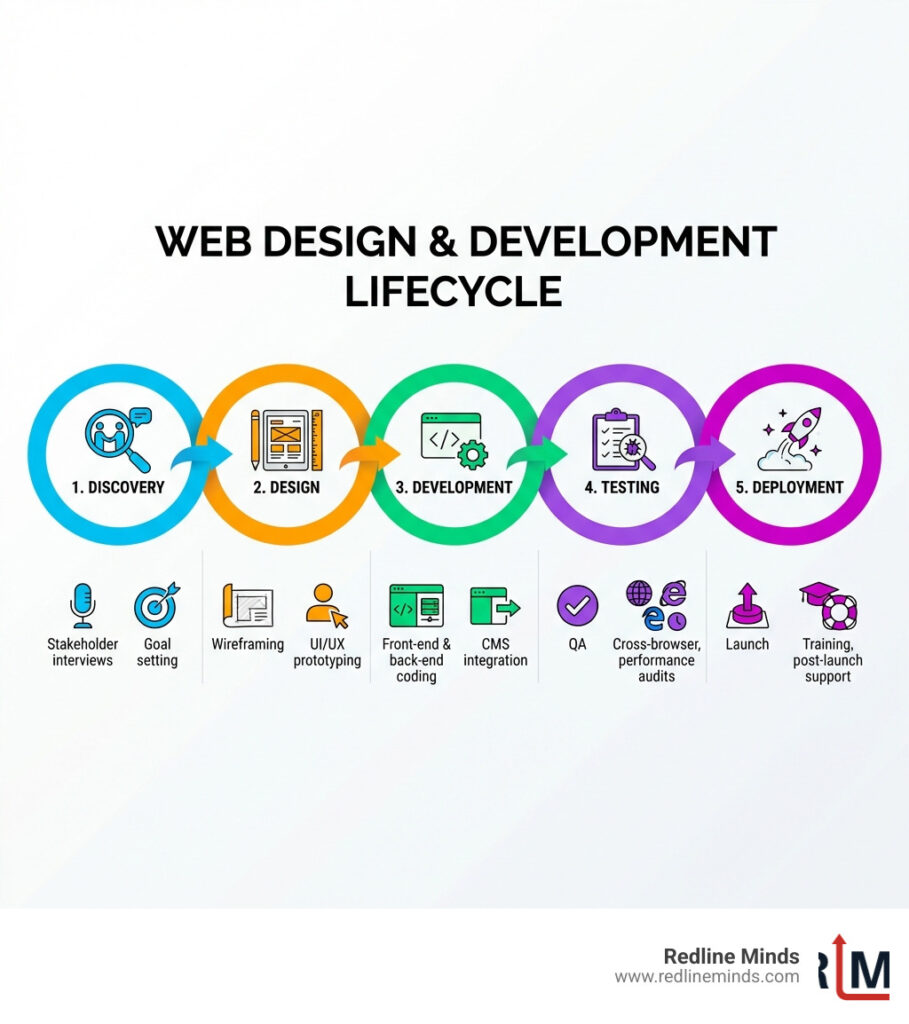
A professional project shouldn’t feel like a mystery. It should follow a structured path. Here is how we break down the journey:
| Phase | Key Activities | Goal |
|---|---|---|
| Discovery | Stakeholder interviews, user personas, goal setting | Aligning vision with business needs |
| Design | Wireframing, UI/UX prototyping, brand application | Visualizing the user journey |
| Development | Front-end/Back-end coding, CMS integration | Building the functional site |
| Deployment | QA, data migration, training, launch | Going live with confidence |
This process ensures we address the 4 key factors to build an ecommerce website: usability, performance, security, and conversion.
The Importance of Quality Assurance and Testing
Never skip the QA phase. A site that looks great on your desktop might break on an older iPhone or a different browser. Thorough testing includes:
- Usability Testing: Can a real person actually find what they need?
- Cross-browser Compatibility: Does it work on Chrome, Safari, and Edge?
- Security Audits: Is customer data protected?
- Performance Benchmarking: Does it load in under 3 seconds?
Post-Launch Maintenance and Security
The day your site launches is just the beginning. Websites are living things; they need regular updates to stay secure. Managed hosting is often a better choice for businesses than “cheap” shared hosting, as it typically includes better security standards, regular backups, and dedicated technical support. If your web design and development company “ghosts” you after the site goes live, you are one software update away from a broken store.
Why Accessibility and Mobile-First Design are Non-Negotiable
In 2026, mobile-first isn’t a “feature”—it’s the standard. With mobile devices holding over 54.25% of the global market share, your site must be designed for thumbs first, mice second. Responsive grids allow your content to adapt seamlessly to any screen size.
Ensuring Compliance and Global Standards
Accessibility is not just a moral obligation; in many places, it’s a legal one. Standards like AODA and WCAG compliance ensure that people with disabilities can navigate your site using screen readers or keyboard navigation.
Inclusive design actually benefits everyone. For example, high-contrast text is easier for everyone to read in bright sunlight. Ethical development means building a site that is usable by the widest possible audience, which in turn leads to better user retention and higher SEO rankings.
The Long-Term Value of a Web Design and Development Company Partnership
The digital landscape changes fast. Today it’s AI integration and predictive analytics; tomorrow it will be something else. A long-term partnership with a web design and development company allows for continuous improvement.
Instead of a “set it and forget it” approach, look for ecommerce website design packages that offer ongoing strategic growth. This might include A/B testing, heat mapping, and regular performance audits to ensure your “growth engine” stays tuned up.
Frequently Asked Questions about Web Development
How much does professional web design and development cost?
The cost of a website is like the cost of a house—it depends on the square footage and the finishes. Project complexity, the level of custom coding required, and the number of third-party integrations all play a role. We’ve written extensively on ecommerce website design cost factors to help you understand where your budget goes. A “cheap” site often costs more in the long run through lost sales and technical debt.
Which CMS platform is best for my business?
There is no “best” platform, only the best platform for you.
- Shopify: Great for ease of use and rapid scaling.
- BigCommerce: Excellent for B2B and complex catalogs.
- Magento (Adobe Commerce): The gold standard for total flexibility, though it requires more maintenance.
- WordPress (WooCommerce): Perfect for content-heavy sites that also sell products.
Before you commit, spend time choosing the right template or considering a custom design that can grow with you.
How long does it take to build a custom website?
A quality build usually takes between 12 to 24 weeks. This timeline includes the discovery phase, multiple design iterations, development sprints, and the often-overlooked content migration phase. Rushing a launch almost always results in bugs and a poor user experience.
Conclusion
Hiring a web design and development company is a major investment in your business’s future. Don’t settle for an agency that just “makes websites.” You need a strategic partner who understands the complexities of B2B and hybrid ecommerce, someone who prioritizes SEO from the start, and someone who will be there to support you long after the launch.
At Redline Minds, we bring Tennessee-based expertise and a deep focus on ecommerce growth to every project. We don’t just want to build you a site; we want to help you dominate your market.
Ready to stop guessing and start growing? Explore our full range of services and let’s build something awesome together.