
The Best Platforms for Scaling Your B2B Ecommerce Operations

The Platforms That Actually Move the Needle for B2B Wholesale
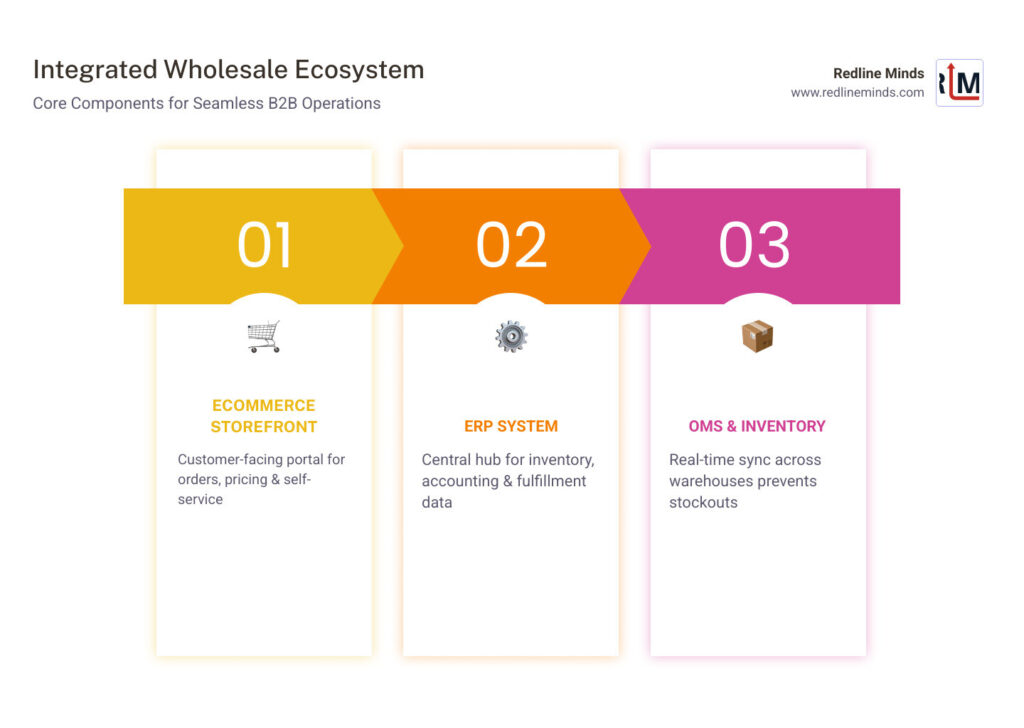
Wholesale ecommerce platform integration is the process of connecting your online store to the back-end systems that run your business — things like your ERP, CRM, inventory management, and order management software — so data flows automatically between them.
Here are the top platforms for scaling B2B wholesale operations through integration:
| Platform | Best For | Key Integration Strength |
|---|---|---|
| Shopify Plus | Mid-market wholesalers | Large app ecosystem, API-first |
| BigCommerce | Growing B2B brands | Native B2B features, open APIs |
| Adobe Commerce | Enterprise wholesale | Deep ERP/CRM customization |
| OroCommerce | Pure B2B operations | Built-for-wholesale architecture |
| Virto Commerce | Complex distributor needs | Composable, modular integrations |
| OrderEase | Multi-channel B2B suppliers | EDI + ERP sync without middleware |
The B2B ecommerce market is enormous — and growing fast. It’s already expected to surpass $20.9 trillion globally, and wholesale is one of its biggest engines.
But here’s the problem most mid-sized distributors and retailers face: their systems don’t talk to each other.
Orders come in through a portal. Inventory lives in an ERP. Pricing rules are buried in spreadsheets. Customer data sits in a CRM no one fully trusts. The result? Manual data entry, fulfillment errors, and frustrated buyers.
That gap between your storefront and your back office is costing real money. Distribution businesses lose roughly 12% of annual revenue from inventory inaccuracies and order errors alone.
The good news: the right platform — with the right integrations — can close that gap fast.
Why wholesale ecommerce platform integration is Essential for 2026
As we look toward 2026, the wholesale landscape is shifting from “digital-optional” to “digital-mandatory.” The wholesale market is projected to grow to over $60 trillion by 2026, and a significant portion of that growth is driven by online transactions. In fact, research shows that 49% of B2B purchases now take place online.
If you are operating with siloed systems, you aren’t just moving slower; you’re losing money. Without a tight wholesale ecommerce platform integration, your team is likely drowning in manual data entry. Studies show that integration can reduce manual data entry by a staggering 70%.
Think about the impact on your fulfillment. When your web store and ERP (Enterprise Resource Planning) are perfectly synced, you achieve 34% faster order processing times. Conversely, businesses without this synchronization lose about 12% of their annual revenue due to inventory inaccuracies. If your website says you have 100 units but your warehouse actually has zero, you’ve just created a customer service nightmare.
Integration provides the real-time visibility that modern B2B buyers demand. They want to see their specific contract pricing, their order history, and accurate stock levels across multiple warehouses without having to call a sales rep. By automating these data flows, you gain operational control and the ability to scale without adding massive headcount to your back office.
Top Platforms for Scaling B2B Operations
Choosing the right foundation is the first step toward a successful integration strategy. While many platforms claim to support B2B, only a few have the “architectural bones” to handle the complexity of wholesale.
Evaluating wholesale ecommerce platform integration Capabilities
When we evaluate platforms for our clients, we look for an API-first architecture. This means the platform is built to talk to other software from the ground up.
- Shopify Plus: This is a powerhouse for mid-market wholesalers who want a user-friendly interface. While it started in B2C, its B2B features have matured significantly, offering a massive app ecosystem that makes connecting to common ERPs and CRMs relatively straightforward. Still, Shopify is not strong for B2B and must be evaluated carefully before selection.
- BigCommerce: We often recommend BigCommerce for brands that need native B2B functionality like customer groups and price lists out of the box. It’s known for having open APIs that don’t charge transaction fees, making it a cost-effective choice for high-volume wholesalers. For a deeper dive into how it stacks up against its biggest rival, check out our BigCommerce vs Shopify: Technical Comparison.
- Adobe Commerce: Formerly known as Magento, this is the “heavy lifter.” It offers extreme customization for complex business logic, though it usually requires more technical oversight.
- OroCommerce: Unlike others that added B2B features later, OroCommerce was built specifically for the B2B world. It handles corporate account hierarchies and multiple price lists natively, which simplifies the integration process for complex distributors.
- Virto Commerce: This platform uses an “Atomic Architecture,” which is a fancy way of saying it is highly modular. It’s perfect for multinationals that need to plug into a wide variety of legacy systems and third-party tools.
- OrderEase: This acts as an “operational brain” for B2B suppliers. It excels at unifying diverse channels—like your portal, Amazon, and EDI (Electronic Data Interchange)—into one stream that feeds directly into your ERP.
Maximizing ROI through wholesale ecommerce platform integration
The return on investment for a properly integrated system isn’t just about “saving time”—it’s about transforming your financial health.
- Reduced Carrying Costs: Inventory integration optimizes stock levels, which can reduce your carrying costs by 28%. You stop over-ordering “just in case” because you finally trust your data.
- Higher Customer Retention: Integration leads to a 31% higher customer retention rate. When buyers can easily reorder via a B2B self-service portal, they stay loyal.
- Larger Order Values: By integrating your CRM, you can offer personalized product recommendations based on past purchases, leading to 22% larger average order values.
- Improved Cash Flow: Accounting integration can reduce your Days Sales Outstanding (DSO) by 10-12 days by automating invoicing and eliminating payment disputes.
Key Features of a Robust Integration Solution
Not all integrations are created equal. If you’re looking for a solution that will actually scale with you, it needs to handle more than just “pushing orders.”
- Real-Time Inventory Sync: This is the baseline. You need a system that updates stock levels across all sales channels and warehouses instantly. This eliminates overselling and ensures your buyers always see accurate availability.
- Personalized Pricing and Complex Contracts: In wholesale, every customer might have a different price. Your integration must be able to pull these specific contract rules from your ERP and display them correctly to the logged-in user on your web store.
- Multi-Warehouse Management: If you ship from multiple locations, your system should automatically route orders to the warehouse closest to the customer to save on shipping costs and time.
- EDI Compliance: Many large retailers (like Home Depot or Costco) require you to use EDI. A robust integration solution handles these documents automatically, so you don’t have to manually type EDI data into your web store.
- AI-Based Productivity Tools: Modern platforms are using AI for things like “semantic search” (helping customers find the right part even if they don’t know the exact SKU) and smart order capture.
To get the most out of your platform, you might also look into core plug-ins for your BigCommerce store or Shopify apps that specifically bridge the gap between B2B and B2C workflows.
Future-Proofing with wholesale ecommerce platform integration
The “next big thing” in wholesale is headless commerce. This separates the “head” (the part the customer sees) from the “body” (the backend logic and data). This allows you to change your customer experience—like adding a mobile app or a new kiosk—without having to rebuild your entire integration.
We are also seeing a massive push toward omnichannel selling. Wholesalers are no longer just selling through reps; they are selling through their own portals, marketplaces like Amazon and Walmart, and even social channels. A unified integration ensures that no matter where the order starts, it ends up in the same place in your ERP for fulfillment.
Choosing the Right Integration Method: iPaaS vs. Custom
How you connect your systems is just as important as which systems you choose. There are three main ways to handle wholesale ecommerce platform integration:
- Point-to-Point: This is a direct connection between two systems (e.g., Shopify to QuickBooks). It’s often the cheapest to start but it becomes a nightmare to manage as you add more systems.
- iPaaS (Integration Platform as a Service): Platforms like APPSeCONNECT or Cleo act as a central hub. They connect your ERP, CRM, and web store in one place. For most mid-market distributors, this is the “sweet spot” because it offers scalability without requiring a team of developers to maintain custom code.
- Custom API Development: This is the most flexible option, but also the most expensive. It involves writing unique code to link your systems. This is usually only necessary for very large enterprises with highly specialized legacy software.
For many of our clients, we recommend looking at BigCommerce services or Shopify-specific consultants to help determine if a pre-built connector or an iPaaS solution is the better fit for their specific tech stack.
Common Pitfalls and How to Avoid Them
Even with the best tools, integration projects can go sideways if you aren’t careful. Here are the most common traps:
- Legacy System Limitations: If your ERP was built in 1995, it might not have the “hooks” needed for modern web integration. You may need a middleware layer to translate the data.
- Data Mapping Errors: If your ERP calls a product “Item123″ but your web store calls it “ProductABC,” the systems won’t talk. Clean data mapping is essential before you flip the switch.
- Siloed Departments: Integration isn’t just an IT project; it’s a business project. Your sales, finance, and warehouse teams all need to be aligned on how data should flow.
- Security and Compliance: B2B transactions often involve sensitive credit terms and personal data. Ensure your integration partner follows GDPR and PCI compliance standards.
Frequently Asked Questions about Wholesale Integration
What is the best integration method for mid-market distributors?
For most mid-market businesses, iPaaS is the gold standard. It provides a balance of speed and flexibility. It allows you to connect 4 or more systems (ERP, CRM, OMS, Ecommerce) without the fragility of point-to-point connections or the massive cost of a fully custom build.
How much can a wholesaler save by automating order processing?
The savings are significant. Beyond the 70% reduction in manual labor, wholesalers often see a 55% acceleration in fulfillment. One case study showed a brewery that achieved a 100% reduction in manual order entry, moving from hours of daily data work to just a 20-minute weekly review.
Does integration support multichannel selling on marketplaces like Amazon?
Yes! A robust wholesale ecommerce platform integration should treat Amazon or Walmart just like another storefront. Orders from these marketplaces flow into your central Order Management System (OMS) or ERP, keeping your inventory levels accurate across all channels and preventing overselling.
Conclusion
The future of wholesale is integrated. Whether you are a distributor in Tennessee looking to modernize your local operations or a manufacturer scaling globally, the goal remains the same: create a seamless flow of data that makes it easier for your customers to buy and easier for your team to sell.
At Redline Minds, we specialize in helping B2B and hybrid retailers navigate these complex transitions. From initial strategy and UX/UI design to the technical heavy lifting of ERP and CRM connections, we focus on building systems that actually drive revenue.
If you are ready to stop fighting with your data and start scaling your sales, we are here to help. Get started with expert B2B integration services and let’s build a foundation that supports your growth for 2026 and beyond.
Share this article
Tap into years of experience and turn your site’s visitors into buyers.
Related Posts
-

The Best Platforms for Scaling Your B2B Ecommerce Operations
Scale B2B operations with wholesale ecommerce platform integration. Compare top platforms, boost efficiency 70%, cut costs 28% in…
-
Choosing Your Transactional Message Champion: Klaviyo or Shopify
Compare shopify vs. klaviyo transactional messages: open rates, customization, deliverability & when to switch for max revenue.
-

Don’t Hire a Web Design and Development Company Until You Read This
Discover how to choose the right web design and development company. Essential tips on goals, services, SEO, ecommerce…