
How to Work with a Website Design and Development Agency
What to Expect When Working with a Website Design and Development Agency
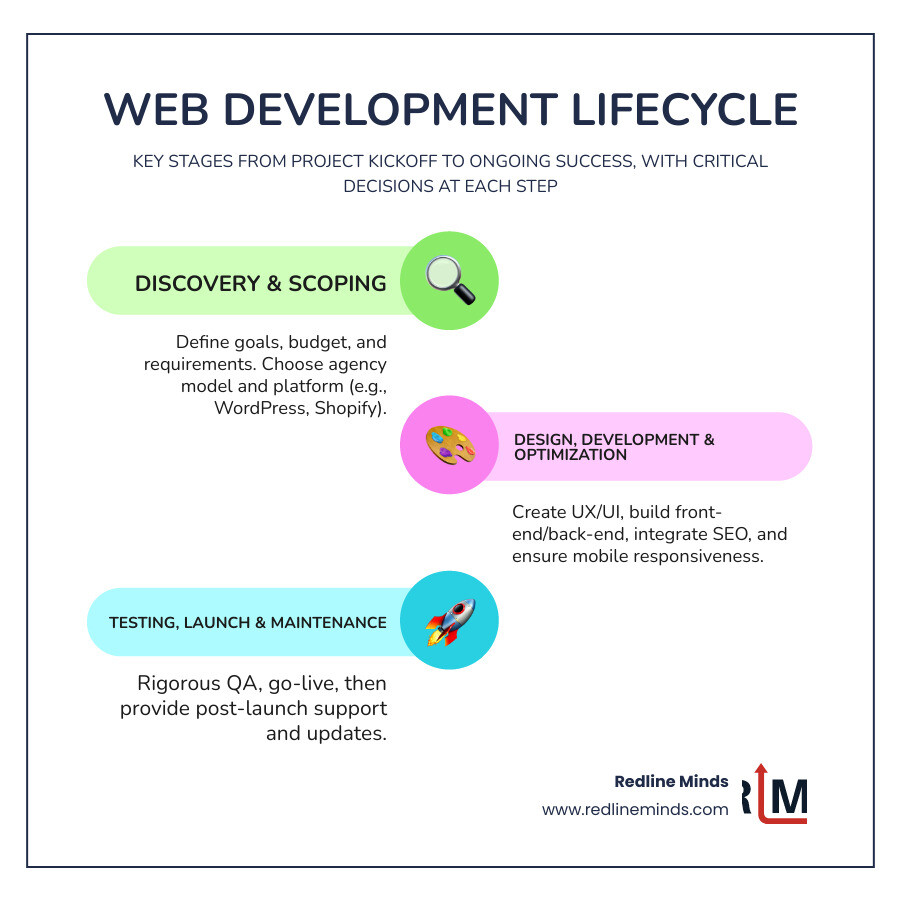
Working with a website design and development agency is one of the biggest investments you’ll make in your online business. Before diving in, here’s a quick overview of what that typically involves:
What a web design and development agency does:
- Designs and builds your website (front-end and back-end)
- Manages your CMS setup (WordPress, Shopify, Webflow, and others)
- Handles UX/UI design, SEO integration, and mobile responsiveness
- Provides ongoing maintenance and support after launch
- Often offers related services like branding, digital marketing, and eCommerce strategy
Who this article is for:
If you’re a growing online retailer with stagnant sales, a new website — or a redesigned one — can be a powerful lever. But only if you choose the right agency and know how to work with them effectively.
Here’s the reality: most businesses underestimate what’s involved. Getting a site that actually drives conversions takes more than picking a pretty template. It takes the right partner, the right process, and realistic expectations about scope, cost, and timelines.
One truth that comes up again and again in the web industry: a website is your most important and cost-effective marketing tool — not just a technical exercise. The agencies that understand that distinction are the ones worth hiring.
This guide walks you through every step of the process, from defining your project scope to asking the right questions in your first consultation.
Defining Your Project Scope and Budget
Before you even send an email to a website design and development agency, you need to have a clear understanding of what you want to achieve and what you are willing to spend. In web development, there is a famous adage: “Inexpensive, Fast, Good—you can only have two.” If you want it fast and good, it won’t be cheap. If you want it cheap and fast, it likely won’t be good.
Understanding the Investment
Budgeting is often where the biggest disconnect happens between clients and agencies. Many professional agencies charge hourly rates ranging from $120 to $200. When you look at a $10,000 budget, that only covers about 50 to 80 hours of work. For a simple site, that might suffice, but for a high-quality, “futuristic,” or complex custom build, costs can quickly escalate to $80,000 or even $90,000. These larger budgets account for deep content planning, custom integrations, enterprise-grade hosting, and long-term support.
To help you plan, we recommend looking at specific resources on Ecommerce Website Design Cost and exploring different Ecommerce Website Design Packages to see what fits your current business stage.
The Scope of Work
A project’s “scope” isn’t just the number of pages. It includes:
- Functionality: Do you need a custom shipping calendar? Multi-store functionality? B2B wholesale portals?
- Content: Are you providing the copy and imagery, or do you need the agency to lead the content strategy?
- Interactivity: Are there complex animations or custom-coded tools?
Getting the brief right from the start is the best way to save money. A vague brief leads to “scope creep,” where the project grows beyond the initial agreement, resulting in higher costs and missed deadlines.
Choosing the Right Website Design and Development Agency Model
Not all agencies are created equal. The “best” model depends entirely on your business needs, your internal team’s capabilities, and your growth goals.
| Agency Model | Best For | Pros | Cons |
|---|---|---|---|
| Freelancers | Small portfolios, blogs, or very tight budgets. | Low cost, direct communication. | Limited capacity; if they get sick, the project stops. Owner needs adequate understanding of the project to end up with a good result. |
| Small Studios | Startups and SMEs needing creative, personalized attention. | High agility, specialized design focus. | May lack deep technical or marketing depth. |
| Full-Service Agencies | Established brands, B2B, and complex eCommerce. | “Soup-to-nuts” services; experts in SEO, UX, and dev. | Higher investment; more formal processes. |
Local vs. Outsourced
While the internet makes it easy to work with anyone globally, there is a distinct advantage to working with a team that understands your market. For businesses in Tennessee, working with a local website design and development agency ensures that the team understands regional market nuances and is available for face-to-face strategy sessions.
A strategic design partner does more than just “make things pretty.” They act as an extension of your brand, ensuring that every digital touchpoint aligns with your business objectives. This is why we believe Web Design Must Match Your Objective; if your goal is lead generation but your site is built like a digital brochure, the project has failed regardless of how good it looks.
Red Flags When Selecting a Website Design and Development Agency
When vetting potential partners, keep an eye out for these warning signs:
- Outdated Portfolios: If an agency’s own website looks like it belongs in 2013, they probably aren’t the best choice for a modern brand.
- Generic Branding: If their work all looks the same, they may be using basic templates rather than custom solutions.
- Lack of SEO Focus: A beautiful site that no one can find is a wasted investment. “SEO is our middle name” should be the agency’s mantra.
- Poor Communication: If they take a week to reply to your initial inquiry, imagine how they’ll handle a mid-project crisis.
Evaluating Technical Expertise and Platform Fit
Choosing a platform is one of the most critical decisions in the development lifecycle. The right website design and development agency won’t force you into a specific platform just because it’s what they know; they will recommend the one that fits your business needs.
The CMS Landscape
- WordPress: Often considered the global standard, WordPress websites are perfect for those looking for an easy-to-use, budget-friendly platform that scales from small blogs to enterprise-level sites.
- Shopify & BigCommerce: These are the heavy hitters for eCommerce. They offer stability and security, which are essential for protecting your investment.
- Magento (Adobe Commerce): Magento is an open-source platform preferred by larger eCommerce stores that require robust features like multi-store functionality and advanced inventory management.
- Webflow & Craft CMS: These are increasingly popular for “design-first” websites that require high levels of visual innovation without the overhead of some larger systems.
The Role of SEO, UX/UI, and Accessibility in a Website Design and Development Agency
A modern website must be more than just a digital storefront; it must be a high-performance machine.
- Mobile-First Design: Mobile devices are now the preferred browsing devices for 7 out of 10 internet users. If your agency isn’t designing with a mobile-first approach, they are ignoring the majority of your audience.
- UX/UI Design: Beautiful things work better because people want to use them. User Experience (UX) and User Interface (UI) design balance originality with research-backed trends to ensure visitors don’t just land on your site—they convert.
- CrUX Metrics: Google uses Chrome User Experience (CrUX) metrics to judge your site’s performance. Fast loading speeds and stable layouts aren’t just “nice to have”; they are essential for search rankings.
- Accessibility: Ensuring your site is usable for everyone is both a moral and legal imperative. We recommend using tools like an Accessibility Checker to monitor compliance and ensure your brand is inclusive.
Vetting Portfolios and Agency Reputation
Experience always speaks louder than words. When you are looking at an agency’s Portfolio, don’t just look for “pretty” sites. Look for results.
What to Look For in Past Work
- Industry Relevance: Have they worked with eCommerce brands or B2B companies before?
- Technical Complexity: Do their sites feature custom integrations or advanced functionality?
- Diversity of Style: Does every site they build look identical, or do they adapt to the client’s brand?
- Metrics: Did the redesign lead to a +36% eCommerce conversion rate or a +47% revenue increase? Real-world statistics like these are the ultimate proof of an agency’s value.
Checking the Reputation
Don’t just take the agency’s word for it. Visit independent sites like Google My Business to read reviews and testimonials. Check social media to see how they interact with the community. Agencies with a decade or more of experience often have a “Platinum Level” of service because they’ve seen every possible technical hurdle and know how to clear it. Clutch is a platform designed for ratings of creative agencies and controls all reviews so there is no way for a business to manipulate or fake ratings.
Navigating the Consultation and Onboarding Process
The first consultation is like a first date—you’re looking for chemistry and alignment. A professional website design and development agency will spend more time asking about your business goals than they will talking about themselves.
The Onboarding Journey
Most high-end agencies use an Agile-backed methodology. This involves feedback loops and “sprints” rather than one long, silent development period. You should expect:
- Discovery: Deep dives into your brand, audience, and technical requirements.
- Strategy: Defining the “road map” for the project.
- Design & Dev: The actual building of the site, often involving regular “check-ins.”
- Maintenance & Support: A website is never “done.” It requires ongoing security updates, troubleshooting, and performance optimization to remain competitive. Some digital products can stay competitive for up to ten years if they are well-tended!
Questions to Ask a Website Design and Development Agency
To ensure a good fit, come prepared with these questions:
- “What is your primary technology stack, and why do you recommend it for me?”
- “How do you handle post-launch support and ongoing maintenance?”
- “What are our specific conversion goals for this project?”
- “How will you ensure the new design aligns with our existing brand identity?”
- “Will you lead the content strategy, or do we need to provide all copy and imagery?”
Frequently Asked Questions about Web Agencies
How long does a typical web design and development project take?
Timeline varies wildly based on complexity. A simple site might take a few weeks, while a complex eCommerce overhaul for a B2B store can take several months. The process includes planning, design, development, testing, and finally, the launch.
What is included in standard website design services?
Typically, you should expect visual design, layout planning, navigation structure, mobile responsiveness, basic SEO, and usability testing. Many agencies also include interactive features, web analytics setup, and CMS training so you can manage your own content.
Is a $10,000 budget realistic for a high-quality website?
It depends on your definition of “high-quality.” For a small business or a startup, $10,000 can get you a very solid, professional site on a platform like WordPress. However, if you are looking for an “innovative tech-company” style site with custom animations and deep integrations, you may find that $10k only covers the discovery and design phase. For reference, complex, bespoke sites often cost $80k+.
Conclusion
Choosing the right website design and development agency is about finding a strategic partner that understands your bottom line. At Redline Minds, we specialize in more than just “building websites.” Based in Tennessee, our team brings decades of combined experience to the table, focusing exclusively on eCommerce consulting, web development, and online marketing.
Whether you are looking to scale a B2B wholesale operation or launch a hybrid store that serves both consumers and retailers, we focus on the metrics that matter: sessions, conversion rates, and revenue. Your website should be your most powerful marketing tool, and we have the expertise to make that a reality.
Ready to transform your online presence? Explore our Services to see how we can help your business grow.
Share this article
Tap into years of experience and turn your site’s visitors into buyers.
Related Posts
-

The Complete Guide to Affiliate App for Shopify
Discover the best affiliate app for Shopify to grow sales, manage referrals, and boost merchant revenue in 2026.
-

The Ultimate Guide to Types of E-Commerce Payment Systems
Learn the types of e commerce payment system to boost sales and reduce cart abandonment in this complete…
-

A Practical Guide to AI Agent Integration Methods
Learn how AI agent integration connects enterprise systems with MCP, Unified APIs, and custom code for secure, real-time…