
Choosing the Right B2B Ecommerce Software
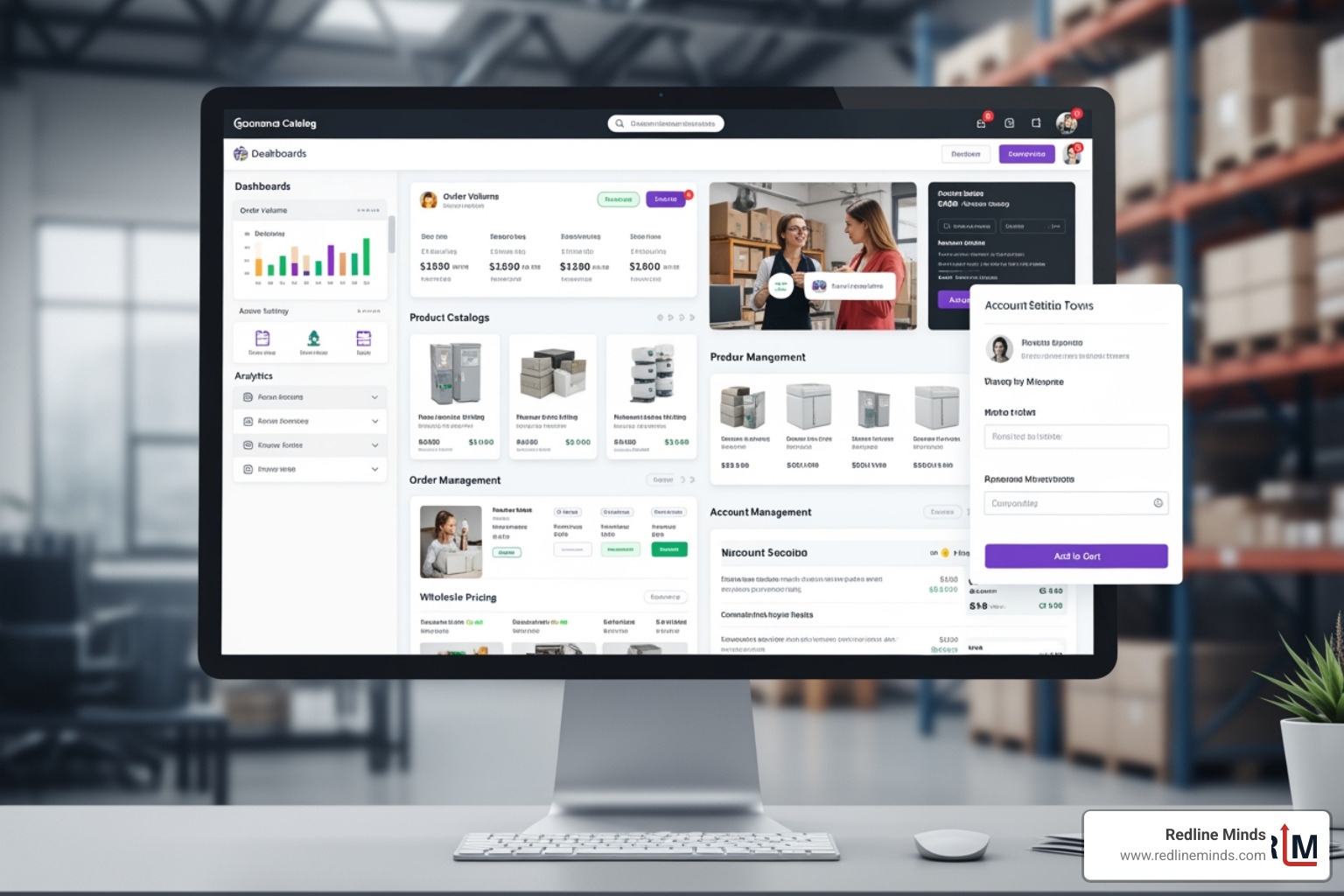
The B2B Ecommerce Platform Landscape Is Changing Fast
An ecommerce b2b platform is software that lets businesses sell products or services to other businesses online — with features built specifically for complex B2B needs like bulk ordering, negotiated pricing, and account-based access.
Here are the top B2B ecommerce platforms worth considering in 2025:
| Platform | Best For |
|---|---|
| BigCommerce B2B Edition | Mid-market businesses wanting strong ROI and built-in B2B tools |
| Shopify Plus | Brands wanting ease of use with B2B and D2C in one place |
| Salesforce Commerce Cloud | Enterprise businesses needing AI and CRM integration |
| OroCommerce | Manufacturers and distributors needing deep B2B customization |
| SAP Commerce Cloud | Large enterprises with complex ERP requirements |
| Sana Commerce | Businesses that run on SAP or Microsoft Dynamics ERP |
| Adobe Commerce (Magento) | Teams needing flexible open-source customization |
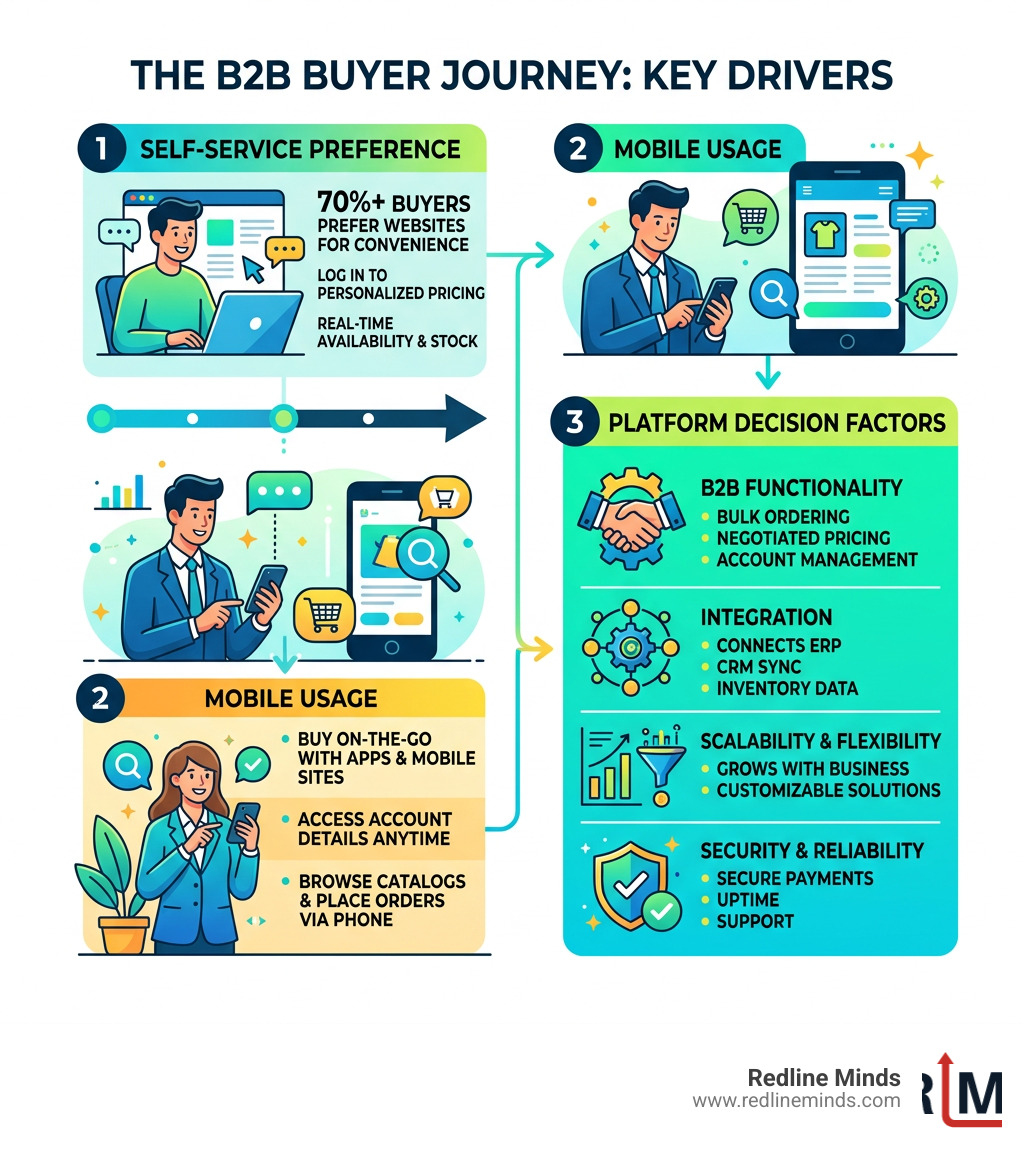
B2B buying has changed dramatically. Your customers — many of them millennials — no longer want to call a sales rep to place an order. They want to log in, see their pricing, and check out in minutes.
The numbers back this up. The global B2B ecommerce market is already worth nearly $29 trillion and is projected to surpass $36 trillion by 2026. And over 70% of B2B buyers say purchasing from a website is more convenient than working through a sales rep.
For mid-sized businesses doing $1M–$10M in annual sales, this shift is both a threat and an opportunity. The right platform can unlock new revenue, cut operational costs, and keep customers coming back. The wrong one can stall growth and create expensive headaches.
This guide breaks down your options so you can make a confident, informed decision.
Understanding the Ecommerce B2B Platform: Key Differences and Benefits
When we talk about an ecommerce b2b platform, it is easy to assume it is just a “B2C site with a login.” In reality, the architecture required for business-to-business transactions is significantly more complex. While B2C focuses on emotional triggers and quick conversions, B2B is about logic, efficiency, and long-term relationships.
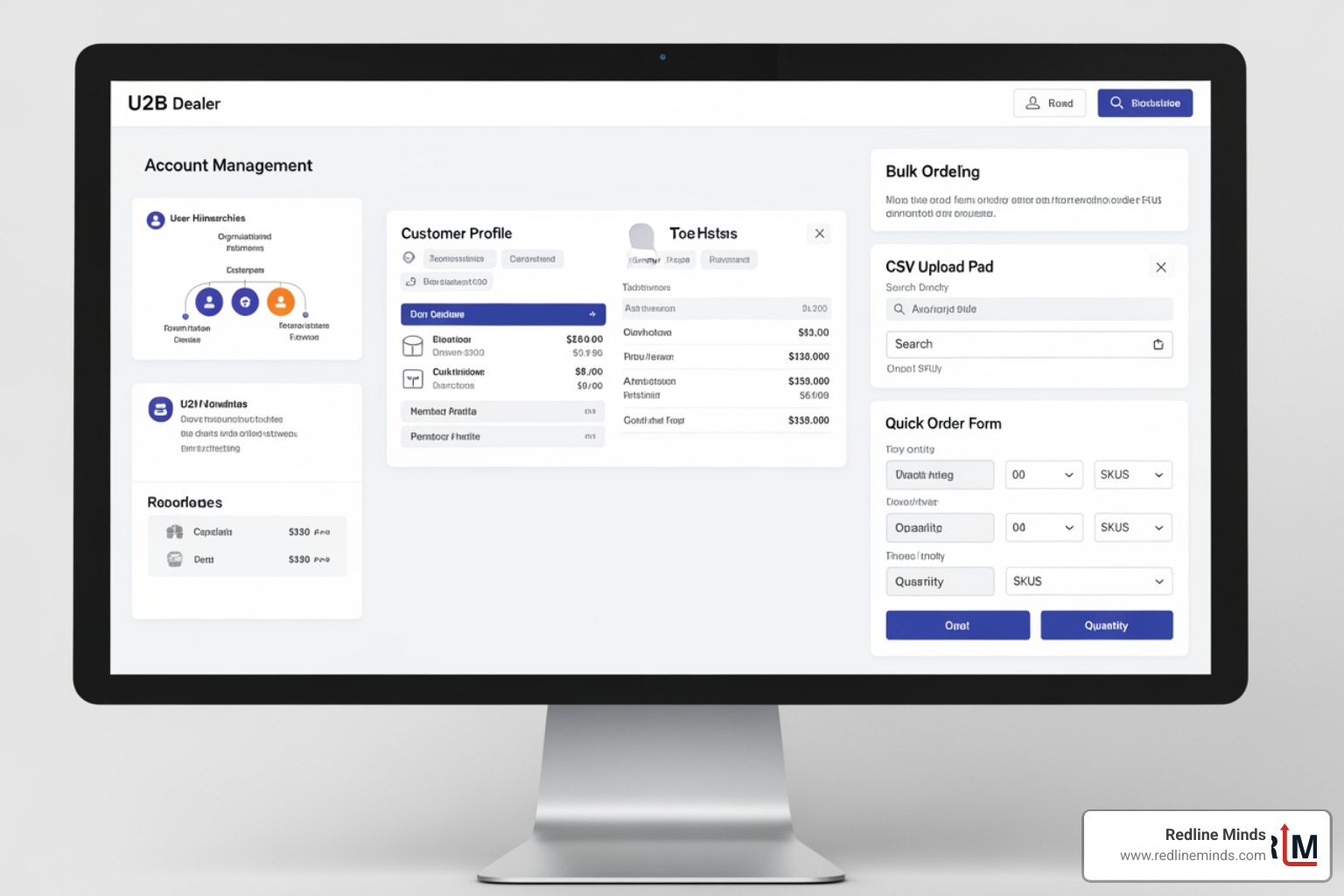
The primary difference lies in the relationship structure. In B2C, a customer is usually an individual. In B2B, a “customer” is a company with multiple users, various departments, and specific purchasing permissions. A robust ecommerce b2b platform must handle:
- Account Hierarchies: Allowing a parent company to manage multiple child accounts or branch locations.
- Negotiated Pricing: Showing specific price lists to specific customers based on their contract, rather than a single MSRP.
- Bulk Ordering: Tools that allow buyers to upload CSV files or use “Quick Order” pads to add hundreds of SKUs to a cart in seconds.
The benefits of moving to a digital model are massive. Research shows that 65% of B2B companies reported an increase in sales after moving online. Beyond revenue, digital platforms provide data-driven insights that sales reps simply can’t capture manually. You can see exactly what your customers are searching for, where they drop off, and which products are trending in real-time. This shift doesn’t replace your sales team; it frees them from taking “order entry” calls so they can focus on high-value consulting and 2025 retail insights to grow the partnership.
Essential Features of a Modern Ecommerce B2B Platform
If you are evaluating software, you need to look past the “pretty” storefront and check under the hood for these B2B-specific tools:
| Feature | B2C Purpose | B2B Purpose |
|---|---|---|
| Catalogs | Same for everyone | Personalized per customer group |
| Pricing | Discounts/Coupons | Negotiated contract rates |
| Checkout | Credit card/PayPal | Purchase Orders (PO), Credit terms, ACH |
| User Roles | Individual buyer | Buyers, Approvers, and Admins |
Modern platforms like BigCommerce B2B Edition also offer “Masquerading” features, where a sales rep can log in as the customer to help them complete an order. Other critical features include OCI Punchout, which allows your catalog to integrate directly into your customer’s procurement software, and multi-warehouse support to ensure shipping logic accounts for where the inventory actually sits.
How an Ecommerce B2B Platform Supports Global Scalability
For businesses looking to expand beyond Tennessee, scalability is non-negotiable. A global ecommerce b2b platform must handle multi-currency transactions, localized content, and regional tax compliance.
Platforms like Salesforce Commerce Cloud and Virto’s Commerce Innovation Platform use headless architecture to make this easier. Headless commerce separates the “front end” (what the customer sees) from the “back end” (the logic and data). This allows you to launch a specialized site for a new market in Europe or Asia without rebuilding your entire core system.
Evaluating the Top B2B Ecommerce Software Options
Choosing between SaaS (Software-as-a-Service) and Open Source is usually the first fork in the road. SaaS platforms like BigCommerce and Shopify Plus handle the hosting, security, and updates for you. Open Source options like Adobe Commerce (Magento) give you total control over the code but require a heavy lift for maintenance and security.
When we look at the Total Cost of Ownership (TCO), SaaS often wins for mid-market companies. You aren’t just paying for the software; you’re paying for the speed to market and the lack of “technical debt.”
Comparing Leading Ecommerce B2B Platform Solutions
- BigCommerce B2B Edition: We often recommend this for businesses that need a “Goldilocks” solution. It offers deep B2B functionality (like custom price lists and quote management) out of the box, but it is easier to manage than enterprise-level legacy systems. You can see more in our technical comparison.
- Shopify Plus: Known for its world-class checkout and ease of use. While historically B2C-focused, their B2B enterprise features have improved significantly, making it a great choice for hybrid brands (selling both D2C and wholesale). Check out our Shopify services for more details.
- OroCommerce: This is one of the few platforms built exclusively for B2B. If you have incredibly complex workflows—like multi-step approval processes for $100k orders—OroCommerce is a powerhouse.
- NetSuite SuiteCommerce: If your entire business already runs on NetSuite, SuiteCommerce offers a “single source of truth.” Your web store and your ERP are essentially the same system, which eliminates many integration headaches.
- Adobe Commerce (Magento): The veteran in the space. It is incredibly flexible but requires a dedicated development team to keep it running smoothly.
- SAP Commerce Cloud: Designed for the largest global enterprises. It handles massive catalogs and complex global requirements but comes with a significant implementation timeline.
- Znode: A headless, API-first platform that is built for manufacturers and distributors who need to manage multiple stores from one central hub.
- Sitecore OrderCloud®: A developer-centric headless platform designed for custom-built B2B experiences that need to scale infinitely.
Critical Factors for Implementation: ERP Integration and Security
In B2B, your ecommerce site is only as good as its connection to your ERP (Enterprise Resource Planning) system. If a customer sees “In Stock” on your website, but your warehouse is actually empty, you’ve just damaged a long-term relationship.
Real-time inventory and data synchronization are the lifeblood of B2B success. Sana Commerce actually specializes in this by “sitting inside” your ERP (like Microsoft Dynamics or SAP), ensuring that pricing and stock levels are always 100% accurate.
Security is the other side of the coin. B2B transactions involve sensitive contract data and large sums of money. Your platform must be PCI compliant and support Single Sign-On (SSO) so your corporate clients can manage their own employee access securely. We also recommend using tools like Feedonomics for AI-driven data enrichment. This ensures your product data is clean and standardized before it ever hits the storefront.
Building the Business Case and Calculating ROI
We know that “going digital” feels like a big expense. However, the cost of not doing it is often higher. When building your business case, look at these three areas:
- Increased Revenue: 65% of companies see a sales lift. Why? Because customers can order 24/7 without waiting for your office to open.
- Operational Savings: Automated order entry reduces errors. Sana Commerce users report a 16% decrease in order errors. That is a lot of saved time for your customer service team.
- Customer Retention: Nearly 90% of millennial buyers will pay more for a seamless experience. If you make it easy to buy, they won’t look at your competitors.
BigCommerce research shows that their B2B customers see an average 391% ROI over three years. To get there, we recommend a phased rollout strategy. Don’t try to move 5,000 customers online on day one. Start with your smaller, “self-service” accounts to work out the kinks, then move your larger contract accounts over once the system is proven.
Good website design is also vital. Even B2B buyers expect a clean, intuitive interface. You can see how we’ve handled this for brands like Vero Linens in our portfolio.
Frequently Asked Questions about B2B Ecommerce
How much does a B2B ecommerce platform typically cost?
Costs vary wildly based on your “Total Cost of Ownership.” You have the platform licensing fee, but you also need to budget for implementation, ERP integration, and ongoing maintenance. A SaaS solution might have a higher monthly fee but lower maintenance costs, while Open Source might look “cheaper” upfront but cost more in developer hours later.
What are the most common pitfalls to avoid during platform selection?
The biggest mistake we see is “over-customizing.” Many businesses try to force the new software to behave exactly like their 20-year-old manual process. Instead, use this as a chance to streamline your workflows. Another pitfall is ignoring data quality. If your product data is a mess in your ERP, it will be a mess on your website.
What future trends in B2B ecommerce should businesses prepare for?
AI is the headline. We are seeing “Agentforce” and other AI tools that can build a storefront in minutes or act as a 24/7 sales assistant for your buyers. Mobile optimization is also critical; 80% of B2B buyers use mobile devices during their journey. If your site doesn’t work on a tablet in a warehouse, you’re losing sales.
Conclusion
Choosing the right ecommerce b2b platform isn’t just a technical decision; it’s a strategic one. The goal is to align your software with your business goals—whether that is global expansion, operational efficiency, or simply keeping up with your customers’ expectations.
At Redline Minds, we specialize in helping mid-market businesses navigate these complex waters. From initial strategy to final implementation, we ensure your B2B store is built for growth.
Ready to modernize your wholesale operations? Contact Redline Minds for B2B Consulting today, and let’s build something that scales.
Share this article
Tap into years of experience and turn your site’s visitors into buyers.
Related Posts
-

The Complete Guide to Affiliate App for Shopify
Discover the best affiliate app for Shopify to grow sales, manage referrals, and boost merchant revenue in 2026.
-

The Ultimate Guide to Types of E-Commerce Payment Systems
Learn the types of e commerce payment system to boost sales and reduce cart abandonment in this complete…
-

A Practical Guide to AI Agent Integration Methods
Learn how AI agent integration connects enterprise systems with MCP, Unified APIs, and custom code for secure, real-time…