
An Essential Guide to Conversion Optimisation Tools

Categorizing Modern Conversion Optimisation Tools
To build a high-performing conversion program, you cannot rely on a single utility. Modern conversion rate optimization is a multi-faceted discipline that requires different lenses to view, analyze, and shape the user journey. Understanding the distinct categories of conversion optimisation tools is the first step toward building an efficient tech stack.
When we look at the CRO landscape, we see six primary categories. Each serves a unique purpose in helping you understand what is happening on your site, why it is happening, and how to fix it.
| Tool Category | Core Capabilities | Key Metrics Tracked | Role in Your CRO Workflow |
|---|---|---|---|
| Quantitative Analytics | Funnel tracking, event monitoring, cohort analysis | Bounce rate, conversion rate, cart abandonment rate | Identifies where the leaks in your sales funnel are occurring. |
| Behavior Analytics | Heatmaps, session replays, scroll maps, form analysis | Scroll depth, hover patterns, rage clicks | Reveals why users are dropping off by showing their physical interactions. |
| A/B & Split Testing | Client-side testing, redirect tests, multivariate testing (MVT) | Statistical significance, conversion uplift, revenue per visitor | Validates your optimization hypotheses by testing changes against a control. |
| Personalization Engines | Dynamic content, product recommendations, contextual banners | Average order value (AOV), repeat purchase rate | Tailors the shopping experience to specific audience segments in real time. |
| Lead Capture & Onsite Messaging | Exit-intent popups, slide-ins, gamified wheels, multi-step forms | Opt-in rate, email/SMS capture rate, click-through rate (CTR) | Captures abandoning traffic and coaxes hesitant buyers toward a purchase. |
| User Feedback & Surveys | Net Promoter Score (NPS), exit surveys, on-page polls | Customer satisfaction (CSAT), qualitative friction points | Gathers direct qualitative feedback from real users about their objections. |
To win at digital marketing, you must combine these categories into a cohesive system. Relying solely on quantitative analytics like Google Analytics 4 will tell you that visitors are abandoning their carts at a rate of 70%, but it won’t tell you that they are doing so because your shipping calculator is confusing. Conversely, watching session recordings without quantitative data will lead you to waste hours watching random sessions that do not represent your primary drop-off points.
By integrating behavioral insights with robust testing frameworks, you can systematically eliminate friction. For a deeper dive into establishing these foundational strategies, explore our guide on CRO Optimization 101: How to Win at Digital Marketing.
Top Software Platforms for Digital Experimentation
Selecting the right software platforms for digital optimization requires balancing your team’s technical capabilities, traffic volume, and business model. The market has shifted dramatically from heavy, developer-dependent enterprise suites to agile, highly automated systems. Let’s explore the leading platforms across the three most critical pillars of modern CRO.
AI-Driven Conversion Optimisation Tools for Rapid Testing
The traditional A/B testing workflow—where a marketer writes a brief, a designer creates mockups, a developer writes the code, and a data scientist analyzes the results—often takes weeks, if not months. For fast-growing ecommerce brands and lean marketing teams, this manual bottleneck is where potential revenue evaporates.
A new breed of agentic, AI-powered conversion optimisation tools has emerged to solve this execution gap. These platforms use machine learning to autonomously scan your pages, generate conversion-focused copy and design variations, run tests, and automatically route traffic to the winning versions.
- Dalton: Positioned as an AI-powered website optimization and CRO platform, Dalton connects to any website in minutes via a single script. It functions like an autonomous CRO specialist. Dalton scans your site, automatically identifies high-impact testing opportunities based on competitive patterns and user behavior, and generates brand-compliant copy and layout variants. Once approved, the system runs the experiments on autopilot and shifts traffic to the highest-performing variations.
- Keak: Designed specifically for speed, Keak is an AI agent that automates the entire A/B testing lifecycle. Its lightweight script (~31KB gzipped) loads asynchronously and applies variants in under 100ms with zero layout shift, protecting your Core Web Vitals. Keak automatically analyzes your page structure, generates copy and CTA variants, and optimizes landing pages to maximize the return on your paid ad campaigns.
- CROAI: This platform democratizes enterprise-grade AI optimization for small-to-mid-sized businesses and agencies. CROAI features an “Auto AI Mode” that rewrites headlines, tests variations, and deploys winners automatically. It also includes “Engagement-Based Testing” for lower-traffic sites, calculating success using a proprietary formula that weights scroll depth, time on site, and CTA interactions to determine winners without needing thousands of transactions.
These automated systems represent a major leap forward for businesses that previously lacked the resources to run traditional experimentation programs. To compare these automated options with more established manual testing platforms, check out our curated list of 27 Conversion Optimization Tools.
Behavior Analytics and Conversion Optimisation Tools for UX Insights
While testing tools tell you which version performs better, behavior analytics tools show you how users interact with those versions. By visualizing user frustration, these platforms provide the qualitative raw material needed to formulate high-impact testing hypotheses.
To understand behavior analytics in action, watch this helpful video walkthrough: 9 Best CRO Tools to 10X Your Conversion Rates in 2025 … – YouTube.
- Hotjar: The industry standard for visual behavior analytics, Hotjar combines heatmaps, session recordings, and user feedback surveys into an intuitive dashboard. Its heatmaps reveal exactly where users click, move, and scroll, while session recordings allow you to watch real, anonymous users navigate your checkout funnel. Hotjar’s AI-assisted analysis helps filter hours of recordings down to the key moments of user frustration, such as “rage clicks” or rapid U-turns.
- Smartlook: Smartlook excels at automatic user interaction tracking for both web and mobile applications. It captures every click, swipe, and form interaction without requiring manual event tagging. Its advanced funnel analysis allows you to build multi-step checkout funnels and watch the exact session recordings of users who dropped off at each stage, making it incredibly easy to pinpoint technical bugs or confusing UI elements.
Integrating these behavioral insights with your conversion tracking is essential for diagnostic health. For a comprehensive look at how to pair qualitative behavior tools with quantitative tracking systems, read our guide on The Best Free and Paid Tools for Tracking Your Marketing Conversions.
Personalization and Lead Capture Engines
A generic website treats every visitor the same, whether they are a first-time ad clicker or a loyal repeat customer. Personalization and lead capture engines allow you to segment your audience and deliver tailored messaging, promotions, and product recommendations that match their specific intent.
- Wisepops: A premier onsite engagement platform, Wisepops allows ecommerce and SaaS teams to build targeted popups, banners, and bars. It features advanced triggering options, including exit-intent, scroll depth, and inactivity. Wisepops also offers built-in A/B testing with control groups and direct revenue attribution, allowing you to measure the exact financial impact of your campaigns.
- OptinMonster: A highly scalable lead generation and conversion platform, OptinMonster uses behavior-based triggers to turn abandoning website traffic into subscribers. With features like dynamic content, geolocation targeting, and exit-intent overlays, it helps retailers deliver highly contextual offers. Choosing annual billing with OptinMonster can save teams approximately 50% compared to monthly subscriptions, making it a cost-effective choice for growing stores.
By tailoring your onsite promotions to user segments, you can significantly reduce cart abandonment and boost average order value. To learn how to leverage personalization on your main landing pages, read our expert breakdown on Unlock Your Website’s Potential: The Power of CRO on Page Optimization.
How to Evaluate and Integrate Your CRO Tech Stack
Building a powerful CRO tech stack is not about acquiring as many tools as possible; it is about choosing platforms that work together seamlessly. A fragmented stack leads to data silos, conflicting metrics, and a slowed-down website that harms user experience.

When evaluating potential conversion optimisation tools, use this four-step framework to ensure compatibility, compliance, and ROI:
- Assess Integration Capabilities: Your testing and behavioral tools must talk to your primary analytics engine (like Google Analytics 4) and your CRM/Email platform (such as Klaviyo or HubSpot). For example, when an A/B test runs, the variant ID should automatically pass to GA4 and your session recording software. This allows you to segment your heatmaps by “Variant A” vs. “Variant B” to see exactly how user behavior changed between the designs.
- Verify CMS and Page Builder Compatibility: Ensure the tool integrates natively with your ecommerce platform (Shopify, BigCommerce, Magento) or your page builders (Webflow, WordPress, Elementor). Platforms like Optibase, for instance, are purpose-built for Webflow, offering native, flicker-free testing directly inside the Webflow designer.
- Ensure Strict Data Compliance: With strict regulations like GDPR in Europe and CCPA in California, your tools must handle user data responsibly. Look for platforms that offer IP anonymization, cookie-less tracking options, and local storage-based data collection. Enterprise-grade tools like Kameleoon achieve zero-latency experimentation while remaining fully compliant with ISO 27001, SOC2, and HIPAA.
- Analyze the Cost vs. Value Ratio: When comparing pricing models, consider both the software subscription cost and the internal resources required to run it. Enterprise suites like Optimizely or Kameleoon can require significant annual commitments and dedicated developer support. Conversely, agile AI platforms like Dalton or Keak offer fast, lower-overhead alternatives. For most mid-sized retailers, the expected ROI timeline for a new CRO tool is 3 to 6 months for initial wins, with full program amortization occurring within 12 to 18 months.
To avoid costly software purchasing mistakes and find the right fit for your business size, read our detailed CRO Software Reviews That Won’t Waste Your Time.
Bridging the Gap Between Insights and Implementation
The ultimate bottleneck in conversion rate optimization is not finding insights—it is executing them.
Too many businesses run a heatmap or analyze a funnel, find a clear usability issue, and then watch that insight sit in a marketing backlog for months. The real loss of potential revenue occurs in this “execution gap” between finding a friction point and actually shipping the coded fix to production.
To bridge this gap, your organization must treat CRO as a cross-team workflow rather than an isolated marketing activity.
- Establish a Centralized Hypothesis Board: Use collaborative project management systems to track your experimentation pipeline. Centralize all test ideas, prioritize them using scoring frameworks like ICE (Impact, Confidence, Ease), and track their progress through design, development, testing, and final deployment.
- Remove Developer Dependencies Where Possible: Use visual editors, low-code testing platforms, or autonomous AI systems like Dalton to run front-end experiments (such as headline tweaks, CTA adjustments, or layout reordering) without pulling your engineering team away from core product development.
- Create Clear Handoff Workflows: When an A/B test achieves statistical significance and proves to be a winner, have a documented workflow to hand that design over to your development team. Include the exact data, behavioral recordings of the winning variant, and the projected revenue uplift to justify the engineering sprint.
By treating optimization as an operational discipline rather than a series of ad-hoc tests, you stop leaving money on the table. To learn how to structure your internal processes to maximize the value of every visitor, read our complete guide: Don’t Leave Money on the Table with Digital Marketing Conversion Rate Optimization.
Frequently Asked Questions about Conversion Rate Optimization
How long should A/B tests run to achieve statistical significance?
For reliable, statistically valid results, most A/B tests should run for 1 to 4 weeks.
The exact duration depends on your website’s traffic volume, conversion baseline, and the expected minimum detectable effect (MDE). While a high-traffic site might reach statistical significance (usually set at 95% confidence) in a few days, you should always run tests in full-week increments (e.g., 7, 14, or 21 days) to account for weekly shopping cycles.
Avoid the temptation to stop a test early just because one variant looks like a winner in the first few days; this often leads to false positives due to early statistical noise.
Do I need a developer to implement conversion rate optimization software?
No, you do not need a developer to get started with modern CRO platforms.
Most behavioral and testing tools can be installed by adding a single JavaScript snippet to your website’s header—a process that takes less than five minutes using Google Tag Manager or your CMS integration settings. Once installed, platforms like CROAI, Keak, and Dalton offer visual, no-code editors that allow non-technical marketers to edit text, swap images, hide elements, and adjust layouts directly on the page to launch experiments.
However, complex back-end tests, such as pricing strategy experiments or custom checkout flows, will still require developer assistance.
How do modern CRO platforms handle user privacy and data compliance?
Leading CRO platforms are built with privacy-first architectures that comply with global data regulations, including GDPR and CCPA.
Modern tools protect user privacy by:
- Anonymizing visitor IP addresses before they are stored.
- Masking sensitive user inputs (like credit card numbers and passwords) in session recordings so they are never captured.
- Utilizing first-party cookies or local storage rather than intrusive third-party tracking.
- Integrating seamlessly with standard Cookie Consent Managers, ensuring that testing scripts only load after a user has granted appropriate consent.
Conclusion
Maximizing the value of your existing traffic is one of the most profitable investments an online brand can make. By pairing the right conversion optimisation tools with a structured, operational workflow, you can stop guessing what your customers want and start building data-driven experiences that convert.
At Redline Minds, we specialize exclusively in ecommerce consulting, web development, and online marketing. Based in Tennessee, our expert team helps B2B, B2C, and hybrid online retailers optimize their user journeys, build seamless UX/UI designs, and implement high-performing experimentation programs that drive real revenue growth.
Ready to unlock your store’s full conversion potential? Connect with us on Redline Minds – LinkedIn or explore our Redline Minds Conversion Optimization Services to schedule a comprehensive website assessment today.
Share this article
Tap into years of experience and turn your site’s visitors into buyers.
Related Posts
-
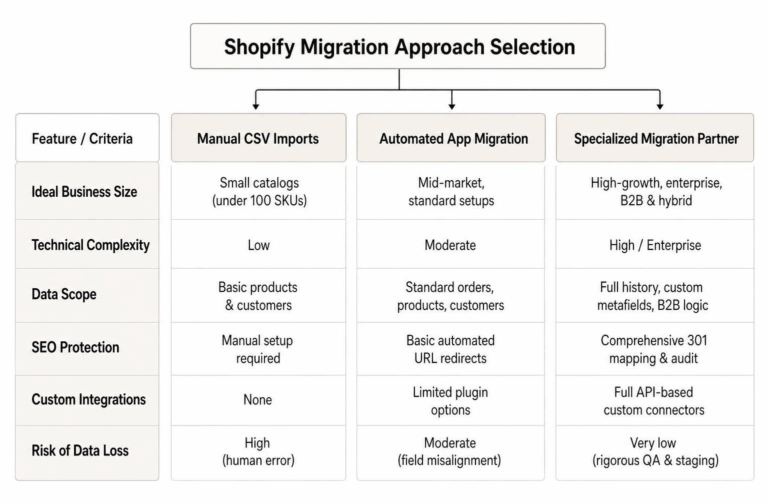
Compare Shopify Migration Services: Options Cheat Sheet
Compare Shopify migration services and find the right Shopify migration company for your store, from manual imports to…
-

Ultimate Checklist for Improving B2B Customer Experience
Ultimate Checklist for Improving B2B Customer Experience – Learn about b2b ecommerce customer experience
-

A Practical Guide to What to Sell Online for Profit
A Practical Guide to What to Sell Online for Profit – Learn about i don t know what…