
Unlock Your Website’s Potential: The Power of CRO On-Page Optimization
Why CRO On-Page Optimization Is the Growth Lever Most Retailers Overlook
CRO on-page optimization is the practice of improving specific elements directly on your web pages — headlines, CTAs, forms, images, and layout — to turn more of your existing visitors into buyers.
Here’s a quick breakdown of what it involves:
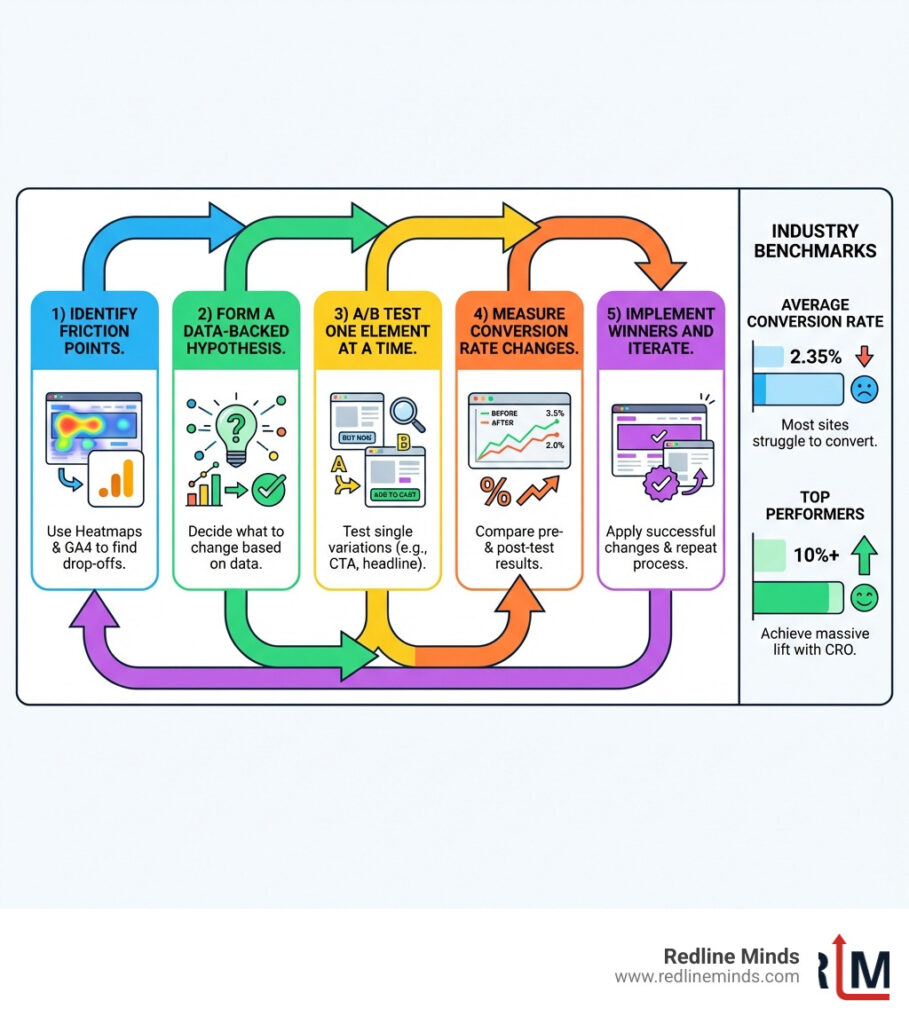
- Identify friction — Find where visitors drop off using heatmaps, session recordings, and analytics
- Form a hypothesis — Decide what to change and why, based on data
- Test changes — Run A/B tests on one element at a time
- Measure results — Compare conversion rates before and after
- Iterate — Apply winners, test again, repeat
The average website converts just 2.35% of visitors into customers. That means roughly 97 out of every 100 people who land on your site leave without buying anything.
For an online retailer doing $1M–$10M in annual sales, that gap is significant. Even a modest improvement — say, moving from 2% to 3% — represents a 50% lift in revenue without spending an extra dollar on ads.
That’s the promise of on-page CRO. And it’s why more mid-sized retailers are paying attention to it right now.
But here’s the problem: most retailers focus almost entirely on driving more traffic. They pour budget into ads and SEO while leaving their product pages, landing pages, and checkout flows largely untouched. The result? A leaky bucket.
Getting traffic is only half the job. Converting it is the other half.
This guide walks you through exactly how to do that — with a practical, step-by-step approach to on-page optimization that’s grounded in data, not guesswork.
The Strategic Intersection of SEO and CRO Onpage
We often hear from clients in Tennessee and beyond who feel like they’re running on a treadmill. They invest heavily in content and backlinks, their rankings climb, their traffic spikes, but their bank balance doesn’t move. Why? Because their SEO and CRO efforts are living in separate silos.
The truth is, SEO and CRO are two sides of the same coin. Think of SEO as the map that brings people to your front door, and cro onpage as the store layout that guides them to the cash register. Without a clear path to purchase, that traffic is just a vanity metric.
When we talk about boosting CRO with on-page strategies, we’re talking about creating a seamless user experience (UX) that satisfies both search engines and human beings. Google loves sites that users love. If a visitor finds exactly what they need and stays on your site to complete a purchase, Google sees that “dwell time” as a massive signal of quality. Conversely, if your page ranks #1 but everyone bounces because the CTA is hidden, your rankings will eventually suffer.
Integrating Conversion Rate Optimization (CRO) into your daily SEO workflow ensures that every click you work so hard to earn actually has a chance to turn into revenue.
Why CRO Onpage is the Missing Link in Your SEO Strategy
Search intent is the secret sauce here. If a user searches for “heavy-duty industrial shelving” (a common B2B query for our hybrid store clients), they have a very specific expectation. If they land on a page that talks vaguely about “storage solutions” without showing the rugged, steel specs they need, they’ll leave.
This is what we call “Message Matching.” It’s the art of ensuring the “pre-visit context”—the ad they clicked or the search result they saw—perfectly aligns with the landing page. According to On-page CRO: what is it and how to do it right, failing to match that message is one of the fastest ways to spike your bounce rate.
By focusing on cro onpage, we aren’t just guessing what users want; we’re using their search intent to dictate our page design. This alignment reduces friction and makes the “yes” much easier for the customer.
On-Page vs. General CRO: What’s the Difference?
While general CRO might look at your entire business model, email funnels, or pricing structures, cro onpage is a surgical strike. It focuses exclusively on the elements living on a specific URL.
According to Optimizely, general CRO is the broad process of increasing the percentage of visitors who take a desired action. CRO onpage, however, gets into the weeds of page-specific friction. It asks:
- Is the headline clear enough?
- Is the form too long?
- Does the mobile menu block the “Buy” button?
We look for “micro-conversions”—small wins like clicking a “Specifications” tab or watching a product video—that eventually lead to the macro-conversion (the sale).
A Step-by-Step Framework for On-Page Optimization
You wouldn’t build a house without a blueprint, and you shouldn’t do CRO without a process. Ad-hoc testing (like changing a button color because you feel like it) is a waste of time. We recommend a structured approach to ensure your results are statistically significant.
First, you must establish baseline metrics. What is your current conversion rate? What is the average time on page? Once you have these, you can set SMART goals (Specific, Measurable, Attainable, Relevant, and Time-bound). For example: “Increase demo sign-ups on the product page by 15% over the next 30 days.”
Before you flip any switches, you need to run some tests to highlight exactly where people are struggling. Your analytics will tell you what is happening, but user testing tells you why.
Identifying Friction Points with Data Analysis
To fix a leaky bucket, you first have to find the holes. We use a mix of quantitative and qualitative data to spot friction.
- GA4 (Google Analytics): Use Google Analytics to identify high-traffic pages with high exit rates. If 80% of people leave on the shipping info page, you’ve found a major bottleneck.
- Heatmaps: Tools like Hotjar or Microsoft Clarity show you where people are clicking (and where they aren’t). Are they clicking an image that isn’t a link? That’s friction.
- Session Recordings: Watching a user struggle to find the “Checkout” button on a mobile device is a “lightbulb moment” for most store owners.
Developing and Testing Your CRO Onpage Hypothesis
Once you’ve identified a problem, you form a hypothesis. A good hypothesis looks like this: “By reducing the number of form fields from six to three, we will increase lead submissions because we are reducing the cognitive effort required.”
To prioritize these ideas, we use the P.I.E. Framework:
- Potential: How much improvement can this page realistically see?
- Importance: How valuable is the traffic to this page?
- Ease: How difficult is it to implement this test?
From there, you can move into A/B testing, where you show Version A to half your visitors and Version B to the other half. For more complex pages, multivariate testing allows you to test multiple elements (like a headline and an image) simultaneously to see which combination wins.
Optimizing High-Impact On-Page Elements
Not all elements are created equal. If you want to see a real lift in your cro onpage results, you need to focus on the “Big Three”: Headlines, CTAs, and Forms.
In our experience with Perfect Product Page Design, we’ve found that visual hierarchy is everything. Users don’t read; they scan. If your most important information isn’t scannable within three seconds, you’ve lost them.
Crafting Headlines and Value Propositions that Convert
Your headline is your first (and sometimes only) chance to grab attention. Instead of focusing on features, focus on benefits.
Research shows that introducing action-oriented language can increase conversions by a staggering 93%. For example, instead of “Our software has project management features,” try “Manage your projects stress-free and meet every deadline.”
A clear value proposition answers one question: “Why should I buy from you instead of your competitor?” If your value prop is buried at the bottom of the page, your cro onpage efforts will fail. Keep it above the fold, clear, and jargon-free.
Designing High-Performance CTAs and Forms in CRO Onpage
The “Call to Action” is the bridge between a visitor and a customer. One of the most famous case studies in our industry is the 300-million-dollar button. By simply changing a button from “Register” to “Continue,” an e-commerce giant saw a massive revenue spike because they removed the psychological barrier of “creating an account.”
When Building Great Landing Pages, follow these CTA best practices:
- Contrast: Use a color that stands out from the rest of the page.
- Action Verbs: Use “Get My Quote” instead of “Submit.”
- Proximity: Place your CTA near the most persuasive part of your copy.
For forms, less is almost always more. A SaaS company once found that reducing their form from six fields to just one (work email) drastically improved their demo sign-up rate. If you don’t need their phone number or zip code right now, don’t ask for it.
Technical and Psychological Levers for Growth
Beyond the visible elements, there are “invisible” factors that can make or break your conversion rate. These include technical performance and the psychological triggers you use to nudge users toward a decision.
Enhancing Page Speed and Mobile Usability
In cro onpage, speed is a feature. Research shows that a mere 1-second delay in page load time can reduce conversions by 7%. For a high-traffic store, that’s a fortune left on the table.
Walmart found that for every 1-second improvement in load time, their conversions increased by 2%. We always tell our Tennessee clients to focus on Page Load Speed as a foundational CRO tactic. This includes:
- Image Compression: Use WebP or AVIF formats.
- Minifying Code: Clean up bloated CSS and JavaScript.
- Mobile First: Ensure buttons are “thumb-friendly” and text is readable without zooming.
Leveraging Social Proof and Urgency
Humans are social creatures. We look to others to see what is safe or popular. This is why social proof—reviews, testimonials, and trust badges—is so powerful.
One European e-commerce store improved their revenue per user by 9.1% simply by showing real-time social proof messages like “15 people just bought this product.”
Other psychological levers include:
- Urgency: “Only 3 left in stock!” or “Sale ends in 2 hours.”
- Authority: Displaying industry awards or “As Seen On” logos.
- Risk Reversal: “30-day money-back guarantee” or “Free returns.”
Measuring and Benchmarking Your Conversion Success
You cannot manage what you do not measure. To run a successful cro onpage program, you need to track your results against industry standards and your own historical data.
Essential Tools for On-Page CRO Analysis
You don’t need a massive budget to start, but you do need the right stack. Here are some of our favorite 27 Conversion Optimization Tools:
- Testing Platforms: VWO, Optimizely, or AB Tasty for running experiments.
- Behavioral Tools: Hotjar or Lucky Orange for heatmaps and recordings.
- Analytics: GA4 for quantitative funnel tracking.
- Calculators: Always use an A/B test significance calculator to ensure your results aren’t just due to chance.
Setting KPIs and Industry Benchmarks
What does “success” look like? While website conversion rates typically fall between 2% and 5%, this varies wildly by industry. For instance, the average lead conversion rate across 14 industries is roughly 2.9%.
Don’t get discouraged if your numbers look low initially. The goal of cro onpage is continuous improvement. If you start at 2% and reach 2.5%, you’ve just increased your revenue by 25% with the same amount of traffic. That is a massive win for any business.
| Metric | Industry Average | Target for “Good” |
|---|---|---|
| Ecommerce Conversion Rate | 2.35% | 5% + |
| B2B Lead Gen Rate | 2.9% | 10% + |
| Page Load Time | 3.2 Seconds | < 2 Seconds |
| Cart Abandonment | 69.9% | < 60% |
Frequently Asked Questions about On-Page CRO
What is the difference between on-page and off-page CRO?
On-page CRO focuses on elements directly on your website (headlines, buttons, speed). Off-page CRO looks at factors outside your site, such as your ad copy on Google or Facebook, your email marketing sequences, or your presence on third-party marketplaces. Both are important, but on-page is where the final decision is usually made.
How long does it take to see results from on-page optimization?
It depends on your traffic. If you have 100,000 visitors a month, you can reach statistical significance in an A/B test in a matter of days. If you have 1,000 visitors, it might take several weeks. Generally, you should run a test for at least two full business cycles (usually two weeks) to account for variations in weekday vs. weekend behavior.
What are the most common on-page mistakes that hurt conversions?
The “Big Three” mistakes we see are:
- Lack of Clarity: Not telling the user exactly what to do next.
- Slow Load Times: Losing users before the page even renders.
- Too Much Friction: Asking for too much information in forms or having a confusing navigation menu.
Conclusion
At Redline Minds, we’ve spent years helping B2B and hybrid ecommerce stores in Tennessee and across the country turn their websites into high-performing sales machines. We know that cro onpage isn’t just a “nice-to-have”—it’s the foundation of sustainable organic growth.
Whether you’re looking to establish a new online sales channel or optimize an existing one, our team specializes in the strategic intersection of SEO, UX/UI design, and web development. We help you move beyond just “getting traffic” and start focusing on “getting results.”
Ready to stop leaving money on the table? Unlock your growth potential with expert conversion optimization and let’s build a strategy that reflects the ambition of your business.
Share this article
Tap into years of experience and turn your site’s visitors into buyers.
Related Posts
-
Compare Shopify Migration Services: Options Cheat Sheet
Compare Shopify migration services and find the right Shopify migration company for your store, from manual imports to…
-

Ultimate Checklist for Improving B2B Customer Experience
Ultimate Checklist for Improving B2B Customer Experience – Learn about b2b ecommerce customer experience
-

A Practical Guide to What to Sell Online for Profit
A Practical Guide to What to Sell Online for Profit – Learn about i don t know what…