
A Practical Guide to Inventory Control for Ecommerce Basics

Why Inventory Control for Ecommerce Protects Profit and Cash Flow
Inventory control for ecommerce means knowing exactly what you have, where it is, what it costs, and when to reorder it. Start by tracking every SKU in real time, setting reorder points with safety stock, and checking stock levels across every sales channel. These basics help prevent stockouts, overselling, and cash getting trapped in products that do not sell.
For a growing online retailer, inventory is not just warehouse stock. It is working capital in physical form. Buy too much, and cash sits on shelves while storage, handling, and markdown costs grow. Buy too little, and customers see unavailable items, orders get canceled, and sales go to competitors.
This is a widespread problem. Online stores average an 8% out-of-stock rate while often carrying 20% to 30% more stock than they need. The goal is not to hold the most inventory. It is to hold the right inventory at the right time.
In this guide, you will learn how to build practical controls around forecasting, reorder points, SKU priorities, inventory accuracy, and financial reporting. The result is better fulfillment, clearer margins, and more cash available to invest in growth.
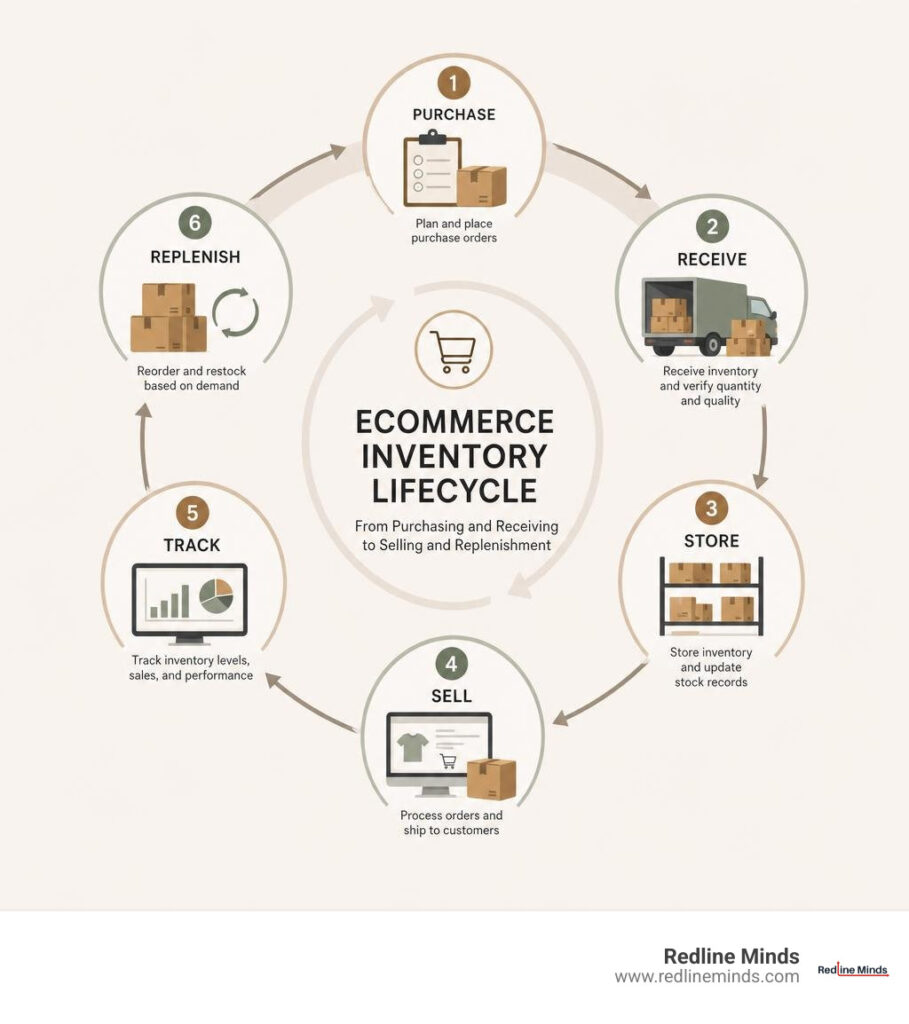
Core Fundamentals of Inventory Control for Ecommerce
At its heart, inventory control is the operational machinery that keeps your physical goods aligned with digital storefront records. When you are building or scaling an online business, mastering stock movements is just as critical as your customer acquisition strategy. A solid foundation in what is ecommerce comprehensive guide online retail demonstrates that sustainable growth relies heavily on back-office operational precision.

Without strict controls, small errors compound. A miscounted carton during receiving becomes an oversold product on your website three weeks later. An untracked return turns into phantom inventory that sits on a shelf unseen by shoppers. Implementing perpetual inventory tracking ensures every purchase, sale, return, and warehouse transfer updates automatically across all records.
Why Inventory Distortion Harms Cash Flow
Inventory distortion—the combined cost of holding excess merchandise and losing sales to out-of-stock items—costs retailers $1.77 trillion annually across the globe. For ecommerce brands alone, inventory distortion generates an estimated $818 billion in annual losses.
This financial hit breaks down into two distinct problems:
- Stockouts (56% of distortion cost): When an item runs out, you lose the immediate sale, waste the advertising dollars spent acquiring the shopper, and risk losing lifetime customer loyalty.
- Overstock (44% of distortion cost): Excess items tie up liquidity, rack up storage and handling fees, and often end in deep clearance markdowns or total write-offs.
Effective inventory control can reduce overall operational costs by 20% to 30%. By balancing stock levels to real customer demand, you keep cash flowing freely through your business rather than trapping it in depreciating products.
Key Differences Between Inventory Management and Control
While people often use the terms interchangeably, inventory management and inventory control serve two distinct operational purposes:
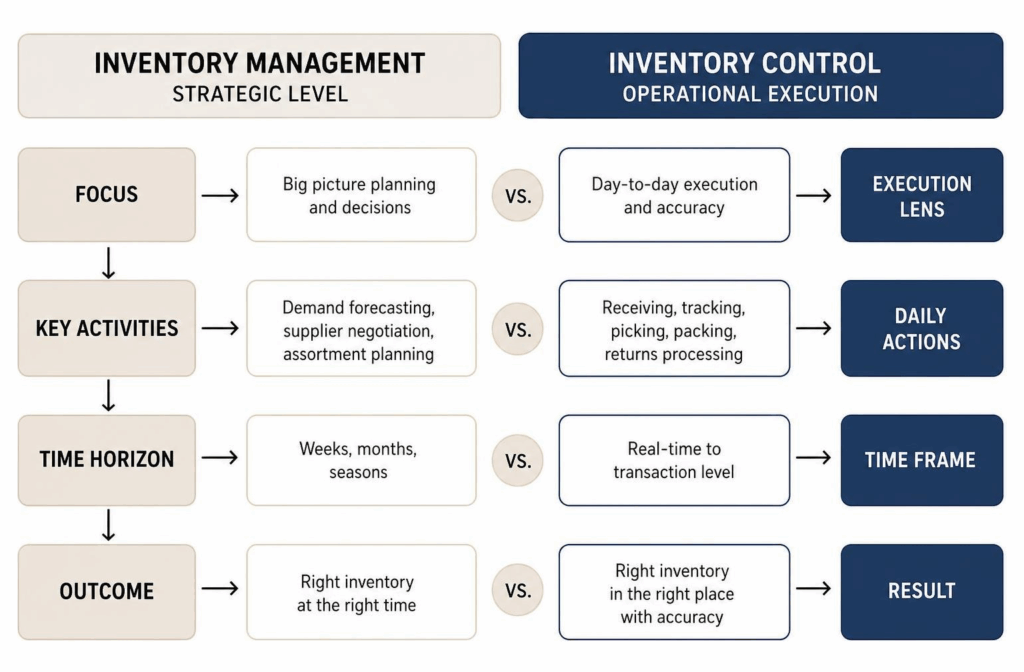
- Inventory Management (Strategic Level): Focuses on the big picture. It encompasses high-level supply chain planning, aggregate demand forecasting, supplier negotiation, and deciding which product categories to launch or discontinue.
- Inventory Control (Operational Execution): Focuses on daily warehouse and catalog mechanics. It involves receiving stock, tracking lot and bin numbers, managing product variations, auditing counts via barcode scanners, and processing returns.
You need both. High-level planning determines what to order for upcoming seasons, while granular control guarantees that units arriving at the loading dock match purchase orders and reach customer doorsteps without error.
Essential Strategies to Optimize Stock Levels
Balancing supply and demand requires structured inventory formulas rather than guesswork. When managing both direct-to-consumer catalogs and wholesale channels, pairing proper inventory practices with effective shipping management allows you to maintain tight order fulfillment windows while keeping inventory holding costs minimal.
To manage stock across various channels without headaches, brands often rely on Multi-channel inventory sync. platforms to automate stock allocation. Let’s look at the operational strategies that keep stock healthy.
Setting Reorder Points and Safety Stock in Inventory Control for Ecommerce
A reorder point (ROP) tells you exactly when to issue a new purchase order to your supplier so you do not run out of stock before the new shipment arrives.
To calculate your ROP, use this standard formula:
$$\text{Reorder Point} = (\text{Average Daily Unit Sales} \times \text{Lead Time in Days}) + \text{Safety Stock}$$
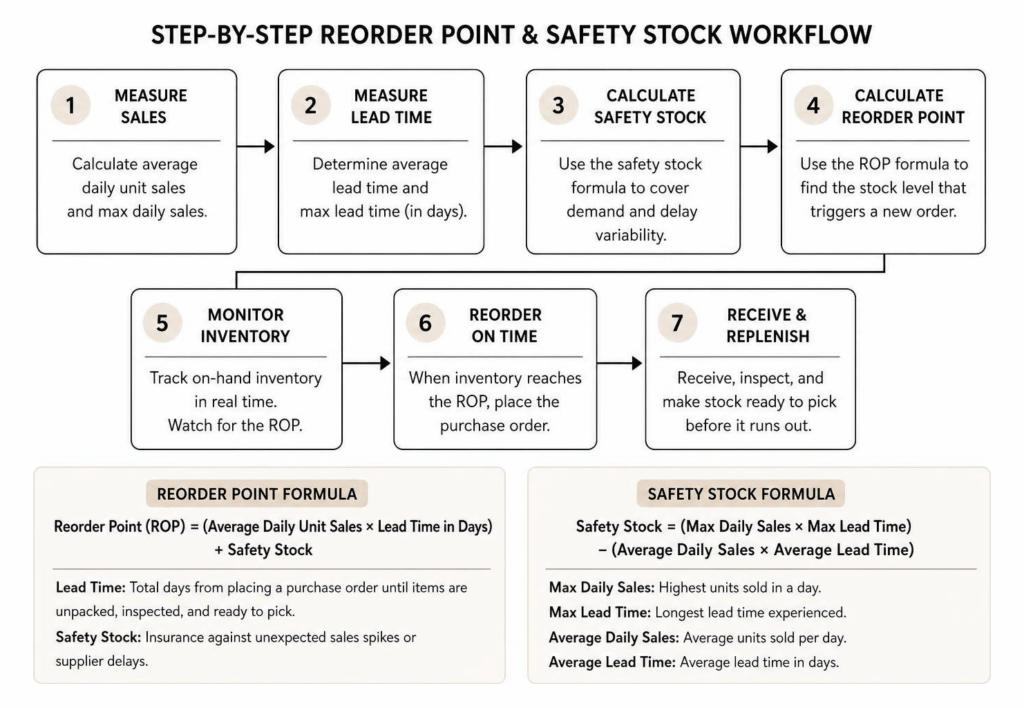
Lead time is the total number of days from placing a purchase order until the items are unpacked, inspected, and ready to pick in your warehouse.
Safety stock serves as an insurance policy against unexpected sales spikes or supplier delays. A reliable safety stock baseline formula is:
$$\text{Safety Stock} = (\text{Max Daily Sales} \times \text{Max Lead Time}) – (\text{Average Daily Sales} \times \text{Average Lead Time})$$
By calculating these thresholds per SKU, your replenishment shifts from subjective guessing to automated precision.
ABC Analysis and Demand Forecasting Models
Not all products contribute equally to your revenue. ABC analysis applies the Pareto principle (the 80/20 rule) to classify items by revenue impact, allowing you to prioritize management time and working capital where it matters most.
| Tier | % of Total SKUs | % of Total Revenue | Management Strategy |
|---|---|---|---|
| A Items | 10% – 20% | 70% – 80% | Tightest control, frequent cycle counts, daily velocity tracking, priority replenishment |
| B Items | 20% – 30% | 15% – 25% | Moderate control, standard safety stock, automated bi-weekly reorder reviews |
| C Items | 50% – 70% | 5% – 10% | Low-touch control, periodic audits, minimal safety buffers, periodic bulk ordering |
Pairing ABC classification with forward-looking demand forecasting prevents stock imbalances. Effective demand forecasting models combine historical sales patterns, seasonal trends, marketing campaign plans, and supplier lead times. Implementing formal forecasting can improve overall forecast accuracy by 10% to 20% and reduce excess inventory holdings by up to 10%.
Preventing Dead Stock and Excess Holding Costs
Dead stock refers to unsold inventory that sits in your warehouse for months with little to no customer demand. It consumes physical space, raises insurance premiums, and freezes operating capital.
To catch and resolve slow-moving inventory before it turns into dead stock:
- Set early-warning velocity triggers: Configure system alerts when an item’s sell-through rate drops below 50% over a 30-day window.
- Bundle slow items with high-velocity heroes: Pair a slower accessory with an “A-Tier” core item at a slight discount.
- Run limited-time flash sales: Liquidate excess items to recapture capital, even if sold near cost.
- Negotiate vendor returns: Work with suppliers on return-to-vendor (RTV) agreements for unopened case packs in exchange for credit on high-demand lines.
Critical Financial Metrics and KPIs to Track
Tracking operational counts is only half the battle; inventory control directly dictates balance sheet strength and profitability. Using specialized tools like Inventory Control Software: Stock, Costs & POs | Fuse Inventory helps tie physical inventory movements directly to financial ledgers, ensuring accurate margin tracking across all product lines. As you scale running your online store, these financial metrics will show you exactly where to optimize.
Inventory Turnover and Days Sales of Inventory
Inventory Turnover measures how many times your business sells and replaces its stock over a given period (typically one year). A higher ratio indicates strong sales velocity and efficient stock holding, while a low ratio points to overstocking.
$$\text{Inventory Turnover Rate} = \frac{\text{Cost of Goods Sold (COGS)}}{\text{Average Inventory Value}}$$
Days Sales of Inventory (DSI), also called Days Inventory Outstanding (DIO), converts that turnover rate into the average number of days it takes to turn physical inventory into sales:
$$\text{DSI} = \left(\frac{\text{Average Inventory Value}}{\text{COGS}}\right) \times 365$$
Most healthy ecommerce brands aim for a turnover rate between 4 and 8, meaning inventory clears and replenishes every 45 to 90 days.
Cash Conversion Cycle and Landed Cost Calculations
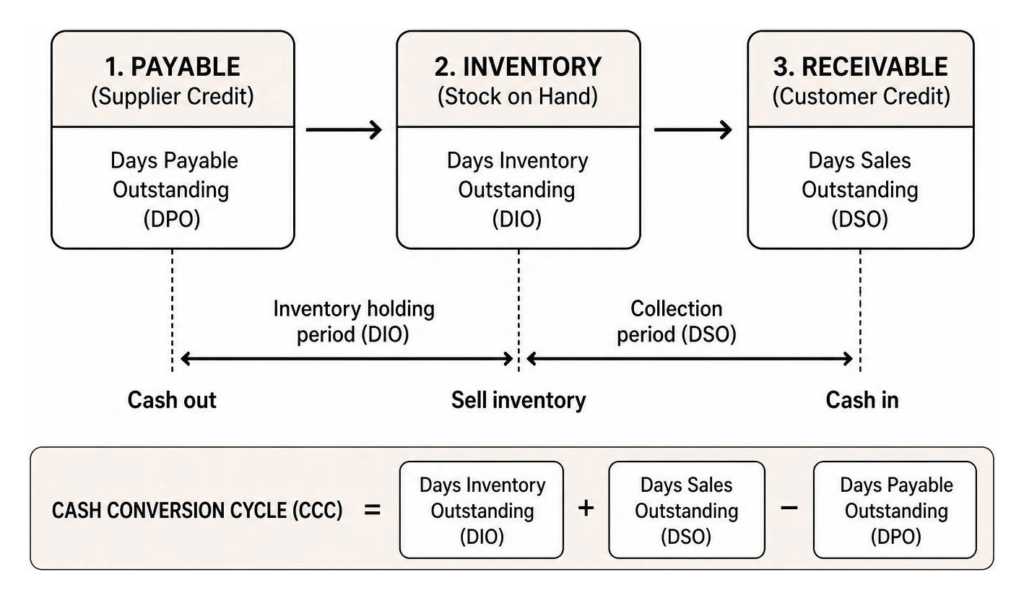
The Cash Conversion Cycle (CCC) measures the time (in days) it takes for invested capital to travel from purchasing inventory to collecting cash from customer orders:
$$\text{CCC} = \text{Days Inventory Outstanding (DIO)} + \text{Days Sales Outstanding (DSO)} – \text{Days Payable Outstanding (DPO)}$$
Shortening your CCC frees up cash to reinvest in growth without needing outside debt or equity.
Accurate financial reporting also relies on calculating true Landed Costs rather than just unit purchase prices. Landed cost incorporates every expense required to get an item onto your shelf:
$$\text{Landed Cost} = \text{Unit Purchase Price} + \text{Freight} + \text{Customs & Tariffs} + \text{Port Handling} + \text{Insurance} + \text{Inbound Processing}$$
Using the First-In, First-Out (FIFO) inventory valuation method ensures that your Cost of Goods Sold reflects the true acquisition costs of your oldest stock first, keeping gross margins accurate during periods of fluctuating supply chain expenses.
Technology and Automation in Modern Warehouse Operations
Manual spreadsheets might work when managing fifty SKUs out of a garage, but scaling an online catalog requires automation. Digital inventory controls connect your digital storefront, warehouse operations, and returns pipelines into a unified system.
Clear warehouse operations directly improve post-purchase satisfaction. Because clear shipping and return policies influence sales, maintaining accurate real-time inventory counts ensures you fulfill delivery promises without delays. Furthermore, when you streamline reverse logistics to increase sales with good return policy, returned merchandise is quickly inspected, re-stocked, and made available for purchase again.

Multi-Channel Synchronization and Buffer Management
If you sell across multiple channels (such as a direct Shopify store, Amazon, Walmart, and a B2B portal), maintaining separate inventory counts invites stockouts and overselling.
A centralized control system maintains a single master stock level and distributes available quantities dynamically:
- Event-Driven Syncing: Pushes inventory updates instantly across all channels whenever an order is placed anywhere.
- Channel Safety Buffers: Hides a small percentage of stock on marketplaces with strict fulfillment penalties (e.g., showing 45 units available on Amazon when you actually have 50 in stock).
- Wholesale Allocation Reserves: Quarantines bulk inventory for scheduled B2B purchase orders so high-volume retail sales do not consume contracted stock.
Choosing Software for Inventory Control for Ecommerce
When evaluating inventory control software, look for platforms that integrate seamlessly with your existing tech stack and operational workflows:
- Real-Time Bi-Directional Synchronization: Automatically aligns catalog quantities across all storefronts, marketplaces, and warehouse locations.
- Automated Landed Cost & COGS Tracking: Calculates freight, customs, and component costs directly inside your financial reports.
- Purchasing & Supplier Workflows: Generates purchase orders based on automated reorder point alerts and tracks partial receipts.
- Multi-Location & Transfer Management: Tracks inventory movements across multiple warehouses, retail storefronts, and third-party logistics (3PL) partners.
- Accounting & ERP Integrations: Syncs inventory asset values and cost of goods sold with platforms like QuickBooks, Xero, or NetSuite for seamless reconciliation.
Barcode Scanning and Perpetual Inventory Systems
Paper pick lists and manual data entry frequently introduce fulfillment errors. Implementing wireless barcode scanners and perpetual inventory tracking resolves data inaccuracies at the source.
- Receiving Audits: Scanning incoming boxes instantly verifies received items against the original purchase order, flagging damaged goods or missing units right away.
- Pick and Pack Verification: Scanners direct pickers along optimized warehouse paths and confirm each SKU before packing, preventing wrong-item shipments.
- Cycle Counting: Instead of shutting down operations for a grueling annual physical count, warehouse staff can perform daily cycle counts on small batches of SKUs to keep inventory accuracy above 99%.
Frequently Asked Questions About Inventory Control
What is the 80/20 rule in inventory management?
The 80/20 rule, or Pareto principle, states that roughly 80% of your total business revenue comes from just 20% of your product catalog. In inventory control, this concept forms the basis of ABC analysis. It helps you focus your time, safety buffers, and capital on your highest-performing products while avoiding over-investment in slow-moving items.
How do stockouts and overstock impact working capital?
Both scenarios drain your available cash. Overstocking ties up liquid capital on warehouse shelves, while adding storage fees and increasing the risk of product obsolescence. Stockouts leave that capital waiting on the sidelines, while actively turning away paying customers, wasting ad spend, and lowering your brand’s marketplace rankings.
How often should an online store conduct inventory audits?
Rather than relying solely on a disruptive annual physical count, best practices favor continuous cycle counting. High-value “A-Tier” products should be counted weekly or monthly, while lower-velocity “C-Tier” items can be checked quarterly. Spot checks should also be performed whenever a picker flags a quantity discrepancy in a specific bin.
Conclusion
Mastering inventory control transforms your stock from a potential balance-sheet risk into a scalable operational asset. By establishing real-time tracking, automating reorder points, prioritizing high-velocity SKUs through ABC analysis, and connecting your warehouse workflows directly to financial ledgers, you protect gross margins and keep working capital moving smoothly.
If you are expanding into multi-channel fulfillment, launching hybrid B2B operations, or upgrading your tech stack, choosing the right operational tools is essential. Review our breakdown of the best e-commerce inventory control options to identify the right system architecture for your store. At Redline Minds, we work with ambitious retailers to build robust ecommerce strategies, conversion-focused storefronts, and seamless operational integrations that support sustainable, profitable growth.
Share this article
Tap into years of experience and turn your site’s visitors into buyers.
Related Posts
-
Compare Shopify Migration Services: Options Cheat Sheet
Compare Shopify migration services and find the right Shopify migration company for your store, from manual imports to…
-

Ultimate Checklist for Improving B2B Customer Experience
Ultimate Checklist for Improving B2B Customer Experience – Learn about b2b ecommerce customer experience
-

A Practical Guide to What to Sell Online for Profit
A Practical Guide to What to Sell Online for Profit – Learn about i don t know what…