
CRO Optimization 101: How to Win at Digital Marketing
What Is CRO in Marketing? (Quick Answer)
What is cro in marketing is one of the most searched questions among online retailers trying to grow — and the answer is simpler than you might think.
CRO stands for Conversion Rate Optimization. It is the process of increasing the percentage of website visitors who take a desired action — like making a purchase, signing up for an email list, or requesting a quote — without needing to drive more traffic.
Here’s what that means at a glance:
| Term | What It Means |
|---|---|
| CRO | Conversion Rate Optimization |
| Conversion | Any action you want a visitor to take |
| Conversion Rate | % of visitors who complete that action |
| Optimization | Systematically testing and improving your site to increase that % |
The formula is straightforward:
(Total Conversions ÷ Total Visitors) × 100 = Conversion Rate
So if 2,000 people visit your store and 40 buy something, your conversion rate is 2%.
Here’s why this matters for a growing online retailer: most businesses pour budget into ads and SEO to get more traffic. But if your site isn’t converting that traffic well, you’re leaving serious money on the table — every single day.
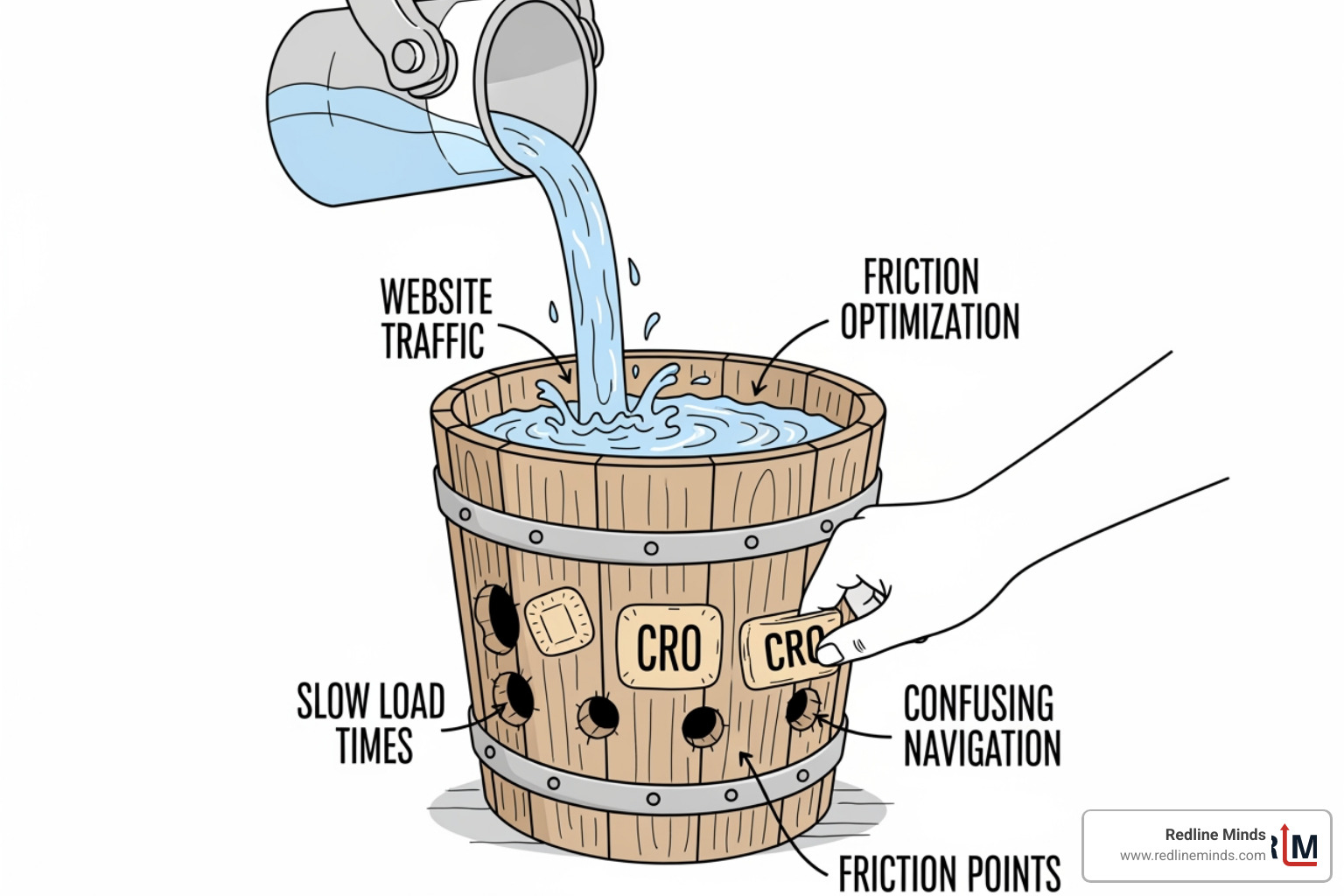
Think of it like a leaky bucket. You can keep pouring more water in (traffic), or you can fix the holes (optimize conversions). CRO fixes the holes.
Even a modest improvement makes a real difference. Moving from a 2% to a 3% conversion rate on a site with 10,000 monthly visitors means 100 extra sales per month — with zero extra ad spend.
That’s the core promise of CRO: work smarter with the traffic you already have.
What is CRO in Marketing and Why Does It Matter?
When we talk about what is cro in marketing, we are looking at the ultimate “work smarter, not harder” strategy. In the early days of the internet, simply having a website was enough. Today, the digital landscape is incredibly crowded. Whether you are running a B2B operation or a hybrid store, you are competing for the limited attention of users who are often one click away from leaving.
At its heart, Conversion Rate Optimization (CRO) is about understanding the human beings behind the clicks. It’s a blend of data science and psychology. By analyzing how people interact with your site, we can identify where they get confused, where they get bored, and what finally pushes them to hit that “Buy Now” button.
The research on the importance of CRO in modern digital presence shows that while traffic is a vanity metric, conversions are a sanity metric. You can have a million visitors, but if none of them convert, your business won’t survive. CRO ensures that your digital strategy isn’t just about “eyes on the page” but about meaningful customer experiences that drive growth.
Defining the Conversion
Not every conversion is a sale. In fact, if you only track sales, you’re missing the bigger picture. We generally categorize conversions into two types:
- Macro-Conversions: These are your primary goals. For an ecommerce site, this is a completed transaction. For a B2B site, it might be a request for a quote or a demo.
- Micro-Conversions: These are the smaller steps that lead up to the big win. Think of these as “breadcrumbs.” Examples include:
- Signing up for a newsletter.
- Creating an account.
- Adding a product to a wishlist or cart.
- Downloading a whitepaper or buyer’s guide.
- Spending a certain amount of time on a key landing page.
By tracking micro-conversions, we can see exactly where the “leaks” in your bucket are occurring. If everyone is adding items to the cart but nobody is checking out, the problem isn’t your product—it’s your checkout process.
The Business Impact of Optimization
The beauty of CRO is that its benefits compound over time. When we improve the revenue per session, we aren’t just making more money today; we are making our entire marketing spend more efficient.
Lowering your Customer Acquisition Cost (CAC) is a major byproduct of a good CRO strategy. If it costs you $10 in ads to get 100 people to your site, and 1 person buys, your CAC is $10. If you optimize your site so that 2 people buy from those same 100 visitors, you’ve effectively cut your CAC in half to $5.
Beyond the numbers, CRO builds brand affinity. No customer ever complained that a website was too easy to use or that the checkout was too fast. A smooth, intuitive experience tells the customer that you value their time. You can find more info about conversion optimization services to see how these strategies translate into long-term loyalty for B2B and retail brands alike.
The Math Behind the Magic: Calculating Your Conversion Rate
To win at what is cro in marketing, you have to embrace the data. While the basic formula is simple, the insights come from segmenting that data. You might have a 3% conversion rate on desktop but only 0.5% on mobile. That tells you exactly where your focus needs to be.
According to the textbook Conversion Optimization: The Art and Science of Converting Prospects to Customers, calculating your rate is the starting line, not the finish line. You need to look at your “Total Visitors” and “Total Conversions” over a specific timeframe—usually a month—to get a reliable baseline.
Benchmarking Success for what is cro in marketing
We often get asked, “What is a good conversion rate?” The honest answer is: better than what you had last month.
However, looking at industry standards can give you a reality check. In the ecommerce world, average conversion rates usually hover between 2% and 5%. If you’re in the finance or professional services sector, those rates can climb as high as 10% or even 24% because the intent of the visitor is often much higher.
If your ecommerce site is sitting at 1%, don’t panic. It just means you have a massive opportunity for growth. Highly successful marketing campaigns can achieve conversion rates of 14% or more by aligning the offer perfectly with the audience’s needs.
Core Elements of a High-Converting Website
If you want to optimize your site, you can’t just throw things at the wall and see what sticks. We like to use a structured approach, often visualized as a hierarchy.
At the base of the pyramid is functionality. If your “Add to Cart” button is broken, no amount of pretty copywriting will save you. As you move up, you focus on things like your value proposition. This is the “Why should I buy from you and not the other guy?” statement. It needs to be clear, bold, and visible within seconds of a page loading.
Trust signals and social proof are also non-negotiable. This includes customer reviews, testimonials, and security badges. For our B2B clients, this might also mean displaying logos of well-known companies you’ve worked with. These elements reduce the “perceived risk” of the purchase. To stay ahead, you can check out these Live Event Hot Conversion Tools That You Probably Don’t Know About which help automate the display of social proof in real-time.
Optimizing Your Call-to-Action (CTA) for what is cro in marketing
The CTA is the “moment of truth.” It’s the point where a visitor decides to become a lead or a customer. Small changes here can lead to big results.
- Button Color: There is no “magic” color, but contrast is key. If your site is mostly blue, a bright orange or green button will pop.
- Action-Oriented Copy: Instead of “Submit,” try “Get My Free Quote” or “Start My Trial.” Use verbs that imply a benefit.
- Placement: Your primary CTA should be “above the fold” (visible without scrolling), but you should also have CTAs further down the page for people who need more information before deciding.
Using heatmap tools for tracking CTA performance allows us to see exactly where users are clicking—and more importantly, where they aren’t. If people are clicking on an unlinked image thinking it’s a button, that’s a clear signal to make that image a CTA.
Reducing Friction and Improving Page Speed
Friction is anything that prevents a user from moving forward. It could be a confusing menu, a form with too many fields, or a slow-loading page.
Google’s shift to mobile-first indexing means that if your mobile site is slow or clunky, you’re losing both SEO rankings and conversions. Research on how page load lag decreases conversions suggests that every additional second of load time can result in a 7% drop in conversions.
For ecommerce managers, ensuring 508 compliance is also crucial. Accessibility isn’t just a legal requirement; it’s good business. Making your site usable for everyone—including those with visual or motor impairments—expands your potential customer base.
The Strategic CRO Process: From Research to Results
We don’t believe in “best practices” as a final solution. What works for a clothing retailer might fail miserably for a B2B industrial supplier. That’s why we follow a systematic process.
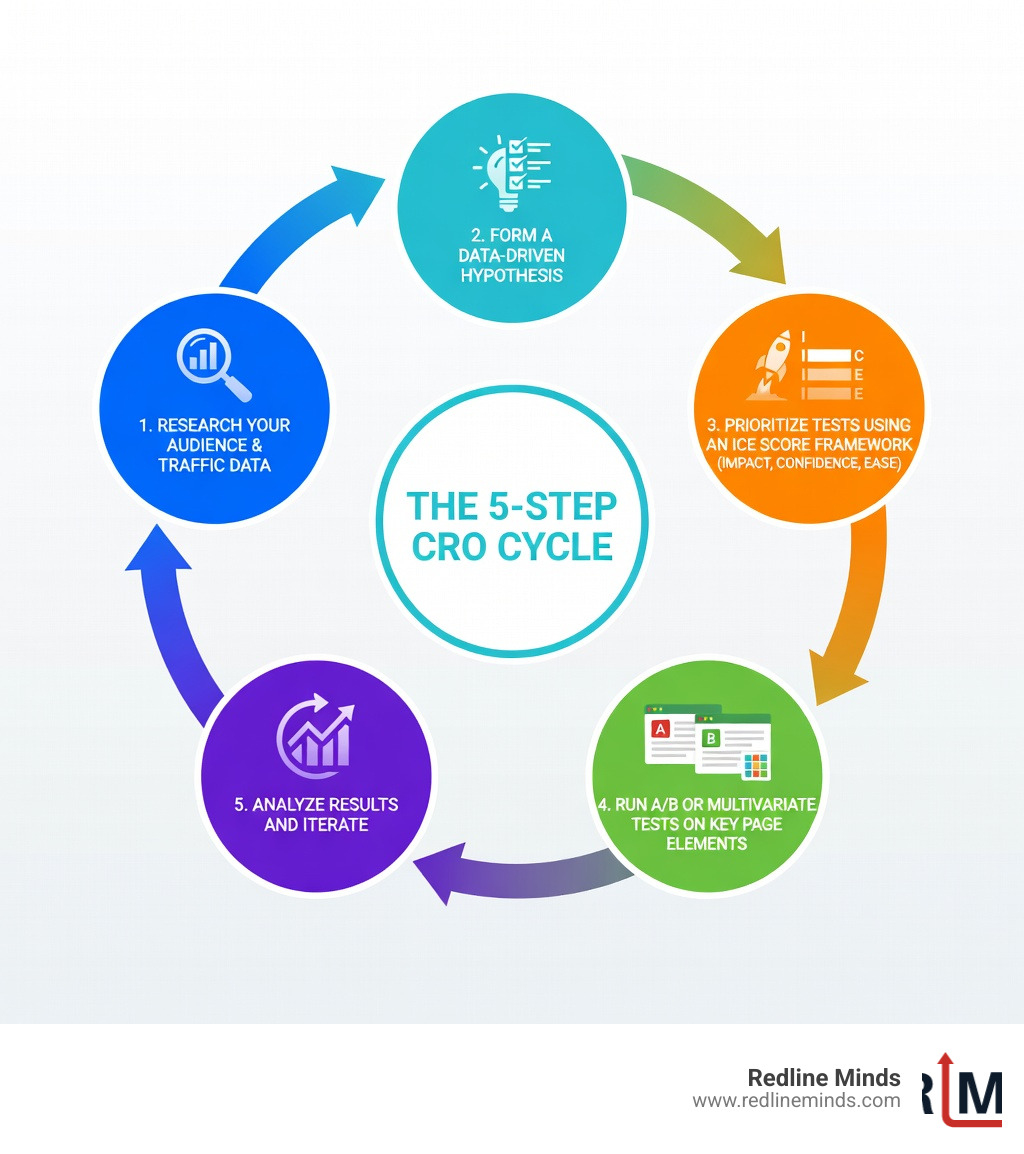
The process starts with data-driven insights. We look at Google Analytics 4 (GA4) to see where people are dropping off. We use session recordings to watch how users navigate. This qualitative research is vital because it answers the “why” behind the “what.” Once we have the data, we can use these 27 Conversion Optimization Tools to start building our tests.
Developing a Data-Driven Hypothesis for what is cro in marketing
A hypothesis isn’t a guess. It’s a structured statement: “Because we observed [X], we believe that changing [Y] will result in [Z].”
To decide what to test first, we use the ICE scoring framework:
- Impact: How much will this change improve the conversion rate?
- Confidence: How sure are we that this will work?
- Ease: How difficult or expensive is it to implement this change?
By multiplying these scores, we get a clear priority list. This prevents us from wasting time on low-impact tweaks. You can follow this framework for forming a testing hypothesis to keep your own team organized.
When running tests, we look for statistical significance. This is a fancy way of saying we want to be 95% sure that the results weren’t just a fluke. We recommend using A/B testing platforms for calculating significance so you don’t have to do the heavy math yourself.
Testing Methodologies
There are several ways to test your hypotheses:
- A/B Testing: You show two versions of a page to similar visitors at the same time and see which one performs better.
- Multivariate Testing (MVT): You test multiple elements on a single page simultaneously to see which combination is the winner.
- Split URL Testing: You test two completely different designs on different URLs.
- Qualitative Research: This involves user interviews or surveys to get direct feedback from your audience.
Advanced Techniques: AI and Personalization in CRO
The future of what is cro in marketing lies in personalization. Modern AI tools allow us to segment visitors based on their behavior in real-time.
For example, if a visitor has looked at three different B2B software packages on your site, AI can automatically change the homepage banner to show a comparison chart of those specific products. This kind of predictive segmentation makes the user feel like the site was built just for them.
The statistics on revenue growth from personalization are staggering, with some businesses seeing a 5% to 15% lift in total revenue. For hybrid stores that serve both retail and wholesale clients, personalization is essential. You can serve different pricing, different shipping options, and even different product catalogs based on the user’s login credentials or browsing history.
Frequently Asked Questions about CRO
What is a good conversion rate for my industry?
While it varies, ecommerce usually sits around 2-3%. B2B lead generation can be much higher, often 5-10%. The best benchmark is your own past performance. If you are improving, you are winning.
How long should I run an A/B test?
Generally, you should run a test for at least two full weeks to account for variations in weekend vs. weekday behavior. However, the real answer depends on your traffic volume; you need enough data to reach statistical significance (usually 95% or higher).
What is the difference between CRO and SEO?
SEO (Search Engine Optimization) is about getting people to your website. CRO is about what they do once they get there. SEO increases the quantity of traffic, while CRO increases the quality and value of that traffic. They are two sides of the same coin!
Conclusion
At Redline Minds, we’ve spent years helping businesses in Tennessee and beyond navigate the complexities of online sales. Whether you are a local retailer in Jefferson City or a national B2B supplier, the principles of what is cro in marketing remain the same: understand your customer, remove the friction, and test everything.
Optimizing your site isn’t a one-and-done project. It’s a continuous cycle of improvement that turns your website from a simple digital brochure into a high-performance sales engine. By focusing on the user experience and making data-backed decisions, you can stop pouring money into a “leaky bucket” and start seeing the ROI your hard work deserves.
Are you ready to stop guessing and start growing? Start optimizing your conversion rates today and let’s turn those clicks into customers.
Share this article
Tap into years of experience and turn your site’s visitors into buyers.
Related Posts
-

The Complete Guide to Affiliate App for Shopify
Discover the best affiliate app for Shopify to grow sales, manage referrals, and boost merchant revenue in 2026.
-

The Ultimate Guide to Types of E-Commerce Payment Systems
Learn the types of e commerce payment system to boost sales and reduce cart abandonment in this complete…
-

A Practical Guide to AI Agent Integration Methods
Learn how AI agent integration connects enterprise systems with MCP, Unified APIs, and custom code for secure, real-time…