
Beginner’s Guide to B2B Ecommerce Platforms

Why a B2B Ecommerce Portal Is the Fastest Way to Scale Wholesale Sales
A B2B ecommerce portal is a dedicated online platform that lets your business customers browse products, place orders, and manage their accounts — without ever calling or emailing your team.
Here’s the quick answer if that’s all you need:
A B2B ecommerce portal is a self-service ordering system built for business buyers. It gives wholesale customers 24/7 access to custom catalogs, account-specific pricing, order history, and real-time inventory — while automatically syncing orders into your back-end systems like QuickBooks or your ERP.
Key things a B2B ecommerce portal does:
- Lets buyers place orders any time, without a sales rep
- Shows each customer only their negotiated prices and approved products
- Reduces manual order entry and admin errors
- Integrates with ERP, QuickBooks, and shipping systems
- Frees up your sales team to focus on growth, not order-taking
If you’re running a wholesale, manufacturing, or distribution business and still processing most orders by phone, email, or spreadsheet — you’re leaving real money on the table.
According to Gartner, 75% of B2B buyers now want to place orders without going through a sales rep. That’s not a niche preference. That’s the majority of your customers.
The businesses that have made the switch are seeing dramatic results: one company shifted over 90% of orders online and grew sales by 40%. Another cut admin time by 175%. These aren’t outliers — they’re what happens when you remove friction from the buying process.
The good news? You don’t need to rebuild your entire business to get there. A well-implemented B2B portal can plug into the tools you already use and go live faster than you might expect.
This guide walks you through everything — from what a B2B portal actually includes, to how to integrate it with your existing systems, to choosing the right platform for your size and complexity.
Essential b2b ecommerce portal terms:
- b2b lead generation strategies
- b2b online store
Understanding the B2B Ecommerce Portal: Beyond the Basics
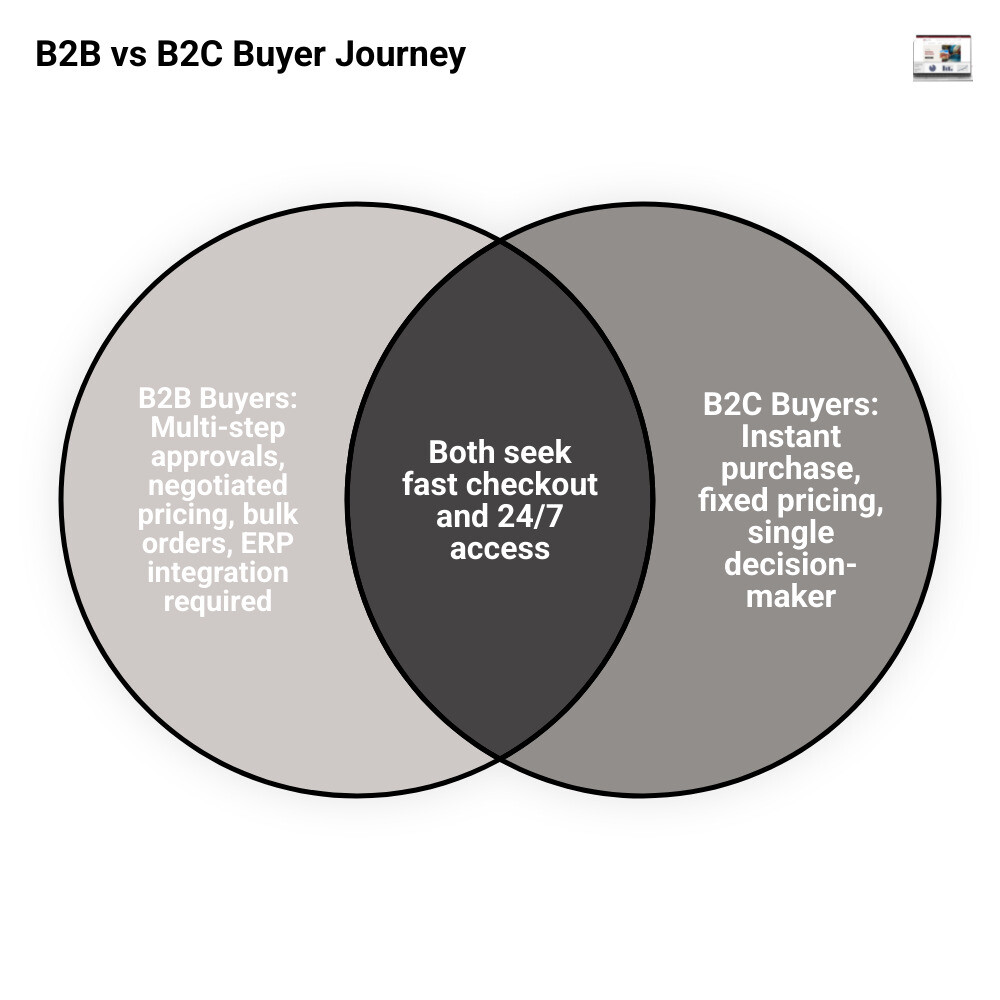
When we talk about a b2b ecommerce portal, it’s easy to think of it as just a “website with a login.” But for manufacturers and distributors, it is much more—it’s the operational backbone of the business. Unlike a B2C site where a stranger buys a pair of shoes once, a B2B portal manages ongoing, high-stakes relationships.
In B2B Ecommerce, buyer expectations have shifted. Modern procurement officers grew up using Amazon and Shopify for their personal lives; they now expect that same speed and 24/7 availability when they are buying $50,000 worth of industrial valves or wholesale organic flour.
A b2b ecommerce portal bridges the gap between traditional wholesale (handshakes and phone calls) and digital efficiency. It allows your customers to engage in self-service, checking their own order status or reordering a frequent shipment at 11:00 PM on a Sunday without waiting for your office to open on Monday morning.
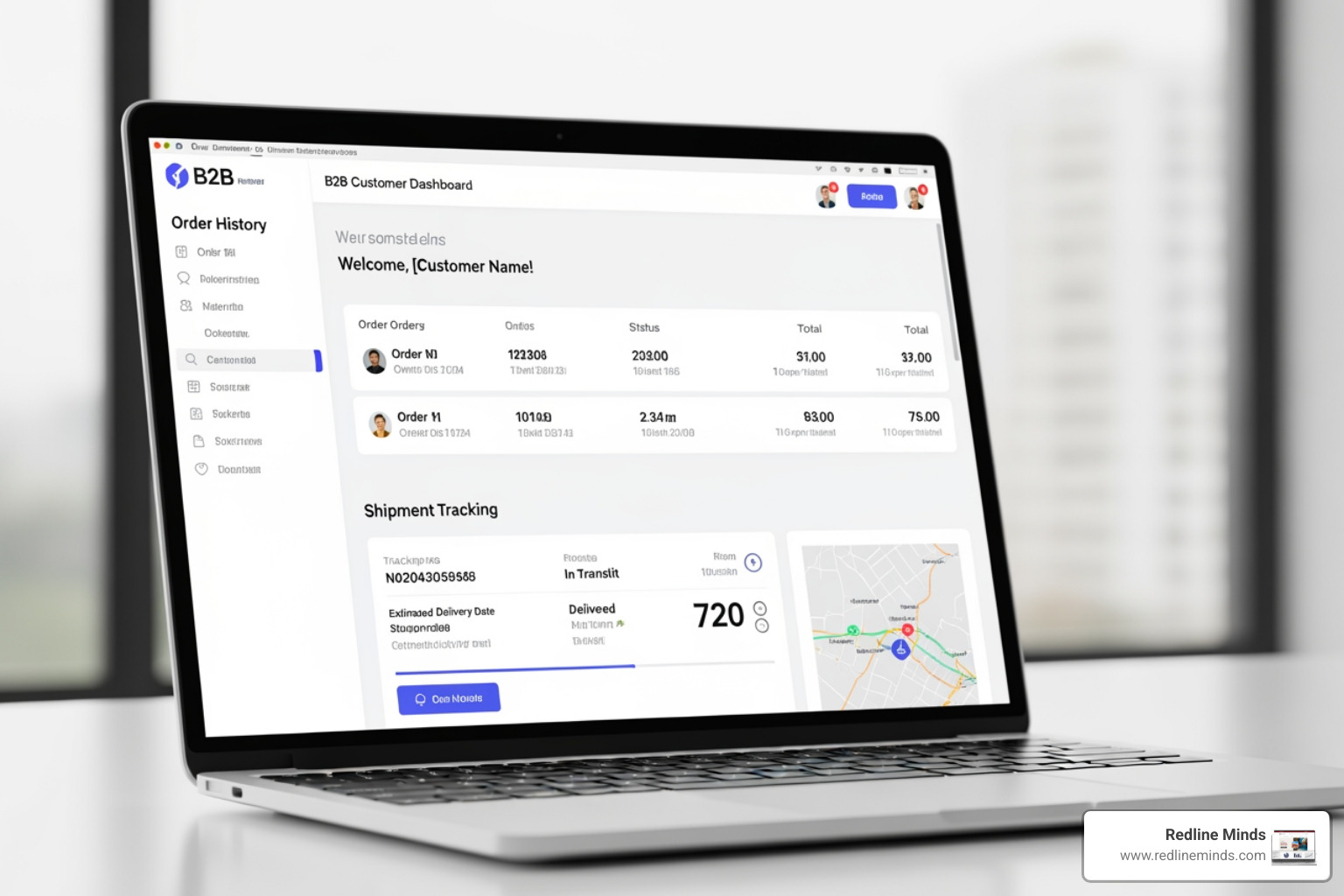
Essential Features of a Modern B2b ecommerce portal
To be effective, your portal needs to handle the “messy” reality of B2B commerce. This isn’t one-size-fits-all.
- Custom Catalogs: Not every customer should see every product. You might have exclusive items for certain distributors or regional restrictions.
- Tiered and Contract Pricing: This is the big one. Your portal must be able to show Customer A their negotiated price while showing Customer B a different one.
- Bulk Ordering & Quantity Rules: Features like “Quick Order” forms (where buyers type in SKUs and quantities) and “Pack Sizing” (selling only in increments of 12 or 24) are non-negotiable.
- Account Management & Net Terms: Buyers need to see their credit limits, pay via “Net 30” terms, and manage multiple sub-users under one corporate account.
- Inventory Visibility: Real-time stock levels prevent the dreaded “out of stock” phone call after an order has already been placed.
Platforms like Udaan – B2B Buying for Retailers have shown how these features can empower even the smallest retail shops to buy like giant corporations by providing transparent pricing and easy credit access.
The Shift Toward Digital Self-Service
The move toward digital isn’t just a trend; it’s a survival strategy. We often see businesses hesitant to “lose the personal touch,” but the data suggests otherwise. As mentioned, 75% of buyers prefer self-service. By providing a portal, you aren’t removing the relationship; you are removing the chores from the relationship.
When you eliminate the need for a buyer to call just to ask, “Where is my invoice?” or “Is this in stock?”, you make their life easier. This reduction in friction is Why B2B Self-Service Portals Are the Future of Wholesale. It leads to an 8x increase in web traffic for manufacturers and a significant boost in average order value (AOV) because buyers can browse the full catalog at their own pace.
| Feature | B2C Requirement | B2B Portal Requirement |
|---|---|---|
| Pricing | Same for everyone | Customer-specific / Negotiated |
| Checkout | Credit Card / PayPal | Net Terms / Purchase Orders |
| Product Access | Public | Restricted / Custom Catalogs |
| Order Volume | Single units | Bulk / Case packs / MOQs |
| User Roles | Single user | Multi-user corporate hierarchy |
Integrating Your B2B Ecommerce Portal with ERP and QuickBooks
The true magic of a b2b ecommerce portal happens behind the scenes. If your portal doesn’t talk to your accounting software or ERP (Enterprise Resource Planning), you’ve just traded one manual task for another.
Integration ensures that when an order is placed on the eCommerce Portal for B2B Brands, it automatically appears in QuickBooks or your ERP as a Sales Order. No re-typing. No typos. No data silos.

For many of our clients, QuickBooks integration is the “killer app.” By syncing inventory levels in real-time, you ensure that if you sell your last pallet in the warehouse, the portal immediately shows “Out of Stock” to the next customer. This level of accuracy is why companies report a 40% increase in conversion rates and a staggering 175% reduction in admin time. Imagine what your office staff could do with those extra hours every week.
Automating the Order-to-Cash Cycle
Automation doesn’t stop at the order. A robust b2b ecommerce portal handles the entire lifecycle:
- Invoice Automation: Automatically generate and email PDF invoices the moment a shipment is processed.
- Payment Gateways: Allow customers to pay via ACH or credit card directly through the portal to settle their outstanding balances.
- Credit Limits: The system can automatically “hold” an order if a customer has exceeded their credit limit, protecting your cash flow.
- Tax Compliance: For our Indian clients or those selling internationally, handling GST invoices and VAT validation is essential for staying compliant without manual audits.
Learning How to Build a B2B Empire with Custom Solutions and Bulk Ordering starts with getting these foundational integrations right.
Maximizing Efficiency with a Sales Rep Portal
One of the biggest myths we hear is that a b2b ecommerce portal will replace the sales team. In reality, it makes them “super-powered.”
Most modern platforms, such as B2B Edition – A better way to B2B | BigCommerce, include a Sales Rep Portal or “Masquerade Mode.” This allows your reps to log in as the customer.
The Strategic Value of a B2b ecommerce portal for Sales Teams
Instead of spending their day as “order takers” (writing down SKUs over the phone), your reps become “opportunity makers.”
- Masquerade Mode: A rep can sit with a customer, log into their account, build a cart for them, and apply a one-time discount to close the deal on the spot.
- Real-Time Insights: Reps can see which customers haven’t logged in lately or whose browsing habits suggest they are looking for a new product line.
- Mobile Access: Whether they are at a trade show or a customer’s warehouse, reps have the entire catalog, real-time stock, and custom pricing in their pocket.
This shift is a core part of modern B2B lead generation strategies. By automating the boring stuff, your sales team can focus on building the high-level relationships that actually grow the business.
Implementation Best Practices for 2026
As we look toward 2026, the technology behind a b2b ecommerce portal has become more accessible, but the stakes are higher. “Good enough” is no longer enough when your competitors are offering seamless digital experiences.
When planning your implementation, we recommend a “crawl, walk, run” approach.
Choosing the Right Platform Architecture
The “best” platform depends entirely on your complexity.
- SaaS (Software as a Service): Solutions like B2B Commerce Platform – Shopify India or BigCommerce are fantastic for businesses that want high reliability and fast updates without managing servers. They offer “B2B built-in,” meaning you can run your DTC and B2B operations from a single dashboard.
- Headless & API-First: For massive enterprises with highly custom workflows, a “headless” approach allows you to build a completely custom front-end while using a powerful back-end to handle the logic.
- Open-Source: While these offer total control, they often come with higher maintenance costs and security responsibilities.
For most wholesalers and manufacturers, the goal is to find The Best Platforms for Scaling Your B2B Ecommerce Operations that offer a low Total Cost of Ownership (TCO) while still allowing for the deep ERP integrations mentioned earlier.
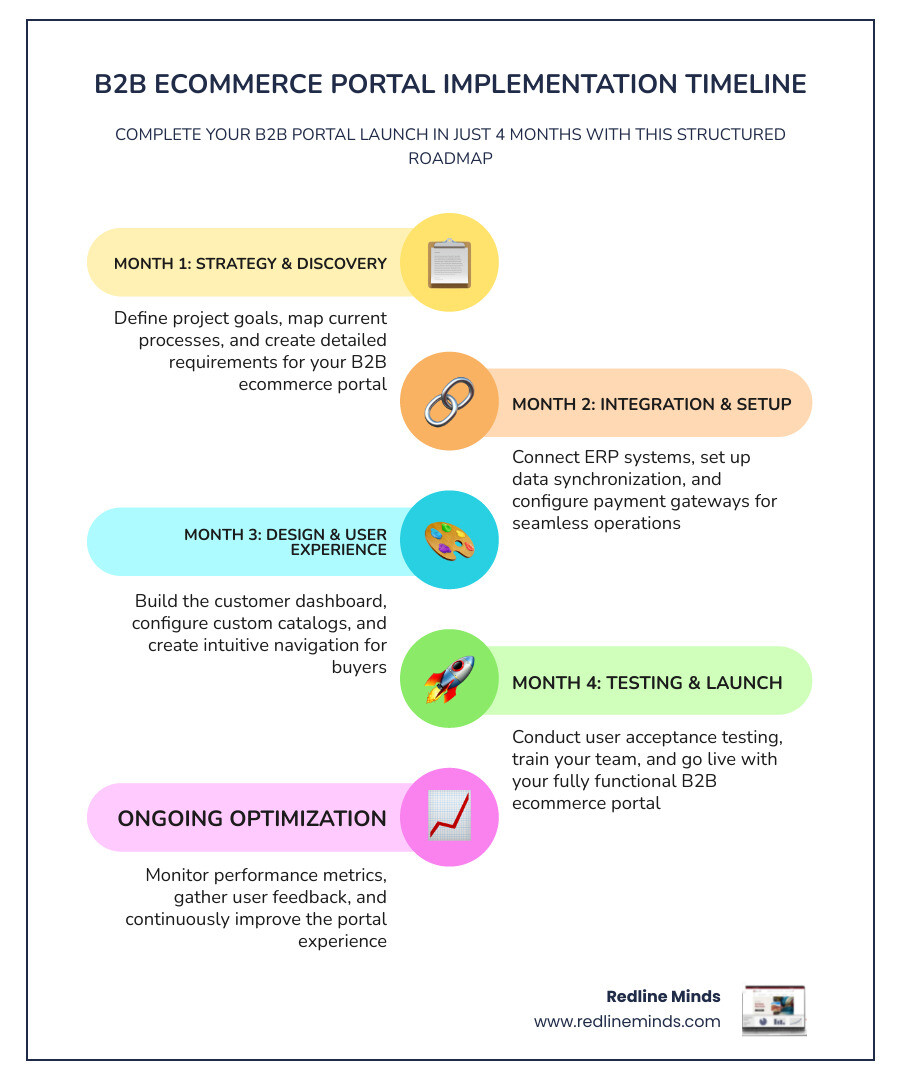
The 4-Month Rule: For a portal that requires deep ERP or PIM (Product Information Management) integration, expect a minimum of four months for a quality launch. This includes time for data cleaning, integration testing, and user acceptance training.
Frequently Asked Questions about B2B Portals
How does a B2B portal reduce manual order processing?
By moving the data entry task to the customer. When a customer places an order in the b2b ecommerce portal, the data is captured once and synced directly to your warehouse and accounting systems. This eliminates the need for your staff to read emails, listen to voicemails, and manually type orders into QuickBooks, which is where most errors happen.
Can I offer different prices to different customers?
Yes, this is a core feature of any true B2B platform. You can create “Customer Groups” or “Price Lists.” When Customer A logs in, they might see a 20% discount on all items based on their contract. When Customer B logs in, they see MSRP. This happens automatically based on their login credentials.
Does a B2B portal replace my existing sales team?
Absolutely not. It transforms their role. Instead of being “human calculators” who provide quotes and check stock, they become consultants. They use the data from the portal to see which accounts are growing and which are shrinking, allowing them to intervene strategically rather than just taking orders.
Conclusion
Building a b2b ecommerce portal is no longer a luxury for the “big guys.” In 2026, it is the standard for any wholesaler, manufacturer, or distributor that wants to remain competitive. By offering your customers the self-service tools they crave, you aren’t just improving their experience—you’re streamlining your own operations, reducing errors, and freeing your sales team to actually sell.
At Redline Minds, we specialize in helping businesses navigate this digital transformation. Whether you are looking to integrate with QuickBooks for the first time or you’re ready to scale a complex multi-organization empire, we provide the strategy and technical expertise to make it happen.
Based in Tennessee, our team understands the unique challenges of B2B and hybrid stores. We don’t just build websites; we build engines for growth.
Ready to see how a B2B portal can transform your business? More info about our B2B services
Redline Minds 349 Nancy Dr, Jefferson City, TN 37760 Find us on MapQuest
Share this article
Tap into years of experience and turn your site’s visitors into buyers.
Related Posts
-

The Complete Guide to Affiliate App for Shopify
Discover the best affiliate app for Shopify to grow sales, manage referrals, and boost merchant revenue in 2026.
-

The Ultimate Guide to Types of E-Commerce Payment Systems
Learn the types of e commerce payment system to boost sales and reduce cart abandonment in this complete…
-

A Practical Guide to AI Agent Integration Methods
Learn how AI agent integration connects enterprise systems with MCP, Unified APIs, and custom code for secure, real-time…