
The Definitive Guide to Conversion Optimization Tools

The Best Conversion Optimization Software in 2026: A Quick Answer
Conversion optimization software helps you turn more of your existing website visitors into paying customers — without spending more on ads.
Here are the top CRO tools worth knowing about in 2026:
- VWO – Full-featured A/B testing and experimentation platform
- Hotjar – Heatmaps, session recordings, and user feedback
- Optimizely – Enterprise-grade experimentation and personalization
- Crazy Egg – Visual analytics and split testing for smaller teams
- Keak – AI-powered A/B testing with automated variant generation
- pagent.ai – Agentic AI experimentation built for e-commerce
- Microsoft Clarity – Free heatmaps and session recordings
- Heap – Automatic event tracking and behavioral analytics
- Mixpanel – Deep product analytics and funnel analysis
- EverConvert – Automated copy testing for coaches and small funnels
Read on for a full breakdown of each tool, what category it fits, and how to pick the right one for your store.
You’re paying for traffic. But if your visitors aren’t buying, that traffic spend is just bleeding your budget dry.
For a mid-sized online retailer doing $1M–$10M a year, even a small lift in conversion rate can mean tens of thousands of dollars in added revenue — with zero increase in ad spend. That’s exactly what conversion optimization software is designed to deliver.
The math is simple. If 2 out of every 100 visitors buy today, and you push that to 3 out of 100, you’ve just grown revenue by 50% from the same traffic. No new campaigns. No higher bids.
Businesses that implement CRO tools report an average ROI of 223%. Yet 25% of businesses say outdated technology is their single biggest blocker to improving conversions.
The problem isn’t a lack of options. There are dozens of tools out there. The challenge is knowing which type of tool solves your specific problem — and how to build a CRO stack that actually works together.
This guide cuts through the noise. We’ll cover what each category of tool does, what features actually matter, and which specific platforms are worth your time in 2026.
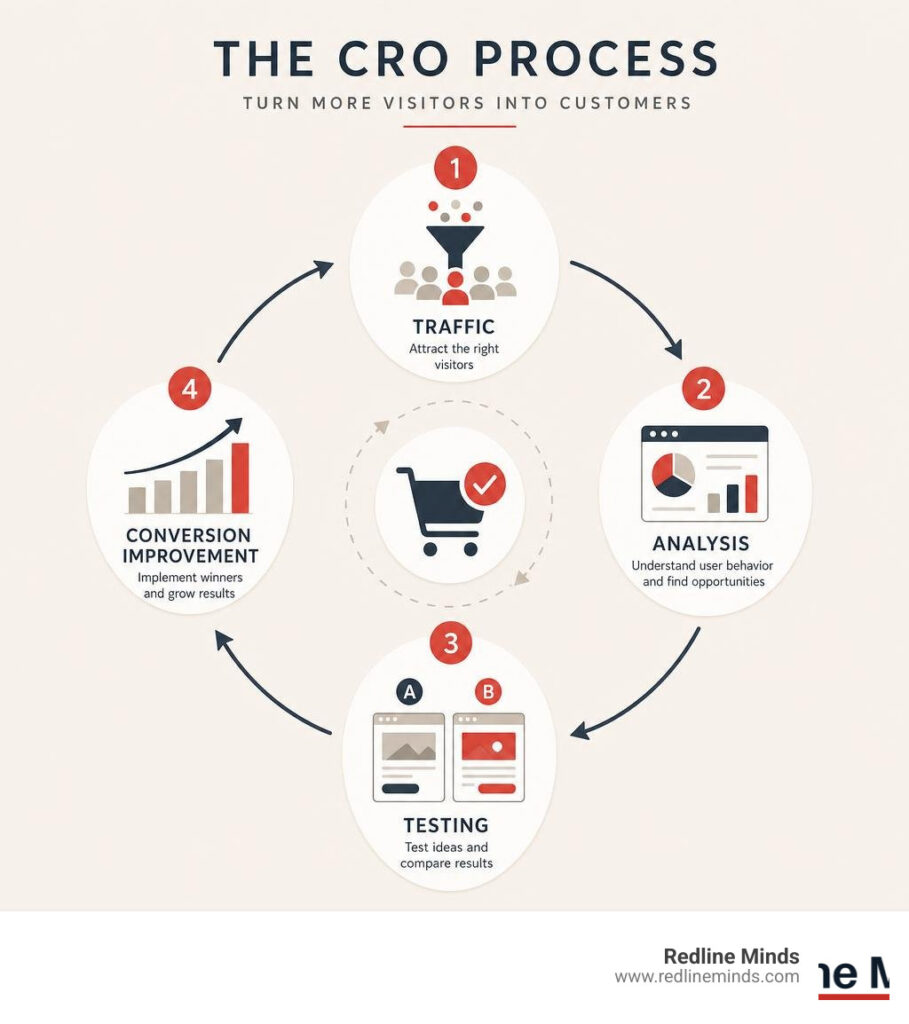
Key terms for conversion optimization software:
What is Conversion Rate Optimization and Why It Matters
At its heart, Conversion Rate Optimization (CRO) is the systematic process of increasing the percentage of website visitors who take a desired action. Whether that action is purchasing a product, signing up for a newsletter, or booking a B2B demo, CRO focuses on making your digital storefront as smooth and persuasive as possible.
Many businesses fall into the trap of thinking that the only way to grow online sales is to buy more traffic. They pump money into Google, Meta, and TikTok ads, watching their customer acquisition costs (CAC) climb higher every quarter. But if your website has underlying friction points, you are essentially pouring water into a leaky bucket.
When you optimize your conversion rate, you improve the efficiency of your entire sales funnel. By understanding the user journey and systematically removing the roadblocks that cause visitors to drop off, you get more value out of every single click. This is why you should Don’t Leave Money on the Table with Digital Marketing Conversion Rate Optimization. It directly boosts your bottom-line profitability and lowers your reliance on expensive ad networks.
Core Categories of CRO Tools: Quantitative, Qualitative, and Testing
If you want to build a high-performing website, you cannot rely on guesswork. You need a mix of hard numbers and human behavioral insights. This is why conversion optimization programs rely on three distinct categories of software.
While it is tempting to look for a single “magic bullet” tool, the most successful strategies combine these categories to form a complete picture of the user experience. You can read our breakdown of 27 Conversion Optimization Tools to see how different platforms fit these categories, or explore The Best Free and Paid Tools for Tracking Your Marketing Conversions to start mapping your data collection.
Quantitative Analytics Tools
Quantitative tools tell you what is happening on your website. They are the foundation of any data-driven marketing stack, tracking metrics like pageviews, traffic sources, bounce rates, and drop-off points in your checkout funnel.
These platforms excel at highlighting the exact pages where you are losing the most visitors. For instance, your analytics might show that 70% of users who reach your cart page leave without initiating checkout. While quantitative data won’t tell you why they are leaving, it acts as a compass, showing you exactly where to focus your Unlock Your Website’s Potential: The Power of CRO On-Page Optimization efforts.
Qualitative User Behavior Tools
Qualitative tools show you why your visitors behave the way they do. Instead of looking at cold spreadsheets, these tools provide visual context through heatmaps, session recordings, and user feedback surveys.
Imagine watching a session replay and seeing a visitor repeatedly click on an unclickable image, or struggle to fill out a form field on a mobile device. Qualitative insights reveal the hidden friction points that numbers alone cannot capture. This visual data is incredibly powerful when implementing Checkout Optimization Tips to Turn Window Shoppers into Buyers, as it lets you see where your checkout process is confusing or frustrating to real people.
A/B and Multivariate Testing Tools
Once you have used quantitative and qualitative tools to identify a problem and form a hypothesis, testing tools let you experiment with potential solutions.
A/B testing (or split testing) involves showing two different versions of a webpage to similar visitors and measuring which one performs better. Multivariate testing takes this a step further by testing multiple elements on a page simultaneously to see how they interact. These platforms use statistical significance models to ensure that your conversion gains are the result of your design changes rather than random chance.
A great example of an enterprise-level experimentation suite is the VWO: A/B Testing & Conversion Rate Optimization Platform, which provides robust tools for running frontend and server-side experiments at scale.
Key Features to Look For in Conversion Optimization Software
Choosing the right conversion optimization software can feel overwhelming given the sheer volume of options on the market. To make an informed choice, look beyond the marketing hype and focus on these critical criteria:
- GDPR and Privacy Compliance: With strict regulations like GDPR and CCPA, your tools must offer robust data privacy features. Look for software that automatically masks personally identifiable information (PII) in session recordings and operates with a privacy-first approach.
- Site Performance Impact: Every script you add to your website has the potential to slow it down. Choose testing tools that load asynchronously and have a small script size (ideally under 50KB) to prevent layout shifts and maintain fast load times.
- Security Features: Ensure the platform has enterprise-grade security protocols, secure data storage, and strict access controls to protect your business and customer data.
- Robust Integrations: Your CRO software should seamlessly connect with your existing tech stack, sharing data effortlessly with your CMS, CRM, and primary analytics platforms.
For a deeper dive into evaluating these platforms without losing hours of your day, check out our guide on CRO Software Reviews That Won’t Waste Your Time.
How to Choose the Right Conversion Optimization Software for Your Business
The best tool for your business depends entirely on your current maturity level, technical resources, and optimization goals.
If you are just starting out, a free tool like Microsoft Clarity paired with standard web analytics is often enough to identify low-hanging fruit. As your program grows, you will want to graduate to dedicated testing suites that support advanced targeting and personalization. Always weigh the tool’s learning curve against your team’s skillsets; a highly complex platform is of no use if your team doesn’t have the developer resources or statistical knowledge to run it correctly. For a solid strategic framework, read CRO Optimization 101: How to Win at Digital Marketing.
Integrating Conversion Optimization Software with Your Marketing Stack
Your optimization software should never live in an isolated silo. To unlock its full potential, it must integrate deeply with your broader marketing and analytics stack.

When your testing platform connects directly to your CRM, email marketing tools, and analytics dashboards, you can run highly sophisticated experiments. For example, you can personalize your homepage layout specifically for returning B2B leads, or show a custom discount code to users who have previously abandoned a cart. API integrations ensure that visitor behavior data flows smoothly between platforms, giving you a unified, 360-degree view of your customer journeys.
Top AI-Powered Conversion Optimization Tools in 2026
The CRO landscape has shifted dramatically. In June 2026, artificial intelligence is no longer just a buzzword—it is actively running, analyzing, and deploying experiments on autopilot. These modern platforms drastically reduce the manual overhead and developer resources traditionally required to run an active testing program.
| Tool | Core Focus | Best For | Key Advantage |
|---|---|---|---|
| Keak | Autonomous A/B Testing | Multi-framework websites | 31KB script, zero layout shift |
| pagent.ai | Agentic E-commerce CRO | Online retailers | Multi-dimensional hypothesis generation |
| EverConvert | Autopilot Copy Testing | Coaches & simple funnels | Performance-based model |
Keak: Autonomous AI-Powered A/B Testing
AI-Powered A/B Testing Platform – Keak is a cutting-edge platform designed to make website optimization completely hands-free. Instead of forcing you to manually design variations and write test code, Keak’s AI agent scans your website, generates high-impact variants, and runs the experiments automatically.
The platform works across almost any framework, from modern JavaScript stacks like React and Next.js to popular e-commerce platforms like Shopify and Webflow. With an incredibly lightweight 31KB script, it applies changes in under 100 milliseconds, ensuring your visitors never experience annoying layout shifts or slow page loads.
pagent.ai: Your Agentic Conversion Co-Pilot
For e-commerce stores looking to scale their experimentation without expanding their development team, pagent.ai – Your conversion co-pilot offers a highly automated approach. Pagent acts as an autonomous member of your growth team, constantly analyzing your product pages, checkout flows, and user segments.
It generates hypotheses across three critical dimensions: functional clarity, emotional resonance, and value communication. Once it designs on-brand copy, layout, or image variations, it sends them to your inbox for a simple one-click approval before launching the test.
EverConvert: Conversion Autopilot for Coaches
If you run a lead generation funnel or coaching business, EverConvert — Conversion Autopilot for Coaches is built specifically for your workflow. It focuses heavily on testing headlines, body copy, and call-to-action buttons to maximize lead capture rates.
EverConvert monitors your active funnels, automatically writing and testing new copy variations based on real customer language. It uses automated rules to cut losing variations early, protecting your ad budget and ensuring that only your highest-converting copy is shown to incoming traffic.
Frequently Asked Questions About CRO Tools
What is the average ROI of conversion rate optimization software?
On average, businesses that implement conversion rate optimization software report an impressive return on investment of 223%. Because CRO focuses on converting the traffic you already have, every conversion lift you achieve directly improves your marketing efficiency and customer acquisition margins.
What is the biggest blocker to improving website conversions?
According to industry research, 25% of businesses state that outdated technology is their biggest roadblock to improving website conversions. Complex legacy systems, developer bottlenecks, and fragmented tools often make it difficult for marketing teams to quickly test and deploy modern user experiences.
How do I measure the success of my CRO program?
While overall conversion rate is the primary metric, a successful CRO program should also track secondary key performance indicators (KPIs). These include Average Order Value (AOV), cart abandonment rates, form completion rates, and Customer Lifetime Value (CLV). Measuring these metrics ensures that your optimization efforts are driving real, long-term business growth rather than just temporary spikes in clicks.
Conclusion
Building a high-converting website doesn’t require massive ad budgets—it requires the right strategy and the right tools. By combining quantitative data, visual behavioral insights, and automated testing, you can systematically remove friction and unlock your website’s true revenue potential.
At Redline Minds, we specialize in helping B2B, hybrid, and retail e-commerce brands scale their online sales. Based in beautiful Tennessee, our expert team provides comprehensive consulting, UX/UI design, and search engine optimization services tailored to your unique business goals.
Ready to stop leaving money on the table? Let’s build a self-improving digital experience together. Explore our Redline Minds Conversion Optimization Services today, or connect with us on Redline Minds – LinkedIn to stay updated on the latest digital marketing insights. If you’re in the neighborhood, check out our local business profile at Redline Minds, 349 Nancy Drive, Jefferson City, TN 37760-4623, US.
Share this article
Tap into years of experience and turn your site’s visitors into buyers.
Related Posts
-
Compare Shopify Migration Services: Options Cheat Sheet
Compare Shopify migration services and find the right Shopify migration company for your store, from manual imports to…
-

Ultimate Checklist for Improving B2B Customer Experience
Ultimate Checklist for Improving B2B Customer Experience – Learn about b2b ecommerce customer experience
-

A Practical Guide to What to Sell Online for Profit
A Practical Guide to What to Sell Online for Profit – Learn about i don t know what…