
Everything You Need to Know About Conversion Rate Optimisation

What is Conversion Rate Optimisation? (Quick Answer)
Conversion rate optimisation (CRO) is the process of increasing the percentage of website visitors who take a desired action — like making a purchase, filling out a form, or signing up for a newsletter — without needing to increase your traffic.
The core formula:
Conversion Rate = (Conversions ÷ Total Visitors) × 100
At a glance:
- The average conversion rate across all industries is around 1.7%
- That means roughly 98 out of every 100 visitors leave without converting
- A jump from 2% to 3% conversion rate = 50% more revenue from the same traffic
- For a $10M ecommerce store, a 1% lift adds $100,000 in revenue instantly
Here’s a number that should stop you cold: on average, only 1.7% of website visitors convert.
That means if you’re running a mid-sized online store doing $1M–$10M in sales, the overwhelming majority of people you’ve paid to attract are leaving empty-handed.
Most businesses respond to flat sales by spending more on ads or chasing more traffic. But that approach gets more expensive every year — especially now that AI-powered search results are eating into organic click-through rates, sending fewer visitors your way to begin with.
CRO flips the equation. Instead of asking “how do we get more visitors?”, it asks “how do we get more value from the visitors we already have?”
It’s not about changing button colours on a whim. It’s a systematic, data-driven process — using behavioural analytics, A/B testing, user feedback, and UX improvements — to remove the friction stopping people from buying.
The compounding effect is real. Businesses that run structured CRO programmes consistently report 50–200% cumulative improvements over 12 months. And unlike paid ads, those gains don’t disappear when you stop spending.
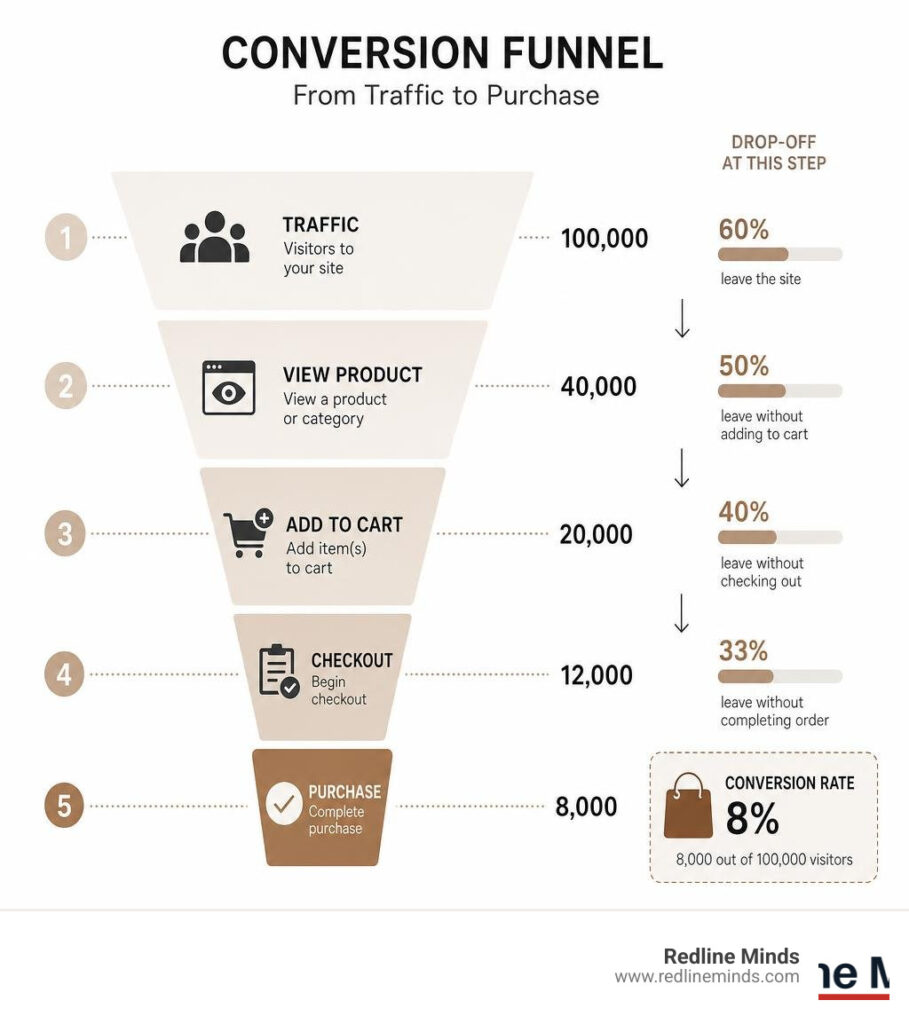
Discover more about conversion rate optimisation:
- cro onpage
- cro software
- digital-marketing optimization tools
What is Conversion Rate Optimisation and Why Does It Matter?
At its core, conversion rate optimisation isn’t just about driving immediate sales. It is about understanding user behavior and systematically designing your website to fulfill their needs. To do this effectively, we must first distinguish between macro conversions and micro conversions.
- Macro Conversions: These are your primary business goals. In ecommerce, it’s a completed purchase. For a B2B or hybrid store, it might be a request for a quote, a bulk ordering account application, or a completed lead form.
- Micro Conversions: These are smaller, incremental actions that indicate a user is moving down the funnel. Examples include adding an item to a cart, signing up for a newsletter, using an on-site product comparison tool, or downloading a spec sheet.
Optimizing the user experience (UX) to support both types of conversions is what makes a business highly efficient. This focus has become incredibly urgent in 2026. The rise of search engine AI Overviews and conversational search models has drastically reduced standard organic click-through rates. Because traffic is harder and more expensive to win, you simply cannot afford to waste the visitors you do get.
According to Conversion rate optimization (CRO) strategy for 2026, businesses must adapt to these AI-driven shifts by extracting maximum value from existing traffic. Doing so lowers your Customer Acquisition Cost (CAC) and builds a highly predictable revenue model.
To benchmark your performance, let’s look at average conversion rates by industry in 2026:
- Professional Services: 4.6%
- B2B SaaS: 1.1% to 3.1%
- B2C Ecommerce: 1.9% to 2.5% (with exceptional top-performers reaching 3% to 5%+)
- Food & Beverage: up to 6%
- Luxury Goods & Jewelry: 0.9%
If your site is converting below these benchmarks, you are likely suffering from what we call “conversion inhibitors.” In our decade of consulting at Redline Minds, we’ve categorized these inhibitors into four main buckets:
- Distraction: Cluttered layouts, too many competing CTAs, or intrusive pop-ups that draw attention away from the main goal.
- Friction: Long forms, slow load times, or a confusing navigation menu.
- Anxiety: A lack of trust signals, hidden shipping costs, or an unpolished design that makes users hesitate to enter credit card details.
- Ambiguity: Confusing copy, weak value propositions, or unclear pricing structures.
By systematically identifying and removing these inhibitors, you can dramatically Unlock Your Website’s Potential: The Power of CRO on Page Optimization.
Homepage and Landing Page Conversion Rate Optimisation
Your homepage and dedicated landing pages are your digital storefront’s handshake. You have about 50 milliseconds to make a good first impression.
To convert a visitor immediately, you must clarify your value proposition above the fold. This means answering three critical questions within seconds of a user landing on your page:
- What is this?
- Why should I care (what’s in it for me)?
- What should I do next?
Your primary Call to Action (CTA) should be highly visible, contrasting in color, and placed above the fold. Avoid generic button copy like “Submit” or “Click Here.” Instead, use specific, benefit-driven language. For example, “Get My Free Quote” or “Explore the B2B Catalog” sets clear expectations and drives action.
For dedicated marketing campaigns, always use tailored landing pages rather than sending traffic to your homepage. Landing pages should have a single, focused goal, which means removing top navigation bars and external links to prevent distraction. For design inspiration that keeps users engaged, check out The Ultimate Guide to Ecommerce UX That Actually Converts.
Product and Pricing Page Conversion Rate Optimisation
Product detail pages (PDPs) are where the emotional decision to buy is finalized. Because online shoppers cannot physically touch, feel, or taste your products, they have to “eat with their eyes.”
High-resolution, premium product photography is non-negotiable. Implementing 360-degree views, zoom functionality, and real-life contextual images will significantly boost conversion rates.
Equally important is the strategic placement of social proof. Display customer reviews, star ratings, and user-generated content directly beneath the product title and near the “Add to Cart” button. If you sell complex B2B products or hybrid retail items, ensure that technical spec sheets, sizing guides, and compatibility tools are incredibly easy to find.
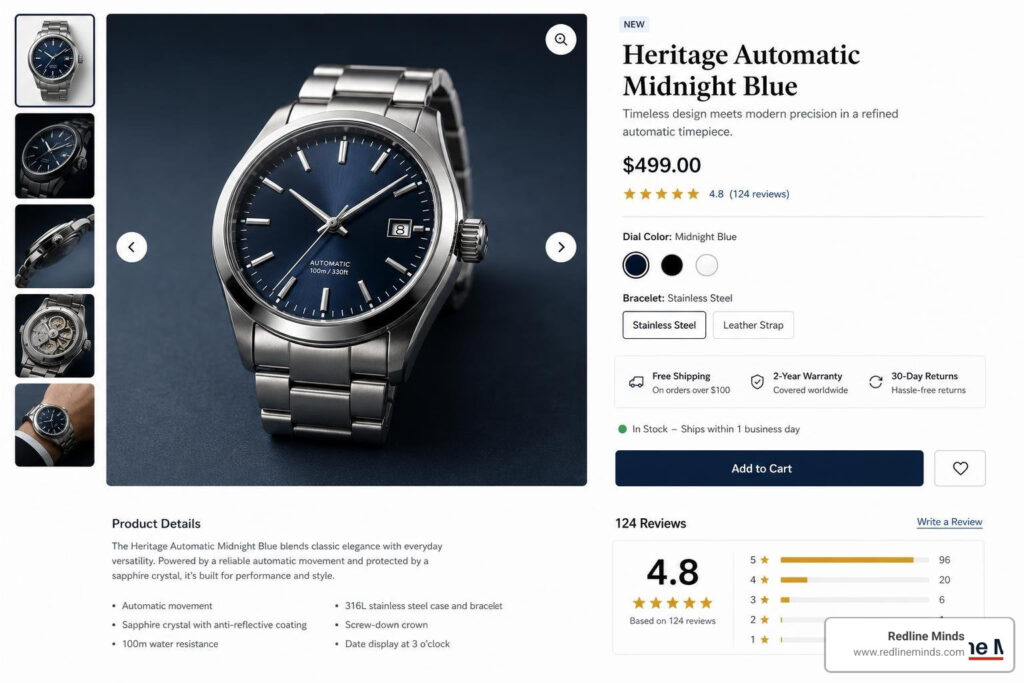
Pricing pages also require careful optimization. Use pricing psychology techniques such as “anchoring” (positioning a premium option next to a standard option to make the standard option look like a bargain) and clear visual hierarchies. If you want to dive deeper into making your products shine, read our guides on How to Optimize Product Pages Without Losing Your Mind, Perfect Product Page Design, and The Ultimate Guide to Ecommerce Image Optimization.
Streamlining Forms and Checkout Flows
The average ecommerce cart abandonment rate is a staggering 70%. This represents a massive leak in your sales funnel. Why do users abandon? More often than not, it’s due to checkout complexity, forced account creation, and unexpected fees.
To recover these lost sales, you must streamline your forms and checkout flows:
- Form Field Reduction: Only ask for what is absolutely necessary. Reducing form fields from 11 to 4 has been shown to increase sign-ups by 120%. If you must collect extensive data (common in B2B onboarding), use a multi-step form with a visual progress bar to make the process feel manageable.
- Guest Checkout: Never force a user to create an account before buying. Always offer a prominent guest checkout option. You can always invite them to save their details on the order confirmation page.
- Accelerated Checkouts: Implement one-click payment options like Shop Pay, PayPal, and Apple Pay. According to Conversion Rate Optimization (CRO): Get Started (2026) – Shopify, Shop Pay alone can lift conversions by up to 50% compared to standard guest checkouts.
- Visual Clarity: Use single-page or accordion-style checkouts that keep the user oriented. Display security badges, return policies, and clear helper text to eliminate checkout anxiety.
For actionable layouts and designs, review The Ultimate List of High Converting Checkout Page Designs.
How to Calculate Conversion Rate and Key Performance Metrics
Before launching any optimization tests, you must establish your baseline metrics. CRO is a highly quantitative discipline. If you aren’t measuring, you’re just guessing.
Beyond the basic conversion rate formula, there are several key performance indicators (KPIs) you need to track to understand the true financial impact of your CRO program:
- Cost Per Lead (CPL): Total marketing spend divided by total leads generated. CRO directly lowers this by generating more leads from the same ad spend.
- Lead-to-Customer Close Rate: The percentage of leads that ultimately turn into paying customers.
- Average Order Value (AOVs): The average dollar amount spent when a customer places an order.
- Cart Abandonment Rate: The percentage of users who add items to their cart but fail to complete the transaction.
To learn how to avoid leaving money on the table, check out our insights on how to Don’t Leave Money on the Table with Digital Marketing Conversion Rate Optimization.
| Metric | Formula | Why It Matters |
|---|---|---|
| Conversion Rate | (Conversions ÷ Total Visitors) × 100 |
Measures overall website efficiency. |
| Cost Per Lead (CPL) | Total Ad Spend ÷ Total Leads |
Determines marketing spend efficiency. |
| Average Order Value (AOV) | Total Revenue ÷ Number of Orders |
Shows how much value each transaction brings. |
| Cart Abandonment Rate | (1 - (Completed Purchases ÷ Cart Additions)) × 100 |
Identifies friction in checkout and pricing. |
The Modern CRO Tech Stack: Behavioral Analytics, A/B Testing, and AI Insights
To run a modern, world-class CRO program, you need a balanced mix of quantitative data (the “what”) and qualitative insights (the “why”).
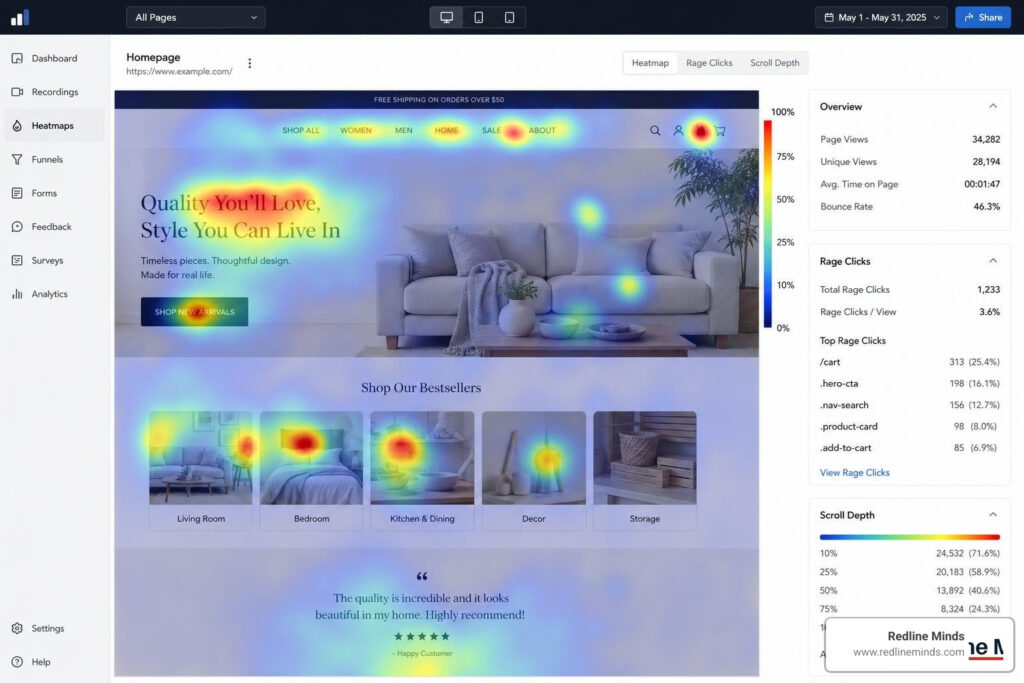
Your CRO tech stack should consist of four key layers:
1. The Analytics Layer
Tools like Google Analytics 4 (GA4) tell you where users are dropping off in your funnel. It highlights high-bounce pages and tracks specific conversion events.
2. The Behavioral Data Layer
This is where you uncover the “why.”
- Heatmaps: Visually represent where users click, move their cursors, and scroll. If users are clicking on non-clickable elements, a heatmap will show you.
- Session Recordings: Allow you to watch anonymous playback of real users navigating your site. You’ll quickly spot “rage clicks” (when a user repeatedly clicks an element in frustration) and layout bugs.
3. The Feedback Layer
Sometimes, the easiest way to find out what’s wrong is to ask. Use exit-intent micro-surveys (1-2 questions) to ask users who are about to leave: “Is there anything stopping you from completing your purchase today?”
4. The Testing Layer
Once you have gathered data and formulated a hypothesis, you must validate it using A/B testing tools. An A/B test splits your traffic evenly between the original page (Control) and your modified page (Variant). You must run these tests until they reach statistical significance (usually a 95% confidence level) to ensure your results aren’t due to random chance.
In 2026, AI-powered insights are changing the game. AI agents can now analyze thousands of hours of session recordings in minutes, highlighting exact friction points and proposing test hypotheses automatically. To choose the right tools for your business, browse our CRO Software Reviews That Won’t Waste Your Time and look at these 27 Conversion Optimization Tools.
How CRO and SEO Work Together for Maximum Growth
For years, businesses treated search engine optimisation (SEO) and CRO as completely separate departments. SEO was the team that brought people to the door, and CRO was the team that tried to get them to buy.
In 2026, this siloed approach is dead. CRO and SEO are two sides of the same coin.
When you align your conversion strategies with user search intent, magic happens. For instance, if a user searches for “how to size a B2B hydraulic pump,” they are looking for informational content. If you send them to a hard-sell product page, they will bounce instantly (hurting your SEO rankings). Instead, giving them a helpful guide with a targeted content upgrade (like a downloadable sizing calculator) matches their intent, keeps them on the page, and captures them as a high-quality lead.
Furthermore, search engines heavily prioritize user experience metrics like page load speed and Core Web Vitals (including Cumulative Layout Shift and Interaction to Next Paint). Because a faster, more stable site is a fundamental requirement for both search rankings and conversion rates, optimizing technical performance satisfies both search crawlers and human visitors.
By integrating these strategies, you ensure that you aren’t just driving empty traffic, but highly qualified visitors primed to convert. Explore this synergy in our dedicated guide on Conversion Rate Optimization (CRO).
Common CRO Mistakes to Avoid
Even well-intentioned optimization efforts can fall flat if you fall into common strategic traps. Here are the most frequent mistakes we help businesses correct:
- Neglecting Mobile Optimisation: Over 62% of global web traffic now comes from mobile devices. Yet, many desktop-centric designs fail on smaller screens. Buttons are too close together, text is unreadable, and checkout forms are incredibly tedious to fill out.
- Overcomplicating the User Journey: Adding too many steps, confusing navigation filters, or multiple competing CTAs creates decision paralysis. Keep the path to purchase as direct as possible.
- Ignoring Page Speed: A site that takes longer than 2 seconds to load is a major conversion killer. Every 1-second delay in page load speed can drop conversion rates by up to 20%.
- Failing Accessibility Standards: Shockingly, 94% of the largest ecommerce websites are not fully accessibility compliant. If users with visual, auditory, or motor impairments cannot navigate your site, you are locking out a massive segment of your market.
For a detailed look at avoiding these pitfalls, refer to the Conversion Rate Optimization: Complete Guide + 20 CRO Tips.
Building a Sustainable, Continuous CRO Program
A common mistake is treating CRO as a one-off “redesign” project. True conversion optimization is an ongoing, systematic business habit. To build a sustainable testing culture, you need a repeatable framework to prioritize your efforts.
We recommend using the ICE Scoring Model or the PIE Framework to score and prioritize your hypothesis backlog:
- Impact (Potential): If this change works, how big of an impact will it have on our conversion rate?
- Confidence (Importance): How confident are we (based on behavioral data, heatmaps, or feedback) that this hypothesis is correct?
- Ease (Ease of Implementation): How much developer time, design resources, or budget will it take to build and test this change?
By scoring every idea from 1 to 10 across these three categories, you can easily identify high-impact, low-effort “quick wins” to tackle first. Only about 12% of run experiments produce a winning result. However, in a true testing culture, there are no failed tests—only learning opportunities that inform your next, more profitable hypothesis.
Frequently Asked Questions About CRO
What is the difference between CRO and UX design?
While they are closely related, UX design focuses broadly on user satisfaction, usability, and task completion. CRO is specifically focused on driving conversion goals and business revenue impact. Good UX is the foundation of good CRO, but CRO ensures that the user experience is strategically aligned with your bottom line.
How long does it take to see results from a CRO program?
“Quick wins” like fixing broken checkout links, adding guest checkout, or clarifying an above-the-fold headline can show measurable conversion lifts within 2 to 4 weeks. Standard A/B tests typically require 2 to 6 weeks to reach statistical significance, depending on your traffic volume. A structured, continuous program will yield massive compounding growth within 3 to 6 months.
Can small businesses benefit from CRO with low traffic?
Absolutely! While traditional, high-volume A/B testing requires thousands of visitors to reach statistical significance, low-traffic sites can focus on qualitative research. You can run manual user testing, analyze session recordings, conduct heuristic evaluations, and implement verified UX best practices to plug conversion leaks.
Conclusion
Maximizing your website’s performance is no longer optional in 2026. With rising acquisition costs and AI-driven search shifts, your business growth relies on how efficiently you convert your existing traffic.
At Redline Minds, we specialize in ecommerce consulting, web development, and digital marketing exclusively for ecommerce. Based in beautiful East Tennessee, we help B2B, B2C, and hybrid stores establish high-converting sales channels through tailored strategy, advanced UX/UI design, and search engine optimization.
If you are ready to stop leaving money on the table, visit our team at Redline Minds, 349 Nancy Drive, Jefferson City, TN 37760-4623, US, connect with us on Redline Minds – LinkedIn, or Partner with Redline Minds for Conversion Rate Optimisation today. Let’s make your website work smarter, not harder.
Share this article
Tap into years of experience and turn your site’s visitors into buyers.
Related Posts
-

The Complete Guide to Affiliate App for Shopify
Discover the best affiliate app for Shopify to grow sales, manage referrals, and boost merchant revenue in 2026.
-

The Ultimate Guide to Types of E-Commerce Payment Systems
Learn the types of e commerce payment system to boost sales and reduce cart abandonment in this complete…
-

A Practical Guide to AI Agent Integration Methods
Learn how AI agent integration connects enterprise systems with MCP, Unified APIs, and custom code for secure, real-time…