
A – Z Guide to AI Tools for Conversion Rate Optimization

The Fastest Way to Turn More Visitors Into Buyers
The best ai tools for conversion rate optimization in 2026 include:
| Tool | Best For |
|---|---|
| VWO | AI-assisted A/B and multivariate testing |
| Dynamic Yield | Real-time personalization engines |
| Optimizely | Enterprise-scale experimentation |
| Hotjar | Behavioral analytics and heatmaps |
| Mutiny | B2B website personalization |
| Pathmonk | Intent-based micro-personalization |
| Keak | Automated AI A/B testing |
| Levered | Reinforcement learning optimization |
| Fibr.ai | Agentic landing page personalization |
| CROAI | Beginner-friendly auto-optimization |
Most online retailers are sitting on a goldmine they can’t see.
You’re spending money on ads. You’re driving traffic. But somewhere between “visitor lands on your site” and “visitor buys something,” people are quietly leaving — and you don’t know exactly why.
That’s the problem AI CRO tools are built to solve.
Traditional conversion rate optimization was slow. You’d form a gut-feel hypothesis, build a test, wait weeks for statistical significance, and maybe move the needle by 2%. Then start again. It was manual, bandwidth-heavy, and often left more questions than answers.
AI changes the equation entirely.
Modern AI-powered tools can analyze thousands of user behavior signals in real time — where people hesitate, what they ignore, where they rage-tap in frustration — and automatically test fixes while your store is running. No waiting. No guessing. No dev tickets.
According to research across leading CRO platforms, companies using AI for conversion optimization see an average 50-60% boost in conversions compared to those relying on traditional methods. AI-powered personalization engines alone can lift conversion rates by 15-30% on average.
For a mid-sized retailer doing $1M–$10M in annual sales, even a 10% improvement in conversion rate can mean hundreds of thousands of dollars in additional revenue — without spending a cent more on traffic.
This guide walks you through everything: what AI CRO actually is, how it finds your friction points, which tools are worth your time, and how to implement them safely and smartly.
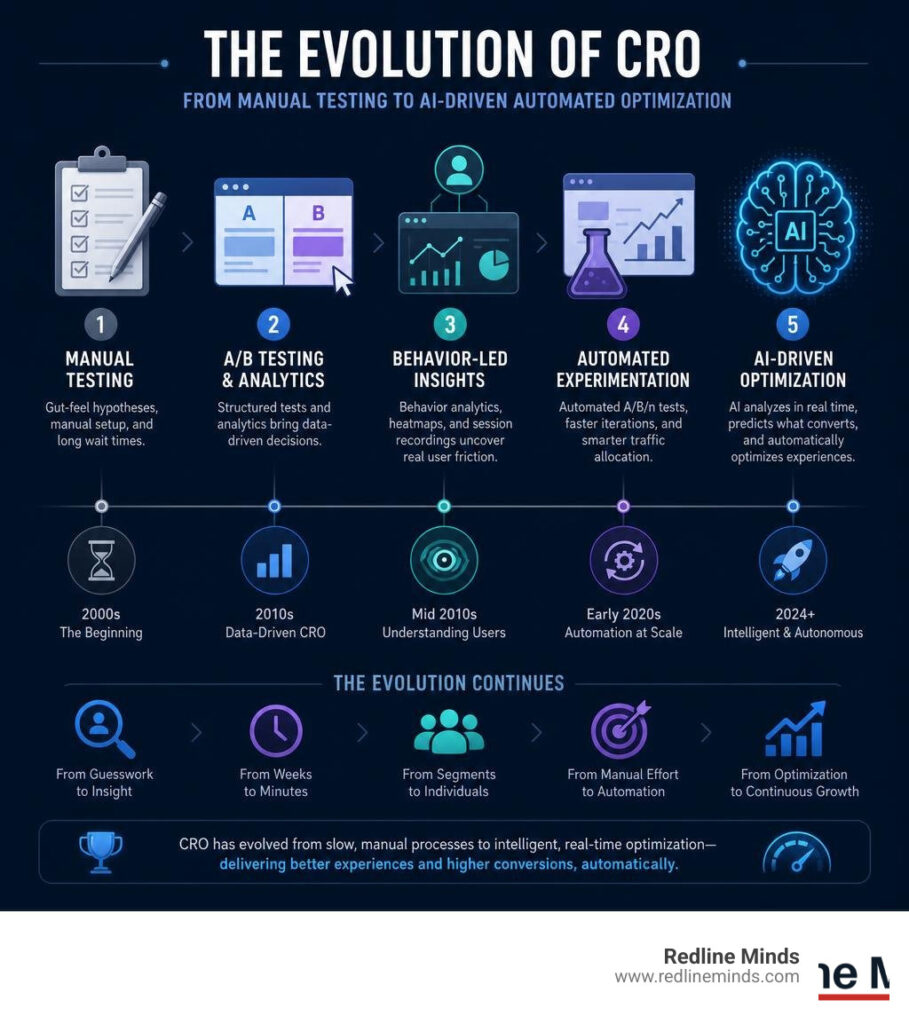
Ai tools for conversion rate optimization vocabulary:
What is AI Conversion Rate Optimization (AI CRO)?

At its core, AI conversion rate optimization (AI CRO) is the practice of using machine learning algorithms, natural language processing, and predictive analytics to automatically diagnose, test, and improve your website’s user experience.
To understand why this is such a massive leap forward, we have to look at how we got here. In our comprehensive resource, Everything You Need to Know About Conversion Rate Optimisation, we outline the traditional CRO process. Historically, CRO relied on heuristic reviews (experts guessing what is wrong based on best practices), manual data analysis of static dashboards, and sequential, slow A/B tests. It was a linear, slow-moving cycle.
AI CRO completely upends this model. Instead of a human analyst looking at last month’s data to guess why checkout conversion dropped, an AI system monitors user sessions in real time. It detects patterns that are invisible to the naked human eye — such as micro-hesitations before clicking a button or specific mouse-movement paths that indicate confusion.
According to a detailed industry breakdown in AI conversion rate optimization: How it works and why it matters, the primary differentiator is speed and scalability. Traditional CRO requires you to run one test at a time to prevent variables from polluting your data. AI systems, however, use advanced multivariate testing and reinforcement learning to test hundreds of minor variations simultaneously, automatically shifting traffic to the winners.
Furthermore, AI CRO enables real-time adaptation. Instead of a static page that looks the same to every visitor, the website dynamically reshapes itself based on the visitor’s traffic source, device, historical behavior, and real-time intent. It is the shift from a static storefront to an intelligent digital salesperson who rearranges the shelves for every customer who walks through the door.
How AI Identifies Conversion Friction and User Drop-offs
Before you can fix a conversion leak, you have to find it. Traditionally, finding leaks meant digging through endless Google Analytics reports or watching hundreds of hours of session recordings on double-speed until your eyes watered.
AI-driven behavioral analytics tools automate this entire discovery process. By continuously scanning your site’s traffic, AI can isolate exact friction points and drop-off areas without requiring manual audits.
Here is how AI pinpoints where you are losing money:
- Rage-Tap and Friction Detection: AI algorithms can instantly flag user frustration. If a user “rage-taps” (clicks a broken link or non-clickable element repeatedly) or experiences “mouse thrashing,” the AI flags the exact CSS element causing the issue.
- Micro-Hesitation Mapping: AI measures the precise milliseconds a user hesitates over a form field, checkout button, or pricing option. High hesitation scores indicate unclear copy, hidden fees, or security concerns.
- Automated Funnel Drop-off Analysis: Instead of just telling you that users are leaving your cart, AI correlates drop-offs with technical and behavioral variables. It might discover that mobile users on Safari drop off at the shipping step because a specific keyboard layout covers the “Continue” button.
To make sense of these insights, we recommend reading Unlock Your Website’s Potential: The Power of CRO on Page Optimization. It explains how on-page elements must be structured to guide users smoothly. When you combine those foundational principles with AI’s rapid diagnostic power, you can eliminate friction points in days rather than months.
Additionally, our guide on The Ultimate Guide to Ecommerce UX That Actually Converts emphasizes that the best user experience is invisible. When AI monitors the user journey, it looks for any moment where the experience becomes visible — meaning the user had to stop, think, or struggle. By resolving these moments, you keep the buyer in a frictionless flow state all the way to the thank-you page.
Top AI Tools for Conversion Rate Optimization in 2026
The market for ai tools for conversion rate optimization has expanded rapidly. To help you navigate your options, let us look at how traditional platforms stack up against the new wave of AI-native tools:
| Feature/Capability | Traditional CRO Tools | AI-Powered CRO Tools (2026) |
|---|---|---|
| Hypothesis Generation | Manual (based on human analysis) | Automated (AI scans pages & GA4 data) |
| Experiment Setup | Requires designers & developers | No-code visual editors & AI copywriters |
| Traffic Allocation | Fixed 50/50 split until test ends | Dynamic (Multi-Armed Bandit shifts traffic) |
| Personalization | Rules-based manual segmentation | 1:1 real-time intent-based personalization |
| Low-Traffic Testing | Infeasible (requires massive sample size) | Feasible (using engagement-based algorithms) |
To explore the wider landscape of optimization suites, you can check out our reviews in An Essential Guide to Conversion Optimisation Tools as well as our curated list of 27 Conversion Optimization Tools. For a deep dive into the absolute best platforms in the industry, the comprehensive guide on Conversion Rate Optimization Tools: 25 Best Platforms (2026) provides an excellent breakdown of features and capabilities.
Below, we break down the leading AI CRO tools by their specific categories.
Agentic Experimentation and AI Tools for Conversion Rate Optimization
The newest frontier in CRO is “agentic” optimization. Instead of tools that merely point out problems, AI agents autonomously generate hypotheses, write alternative copy, design new layouts, run tests, and push the winning variations live.
Two prominent players leading this space are Keak and Levered:
- Keak: As an AI-Powered A/B Testing Platform – Keak operates as an always-on optimization agent. It automatically scans your landing pages, writes new headlines and calls-to-action based on conversion psychological frameworks, launches A/B tests, and implements the winners. It is designed to run completely on autopilot while keeping you in the loop for final approvals.
- Levered: If you are running complex web apps or SaaS products, Levered — Infrastructure for Self-Optimizing Products provides the underlying infrastructure for self-optimizing digital products. Instead of traditional fixed-horizon tests, Levered uses reinforcement learning to let your product continuously learn from user interactions at runtime, dynamically adjusting layouts and user flows to maximize engagement.
These tools turn your website into a living, self-optimizing engine that learns and improves while you sleep.
Real-Time Personalization Engines
Static websites are a relic of the past. Today’s consumers expect an experience tailored directly to their needs. AI personalization engines analyze a visitor’s real-time behavior to serve dynamic content, unique promotional offers, and tailored product recommendations.
This is especially critical during the high-stakes checkout process. As we discuss in Checkout Optimization Tips to Turn Window Shoppers into Buyers, a personalized nudge at the right moment can save an abandoned sale. For instance, if an AI engine detects a user hesitating on the shipping step, it can dynamically display a local trust badge or trigger a free shipping threshold alert.
Furthermore, implementing these dynamic changes requires inspiration from proven designs. Our resource on The Ultimate List of High Converting Checkout Page Designs showcases how top-tier brands structure their pages. AI engines can take these layouts and dynamically swap out elements — such as showing a B2B buyer a corporate purchase order form while showing a retail shopper a one-click Apple Pay button.
Behavioral Analytics and AI-Powered Heatmaps
While quantitative tools tell you what is happening, qualitative tools tell you why. AI-powered heatmaps and behavioral analytics platforms bridge this gap by translating millions of raw clicks, scrolls, and movements into visual clarity.
Unlike traditional heatmaps that require thousands of page views to compile, predictive AI heatmaps can analyze your page design and instantly predict where users will look within the first three seconds of landing. This allows you to optimize your visual hierarchy before you even launch a page.
For a visual demonstration of how these visual analytics systems operate in real-time, watch the video Conversion Rate Optimization with AI Tools – YouTube. It showcases how modern marketers use AI behavioral overlays to instantly spot navigation bottlenecks and redesign pages for maximum visual impact.
The Role of AI in A/B Testing and Automated Experimentation
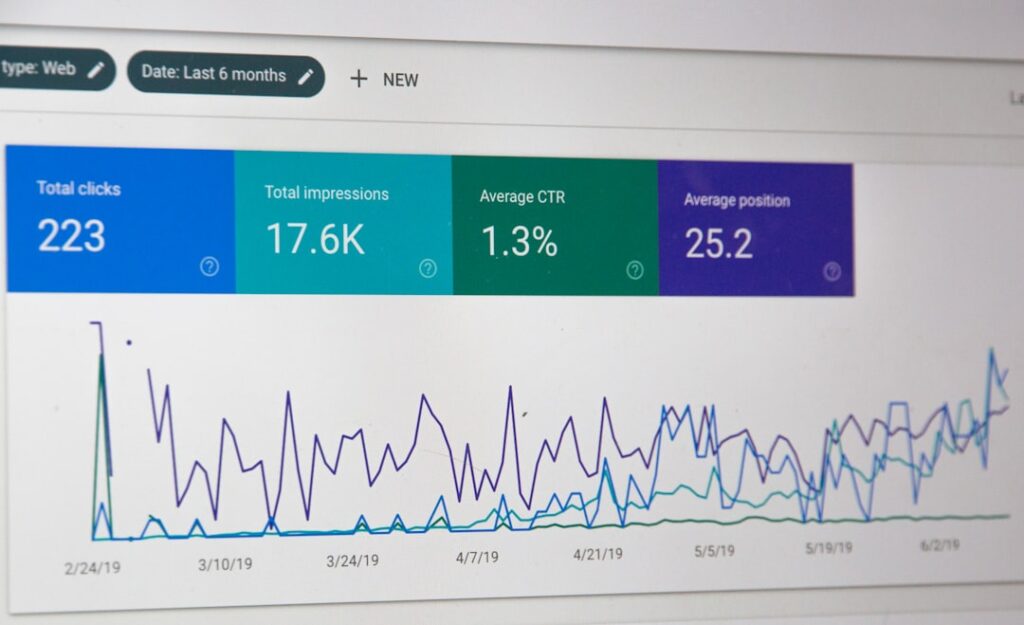
A/B testing is the scientific foundation of CRO. However, traditional testing has always suffered from two major bottlenecks: the speed of generating test variations and the time required to reach statistical significance.
AI streamlines both sides of this equation. First, AI handles hypothesis generation by scanning your historical GA4 data, identifying low-performing pages, and suggesting tests based on proven psychological triggers. Second, generative AI can write hundreds of copy variations in seconds, eliminating the creative logjam.
To understand how to structure these experiments within a broader growth strategy, explore CRO Optimization 101: How to Win at Digital Marketing. It details the strategic framework required to build a repeatable testing program.
Additionally, our guide on Conversion Rate Optimization (CRO) explains the math behind statistical significance and why rushing a test can lead to false positives. AI algorithms handle this complex math in the background, automatically monitoring confidence intervals and declaring winners with mathematical precision.
Multi-Armed Bandit Algorithms vs. Traditional Testing
One of the most powerful advancements in AI testing is the shift from traditional A/B testing to Multi-Armed Bandit (MAB) algorithms.
In a traditional A/B test, traffic is split evenly (50/50) between the original page and a variant. This split remains fixed until the test achieves statistical significance. If the variant is performing terribly, you still have to send 50% of your traffic to it for weeks, resulting in a high “opportunity cost” of lost sales.
Multi-Armed Bandit algorithms use reinforcement learning to solve this problem. As the test runs, the algorithm continuously monitors performance. If Variant A starts outperforming Variant B, the AI dynamically shifts more traffic to Variant A.
This minimizes your opportunity cost while still dedicating a small portion of traffic to Variant B to see if its performance improves over time. For fast-moving ecommerce stores, MAB algorithms ensure you never lose revenue for the sake of running an experiment.
Implementing AI Tools for Conversion Rate Optimization Safely
With great power comes great responsibility. Giving an autonomous AI agent control over your website’s content can feel incredibly daunting. To protect your brand, you must implement these tools with proper guardrails.
Here are the best practices for safe AI CRO implementation:
- Keep a Human in the Loop: Always configure your AI tools to “approval mode” initially. This allows you to review AI-generated copy and layout variations to ensure they match your brand voice and style guidelines before going live.
- Monitor Core Web Vitals: Adding heavy JavaScript snippets can slow down your site and harm your SEO. Choose lightweight AI tools (like Keak or CROAI) that load asynchronously and apply variations in under 100ms to prevent layout shifts.
- Protect Data Privacy: Ensure your AI tools are compliant with GDPR and CCPA. Avoid tools that record personally identifiable information (PII) in session recordings, and prioritize platforms that offer cookieless tracking options.
As we emphasize in Don’t Leave Money on the Table with Digital Marketing Conversion Rate Optimization, optimization should never come at the expense of your technical foundation or brand integrity. A fast, secure, and on-brand website is the ultimate prerequisite for conversion success.
Frequently Asked Questions About AI CRO
How does AI CRO differ from traditional CRO?
Traditional CRO is a slow, manual process relying on human analysts to pull data, formulate hypotheses, design static tests, and wait weeks for results. AI CRO automates the entire loop. It uses machine learning to identify friction points in real time, generate copy and design variations, and dynamically allocate traffic using predictive algorithms to find winners in days instead of months.
Will AI tools slow down my website’s page speed?
Not if you choose the right tools. Modern AI CRO platforms utilize lightweight, asynchronous JavaScript scripts that typically load in the background. Many top-tier platforms feature “anti-flicker” technology that applies visual variations in under 100ms, ensuring there is zero layout shift (CLS) and minimal impact on your Core Web Vitals or search engine rankings.
Can small businesses with low traffic benefit from AI CRO?
Yes! Traditional A/B testing requires thousands of visitors per month to achieve statistical significance. However, modern AI tools use “engagement-based” testing algorithms. Instead of waiting for a final purchase conversion, the AI measures micro-conversions (scroll depth, time on site, CTA clicks) to determine winning variations with a fraction of the traffic, making optimization accessible for startups and niche B2B stores.
Conclusion
The era of guessing why your website visitors aren’t buying is officially over. By integrating ai tools for conversion rate optimization into your marketing stack, you can transform your digital storefront from a static brochure into an intelligent, self-optimizing sales machine.
However, technology is only as good as the strategy behind it. While AI tools are incredibly efficient at running tests and generating copy, they still require human direction, brand alignment, and deep ecommerce expertise to deliver true, long-term ROI improvements.
That is where we come in. At Redline Minds, we specialize exclusively in ecommerce consulting, web development, and digital marketing for B2B, retail, and hybrid online stores. Operating from our home base in Tennessee, our expert team helps retailers design, build, and optimize high-converting online sales channels.
Ready to unlock your store’s true revenue potential? Partner with Redline Minds for Expert Conversion Optimization and let us help you turn your hard-earned traffic into loyal, repeat buyers.
Share this article
Tap into years of experience and turn your site’s visitors into buyers.
Related Posts
-
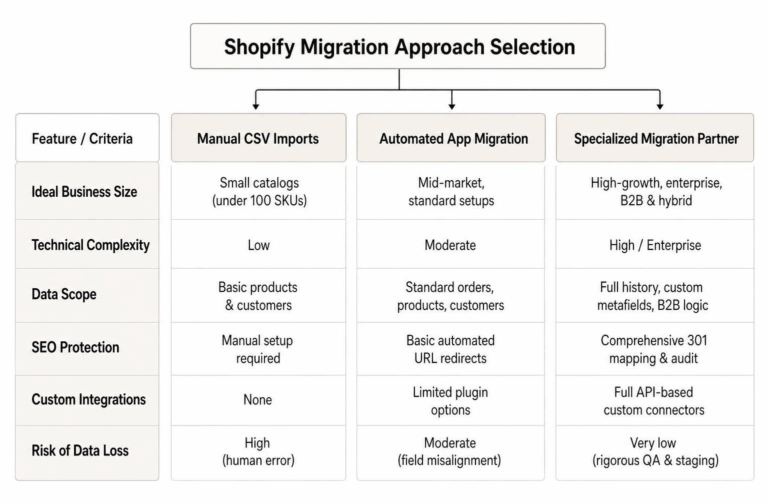
Compare Shopify Migration Services: Options Cheat Sheet
Compare Shopify migration services and find the right Shopify migration company for your store, from manual imports to…
-

Ultimate Checklist for Improving B2B Customer Experience
Ultimate Checklist for Improving B2B Customer Experience – Learn about b2b ecommerce customer experience
-

A Practical Guide to What to Sell Online for Profit
A Practical Guide to What to Sell Online for Profit – Learn about i don t know what…