
The Ultimate Guide to Types of E-Commerce Payment Systems

Why the Types of E-Commerce Payment System You Offer Can Make or Break Your Sales
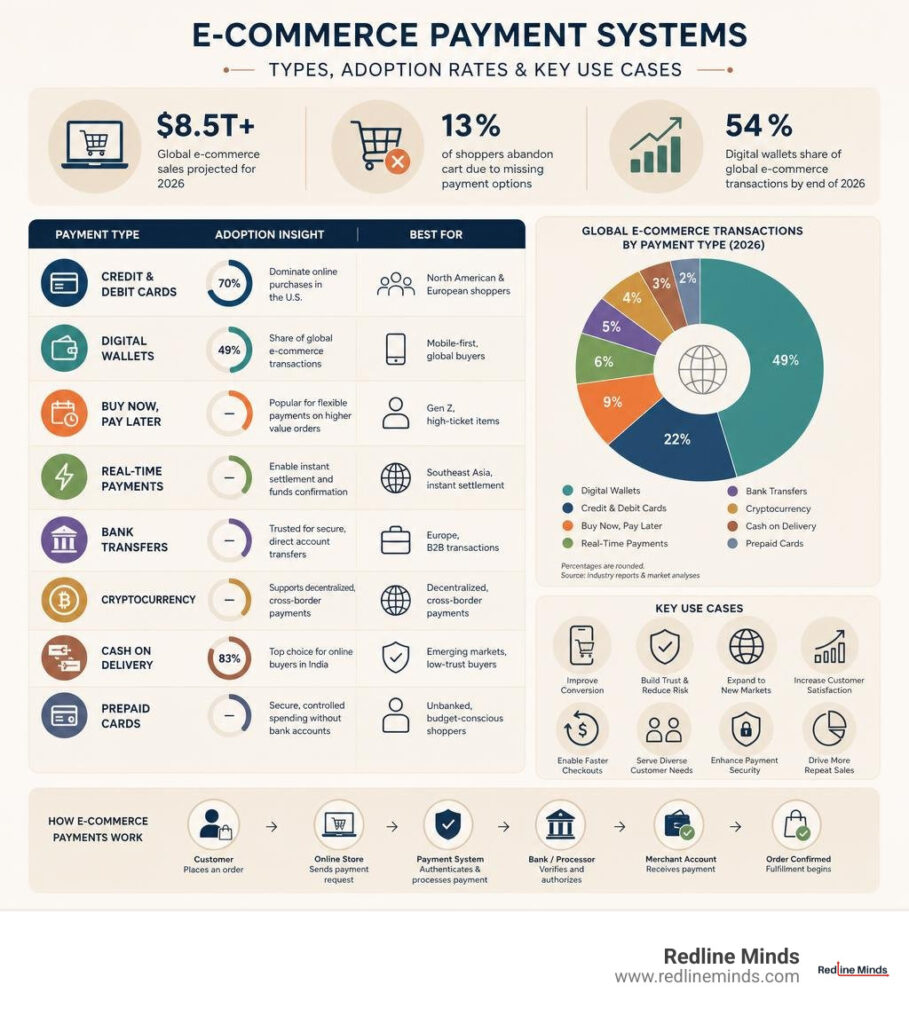
The types of e-commerce payment system you offer at checkout directly determine whether a customer completes their purchase — or leaves forever. Here’s a quick overview of the main categories:
| Payment Type | Examples | Best For |
|---|---|---|
| Credit & Debit Cards | Visa, Mastercard | North American & European shoppers |
| Digital Wallets | PayPal, Apple Pay, GCash | Mobile-first, global buyers |
| Buy Now, Pay Later | Afterpay, Klarna | Gen Z, high-ticket items |
| Real-Time Payments | PromptPay, QRIS, PayNow | Southeast Asia, instant settlement |
| Bank Transfers | ACH, iDEAL | Europe, B2B transactions |
| Cryptocurrency | Bitcoin, USDC | Decentralized, cross-border payments |
| Cash on Delivery | COD | Emerging markets, low-trust buyers |
| Prepaid Cards | Vanilla, Paysafecard | Unbanked, budget-conscious shoppers |
E-commerce sales are expected to exceed $8.5 trillion worldwide by 2026. Yet 13% of shoppers globally abandon their cart simply because their preferred payment method isn’t available.
That’s not a product problem. That’s a checkout problem.
If you’re running a mid-sized online store, the payment methods you support aren’t just a technical decision — they’re a revenue decision. Digital wallets alone now account for 49% of global e-commerce transactions and are projected to increase to 54% by the end of 2026. Meanwhile, credit cards still dominate in the U.S. at 70% of online purchases, and cash on delivery remains the top choice for around 83% of online buyers in India.
There is no single “best” payment system. There’s only the right mix for your customers, your market, and your products.
This guide breaks down every major payment type, explains how each one works, and gives you a clear framework for choosing the right combination — without overcomplicating your checkout or leaving money on the table.
What is an E-Commerce Payment System and How Does It Work?
At its core, an E-commerce payment system is the digital infrastructure that enables businesses to accept electronic payments for online transactions. It is a vital subcomponent of electronic data interchange (EDI), acting as the bridge between your online store, the customer’s financial institution, and your business bank account.
While clicking “buy now” takes only a second for a shopper, the underlying network of security protocols, financial intermediaries, and diverse payment methods is a complex ecosystem keeping global digital commerce alive. For a merchant, setting up the right Ecommerce Payment Options requires understanding three core components:
- The Payment Gateway: The customer-facing software that captures, encrypts, and securely transmits payment data from your website to the processor.
- The Payment Processor: The back-end engine that routes the transaction data through the appropriate card networks (like Visa or Mastercard) or alternative payment rails to authorize the transfer of funds.
- The Merchant Account: A specialized business bank account that temporarily holds approved transaction funds before they are settled into your primary business bank account.
The Role of Payment Gateways and Processors
To understand how these elements interact, it helps to look at the step-by-step transaction flow. When a customer initiates a checkout, the system undergoes a rapid sequence of encryption, authorization, and settlement.
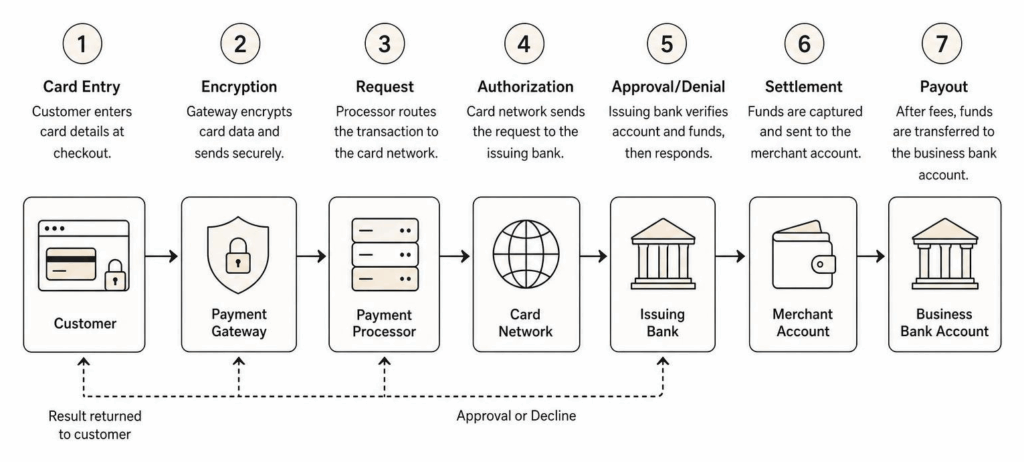
- Encryption: The customer enters their payment details at checkout. The payment gateway immediately encrypts this sensitive data using Transport Layer Security (TLS) and sends it securely to the payment processor.
- Authorization: The payment processor routes the transaction to the customer’s issuing bank (or payment provider) to verify that the account is valid and has sufficient funds.
- Approval/Denial: The issuing bank approves or declines the transaction, sending the status back through the processor and gateway to your website. This entire loop happens in a matter of seconds.
- Settlement: Once authorized, the funds are routed to your merchant account. After processing fees are deducted, the remaining balance is cleared and transferred to your primary business bank account.
For modern merchants, choosing a payment provider that offers seamless API integration or pre-built platform plugins is essential to keep this flow running smoothly without coding errors.
Understanding the Different Types of E Commerce Payment System
Selecting the right mix of payment options requires navigating a vast landscape of traditional and alternative technologies. Let’s look at how the main types of e-commerce payment system compare in terms of transaction speed, average merchant fees, and chargeback risk.
| Payment Category | Settlement Speed | Relative Merchant Fees | Chargeback/Fraud Exposure |
|---|---|---|---|
| Credit & Debit Cards | 2–3 Business Days | Moderate (1.5% – 3.5%) | High (120-day dispute window) |
| Digital Wallets | Instant to 1 Day | Moderate (2% – 4%) | Medium (Depends on linked source) |
| Buy Now, Pay Later | Instant (Upfront to Merchant) | High (2% – 8%) | Low (Provider absorbs customer risk) |
| Real-Time Payments | Instant | Low (Under 1% or Flat) | Zero (Irreversible by design) |
| Bank Transfers / ACH | 1–5 Business Days | Very Low (Often Flat Fee) | Low |
| Cryptocurrency | Near-Instant | Very Low (Around 1%) | Zero (Irreversible) |
| Cash on Delivery | Delayed (Logistics-dependent) | Variable (Carrier fees) | Medium (High refusal-at-door risk) |
Traditional Cards vs. Modern Types of E Commerce Payment System
Despite the rise of alternative payment methods, credit and debit cards remain foundational to global e-commerce. In North America, cards are still highly dominant, with credit cards accounting for 70% of online purchases in the U.S.
Debit cards are highly favored by merchants because they offer similar security and convenience to credit cards but usually incur much lower transaction fees. According to the Federal Reserve, debit card transaction fees can be as low as 0.74%, whereas credit card processing fees typically range from 1.5% to 3.5% per transaction.
However, relying solely on traditional cards carries distinct challenges. Card transactions carry the highest chargeback exposure, allowing consumers to dispute charges up to 120 days after a purchase. Additionally, cross-border card transactions face high friction from automated fraud screening rules applied by issuing banks, leading to false declines. For a deeper dive into optimizing card checkouts, see our guide, Click Pay Done Your Ultimate Guide To Online Payment Options.
Digital Wallets and Mobile Payments
Digital wallets act as secure, prepaid electronic accounts that store multiple debit cards, credit cards, or direct bank credentials. This eliminates the need for shoppers to manually re-enter their financial details during checkout, drastically reducing friction.
Digital wallet transactions have experienced explosive growth, soaring 62% year-over-year. They are projected to account for 54% of global e-commerce transactions by the end of 2026. This growth is heavily driven by mobile commerce, which is responsible for 59% of total retail e-commerce sales, accounting for $4.01 trillion.
Modern digital wallets rely heavily on tokenization—a security process that replaces sensitive card numbers with a unique, single-use digital identifier (or token) for each transaction. This ensures that even if a merchant’s database is breached, the customer’s actual card details are never exposed.
While PayPal and Apple Pay dominate Western markets, localized digital wallets are critical for international expansion. For instance, GCash in the Philippines has over 94 million users, and Touch ‘n Go eWallet in Malaysia has over 17.8 million users. If your checkout only supports standard credit cards in these regions, you are structurally locked out of the majority of the market.
Buy Now, Pay Later (BNPL) and Alternative Financing
Buy Now, Pay Later (BNPL) has quickly evolved from a trendy alternative to an essential checkout feature, particularly for Gen Z and Millennial shoppers who frequently avoid traditional credit cards.
BNPL services allow consumers to split their purchases into interest-free installments—typically four equal payments cleared over a short period. The major benefit for merchants is that the BNPL provider pays the merchant the full purchase amount upfront (minus processing fees) and assumes all risk of customer default. This has been shown to dramatically increase average order values (AOV) and conversion rates, as outlined in our article Splitting Bills And Thrills With Buy Now Pay Later Solutions.
However, this convenience comes at a cost. BNPL merchant transaction fees are among the highest in the industry, ranging from 2% to 8% of the total sale. Merchants must weigh these higher fees against the projected boost in conversion and order value.
Real-Time Payments and Direct Bank Transfers
Real-time payments (RTP) and direct bank transfers represent a massive shift toward card-free digital commerce. Unlike traditional card networks, real-time payments run on government-backed, national payment rails that allow instant, bank-to-bank transfers via mobile devices.
Examples of highly successful real-time payment systems include:
- QRIS (Indonesia): A unified national QR code standard operated by Bank Indonesia.
- PromptPay (Thailand): Thailand’s national real-time payment rail, allowing instant transfers using a mobile number or citizen ID.
- iDEAL (Netherlands): A direct bank transfer system that accounts for the vast majority of e-commerce transactions in the Dutch market.
For merchants, real-time payments are highly attractive. They offer near-instant settlement and carry virtually zero chargeback exposure because the transactions are authorized directly by the buyer through their secure banking app. This makes them irreversible by design. To learn more about how these modern architectures operate, read about the different Types Of Electronic Payment Systems.
Cryptocurrencies and Decentralized Payments
Cryptocurrency payments utilize decentralized blockchain networks to record transactions on a public ledger, eliminating traditional financial intermediaries.
While still considered an alternative method, the utility of crypto for cross-border B2B transactions and tech-forward consumer niches is growing. Accepting cryptocurrencies like Bitcoin or stablecoins (such as USDC) allows merchants to bypass expensive cross-border wire fees and currency conversion costs. Crypto transactions typically incur processing fees of around 1%, and because they are recorded on a blockchain, they are completely immune to chargebacks. For a forward-looking perspective on this technology, check out the Future Of Online Payments.
Cash on Delivery (COD) and Offline-Adjacent Methods
While it may seem counterintuitive in a digital-first world, Cash on Delivery (COD) remains a crucial tool for overcoming trust and infrastructure barriers in emerging markets. In some regions, COD is preferred by customers who are unbanked, technologically challenged, or hesitant to share financial details online. For example, around 83% of customers in India have historically preferred COD when purchasing online.
- Pros of COD: Opens access to cash-reliant demographic segments; builds initial trust with cautious buyers who want to inspect physical goods before paying.
- Cons of COD: High operational risk; increased rates of delivery refusal (where customers change their mind before the courier arrives); delayed cash flow as logistics partners hold cash before transferring it to the merchant.
Choosing the Right Payment Methods for Your Business
With so many types of e-commerce payment system available, the goal is not to offer every single option, but to design a highly strategic payment mix. Over-cluttering your checkout with too many logos creates decision fatigue, which can actually increase cart abandonment.
Instead, we recommend using a structured selection framework based on:
- Your Target Demographics: Younger cohorts (Gen Z/Millennials) expect BNPL and mobile-first wallets. Older demographics prefer traditional credit cards and bank-direct options.
- Geographical Footprint: If you sell globally, you must localize. Treating global markets with a “one-size-fits-all” card checkout will lead to low conversion rates.
- Average Order Value (AOV): Low-ticket items benefit from quick, one-click digital wallets. High-ticket items require BNPL or flexible financing options to ease the purchase decision.
Selecting the Best Types of E Commerce Payment System for B2B
At Redline Minds, we specialize in B2B and hybrid e-commerce stores. B2B transactions differ significantly from consumer retail; they involve larger order volumes, complex approval workflows, and distinct payment terms.
If you are running a B2B or hybrid store, your payment system must support business-specific options:
- Trade Credit and Net Terms: Allowing pre-approved corporate buyers to purchase goods on Net 30 or Net 60 terms.
- Purchase Orders (PO): The ability for buyers to upload PO numbers at checkout for internal corporate accounting.
- ACH and Wire Transfers: Direct bank routing is essential for high-value B2B orders where credit card limits would be exceeded or card transaction fees would decimate profit margins.
Implementing these systems requires robust platform integration to ensure that credit limits and customer-specific pricing are calculated accurately in real time.
Common Mistakes Merchants Make When Selecting Payment Systems
Through our e-commerce consulting work, we frequently see merchants fall into the same three traps:
- The “Cards-First” Assumption: Assuming that because credit cards work well in North America, they will suffice globally. This structurally excludes millions of buyers in mobile-first and cash-reliant economies.
- Checkout Clutter: Adding dozens of alternative payment buttons to the checkout page, creating visual chaos and distracting the buyer from completing the purchase.
- Neglecting Mobile Optimization: Failing to test how digital wallet redirects and authentication screens perform on mobile devices. If a customer has to jump through multiple slow redirects on their phone, they will abandon the cart.
Security, Fraud Prevention, and Compliance
Accepting payments online comes with the strict responsibility of protecting sensitive customer data. To safeguard your business and your buyers, you must implement robust Online Transaction Security Measures.
- PCI DSS Compliance: The Payment Card Industry Data Security Standard (PCI DSS) is a mandated set of security requirements for any business that accepts, transmits, or stores cardholder data. Using a hosted payment gateway can shift much of this compliance burden off your servers.
- Multi-Factor Authentication (MFA) & 3D Secure: Modern protocols like 3D Secure (3DS) add an extra layer of verification, requiring shoppers to approve transactions via their banking app or a one-time SMS code. This significantly reduces unauthorized card use.
- Machine Learning Fraud Detection: Leading payment processors utilize real-time AI to analyze IP addresses, geolocation, and shopping behavior to flag and block high-risk transactions before they are processed.
Additionally, merchants must ensure their e-commerce platform is integrated with automated tax compliance software to handle the complexities of Collecting Sales Taxes Correctly across different jurisdictions.
Frequently Asked Questions about E-Commerce Payments
What is the most popular e-commerce payment system globally?
Globally, digital wallets are the most popular payment system, accounting for approximately 49% of all e-commerce transactions. However, payment dominance is highly regional. Credit cards remain the leader in the United States, while real-time payment rails and local mobile wallets dominate in regions like Europe and Southeast Asia.
How do payment gateways differ from payment processors?
The payment gateway acts as the secure digital portal on your website that captures and encrypts the customer’s payment details. The payment processor is the back-end service that takes that encrypted data, communicates with the card networks and banks, and executes the actual transfer of funds.
Why do customers abandon their carts at checkout?
Cart abandonment is heavily driven by checkout friction. The most common causes include unexpected shipping costs, a forced account creation process, a cluttered interface, and the absence of the customer’s preferred payment method. Offering a diverse, localized, and mobile-optimized selection of payment methods directly reduces these drop-offs.
Conclusion
Optimizing the types of e-commerce payment system you offer is one of the most effective levers for driving revenue growth, lowering transaction costs, and improving customer loyalty. In a highly competitive digital landscape, your checkout experience should be a seamless, frictionless gateway—not a barrier.
At Redline Minds, we specialize in helping B2B, hybrid, and D2C online retailers design, build, and optimize high-converting e-commerce channels. From selecting the right payment gateways to integrating complex ERP systems and automating tax compliance, our team of Tennessee-based experts is here to guide you.
Ready to eliminate checkout friction and scale your online sales? Let us help you build a robust ecommerce payment strategy tailored to your unique business model. Reach out to Redline Minds today.
Share this article
Tap into years of experience and turn your site’s visitors into buyers.
Related Posts
-
Compare Shopify Migration Services: Options Cheat Sheet
Compare Shopify migration services and find the right Shopify migration company for your store, from manual imports to…
-
Ultimate Checklist for Improving B2B Customer Experience
Ultimate Checklist for Improving B2B Customer Experience – Learn about b2b ecommerce customer experience
-

A Practical Guide to What to Sell Online for Profit
A Practical Guide to What to Sell Online for Profit – Learn about i don t know what…