
A Practical Guide to AI Agent Integration Methods

Why AI Agent Integration Turns Automation Into Real Work
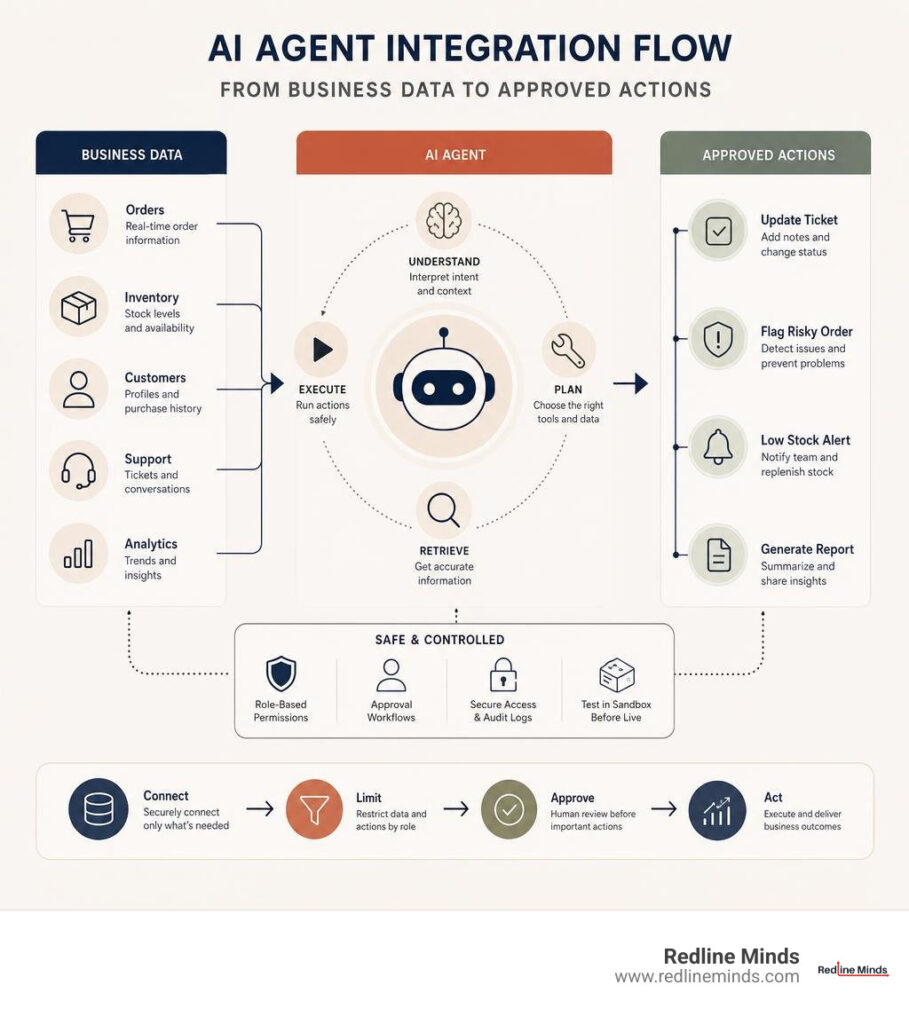
AI agent integration connects an AI agent to the data and systems it needs to do useful work. For an online retailer, that can mean letting an agent securely read order, inventory, CRM, and support data – then take approved actions, such as updating a ticket, flagging a risky order, or alerting a team when stock runs low.
A practical starting point is simple:
- Choose one high-value workflow with a clear outcome.
- Connect only the data sources the agent needs.
- Limit which actions it can take, using role-based permissions and approval steps.
- Test in a sandbox before allowing live updates.
Without integrations, an AI agent can write and reason, but it works from incomplete or outdated context. With the right connections, it can retrieve current business information and act across the tools your team already uses.
For ecommerce teams, this matters because sales and operations depend on fast, accurate decisions. An agent that can check inventory, order status, customer history, and support tickets can reduce manual switching between systems while helping staff respond faster.
The key is to treat integration as more than plugging in an API. Reliable agent workflows need clean data, clear tool rules, secure access controls, event-based updates, and a way to catch errors before they affect customers.
Modern Frameworks and AI Agent Integration Architecture
Integrating an AI agent into an enterprise technology stack transforms static machine learning models into dynamic operational partners. Modern architectures decouple raw large language model (LLM) reasoning from external execution environments. Instead of hard-coding every step of an automated routine, the system presents the model with structured tool definitions, OpenAPI specifications, and type-safe parameter requirements. The agent evaluates user intent, identifies the missing information or desired goal, and dynamically decides which tools to invoke.

This architectural shift hinges on four technical pillars: dynamic tool calling, runtime context injection, bidirectional state persistence, and deterministic schema enforcement. When an agent receives an operational request, it constructs an internal plan, validates parameter types against strict schemas (such as Pydantic models or JSON Schema), and dispatches calls to connected endpoints. Because LLM context windows carry token overhead and inference costs, modern integration frameworks prioritize concise payloads and sub-100ms API response times to prevent compounding latency across multi-step execution loops.
Data vs. Action AI Agent Integration
Production-ready agent deployments divide integrations into two foundational categories:
- Data Integration (Read-Level Context): Grants the agent read-only access to internal knowledge bases, inventory catalogs, ERP records, and transaction histories. Data integration allows an agent to understand the current state of a business without the risk of altering records.
- Action Integration (Write-Level Execution): Empowers the agent to perform deterministic state changes across external software. This includes generating customer invoices, updating shipping statuses, mutating CRM deal stages, and modifying database entries.
In ecommerce environments, combining these two layers enables teams to offer great customer support in ecommerce by allowing an agent to read recent tracking numbers from a logistics portal and immediately update an open ticketing conversation with accurate delivery windows.
Grounding Agents with RAG Pipelines and Data Normalization
Retrieval-Augmented Generation (RAG) grounds agentic reasoning in verified, authoritative enterprise data. When an agent processes unstructured data like PDF spec sheets, policy docs, or historical customer emails, ingestion engines extract text via optical character recognition and natural language parsing, split the text into semantic chunks, and generate dense vector embeddings.
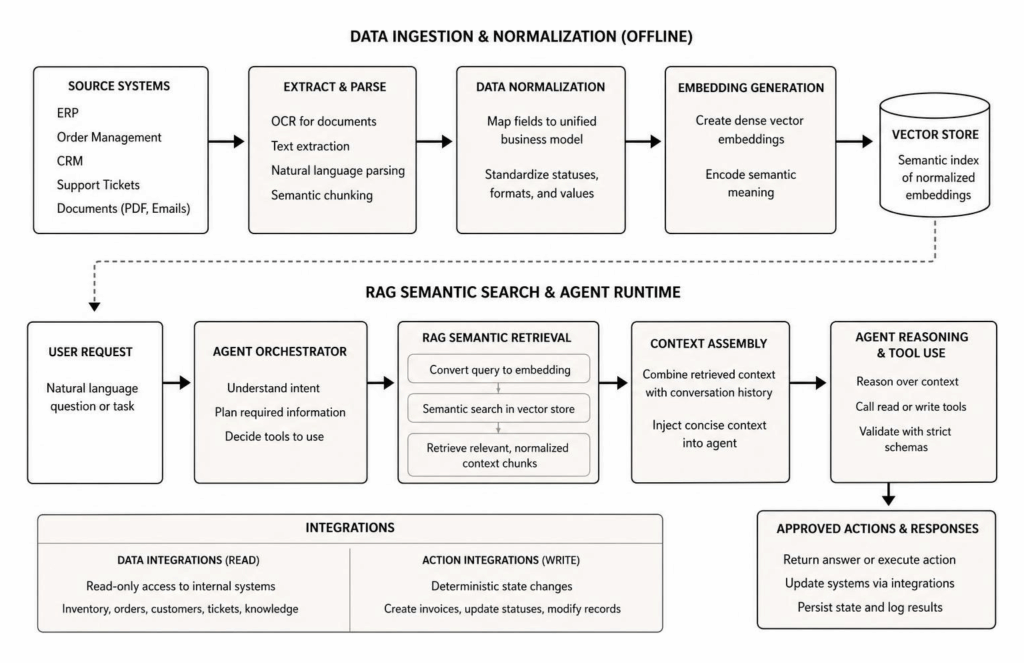
Data normalization across disparate systems is vital. If an ERP defines order fulfillment as COMPLETED while an order management system labels it SHIPPED_CLOSED, un-normalized data injected into an embedding index creates vector drift and agent hallucinations. Normalizing records into standardized unified models guarantees high semantic search precision. Developers building custom Python architectures can use the official OpenAI Agents SDK Documentation to establish structured function interfaces, sandboxed execution runtimes, and guardrails for their data retrieval workflows.
Primary Connectivity Methods: MCP, Unified APIs, and Custom Code
Engineering teams must select an integration method that balances development speed, system maintenance, and protocol standardization.
| Integration Method | Architectural Paradigm | Ideal Use Case | Primary Trade-Off | Maintenance Overhead |
|---|---|---|---|---|
| Custom Native APIs | Direct, bespoke REST/GraphQL endpoints | Proprietary internal systems requiring tailored logic | High engineering resource commitment | High; internal team maintains each connector |
| Unified APIs | Standardized data abstraction layer | Multi-tenant SaaS data synchronization (CRM, HRIS, ERP) | Limited to common denominator schema fields | Low; vendor handles upstream API updates |
| Model Context Protocol (MCP) | Open-standard client-server tool protocol | Dynamic, runtime tool calling across decentralized tools | Emerging ecosystem; requires dedicated server hosts | Moderate; standard protocol minimizes custom wrapper code |
Selecting the right strategy requires understanding the ins and outs of finding reliable technology services to ensure that your external development partners implement architectures capable of scaling without constant engineering refactoring.
Model Context Protocol (MCP) and Standardized Tool Calling
The Model Context Protocol (MCP) is an open standard designed to simplify how models interface with external data sources and execution tools. Rather than writing custom API wrappers for every database or external SaaS platform, developers deploy MCP servers that expose standardized tool manifests, prompts, and context resources.
MCP-enabled agents query the server’s manifest, inspect input requirements, and call exposed endpoints dynamically. Leading MCP implementations introduce less than 100ms of overhead per tool call, making them well-suited for interactive conversational applications and real-time operations. To understand how MCP standardizes connections across distributed environments, watch this Model Context Protocol and agent integration guide for a practical breakdown of the protocol’s client-server mechanics.
Unified APIs and Embedded Integration Platforms
Unified APIs aggregate dozens of disparate software tools within a vertical into a single, standardized data model. Instead of maintaining 20 unique integrations for different ERP or ticketing systems, your engineering team connects to a single unified schema.
Unified platforms manage OAuth credential lifecycles, automated token refreshes, rate-limiting queues, and schema drifts behind an abstraction layer. Building custom observability tools to handle multi-platform integrations can take an internal engineering team at least 3 months of dedicated effort. Leveraging unified abstraction layers frees your developers to focus on core agent differentiation rather than updating brittle API connectors.
Agent-to-Agent (A2A) Protocols and Multi-Agent Handoffs
Complex enterprise workflows frequently overwhelm a single, monolithic agent. Multi-agent systems solve this through delegated reasoning, where a triage or supervisor agent delegates specialized subtasks to dedicated sub-agents.
Delegation occurs either by treating sub-agents as callable tools or by executing stateful handoffs where conversation context and working memory transfer entirely to the specialist. For developers working in Python, inspecting the OpenAI Agents SDK GitHub Repository reveals how primitives like Handoffs and Agents as Tools streamline multi-agent orchestration without excessive boilerplate code.
Security, Governance, and Operational Reliability
Deploying autonomous agents requires strict enterprise security boundaries. When an agent possesses write-level access to databases and billing tools, traditional API security models must be upgraded with agentic governance layers to prevent prompt injection vulnerabilities, unauthorized data exposure, and catastrophic execution loops.

Enterprises must establish an explicit IT services definition and scope that establishes strict security policies, SOC 2 compliance baselines, and clear accountability for automated decisions.
Access Control Lists and Role-Based Guardrails
An AI agent must never inherit unrestricted administrative access to connected tools. Implementing Access Control Lists (ACLs) and fine-grained Role-Based Access Control (RBAC) ensures the agent executes tasks strictly within the permission scope of the currently authenticated end user.
- User-Level OAuth Scoping: Ensure the agent acts on behalf of the user’s specific session token rather than a broad, administrative API key.
- Input and Output Guardrails: Validate user inputs against adversarial prompt injections and sanitize agent outputs to prevent data exfiltration.
- Tool-Level Permission Boundaries: Restrict destructive database operations (such as deleting user accounts or issuing batch refunds) to authenticated administrative personas.
Sandboxed Execution Environments and Human-in-the-Loop Gates
When an agent writes or executes dynamic code, runs shell commands, or patches files, that execution must occur within isolated, ephemeral container sandboxes. Containerized sandboxes isolate system environments, preventing rogue execution cycles from accessing underlying network resources.
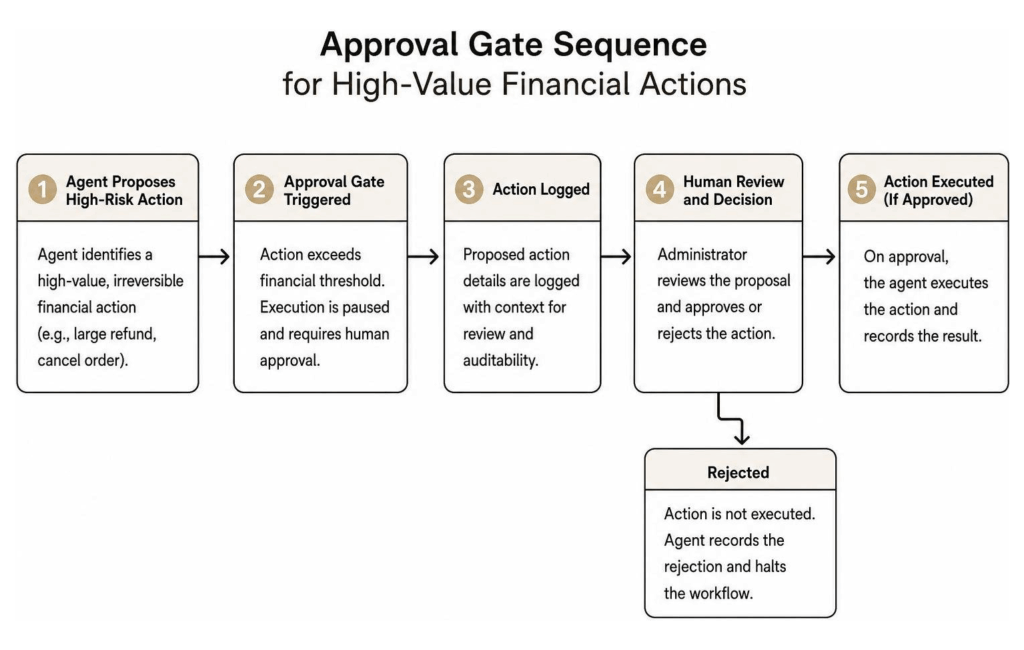
Furthermore, integration architectures should enforce approval gates for high-risk, irreversible operations. For actions exceeding financial thresholds—such as issuing refunds over a specific amount or canceling wholesale purchase orders—the agent pauses execution, logs the proposed action, and waits for a human administrator’s explicit approval. For step-by-step guidance on designing approval boundaries and tool calling pipelines, review the Agent.ai Tools & Integration Documentation.
Real-Time Event Handling with Webhooks and Tracing
Polling third-party APIs repeatedly creates unacceptable network overhead, exhausts rate limits, and slows response times. Enterprise agent integration relies on webhook listeners to trigger agent workflows instantly upon upstream system events (such as an order placement, inventory drop, or payment failure).
To maintain operational reliability, integrate OpenTelemetry tracing across all agent endpoints. Tracing captures complete execution graphs: the original user prompt, retrieved vector contexts, generated tool-calling payloads, third-party API latency metrics, and error codes. When an external SaaS provider changes its API schema, tracing highlights the exact payload failure point immediately.
Step-by-Step Deployment for Ecommerce and Enterprise Workflows
For online retailers and B2B distributors, deploying AI agents can significantly optimize back-office operations and customer-facing experiences. Integrated agents handle order status lookups, update inventory levels across warehouse channels, and recommend complementary products based on live ERP purchase histories.
Integrating intelligent systems with your storefront technology allows businesses to leverage specialized AI tools for conversion rate optimization to deliver hyper-personalized user journeys and streamlined checkout flows.
Step-by-Step Roadmap for Practical AI Agent Integration
Deploying an integrated AI agent requires a methodical, step-by-step engineering rollout:
- Scope the Operational Objective: Identify a single repetitive task with measurable ROI (e.g., automated returns processing or B2B quote drafting).
- Audit and Select APIs: Inventory target data systems (ERP, CRM, OMS) and verify endpoint availability, rate limits, and webhook support.
- Establish Data Normalization Pipelines: Map external schemas to clean internal data structures and populate vector databases for retrieval grounding.
- Configure Access Scopes and Guardrails: Enforce least-privilege API permissions, user-level token authorization, and automated input/output safety checks.
- Implement Sandbox and Human Approval Gates: Test execution loops in isolated sandbox environments with human-in-the-loop gates on destructive mutations.
- Deploy Webhook Triggers and Observability: Connect real-time event listeners and activate OpenTelemetry distributed tracing.
- Staged Rollout and Continuous Evaluation: Release the integration to a small subset of internal users, monitor tool accuracy, and refine system prompts.
Real-World Applications: Fraud Detection and Support Automation
A compelling demonstration of integrated agentic workflows is automated claims analysis and fraud prevention in modern ecommerce. When an order is placed or a refund is requested, an autonomous fraud agent reads customer purchase history from the CRM, cross-references shipping telemetry from logistics partners, and compares claims data against known risk profiles.
In real-world implementations, AI-powered claims analysis alone has prevented an estimated €100K in fraud over five months, with the entire fraud prevention initiative projected to save €1.2M annually. Remarkably, using modern low-code integration layers, teams have built functional fraud detection systems in one week without engineering support.
Frequently Asked Questions about Agent Connectivity
What is the difference between traditional API integration and AI agent integration?
Traditional API integration links systems through static, hard-coded logic paths where an event in System A strictly triggers a predetermined update in System B. AI agent integration uses an LLM reasoning engine to dynamically choose which endpoints to call, evaluate intermediate response data, adapt parameters to novel situations, and chain multi-step tools together autonomously to achieve a high-level goal.
When should businesses choose Model Context Protocol over Unified APIs?
Choose Model Context Protocol (MCP) when building autonomous agents that require dynamic, runtime discovery of specialized local or remote tools and decentralized context servers. Choose Unified APIs when the primary requirement is syncing large volumes of normalized, structured data across common multi-tenant SaaS platforms (such as aggregating CRM or ticketing data) via reliable, static background pipelines.
How do integrations prevent hallucinations in enterprise AI agents?
Integrations prevent hallucinations by grounding the agent’s generative reasoning in authoritative, real-time enterprise data. Rather than relying entirely on static training weights, the agent queries external databases, ERP records, and verified knowledge bases via RAG pipelines or direct API calls, inserting factual context directly into the prompt before generating an answer.
Conclusion
AI agent integration is the critical bridge turning isolated language models into capable, autonomous digital team members. By connecting reasoning engines to real-time data layers and secure execution APIs, businesses eliminate operational silos, automate manual cross-system tasks, and build scalable ecommerce workflows.
Building reliable agent architectures requires deep expertise in API design, data harmonization, security guardrails, and storefront systems. We invite you to explore our specialized ecommerce and AI integration services at Redline Minds to discover how our team helps retailers and B2B enterprises design, build, and scale future-ready automation infrastructure.
Share this article
Tap into years of experience and turn your site’s visitors into buyers.
Related Posts
-

A Practical Guide to AI Agent Integration Methods
Learn how AI agent integration connects enterprise systems with MCP, Unified APIs, and custom code for secure, real-time…
-

The Definitive Guide to AI Agent Commerce
Explore how AI agent commerce transforms shopping with autonomous agents, new protocols, and secure payments in this 2026…
-

Ultimate Checklist for Conversion Rate Optimization Tools
Discover the best conversion rate optimization tools and strategies to boost conversions, lower costs, and grow your ecommerce…