
Beyond the Numbers: A Guide to Ecommerce SEO Analytics

What Is Ecommerce SEO Analytics (And Why It Matters for Your Store)
Ecommerce SEO analytics is the practice of tracking, measuring, and interpreting data from your online store’s organic search performance to drive more traffic, conversions, and revenue.
Here’s what it covers at a glance:
| Area | What It Measures |
|---|---|
| Technical SEO | Crawlability, indexing, site speed, Core Web Vitals |
| Keyword Performance | Rankings, search intent, organic click-through rates |
| Traffic & Acquisition | Organic sessions, traffic sources, new vs. returning visitors |
| Conversions | Conversion rate, average order value (AOV), cart abandonment |
| Customer Value | Customer lifetime value (CLV), repeat purchase rate |
Running an online store between $1M and $10M in annual sales means every traffic source counts. Paid ads are expensive. Social is unpredictable. But organic search – when done right – compounds over time.
The problem? Most store owners track some data but don’t connect it to actual revenue. They know their traffic went up, but not why. Or they see a drop and don’t know where to start.
That’s exactly what this guide fixes.
AI Overviews and answer engines are reshaping search, with studies showing organic clicks can drop by up to 64% when AI results appear. Understanding your SEO data isn’t optional anymore – it’s how you stay visible.
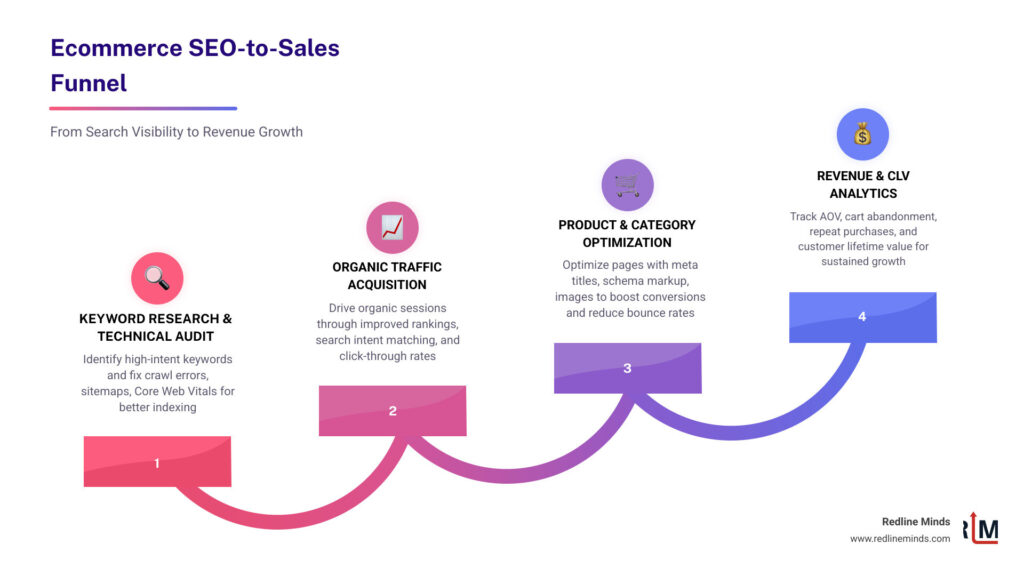
The Strategic Importance of Ecommerce SEO Analytics
In the world of online retail, staying ahead of the competition requires more than just a gut feeling; it requires a robust strategy that leverages data-driven insights. At Redline Minds, we often see stores that treat SEO like a “set it and forget it” task. But without ecommerce SEO analytics, you are essentially flying a plane without a dashboard.

When we talk about the strategic importance of these analytics, we are looking at how data bridges the gap between marketing efforts and actual sales. It’s about understanding the “why” behind your customer’s journey. Why did they land on your category page but leave before clicking a product? Why is one specific blog post driving 40% of your new leads?
For B2B and hybrid stores, the stakes are even higher. Your customers often have longer decision-making cycles and higher order values. If your SEO strategy isn’t backed by analytics, you might be optimizing for keywords that bring in “window shoppers” rather than procurement officers ready to buy in bulk. To get a better handle on the basics, you might want to start with our guide on What is SEO? How to Do SEO for Ecommerce.
Defining Ecommerce SEO Analytics for Growth
At its core, ecommerce SEO analytics involves the detailed tracking and analysis of data from your online marketing campaigns, website traffic, customer engagement, and sales conversions. It is the process of linking your organic search visibility directly to your bottom line.
This isn’t just about checking your rank on Google. It’s about marketing attribution—knowing which touchpoints led to a sale. For example, a customer might find you through an informational blog post, return later via a direct search, and finally purchase after seeing a retargeting ad. Analytics helps you see the role SEO played in that first discovery.
A critical tool in this process is Search Console Documentation. Google Search Console (GSC) provides the raw data on how Google sees your site, which keywords are actually triggering impressions, and where your click-through rates (CTR) are lagging. By integrating GSC data with your sales platform, you can begin to see which queries actually put money in the bank.
Why Data-Driven SEO is Essential for Online Stores
Data-driven SEO is essential because it allows us to identify and fix leaks in the conversion funnel. Ecommerce sites are notoriously complex. With thousands of products, dozens of categories, and dynamic content, things break easily.
Analytics allows us to monitor:
- Bounce Rates: Are people landing on your pages and leaving immediately? This often signals a mismatch between the search query and your content.
- User Behavior: Using reports like the User Flow in Google Analytics, we can see the path shoppers take. If they are looping back and forth between the cart and a shipping info page, you’ve got a UX problem that’s killing your SEO-driven conversions.
- ROI: We can calculate exactly what an organic visitor is worth compared to a paid visitor. Often, organic visitors have a higher Customer Lifetime Value (CLV) because they found you while looking for a solution, rather than being “interrupted” by an ad.
For more actionable advice, check out our Top SEO Tips for Online Stores.
Technical Foundations: Auditing for Search Visibility
Before you can analyze your success, you have to make sure your site is actually “readable” by search engines. Ecommerce sites face unique technical challenges like URL parameters, pagination, and massive amounts of dynamic content.
A technical SEO audit is like a routine check-up for your online store. Instead of waiting for traffic to drop, we use audits to spot issues before they impact the bottom line. This is especially true for stores using platforms like Magento or Shopify, where a single plugin update can accidentally “noindex” half your catalog. Our SEO Checklist for Ecommerce is a great place to start your audit journey.
Optimizing Site Architecture and Crawl Depth
Site architecture is how your pages are organized and linked together. For ecommerce, we generally aim for a “flat” structure. This means a user (and a search engine bot) should be able to reach any product on your site in three clicks or fewer from the homepage.
Key elements include:
- Faceted Navigation and Filters: These are great for users (e.g., “Blue,” “Size XL,” “Under $50”), but they can create thousands of duplicate URLs that waste your crawl budget.
- Canonical Tags: We use canonical tags to tell Google, “Hey, even though there are five versions of this page based on filters, this one is the ‘master’ page you should index.”
- Crawl Depth: If your products are buried ten clicks deep, Google might never find them. We use internal linking and breadcrumbs to pull those pages closer to the surface.
If your store uses complex filtering, the URL parameter crawl tool in GSC is your best friend. It lets you set rules for how Google should treat those messy URLs, ensuring only your high-value pages get indexed.
Core Web Vitals and Performance Metrics
Google has made it very clear: site speed is a ranking factor. They use Core Web Vitals to measure the real-world user experience of your pages.
- LCP (Largest Contentful Paint): How fast does the main content load? Aim for under 2.5 seconds.
- CLS (Cumulative Layout Shift): Does the page jump around while loading? (Super annoying for shoppers trying to click “Add to Cart”). Aim for a score under 0.1.
- INP (Interaction to Next Paint): How responsive is the site when a user clicks a button?
For ecommerce, these metrics directly impact bounce rates. Google has reported that the probability of a bounce increases by 32% as page load time goes from 1 second to 3 seconds. You can read more about why this matters in our post: Google Core Vitals Ecommerce Sites Should You Worry.
Leveraging Structured Data for Product Visibility
Structured data, or schema markup, is a piece of code you add to your site to help search engines understand your content. For ecommerce, this is what allows your products to show up in search results with “Rich Snippets”—those shiny gold stars, prices, and “In Stock” labels.
Using JSON-LD format for Product and Review schema is the industry standard. It gives shoppers confidence before they even click. You can (and should) test your implementation using Google’s Rich Results Test to ensure everything is firing correctly.
Essential KPIs for Measuring Ecommerce SEO Analytics
If you aren’t measuring the right things, you’re just looking at pretty graphs. In ecommerce SEO analytics, we divide metrics into two main buckets: Acquisition (getting them there) and Retention (keeping them coming back).
| Acquisition Metrics | Retention & Value Metrics |
|---|---|
| Organic Sessions | Repeat Purchase Rate |
| Keyword Rankings | Customer Lifetime Value (CLV) |
| Click-Through Rate (CTR) | Average Order Value (AOV) |
| New Visitor Ratio | Revenue per User |
To track these effectively, you need a properly configured Google Analytics account. We also highly recommend setting up Google Analytics Campaign Tracking to see how your different SEO efforts (like guest posting or email marketing) contribute to the whole.
Tracking Conversion Rates and Average Order Value
The ultimate goal of SEO isn’t traffic; it’s sales. This is where the Conversion Rate (CR) and Average Order Value (AOV) come in.
If your organic traffic is high but your CR is low, you might be ranking for the wrong keywords. For instance, ranking for “how to fix a faucet” is great for a blog, but if you sell high-end faucets, those visitors might not be ready to buy.
To get the full picture, we use the Enhanced Ecommerce library and hit types. This allows you to see the “Checkout Behavior Analysis” report. You can see exactly where people drop off—is it at the shipping calculation? The payment entry? This data tells you if your SEO traffic is hitting a wall at the finish line.
Analyzing Customer Lifetime Value (CLV) through Ecommerce SEO Analytics
Customer Lifetime Value (CLV) is the total amount of money a customer is expected to spend in your store during their lifetime. SEO is a powerful tool for increasing CLV because it helps build brand authority and trust.
By using customer segmentation, we can see which organic keywords brought in your most loyal customers. Do people who find you through “B2B industrial supplies” stay longer than those who find you through a “discount” keyword?
Integrating your analytics with CRM systems allows you to see the full story. You can identify your “whales”—the high-value repeat buyers—and look back at the original SEO path they took to find you. This is the “secret sauce” for scaling a B2B or hybrid store.
Advanced Keyword Intelligence and Content Strategy
Keyword research for ecommerce is a different beast than for a standard blog. We aren’t just looking for volume; we are looking for commercial intent.
A search query like “best running shoes” has research intent (MOFU), while “buy Nike Air Zoom size 11” has high commercial intent (BOFU). We want to target both, but we measure them differently. If you want to dive deep into becoming a pro, check out How to Become an SEO Expert for Your Ecommerce Site.
Mapping Search Intent to the Product Journey
We categorize keywords into stages of the buyer’s journey:
- TOFU (Top of Funnel): Educational queries. “Why are my feet sore after running?”
- MOFU (Middle of Funnel): Comparison queries. “Nike vs. Adidas running shoes.”
- BOFU (Bottom of Funnel): Transactional queries. “Nike Air Zoom price.”
Understanding Search intent is crucial. If you try to rank a product page for a TOFU keyword, you will likely fail because Google wants to show a blog post or a guide for that query. Use the Google Keyword Planner to find these variations and map them to the right pages on your site.
On-Page Optimization for Category and Product Pages
Every page on your site should have a job.
- Category Pages: These are your “hubs.” They should target broader, higher-volume keywords.
- Product Pages: These are your “closers.” They should target specific long-tail keywords, including SKUs, colors, and technical specs.
Don’t just copy and paste manufacturer descriptions! That’s a one-way ticket to “Duplicate Content Jail.” Write unique, benefit-driven copy. Optimize your meta titles (keep them under 60 characters) and meta descriptions (around 160 characters). And don’t forget image alt text—it’s not just for accessibility; it’s a great way to show up in Google Image search. For a list of tools to help with this, see our Best SEO Tools for Ecommerce.
Future-Proofing: AI Search and 2026 Trends
The world of search is changing faster than ever. By 2026, the concept of “SEO Everywhere” will be the norm. This means optimizing not just for Google, but for AI “answer engines” like ChatGPT, Perplexity, and Gemini.
Recent studies conducted by Semrush show that when AI Overviews appear, traditional organic clicks can drop significantly. However, being the source that the AI cites can lead to high-quality, high-intent traffic.
Adapting to Generative AI and LLM Visibility
To stay visible in an AI-driven world, your brand needs to be mentioned across the web in authoritative places. AI models look for consensus. If multiple reputable sites mention your products as the “best B2B solution for X,” the AI is more likely to recommend you.
We also see the rise of the universal commerce protocol (UCP) and direct integrations that allow users to buy products directly from an AI chat interface. Ensuring your product feed is clean and your structured data is perfect is no longer just for Google—it’s for the AI agents that will soon be doing the shopping for us.
International SEO and Localization Strategies
If you are expanding globally, ecommerce SEO analytics becomes even more complex. You need to use hreflang tags to tell search engines which language and country version of a page to show.
Localization is more than just translation. It’s about understanding local search habits, currencies, and even different search engines (like Baidu or Yandex). When using content, be mindful of licensing, such as the Creative Commons Attribution 4.0 License, to ensure you are staying compliant as you scale.
Frequently Asked Questions about Ecommerce SEO Analytics
What are the most important SEO KPIs for ecommerce?
The “Big Three” are Organic Revenue, Conversion Rate from Organic Search, and Average Order Value (AOV). While rankings and traffic are nice, they don’t pay the bills. You want to see that your organic traffic is actually moving the needle on your total sales.
How do I handle duplicate content from product filters?
The best way is to use canonical tags. This tells Google which version of the page is the “official” one. For example, if you have a page for “Red Widgets” and “Blue Widgets,” but they are essentially the same product, you might canonicalize them to the main “Widgets” page. You can also use robots.txt to block search engines from crawling low-value filter combinations.
Which tools are best for an ecommerce SEO audit?
For technical data, Google Search Console is mandatory. For deeper analysis, we like Ahrefs or SEMrush for keyword and backlink data. If you are looking for automated checks, platforms like Siteimprove are excellent for catching errors across thousands of pages.
Conclusion
At Redline Minds, we believe that ecommerce SEO analytics is the foundation of sustainable, long-term growth. Whether you are a B2B manufacturer in Tennessee or a hybrid retail store looking to establish a national presence, the data doesn’t lie. By moving “beyond the numbers” and understanding the behavior and intent of your shoppers, you can turn your store into a conversion machine.
Ready to stop guessing and start growing? We specialize in helping B2B and hybrid stores navigate the complexities of the modern search landscape. Explore our Top Ecommerce SEO Tools for Growth or Elevate your store with expert Search Engine Optimization today. Let’s make your data work for you.
Share this article
Tap into years of experience and turn your site’s visitors into buyers.
Related Posts
-

The Complete Guide to Affiliate App for Shopify
Discover the best affiliate app for Shopify to grow sales, manage referrals, and boost merchant revenue in 2026.
-

The Ultimate Guide to Types of E-Commerce Payment Systems
Learn the types of e commerce payment system to boost sales and reduce cart abandonment in this complete…
-

A Practical Guide to AI Agent Integration Methods
Learn how AI agent integration connects enterprise systems with MCP, Unified APIs, and custom code for secure, real-time…