
How to fix duplicate content on your product pages
Why Duplicate Content Is Quietly Killing Your Ecommerce Rankings
The best duplicate content ecommerce solution comes down to a few core fixes: canonical tags, 301 redirects, noindex directives, and unique product descriptions. Here’s a quick breakdown:
- Canonical tags — Tell search engines which version of a page is the “official” one
- 301 redirects — Permanently redirect duplicate URLs to your preferred page
- Noindex tags — Stop search engines from indexing low-value pages like filtered results or pagination
- Unique product descriptions — Replace copied manufacturer text with original copy
- URL parameter management — Configure Google Search Console to ignore tracking and sorting parameters
Nearly one in three websites has duplicate content issues. For ecommerce stores, the risk is even higher.
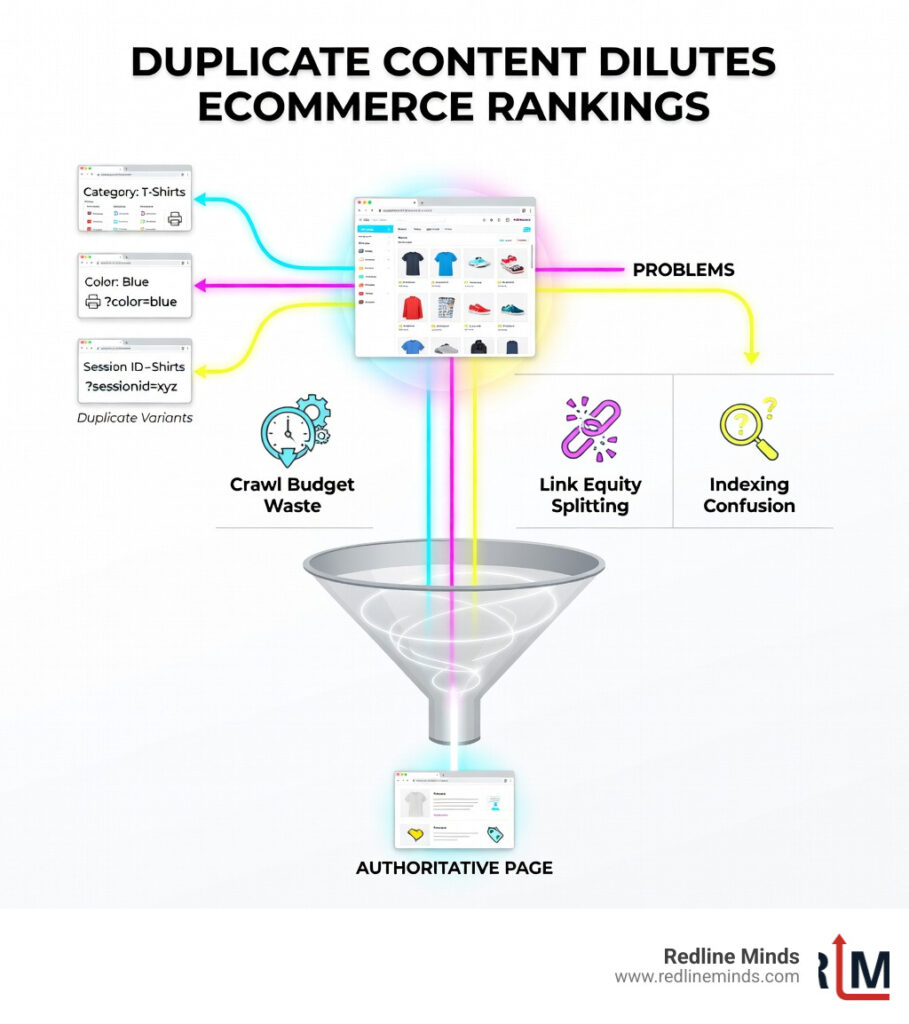
Think about a store with 80 products. Each product might appear under multiple category pages, with size and color filter variations in the URL, a printer-friendly version, and a session ID tacked on. That’s potentially hundreds of near-identical pages competing against each other in Google’s index.
When search engines crawl your site and find the same content at multiple URLs, they get confused. They don’t know which page to rank. So instead of one strong page climbing the search results, you end up with several weak ones splitting your ranking signals — and your traffic pays the price.
Industry experts put it plainly: fixing duplicate content isn’t about avoiding penalties. It’s about making sure your link equity, crawl budget, and ranking signals all flow to one authoritative page instead of being spread thin across duplicates.
The good news? Most of these issues are technical — and they’re fixable.
Why You Need a Duplicate Content Ecommerce Solution
If we want our online stores to thrive, we have to understand how search engines view our “shelves.” When Googlebot visits your site, it doesn’t have an infinite amount of time. This is what we call a crawl budget. If your site is cluttered with 5,000 versions of the same blue t-shirt because of different URL parameters, Google might spend its entire budget crawling those duplicates and never even find your new, high-margin arrivals.
Beyond the budget, there is the issue of “link equity”—or what SEOs often call “link juice.” When other sites link to you, they pass authority. If those links are split between example.com/product, example.com/product?color=blue, and example.com/product?sessionid=xyz, that authority is diluted. We want all that power concentrated on a single URL to help it rank.
Neglecting these issues leads to keyword cannibalization, where your own pages fight each other for the same spot on the search results page. This is a common pitfall we highlight in our SEO Checklist for Ecommerce.
To get a clearer picture, let’s look at the two types of duplication we deal with:
| Feature | Internal Duplicate Content | External Duplicate Content |
|---|---|---|
| Source | Within your own domain (parameters, filters). | Other domains (scrapers, marketplaces). |
| Main Cause | CMS settings, session IDs, faceted navigation. | Manufacturer descriptions, content theft. |
| SEO Impact | Diluted authority and crawl budget waste. | Outranked by larger retailers or scrapers. |
| Primary Fix | Canonical tags, 301 redirects, GSC settings. | Unique copy, DMCA requests, canonicals. |
Common Causes of Duplication in Online Stores
In our experience helping B2B and hybrid stores in Tennessee and beyond, we’ve seen that duplication rarely happens on purpose. It’s usually a byproduct of how modern ecommerce platforms function.
URL Parameters and Session IDs
Many marketers use UTM parameters to track where traffic comes from. While great for analytics, they create a new URL for every click. Similarly, session IDs—those long strings of numbers added to a URL to keep a user’s cart active—can generate thousands of unique URLs that all lead to the exact same product page.
Faceted Navigation
Faceted navigation (filters for size, color, price) is a user experience dream but an SEO nightmare. As Google’s advice on faceted navigation points out, these filters can create an almost infinite number of URL combinations. If every time a user clicks “Large” and “Blue,” a new indexable URL is born, you’re looking at massive duplication.
Manufacturer Descriptions
This is the “silent killer” for many retailers. If you sell the same power drill as 500 other stores and you all use the manufacturer’s provided blurb, you have no competitive advantage in search. Google sees 500 pages with the same text and picks the one with the most authority (usually the biggest brand) to show.
Pagination
If your category pages run onto page 2, 3, and 4, and each page has the same introductory text at the top, you’ve created a duplicate content issue. We often discuss this in our Top SEO Tips for Online Stores, where we recommend keeping unique content only on the first page of a series.
Technical Fixes for Product Page Duplication
When we talk about a duplicate content ecommerce solution, we are looking for ways to signal to Google which page is the “Master.”
Canonical Tags: The “Official” Stamp
The most powerful tool in our kit is the canonical tag (rel="canonical"). This piece of code tells search engines, “Hey, even though you found me at this URL, the ‘real’ version is over here.” You should learn how to specify a canonical correctly to ensure you aren’t sending mixed signals.
301 Redirects: The Permanent Move
If you have two pages that are identical and you don’t need both, a 301 redirect is the way to go. It tells the browser and the search engine that the old page has moved permanently to a new address. For those on Apache servers, this is often handled in the .htaccess file on Apache.
Noindex Tags: The “Do Not Enter” Sign
Sometimes, you want a page to exist for users (like a specific filtered view) but you don’t want it in Google’s index. A noindex meta tag is perfect for this. It keeps your search results clean without breaking your site’s functionality. Using the Best SEO Tools for Ecommerce can help you identify which pages need this tag.
Implementing a Duplicate Content Ecommerce Solution via Canonicalization
We always recommend using “self-referencing” canonical tags. This means every page on your site should have a canonical tag pointing to itself. Why? Because if someone adds a tracking parameter to your URL (like ?utm_source=facebook), the self-referencing tag will point back to the clean version of the URL, consolidating all that link equity.
By defining “Master URLs” for your products, you ensure that even if a product lives in three different categories (e.g., /shoes/mens, /shoes/running, and /sale/shoes), search engines only index the one preferred version. This is the cornerstone of signal consolidation.
Managing URL Parameters as a Duplicate Content Ecommerce Solution
Google is pretty smart, but it still needs a little help with parameters. Within Google Search Console, you can define how specific parameters behave.
- Passive Parameters: These don’t change the content (like UTM codes). We can tell Google to ignore these.
- Active Parameters: These change the content (like
?category=boots). We want Google to pay attention to these, but only in a controlled way.
By setting these rules, you prevent Googlebot from getting lost in a maze of sorting variations (like ?sort=price_asc vs ?sort=price_desc).
Content Strategies to Eliminate Duplicates
While technical fixes are essential, the “gold standard” for a duplicate content ecommerce solution is simply creating unique, high-quality content.
Unique Descriptions and Brand Voice
One of the most effective things we did for a client was help them rewrite descriptions for their top 1,000 products. By moving away from manufacturer copy and injecting a unique brand voice, they saw a 20% increase in organic traffic and a 15% boost in conversions.
When you write your own copy, you aren’t just avoiding duplication; you’re building trust. This is a major part of What is SEO? How to Do SEO for Ecommerce.
Leveraging User-Generated Content (UGC)
Reviews are a secret weapon. Search engines treat customer reviews as fresh, unique content. If two stores use the same manufacturer description, but one store has 50 unique customer reviews, that store will almost always rank higher because its content is more “valuable” and “fresh.”
Handling Product Variations
Instead of creating separate pages for every size and color, consider consolidating them onto one URL with a dropdown menu. If you must have separate URLs for variations, ensure each one has a canonical tag pointing back to the “main” product page.
Ways to differentiate your product pages:
- Add a “How to Use” section or a video.
- Include unique FAQs for that specific item.
- Write about the product’s psychology—how will it make the customer’s life better?
- Use specific, high-quality images with unique alt-text.
Frequently Asked Questions about Ecommerce Duplication
Does duplicate content lead to a Google penalty?
Not in the way most people think. Google doesn’t usually hand out a manual “penalty” (where your site is removed from search) for unintentional duplicates. Instead, it simply “filters” the duplicates out. The real “penalty” is the loss of traffic and rankings because your site looks messy and inefficient to the algorithm. However, if you are scraping content from other sites with deceptive intent, that can lead to a manual action.
How do I handle product variations like size and color?
The best approach is to use a single URL with a selection tool for size and color. This keeps all your reviews, backlinks, and authority on one page. If your platform creates separate URLs for every color (e.g., /t-shirt-blue, /t-shirt-red), make sure the red and blue versions use a canonical tag pointing to the main /t-shirt page.
Should I use manufacturer-provided descriptions?
Only as a placeholder. Relying on them long-term is an SEO nightmare. Since 25-30% of the web is duplicate content, using the same text as everyone else makes it nearly impossible for a small or medium-sized store to outrank the “big box” retailers. We always recommend prioritizing your top-selling products for custom rewrites first.
Conclusion
Managing a high-growth online store is a massive undertaking, and duplicate content is often the “silent killer” that keeps great products from being found. Whether it’s fixing faceted navigation or rewriting generic descriptions, taking action now will pay dividends in your search visibility.
At Redline Minds, we specialize in these complex ecommerce challenges. Based in Tennessee, we serve B2B and hybrid stores with a focus on web development, UX/UI design, and high-impact SEO strategy. We don’t just find the problems; we build the technical solutions to fix them.
If you’re ready to stop splitting your rankings and start dominating your niche, let’s talk. Our team is ready to help you build a robust, search-friendly store that converts.
Share this article
Tap into years of experience and turn your site’s visitors into buyers.
Related Posts
-

The Complete Guide to Affiliate App for Shopify
Discover the best affiliate app for Shopify to grow sales, manage referrals, and boost merchant revenue in 2026.
-

The Ultimate Guide to Types of E-Commerce Payment Systems
Learn the types of e commerce payment system to boost sales and reduce cart abandonment in this complete…
-

A Practical Guide to AI Agent Integration Methods
Learn how AI agent integration connects enterprise systems with MCP, Unified APIs, and custom code for secure, real-time…