
Don’t Leave Money on the Table with Digital Marketing Conversion Rate Optimization

You’re Getting Traffic — But Are You Getting Sales?
Digital marketing conversion rate optimization (CRO) is the process of improving your website so more visitors take a desired action — like making a purchase, filling out a form, or signing up for an email list.
Here’s a quick breakdown:
- What it is: Systematically testing and improving your website to turn more visitors into customers
- How it’s measured: Conversion Rate = (Conversions ÷ Visitors) × 100
- Why it matters: A 2023 survey found the average conversion rate across 14 industries is just 2.9% — meaning most visitors leave without buying
- Where to start: Landing pages, product pages, checkout flows, and calls to action
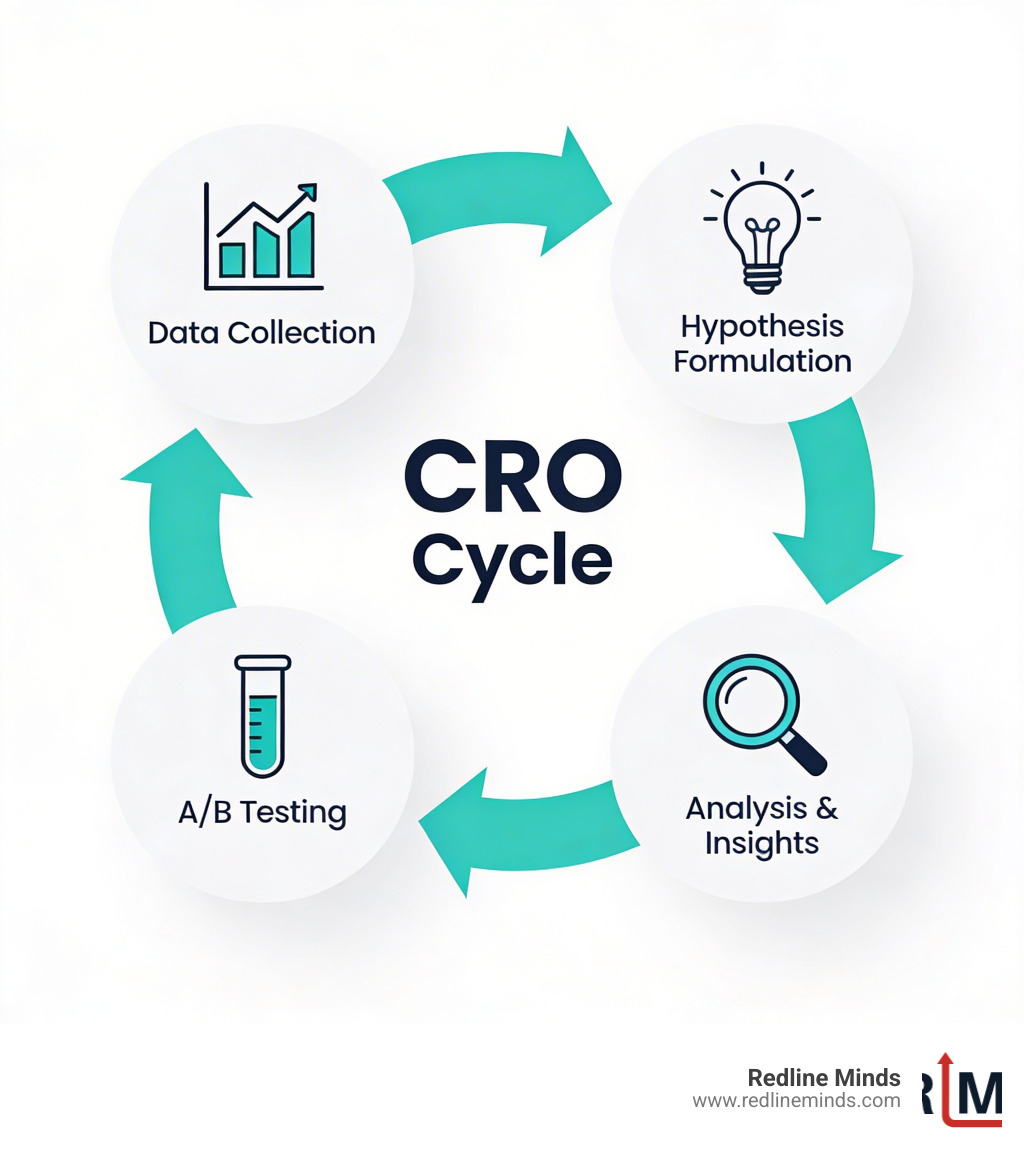
- Core method: Gather data → form a hypothesis → run A/B tests → analyze results → repeat
Here’s a number that should stop you in your tracks: only one in five businesses is satisfied with their conversion rates.
That means the vast majority of online retailers — probably including you — are spending real money driving traffic to a website that isn’t working hard enough to convert that traffic into revenue.
Think about it this way. If your store gets 10,000 visitors a month at a 1% conversion rate, you’re getting 100 sales. Bump that rate to 2% — without spending a single extra dollar on ads — and you double your sales overnight.
That’s the power of CRO.
It’s not about getting more people in the door. It’s about making sure the people already walking through your door actually buy something.
This guide breaks down exactly how digital marketing conversion rate optimization works, what principles drive it, and the specific strategies that move the needle for online retailers like you.
What is Digital Marketing Conversion Rate Optimization?
At its heart, digital marketing conversion rate optimization is the art and science of getting people to do what you want them to do on your website. We often think of a “conversion” as a completed sale, but in ecommerce, it’s much broader than that. A conversion refers to any user achieving a specific goal by taking a desired action.
To get a handle on this, we need to distinguish between two types of goals:
- Macro Conversions: These are the “big wins.” For an ecommerce store, this is almost always a completed purchase. For a B2B company, it might be a request for a quote or a scheduled demo.
- Micro Conversions: These are the smaller steps that lead up to the big win. Think of things like adding an item to a cart, signing up for a newsletter, or even spending a certain amount of time on a high-value page.
We view Conversion Rate Optimization (CRO) as a way to bridge the gap between visitor intent and business results. If a visitor arrives on your site, they usually have an intent—to learn, to compare, or to buy. If your site is cluttered or confusing, that intent evaporates.
The standard calculation is simple: (Total Conversions / Total Visitors) x 100. If 100 people visit your site and 3 buy something, you have a 3% conversion rate. Our job is to make that 3% look more like 4% or 5%.
| Conversion Type | Example Action | Goal Level |
|---|---|---|
| Macro | Completed Checkout / Purchase | Primary |
| Macro | B2B Quote Request Form | Primary |
| Micro | Email Newsletter Signup | Secondary |
| Micro | “Add to Cart” Click | Secondary |
| Micro | Viewing a Product Demo Video | Secondary |
The Role of Data in Digital Marketing Conversion Rate Optimization
You can’t optimize what you don’t measure. In our work with B2B and hybrid stores, we see too many businesses making design changes based on “gut feelings.” We have a strict rule: leave all assumptions at the door.
To truly understand what’s happening on your site, you need two types of data:
- Quantitative Data: This is the “what.” Tools like Google Analytics tell us exactly how many people are visiting, where they are dropping off, and which pages are underperforming.
- Qualitative Data: This is the “why.” This comes from heatmaps, session replays, and user surveys. It helps us understand if users are frustrated by a broken button or if they simply can’t find the shipping information.
By digging into our Category: Conversion Optimization resources, you’ll see that user behavior is the ultimate guide. If the data shows that 70% of your mobile users are clicking an image that isn’t linked to anything, that’s a massive clue that they expect to see more details there.
Industry Benchmarks and Realistic Expectations
We often get asked, “What’s a good conversion rate?” The truth is, it depends. A 2023 survey by Ruler Analytics found the average across fourteen industries was about 2.9%. However, ecommerce businesses often see averages closer to 2% to 3%.
If you’re in the B2B sector, the numbers shift again. SaaS companies might see 1%, while legal services could see over 7%. Instead of obsessing over what others are doing, we recommend focusing on marginal gains. A 1% weekly improvement in your conversion rate through A/B testing can lead to a nearly 5% better performing page after three years. It’s a marathon, not a sprint.
Core Principles of Conversion-Centered Design
If you want your website to convert, it has to be designed for it. This is where Unbounce principles of conversion-centered design come into play. The goal isn’t just to make a site that looks “pretty”—it’s to make a site that functions as a high-performance sales tool.
One of the most critical concepts is the attention ratio. This is the ratio of links on a page to the number of conversion goals. On a high-performing landing page, that ratio should ideally be 1:1. If you want someone to download a whitepaper, don’t give them a navigation menu with 15 other places to go.
When Building Great Landing Pages, we also emphasize the “above the fold” rule. Your most important message and your primary Call to Action (CTA) must be visible without the user having to scroll. Following Sullivan’s principle—form follows function—means every design element must serve the goal of the page.
Visual Cues and Information Hierarchy
How you direct a user’s eyes determines whether they convert. We use several visual principles to make the path to conversion obvious:
- Encapsulation: Think of this as the “James Bond gun barrel” effect. By framing your CTA or form in a box or a contrasting border, you naturally draw the eye toward it.
- Directional Cues: Humans are hardwired to follow arrows or the gaze of people in photos. Use directional cues like arrows or pointing fingers to lead the visitor to your signup button.
- White Space: Don’t be afraid of empty space. It allows your content to breathe and prevents “banner blindness,” where users ignore cluttered areas of a site.
- Contrast: Your “Buy Now” button should not be the same color as your footer. It should pop.
A great way to test your design is the five-second test. Show someone your page for five seconds, then ask them what the page was about and what they were supposed to do. If they can’t answer, your hierarchy is broken. For more on this, check out our guide on Perfect Product Page Design.
Building Trust and Social Proof
In an era where fake reviews are everywhere, instilling trust is non-negotiable. We use social proof to prove to visitors that your brand is reliable. This includes testimonials (with real names and photos), client logos, and trust badges.
There’s a funny academic term for why we do this: mimetic isomorphism. It’s a fancy way of saying that organizations—and people—tend to copy each other in times of uncertainty. If a visitor sees that “5,000 other Tennessee businesses use this service,” they feel safer joining in.
Consistency is also a trust-builder. Message matching means the text in your ad should be the exact same text a user sees on the landing page. If your ad says “Save 32% on Insurance,” but the landing page just says “Welcome to our Insurance Site,” the user gets confused and leaves. Design matching works the same way; the colors and “vibe” of your ad should carry over to your site.
Identifying Bottlenecks and Running A/B Tests
Every ecommerce site has a funnel. Visitors enter at the top (homepage or landing page) and ideally exit at the bottom (the thank you page). Along the way, people drop off. This is our Ecommerce Marketing Funnel, and identifying where the drop-off is highest is the first step to optimization.
Common bottlenecks include:
- The Cart: High cart abandonment often points to unexpected shipping costs or a forced account creation.
- Product Pages: If people are viewing products but not adding to the cart, your descriptions might be weak, or your images might be low-quality.
- Exit Pages: Using tools like Google Analytics, we look for “leaky” pages where visitors frequently leave the site entirely.
Hypothesis Development and Prioritization
Once we find a problem, we don’t just throw spaghetti at the wall. We develop a hypothesis. A good hypothesis follows this structure: “We believe that doing [X] for [Y audience] will result in [Z outcome].”
But we can’t test everything at once. We use the PIE framework to prioritize:
- Potential: How much improvement can be made on this page?
- Importance: How much traffic does this page get?
- Ease: How difficult is it to implement this change?
To help you get started, we’ve compiled a list of 27 Conversion Optimization Tools that can assist in both research and Online Controlled Experiments.
The Mechanics of A/B Testing
A/B testing is a randomized experiment with two variants, A and B. Variant A is your current version (the control), and Variant B is the version with one specific change (the variation).
To get valid results, you need:
- Statistical Relevance: You can’t stop a test after two hours just because one version is winning. You need a large enough sample size to ensure the results aren’t just luck.
- Confidence Rate: Most experts aim for a 95% confidence rate, meaning there’s only a 5% chance the result was a fluke.
- Lift Percentage: This is the percentage increase in conversions between the control and the variation.
We also look at the null hypothesis, which is the assumption that the change you made had no effect at all. Our goal is to prove the null hypothesis wrong!
High-Impact Strategies for Website Optimization
Where should you actually start clicking and changing things? We recommend starting with high-traffic, high-intent pages.
- The Homepage: What Makes a Great Homepage for Ecommerce is a clear value proposition and a direct path to products. Avoid the temptation to put every single promotion on the homepage.
- Pricing Pages: Be clear. Hidden fees are conversion killers.
- CTA Buttons: Sometimes the simplest changes work best. One company increased logins by 36% just by changing a login icon to the word “Login.” Use action-oriented text like “Get My Free Quote” instead of “Submit.”
- Forms: Keep them short. Every extra field you add to a form decreases the chance someone will finish it. If you must have a long form, use a multi-step progress bar.
- Social Contests: When done right, these can be lead-generation goldmines. See our breakdown of the Anatomy of a Great Social Contest.
Maximizing ROI with Digital Marketing Conversion Rate Optimization
CRO doesn’t stop once a user leaves your site. We use remarketing and retargeting to bring them back. While the terms are often used interchangeably, there is a difference:
- Remarketing: Usually involves using email lists to reach out to people who have already interacted with you (like sending a “we miss you” discount).
- Retargeting: Uses browser cookies (pixels) to show ads to people who visited your site but didn’t buy.
According to research from Moosend, abandoned cart emails have an incredible 45% open rate. Half of the people who click those emails end up making a purchase. That is “found money” that most businesses leave on the table.
Technical Optimization: Speed and Mobile-First
You can have the most beautiful design in the world, but if it takes 10 seconds to load, your conversion rate will be zero. According to Moz on page speed, site speed is a major ranking factor for Google and a major frustration for users. A mere one-second reduction in load time can significantly boost conversions.
Furthermore, Statista mobile data shows that about two-thirds of online retail purchases happen on mobile devices. If your “Buy Now” button is too small for a thumb to click, you’re losing sales. We use tools like Google’s Lighthouse to audit site performance and ensure every page is truly responsive.
Frequently Asked Questions
How does CRO differ from SEO?
Think of SEO (Search Engine Optimization) as the tool that gets people to the front door, while CRO is the tool that gets them to buy once they are inside. SEO focuses on search intent and ranking, while CRO focuses on user experience and action. They are complementary goals; a site that is easy to navigate and fast (good CRO) is also a site that Google loves to rank (good SEO).
What is a good conversion rate for ecommerce?
While there is no “perfect” number, the B2C ecommerce businesses averaged a 2% conversion rate in early 2023. Most businesses find themselves in the 2.5% to 3% range. If you are below 1%, you likely have a functional issue with your site. If you are above 5%, you are a top performer!
Which tools are essential for starting CRO?
You don’t need a million-dollar budget to start. The essentials include:
- Google Analytics: For the hard numbers.
- Hotjar or Lucky Orange: For heatmaps and session replays.
- A/B Testing Platforms: Like Optimizely or VWO (or even simpler tools for smaller sites).
- Lighthouse: For checking your technical health and speed.
Conclusion
At Redline Minds, we’ve seen how digital marketing conversion rate optimization can transform a struggling online store into a thriving brand. Whether you are running a B2B operation in Jefferson City, TN, or a hybrid store shipping across the country, the principles remain the same: listen to the data, focus on the user, and never stop testing.
Optimization is not a one-time project; it’s a culture of continuous iteration. By focusing on the small, marginal gains, you build a sustainable path to growth.
Don’t leave money on the table—start your conversion optimization journey today. If you need a partner to help navigate the complexities of ecommerce strategy, UX design, or B2B workflows, we’re here to help you turn those clicks into customers.
Share this article
Tap into years of experience and turn your site’s visitors into buyers.
Related Posts
-
Compare Shopify Migration Services: Options Cheat Sheet
Compare Shopify migration services and find the right Shopify migration company for your store, from manual imports to…
-

Ultimate Checklist for Improving B2B Customer Experience
Ultimate Checklist for Improving B2B Customer Experience – Learn about b2b ecommerce customer experience
-

A Practical Guide to What to Sell Online for Profit
A Practical Guide to What to Sell Online for Profit – Learn about i don t know what…