
The Secret Sauce of B2B Wholesale Inventory Management
The Real Difference Between Winning and Losing in Wholesale? It’s Your Inventory.
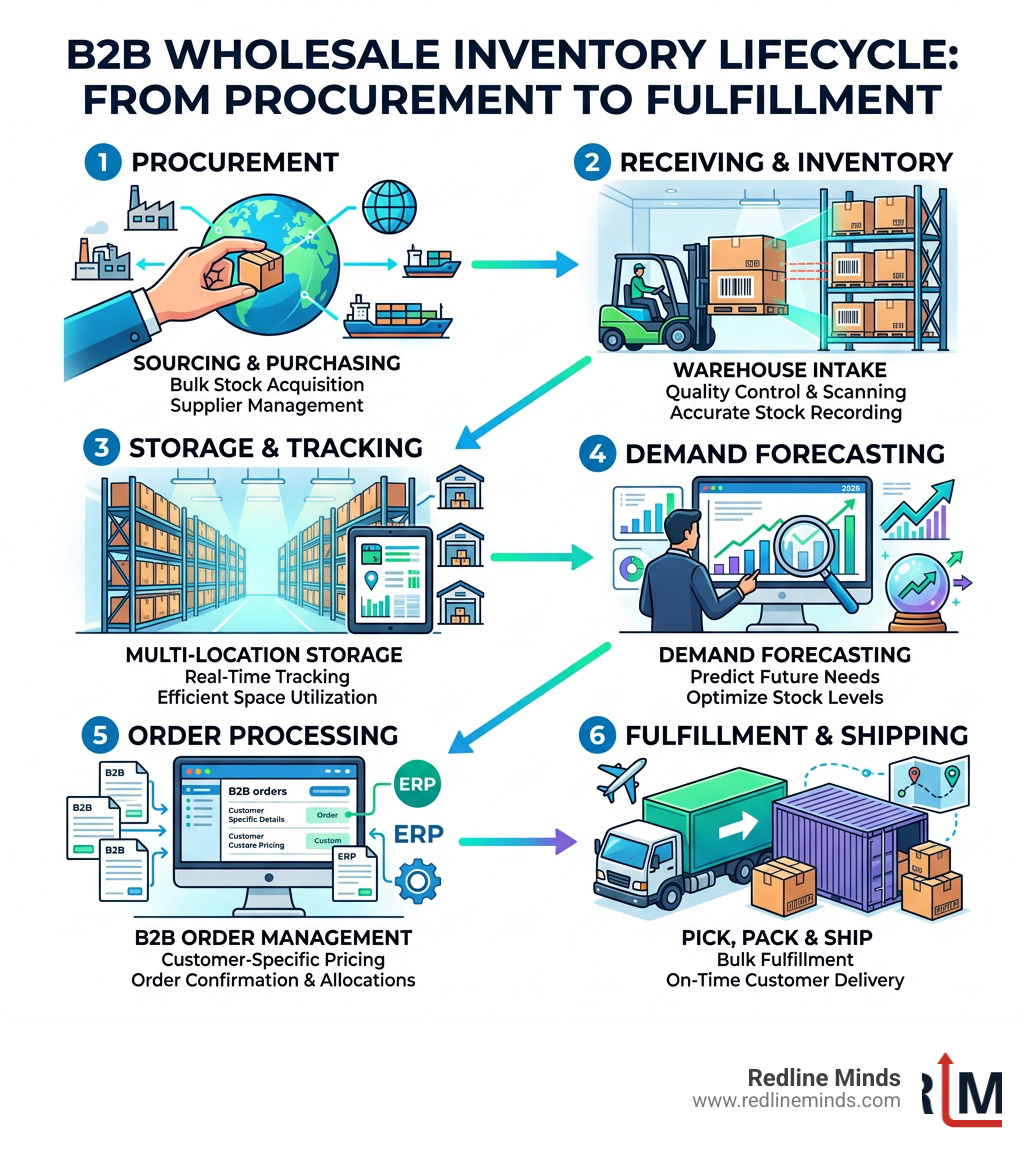
B2B wholesale inventory management is the process of tracking, controlling, and optimizing stock that moves between businesses — from procurement and storage through to order fulfillment.
Here’s a quick breakdown of what it involves and why it matters:
| What It Covers | Why It Matters |
|---|---|
| Bulk stock procurement | Keeps supply chains moving without costly gaps |
| Multi-location tracking | Prevents oversells and stock allocation errors |
| Automated reordering | Reduces manual work and human error |
| Demand forecasting | Aligns stock levels with real buyer behavior |
| ERP and EDI integration | Syncs inventory across all business systems |
| Customer-specific pricing | Supports complex B2B ordering relationships |
Think about how different it is to ship one product to a consumer versus 500 units to a retailer — on a standing order, with negotiated pricing, across three warehouses.
That’s B2B wholesale. And managing it well is significantly harder than standard retail inventory.
The stakes are high. When inventory data is off, relationships suffer. Orders get delayed. Your best wholesale accounts go elsewhere. And that’s before you factor in the financial hit — inventory inaccuracies alone can cost businesses up to 10% of annual revenue.
Yet surprisingly, 43% of small businesses still track inventory manually or not at all. For a mid-sized wholesale operation doing millions in revenue, that’s a ticking clock.
This guide breaks down exactly how to manage B2B stock efficiently — what makes it unique, where most wholesalers go wrong, and what modern inventory systems can do to fix it.
Why B2B Wholesale Inventory Management is the Backbone of Your Business

In B2B, inventory isn’t just stuff sitting on shelves; it’s liquid capital. Unlike B2C, where a single lost sale is a minor annoyance, a B2B stockout can sever a decade-long partnership. If a retailer relies on you for their seasonal launch and you can’t deliver, you haven’t just lost a transaction—you’ve lost their trust.
The financial implications are staggering. Inventory inaccuracies cost businesses up to 10% of annual revenue. For a wholesaler, that 10% isn’t just a rounding error; it’s the difference between scaling your operations and barely treading water. When your data is wrong, you’re either carrying too much “dead stock” (tying up cash) or too little (losing deals).
Efficiency in capital is what separates the pros from the amateurs. Shockingly, 43% of small businesses still track inventory manually or don’t track it at all. In a market where the explosive growth of B2B eCommerce is hitting $30 trillion, relying on a dusty Excel sheet is like bringing a knife to a laser-tag fight.
B2B vs. B2C Inventory: A High-Stakes Comparison
| Feature | B2C (Retail) | B2B (Wholesale) |
|---|---|---|
| Order Volume | High frequency, small quantities | Lower frequency, massive bulk quantities |
| Pricing | Standardized MSRP | Negotiated tiers and customer-specific lists |
| Fulfillment | Fast shipping (speed is king) | Accuracy and guaranteed dates (reliability is king) |
| Returns | Simple individual returns | Complex pallet-level reverse logistics |
| Lead Times | Short, often immediate | Long, multi-month cycles |
Real-time Visibility and B2B Wholesale Inventory Management
Visibility is the antidote to chaos. In wholesale, “real-time” doesn’t just mean knowing you have 1,000 widgets; it means knowing that 400 are already “spoken for” via standing orders, 200 are in transit from the manufacturer, and 100 are reserved for your VIP client.
Without this level of detail, you risk the “Accuracy Trap.” While 95-97% accuracy benchmarks for wholesalers are generally acceptable, industries dealing with perishables often require 98-99%.
To hit these numbers, we recommend ditching the clipboards for mobile barcode scanning. Scanning turns hours of manual counting into minutes of digital confirmation, eliminating the “latency” (the time gap between a sale happening and the system updating). If your sales rep is in the field promising stock that was sold five minutes ago in the warehouse, you have a latency problem. Solving this requires looking at Ecommerce Inventory Control Options Best Options that sync data instantly across all touchpoints.
Scaling with Automated B2B Wholesale Inventory Management
As we help our clients grow at Redline Minds, we see one recurring theme: manual processes don’t scale. You might manage 50 SKUs on a spreadsheet, but you can’t manage 5,000 across four warehouses that way.
Automation is the engine of scalability. This involves:
- ERP Integration: Connecting your inventory to your accounting and sales data so the “left hand” always knows what the “right hand” is doing.
- EDI Compliance: Electronically exchanging documents like purchase orders and invoices with big-box retailers who require it.
- AI-Powered Forecasting: AI-powered demand forecasting is no longer just for the giants. It helps you predict trends before they happen, ensuring you aren’t stuck with last year’s fads.
The payoff? Precise tracking can lead to a 15–25% safety stock reduction through tracking. That’s a massive amount of capital freed up to invest back into marketing or product development. For a deeper look at the tech stack required for this, check out our guide on Best E-Commerce Inventory Control Options 2024.
Essential Features of Modern Wholesale Software
If you’re shopping for b2b wholesale inventory management software, you aren’t just looking for a digital tally sheet. You need a system that understands the “language” of wholesale.
1. Multi-Warehouse Management If you have stock in Tennessee and a 3PL in California, you need to know exactly what is where. Modern systems allow for “virtual” inventory pools and automated transfers between sites to keep fulfillment costs low.
2. Units of Measure (UoM) Conversion In wholesale, you often buy in pallets, store in cases, and sell in packs (or even individual units). If your software can’t automatically convert these numbers, your inventory counts will be a nightmare.
3. Tiered Pricing and Customer-Specific Catalogs B2B is built on relationships. You might give a 20% discount to a legacy buyer while charging full wholesale price to a new lead. Your system must automatically apply these rules at checkout so your sales team isn’t manually adjusting invoices—a process that is ripe for human error.
4. Advanced Analytics and Buyer Behavior Advanced analytics for buyer behavior allow you to see why people are buying, not just what. Are they searching for items you don’t have? Is there a sudden spike in a specific region?
5. Meeting New Expectations Millennial and Gen Z buyer expectations are shifting the landscape. These younger decision-makers (who now make up over 70% of B2B researchers) want a “consumer-like” experience. They want to log in, see their custom pricing, check real-time availability, and order without having to call a sales rep.
Strategies to Overcome Complex Supply Chain Challenges
The supply chain has felt like a roller coaster lately. COVID-19 acted as a catalyst for digital adoption, forcing wholesalers to move away from “the way we’ve always done it.” Here is how we recommend staying ahead of the curve:
- The 80/20 Rule: In most wholesale businesses, 20% of your products generate 80% of your revenue. Focus your highest-intensity tracking (and safety stock) on that 20%. Don’t let your “A-list” items go out of stock because you were too busy counting slow-moving “C-list” widgets.
- Cycle Counting over Physical Audits: Stop shutting down your warehouse for three days a year to count everything. Implement “cycle counting,” where you count a small subset of items every day. It’s more accurate and less disruptive.
- Lead Time Optimization: Don’t just guess when to reorder. Use your software to track actual lead times from suppliers. If a vendor says 30 days but consistently takes 45, your system should adjust its reorder points automatically.
- Self-Service Portals: This is the “secret sauce” for modern wholesalers. By giving customers a portal, you reduce the administrative burden on your team. Why B2B Self-Service Portals Are the Future of Wholesale explains how these portals turn your inventory data into a sales-generating machine.
Frequently Asked Questions about B2B Inventory
How does B2B wholesale inventory management differ from B2C?
The primary difference is scale and complexity. While B2C focuses on “one-to-one” transactions (shipping one shirt to one person), B2B involves “one-to-many” (shipping 500 shirts to a retailer). B2B also requires handling negotiated pricing, bulk shipping (freight), and strict compliance requirements like EDI and specific labeling that B2C consumers don’t care about.
What are the main challenges in managing bulk wholesale stock?
The biggest hurdles are data latency (outdated stock numbers), complex pricing matrices, and managing “reserved” stock. Because wholesale orders are so large, one mistake in stock allocation can lead to massive overselling, which is much harder to fix than a single B2C backorder.
Why is real-time inventory tracking critical for B2B relationships?
Wholesale is a relationship business. If a retailer plans a marketing campaign around your product and you can’t fulfill the order because your inventory count was wrong, you’ve damaged their business. Real-time tracking ensures that when your sales rep says “Yes, we have it,” they are telling the truth.
Conclusion
At Redline Minds, we’ve seen how b2b wholesale inventory management can make or break an ecommerce operation. Whether you are a traditional wholesaler moving online or a hybrid brand managing both D2C and B2B channels, your inventory is your most valuable asset.
Managing it shouldn’t feel like a guessing game. By implementing real-time visibility, leveraging automation, and focusing on the specific needs of the B2B buyer, you can protect your margins and build lasting buyer loyalty.
If you’re ready to stop the spreadsheet madness and start scaling with precision, we’re here to help. From strategic consulting to full-scale web development, we specialize in helping businesses like yours master the complexities of modern commerce. Transform your operations with our B2B ecommerce services and let’s get your inventory working for you, not against you.
Share this article
Tap into years of experience and turn your site’s visitors into buyers.
Related Posts
-

The Complete Guide to Affiliate App for Shopify
Discover the best affiliate app for Shopify to grow sales, manage referrals, and boost merchant revenue in 2026.
-

The Ultimate Guide to Types of E-Commerce Payment Systems
Learn the types of e commerce payment system to boost sales and reduce cart abandonment in this complete…
-

A Practical Guide to AI Agent Integration Methods
Learn how AI agent integration connects enterprise systems with MCP, Unified APIs, and custom code for secure, real-time…