
Everything You Need to Know About B2B E-Commerce

What Is B2B E-Commerce? (And Why It Matters for Growing Businesses)
Business to business e commerce is the online buying and selling of goods, services, or information between two companies — not between a business and an individual consumer.
Here’s a quick breakdown:
| B2B E-Commerce | |
|---|---|
| Who buys? | Businesses, procurement teams, resellers |
| What’s sold? | Products, software, raw materials, wholesale goods |
| How? | Digital platforms, online portals, marketplaces |
| Order size | Large, often recurring bulk orders |
| Payment style | Invoices, purchase orders, net terms |
Think of a flour mill selling bulk sacks to a commercial bakery, or a software company selling licenses to a retailer’s entire team. That’s B2B e-commerce in action.
It’s a massive and fast-growing space. B2B e-commerce sales grew 10.5% in 2024, and analysts project continued growth of 7.8% year-over-year. The global market was already valued at an estimated $4.9 trillion back in 2021.
And here’s what’s changing the game: 73% of B2B buyers now prefer to research and purchase independently online. They want self-service, speed, and a buying experience that feels as smooth as shopping on Amazon — even when placing a 500-unit order.
For mid-sized retailers and wholesale businesses, this shift is both a challenge and a huge opportunity. The businesses that digitize their B2B operations now are the ones that will own their markets in the next few years.
Business to business e commerce terms simplified:
- b2b ecommerce portal
- b2b lead generation strategies
- b2b wholesale inventory management
What is Business to Business E Commerce and How Does It Work?
At its core, business to business e commerce digitizes the age-old processes of corporate procurement and supply chain relationships. In the analog days, a B2B transaction required a flurry of phone calls, faxed purchase orders, manual catalog browsing, and long back-and-forth negotiations with sales representatives. Today, digital platforms streamline this entire workflow.
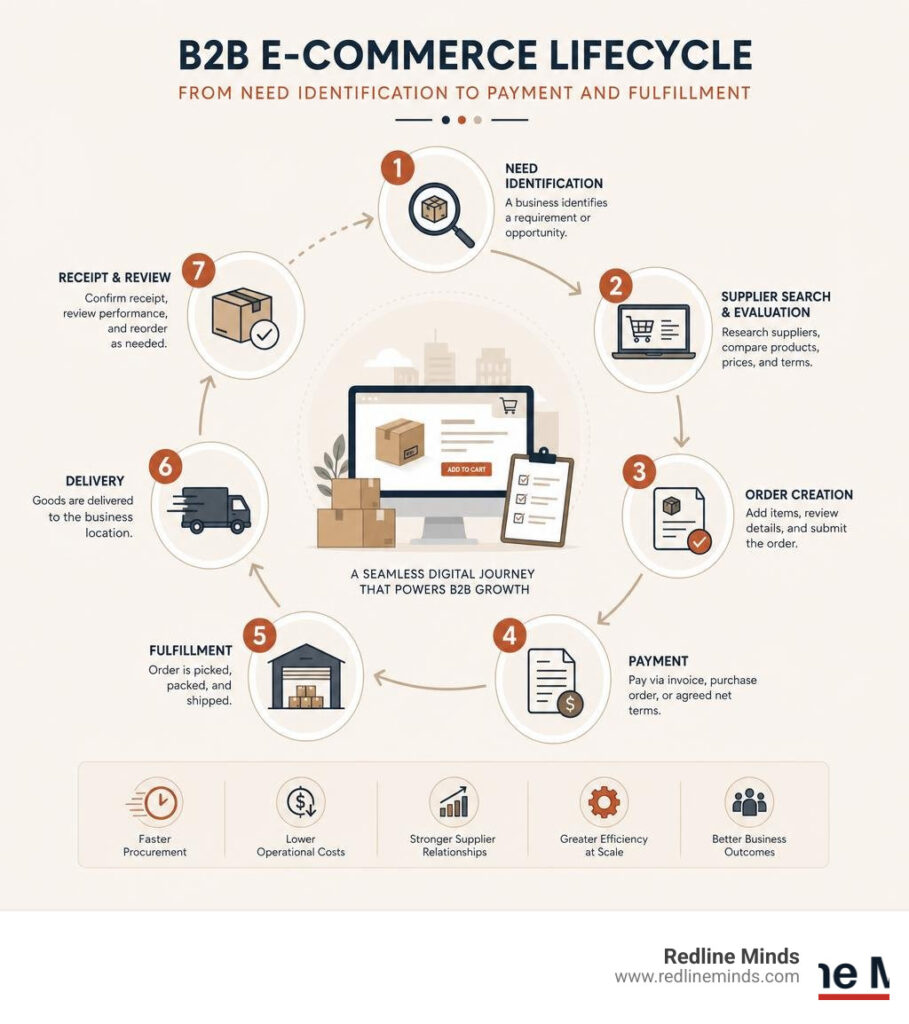
The modern B2B e-commerce transaction flow typically follows these key steps:
- Identification of Needs: A business buyer identifies a shortage of inventory, raw materials, or software licenses.
- Digital Discovery & Research: The buyer conducts independent research. They visit digital storefronts, compare technical specifications, and read reviews (which factor into buying decisions for 97% of B2B customers).
- Account Log-In & Customization: Unlike standard retail sites, B2B buyers usually log into a secure portal. Here, they see pre-negotiated contract pricing, custom catalogs tailored to their industry, and their specific credit terms.
- Negotiation & Automated Quoting: If the order is highly customized or exceptionally large, the buyer can submit a digital Request for Quote (RFQ) directly through the platform. Sales reps can quickly review, adjust, and approve the quote online.
- Order Placement: The buyer submits a digital purchase order (PO), often utilizing quick-order forms, bulk CSV uploads, or automated reordering templates.
- Fulfillment, Tracking, & Settlement: The order integrates with the seller’s backend systems. Split shipments are scheduled if necessary, real-time tracking is provided, and the transaction is settled via credit terms, invoices, or digital payment gateways.
By moving these steps online, companies can eliminate manual bottlenecks, reduce human error, and accelerate transaction speeds. For more insights on setting up these frameworks, check out our comprehensive guide on B2B Ecommerce.
The Core Differences Between B2B and B2C E-Commerce
While B2B and B2C e-commerce share the same basic goal—selling something online—the mechanics under the hood are vastly different. B2C transactions are emotional, fast, and straightforward. B2B transactions are logical, highly structured, and relationship-driven.
Here is a detailed comparison of how these two digital commerce worlds operate:
| Feature | B2B E-Commerce | B2C E-Commerce |
|---|---|---|
| Target Audience | Professional buyers, procurement managers, business owners | Individual consumers |
| Decision-Making Process | Multi-step, involving multiple stakeholders and formal approvals | Single-person, often impulsive or quick |
| Pricing Models | Dynamic, tiered, pre-negotiated, and account-specific | Fixed and uniform for all shoppers |
| Order Volumes | Large bulk quantities with strict Minimum Order Quantities (MOQs) | Small, individual units |
| Sales Cycle | Weeks to months, focused on long-term relationships | Minutes to days, transactional |
| Payment Methods | Trade credit, net terms (Net 30/60), purchase orders, bank transfers | Credit cards, digital wallets, buy-now-pay-later (BNPL) |
| Checkout Complexity | Highly customized, requires role-based approval gates | Simple, fast, one-click checkouts |
Understanding these differences is crucial. If you try to run a B2B operation using a standard B2C storefront setup, you will quickly find yourself buried in manual workarounds and frustrated customers.
Key Business Models in Business to Business E Commerce
The B2B digital landscape is incredibly diverse. Depending on where a business sits in the supply chain, its digital commerce platform must serve a unique purpose. The four primary models include:
1. Manufacturers
Manufacturers sell finished goods directly to distributors, wholesalers, or other businesses (often called Manufacturer-to-Business, or M2B). For example, an automotive parts manufacturer might sell engines and fuel pumps directly to car assembly plants. Their e-commerce platforms must handle complex product configurations, custom engineering specs, and seamless integration with deep supply chain systems.
2. Distributors
Distributors act as the bridge between manufacturers and wholesalers or retailers. They manage massive logistics networks and complex inventory catalogs. A distributor’s e-commerce platform must focus heavily on real-time inventory visibility, rapid order processing, and region-based allocation rules.
3. Wholesalers
Wholesalers buy goods in bulk from manufacturers or distributors and sell them in smaller, yet still substantial, quantities to retail businesses. For wholesalers, digital convenience is the ultimate competitive advantage. Providing buyers with intuitive portals to reorder goods is essential for survival, which is why Why B2B Self-Service Portals Are the Future of Wholesale has become a central focus for modern wholesale brands.
4. Software-as-a-Service (SaaS) and Service Providers
B2B isn’t just for physical goods. SaaS companies and professional service providers utilize digital commerce to sell subscription licenses, cloud storage, and enterprise software. These platforms require robust recurring billing systems, subscription management portals, and automated user provisioning.
The Strategic Benefits of Digitizing Your B2B Operations
Transitioning your B2B operations to a digital e-commerce model is no longer just a defensive play to keep up with competitors—it is a powerful engine for business growth. When you replace manual order entry with an automated storefront, you unlock massive strategic advantages.
First, operational efficiency skyrockets. Sales representatives who once spent 70% of their time on repetitive data entry, inventory verification, and invoice emailing are suddenly freed to do what they do best: build strategic partnerships and close high-value deals.
Second, digital commerce enables rapid market expansion. An online portal is open 24/7/365, allowing you to acquire and serve customers in different time zones and global regions without expanding your sales headcount.
Finally, a stellar digital experience significantly improves customer retention. Business buyers are consumers in their personal lives; they expect the same frictionless, intuitive experience when buying for work. If your digital portal makes their jobs easier, they will keep coming back to you.

Empowering Buyers with Self-Service Portals
The modern B2B buyer wants control. They don’t want to wait for business hours to call a sales rep just to check on an order status or find out if an item is in stock. They want to find that information themselves, instantly.
This is where self-service portals shine. A robust portal gives buyers 24/7 access to:
- Order History & Tracking: View past purchases, track active shipments, and download invoices.
- One-Click Reordering: Instantly replicate previous complex bulk orders with a single click.
- Account Management: Manage multiple corporate shipping addresses, view credit limits, and assign buyer roles within their organization.
Providing this level of autonomy builds trust and streamlines operations. To dive deeper into how these portals can transform your wholesale relationships, read our post on The Power of the B2B Customer Portal.
Driving Revenue with Custom Solutions and Bulk Ordering
In B2B commerce, one size rarely fits all. A loyal customer who orders 10,000 units a month should not see the same price list as a new buyer purchasing 50 units.
A modern e-commerce platform allows you to configure complex, personalized pricing rules automatically. You can build:
- Tiered & Volume-Based Pricing: Automatically lower the per-unit price as the order quantity increases.
- Custom Catalogs: Restrict or highlight specific products based on the logged-in customer’s contract terms or geographic location.
- Personalized Promotions: Offer targeted discounts to specific customer groups to clear out seasonal inventory or incentivize larger orders.
By automating these personalized structures, you can confidently scale your operations while protecting your margins. Learn how to implement these strategies effectively in our detailed guide: How to Build a B2B Empire with Custom Solutions and Bulk Ordering.
Overcoming Key Challenges in B2B E-Commerce
While the benefits of B2B digital commerce are undeniable, getting there isn’t always a walk in the park. B2B operations are inherently complex, and digitizing them requires navigating unique hurdles.
One major challenge is legacy system friction. Many established B2B brands rely on decades-old ERP (Enterprise Resource Planning) systems or custom databases that were never designed to communicate with a modern web storefront. Bridging this gap requires careful planning and robust integration strategies.
Another obstacle is channel conflict. Sales reps may worry that a self-service website will cannibalize their commissions, while traditional distributor networks might feel threatened by direct digital channels. Overcoming this requires aligning incentives—such as giving sales reps commission on digital orders placed within their territories and using the website to support, not replace, human relationships.
Finally, managing complex pricing structures without slowing down site performance is a major hurdle. When thousands of customers have custom negotiated contracts, your platform must be capable of calculating unique prices in real-time without causing the website to lag.

Managing Complex Wholesale Inventory
In B2C retail, if an item is out of stock, the shopper simply clicks away or signs up for a restock notification. In B2B, an inaccurate inventory count can halt a client’s entire production line, destroying a multi-year business relationship in an instant.
Wholesale inventory management requires:
- Real-Time Synchronization: Ensuring online inventory levels update instantly across all warehouses and sales channels.
- Multi-Warehouse Allocation: Dynamically routing orders to the closest fulfillment center to minimize shipping costs and transit times.
- Stock Allocation Rules: Reserving specific quantities of high-demand items for your most loyal, contracted accounts, preventing first-time buyers from wiping out your stock.
To master this balance, we recommend reading The Secret Sauce of B2B Wholesale Inventory Management.
Navigating the Technical Requirements of Business to Business E Commerce
A successful B2B storefront does not exist in a vacuum. It must act as the digital face of a deeply connected ecosystem. To run smoothly, your platform needs to integrate seamlessly with several key systems:
- ERP (Enterprise Resource Planning): The central nervous system of your business. The ERP manages inventory, billing, manufacturing, and shipping. Your e-commerce store must sync with the ERP constantly to ensure accurate product data and order processing.
- CRM (Customer Relationship Management): Tracks customer interactions, sales pipelines, and support tickets. Integrating your CRM ensures your sales team has a unified, 360-degree view of both online and offline buyer behavior.
- API Connectivity: Modern architectures rely on APIs (Application Programming Interfaces) to pass data quickly and securely between disconnected applications.
For a deeper dive into how to connect these complex systems without pulling your hair out, take a look at BigCommerce’s helpful resource on Understanding ERP Integration for B2B E-Commerce.
Choosing the Right Platform and Technology Stack
Selecting the software that will power your digital B2B empire is one of the most critical decisions you will make. The platform you choose must be flexible enough to handle complex business rules, secure enough to protect sensitive corporate data, and scalable enough to grow alongside your brand.
Many modern businesses are turning toward headless architecture (separating the front-end design from the back-end commerce engine) or composable commerce. This approach allows you to plug in best-of-breed tools for search, checkout, and content management via APIs, giving you total creative and functional freedom.
But before you write a single line of code, you need to understand the landscape of available options. To start your evaluation, check out our guide on Choosing the Right B2B Ecommerce Software as well as The Ultimate B2B Online Store Comparison.
Evaluating the Best Platforms for Scaling Operations
When comparing platforms, you will find options ranging from SaaS-based systems to highly customizable open-source frameworks. The right choice depends on your technical resources, catalog complexity, and growth goals.
- SaaS Platforms (e.g., BigCommerce B2B Edition): These platforms handle hosting, security, and maintenance for you, allowing you to go to market quickly with native B2B features like corporate account management and custom price lists.
- Composable/Enterprise Platforms: Built for massive operations with highly unique workflows, these platforms offer unmatched flexibility but require experienced development teams to implement and maintain.
To help narrow down your search, we have put together a detailed analysis of The Best Platforms for Scaling Your B2B Ecommerce Operations.
Customizing the Checkout and Ordering Experience
The standard B2C checkout is designed to get a customer to enter their credit card and click “buy” as fast as possible. In B2B, the checkout must accommodate complex corporate purchasing rules.
A custom B2B checkout experience must support:
- Flexible Payment Terms: Allowing approved customers to check out using “Net 30” terms, purchase orders, or company credit lines.
- Role-Based Approvals: If a junior buyer adds items to their cart, the system should automatically route the order to their manager for digital approval before processing payment.
- Custom Shipping Options: Handling split shipments, freight shipping calculations, or allowing buyers to use their own corporate shipping accounts (e.g., FedEx/UPS collect).
Building these specialized checkout workflows requires technical expertise. Developers can find practical strategies and code concepts in our The Developer Guide to Custom Checkout Components for B2B Stores.
Effective Marketing and Lead Generation Strategies
Building a beautiful B2B e-commerce store is only half the battle; you also need to drive the right professional buyers to it. B2B marketing is less about viral social media posts and more about targeting specific decision-makers with high-value, educational content.
One of the most effective strategies is Account-Based Marketing (ABM). Instead of casting a wide net, ABM focuses your marketing resources on a defined set of high-value target accounts. You create personalized campaigns, landing pages, and content tailored to the exact pain points of those specific businesses.
Additionally, Search Engine Optimization (SEO) is critical. When procurement managers are looking for a new supplier, they start on Google. By targeting long-tail, technical keywords (like specific industrial part numbers or wholesale terms) and publishing in-depth guides, you can capture buyers right at the start of their discovery phase.
For a complete breakdown of how to build a steady pipeline of qualified business leads, explore The No-Nonsense Guide to B2B Lead Generation Strategies.
Future Trends: AI, Mobile, and Composable Commerce
The world of B2B digital commerce moves fast. As we look ahead, several key trends are reshaping how companies buy and sell online:
- Artificial Intelligence (AI): AI is no longer a buzzword; it is a core operational tool. Over 84% of retailers are currently using or considering AI. In B2B, AI drives predictive search, automated catalog generation, and dynamic pricing engines that adjust contract terms in real-time based on market fluctuations.
- Mobile Commerce: There is a common myth that B2B buyers only purchase on desktop computers. In reality, mobile devices now generate about 70% of online B2B sales. Field technicians, warehouse managers, and on-the-go buyers expect fully responsive, mobile-optimized ordering portals.
- Composable Architecture: Moving away from rigid, monolithic systems toward flexible, modular software stacks that allow businesses to adapt quickly to market disruptions.
To see how leading platforms are addressing these shifts, take a look at the capabilities of the BigCommerce B2B Edition.
Frequently Asked Questions about B2B E-Commerce
Navigating the transition to digital commerce can raise plenty of questions. Here are some of the most common queries we hear from businesses taking this journey:
What is the difference between B2B and B2C e-commerce?
B2B (business-to-business) e-commerce involves digital transactions of goods and services between two companies. B2C (business-to-consumer) involves selling directly to individual end consumers. B2B transactions typically feature larger order volumes, longer sales cycles, multi-stakeholder decision-making, and customized pricing and payment terms, whereas B2C transactions are straightforward and uniform.
How do B2B e-commerce platforms handle custom pricing?
Modern B2B platforms utilize customer groups and dynamic price lists. When a business customer logs into their secure portal, the platform recognizes their account and automatically displays their unique pre-negotiated contract prices, tiered volume discounts, and specific tax rates, hiding public retail pricing.
Why is ERP integration critical for B2B e-commerce?
An ERP manages your central inventory, billing, and fulfillment workflows. Integrating your e-commerce store with your ERP ensures that stock levels, order statuses, and custom pricing contracts are synced in real-time. This prevents overselling, reduces manual order entry errors, and provides buyers with accurate, up-to-date account information.
Conclusion
The shift toward business to business e commerce is one of the most significant economic transformations of our time. Moving your wholesale, manufacturing, or distribution operations online is no longer just about convenience—it is a critical foundation for long-term growth, operational resilience, and customer satisfaction.
At Redline Minds, we specialize in helping businesses navigate this digital evolution. Based in Tennessee, our expert team focuses exclusively on e-commerce strategy, UX/UI design, SEO, and custom platform development for B2B and hybrid stores. We build tailored digital solutions that eliminate manual work, streamline your supply chain, and delight your buyers.
Ready to take your B2B operations to the next level? Connect with us:
- Learn more about our team and stay updated via Redline Minds on LinkedIn.
- Visit us at our physical office: Redline Minds Location at 349 Nancy Drive, Jefferson City, TN 37760.
- Let’s discuss your custom project: Partner with Redline Minds for Custom B2B Solutions.
Share this article
Tap into years of experience and turn your site’s visitors into buyers.
Related Posts
-
Compare Shopify Migration Services: Options Cheat Sheet
Compare Shopify migration services and find the right Shopify migration company for your store, from manual imports to…
-

Ultimate Checklist for Improving B2B Customer Experience
Ultimate Checklist for Improving B2B Customer Experience – Learn about b2b ecommerce customer experience
-

A Practical Guide to What to Sell Online for Profit
A Practical Guide to What to Sell Online for Profit – Learn about i don t know what…