
The Definitive Guide to Online Store SEO
Building a Technical Foundation for Online Store SEO
Before you start worrying about catchy product descriptions, you need to ensure search engines can actually find and read your site. Think of technical SEO as the plumbing of your house; if it doesn’t work, it doesn’t matter how pretty the wallpaper is.
The Mechanics of Crawling and Indexing
Search engines like Google use “crawlers” (or bots) to discover pages. For an e-commerce site with hundreds or thousands of products, managing your crawl budget is vital. This is the number of pages Google will crawl on your site within a specific timeframe. If your site is cluttered with low-value pages, the bots might leave before they ever find your best-selling products.
To see how Google perceives your store, we recommend using the URL Inspection Tool in Search Console. It allows you to check if a specific page is indexed and reveals technical errors that might be hiding your content from the world.
Essential Technical Elements
- Site Hierarchy: A “flat” structure is best for online store seo. A shopper (and a bot) should be able to reach any product in three clicks or fewer from the homepage.
- Robots.txt: This file tells search engines which parts of your site not to visit. In e-commerce, you often want to block crawlers from “junk” pages like customer account folders, checkout pages, or internal search result parameters.
- XML Sitemaps: This is a roadmap of your site’s most important URLs. Make sure yours is updated and submitted via Google Search Console so new products are found quickly.
- HTTPS Security: Google has confirmed that security is a ranking signal. For e-commerce, an SSL certificate isn’t just an SEO boost; it’s a requirement for customer trust and payment processing.
Optimizing Site Speed and Core Web Vitals
Speed is a massive ranking factor. Research shows that conversion rates can drop by 7% with just a one-second delay in loading time. If your site takes three seconds or longer to load, you could see an alarming 20% reduction in completed purchases.
Google measures this through Core Web Vitals, a set of metrics that look at:
- LCP (Largest Contentful Paint): How fast the main content loads.
- FID (First Input Delay): How fast the site responds to a user’s first click.
- CLS (Cumulative Layout Shift): How much the page “jumps around” while loading.
We’ve discussed this in detail in our guide on Google Core Vitals: Ecommerce Sites – Should You Worry?. The short answer is: Yes, you should. You can check your current standing using the Page Speed Insights Tool.
To improve your scores, focus on image compression (keeping files under 100KB), leveraging browser caching, and using a Content Delivery Network (CDN). We also dive deeper into these technicalities in our post on Page Load Speed. Finally, ensure you have a responsive design. Since Google uses mobile-first indexing, it primarily looks at the mobile version of your store to determine your rankings.
Managing Duplicate Content and Canonical Tags
Duplicate content is the “silent killer” of online store seo. It often happens because of faceted navigation—those handy filters for size, color, or price that create thousands of unique URLs with nearly identical content.
When search engines see five different URLs for the same t-shirt, they get confused about which one to rank. This is where canonical tags come in. By specifying a canonical URL, you tell Google, “Hey, this is the main version of the page; ignore the others.”
Other ways to handle duplicates include:
- 301 Redirects: Permanently sending traffic from an old or duplicate URL to the correct one.
- Unique Boilerplate: Avoid using the exact same “About our brand” text on every single product page.
- Product Variants: Instead of creating a new page for every color of a shirt, try to keep them on one URL with a selector, if your platform allows it.
Strategic Keyword Research for E-commerce Success
Keyword research for e-commerce isn’t just about finding words with high search volume; it’s about finding words with purchase intent.
Transactional vs. Informational Intent
- Informational Intent: “How to clean leather boots.” These users are looking for help, not necessarily a product.
- Transactional Intent: “Buy waterproof leather hiking boots size 10.” These users have their wallets out.
For a deeper dive into the “how-to” of this process, check out our resource: What is SEO? How to Do SEO for Ecommerce.
Long-Tail Keywords and Business Impact
While “shoes” has massive search volume, it’s nearly impossible to rank for. However, “women’s red running shoes for flat feet” is a long-tail keyword that is easier to rank for and much more likely to convert. We also look for LSI (Latent Semantic Indexing) keywords—terms related to your main keyword (like “footwear,” “sneakers,” or “arch support”)—to help search engines understand the context of your page.
A great way to find opportunities is through competitor gap analysis. Tools like Semrush or Ahrefs can show you which keywords your competitors rank for that you don’t.
Mapping Keywords to the Online Store SEO Funnel
To stay organized, you must map your keywords to the right pages:
- Category Pages: Target broad, high-volume terms (e.g., “Men’s Jackets”).
- Product Detail Pages (PDPs): Target specific, high-intent terms (e.g., “North Face Men’s Thermoball Jacket Black”).
- Blog Posts: Target informational “top of funnel” terms (e.g., “Best jackets for winter hiking”).
Don’t forget to consider seasonal trends and your specific buyer personas. A B2B buyer might search for “bulk industrial safety gear,” while a consumer might search for “heavy-duty work gloves.”
Identifying High-Intent Product Keywords
If you sell niche items or replacement parts, product codes and material specs are your best friends. Shoppers searching for a specific SKU or “316 stainless steel bolts” know exactly what they want. Including these details ensures you capture that highly qualified traffic.
High-Conversion On-Page Optimization Techniques
On-page SEO is where you tell Google exactly what your page is about while simultaneously convincing the human reader to click “Add to Cart.”
The “Big Three” of On-Page SEO
- Title Tags: Keep these under 60 characters. Front-load your primary keyword and include your brand name at the end.
- Meta Descriptions: While not a direct ranking factor, they are your “ad copy” in the search results. Write compelling descriptions that include a call to action (CTA) like “Shop Now” or “Free Shipping.”
- Header Tags (H1, H2, H3): Use only one H1 per page (the product or category name). Use H2s and H3s to break up the text and include secondary keywords.
For more quick wins, see our Top SEO Tips for Online Stores.
Unique Product Descriptions
Never, ever copy-paste descriptions from a manufacturer. Google hates duplicate content, and you’ll struggle to rank. Write unique product descriptions that focus on benefits, not just features. Instead of just saying “100% Cotton,” say “Breathable 100% cotton that keeps you cool during summer hikes.”
Leveraging Structured Data for Online Store SEO
Structured data (or Schema markup) is a piece of code that provides search engines with specific data about your products. When implemented correctly, it can result in rich snippets—those eye-catching results that show price, availability, and star ratings directly on the search page.
You can verify your code using Google’s Rich Results Test.
| Feature | Standard Search Result | Rich Search Result |
|---|---|---|
| Visibility | Plain text link and description | Includes price, stars, and stock status |
| Trust Factor | Neutral | High (stars provide social proof) |
| Click-Through Rate | Average | Significantly Higher |
Optimizing Visual Media and Accessibility
Images are essential for e-commerce, but they can be heavy. Use the WebP format for better compression and implement lazy loading so images only load as the user scrolls down.
Crucially, every image needs alt text. This is a short description of the image that helps search engines “see” the photo and allows visually impaired users to understand the content via screen readers. It’s a win for both online store seo and accessibility.
Content Marketing and Authority Building
SEO doesn’t end on the product page. To build long-term authority, you need a content strategy.
Blogging and Internal Linking
Blogging allows you to answer the questions your customers are asking. For example, a blog post titled “How to Choose the Right Size Solar Panel” can link directly to your solar panel category pages. This internal linking passes “link juice” (authority) from your helpful blog posts to your “money” pages.
We’ve put together an SEO Checklist for Ecommerce to help you keep track of these tasks.
Backlink Acquisition and Digital PR
Backlinks (links from other websites to yours) are like votes of confidence. In online store seo, quality outranks volume. One link from a major industry publication is worth more than a hundred links from obscure, irrelevant blogs.
Effective ways to earn links include:
- Guest Posting: Writing high-quality articles for reputable sites in your niche.
- Digital PR: Creating interesting data studies or newsworthy products that journalists want to write about.
- Broken Link Building: Finding broken links on other sites and suggesting your content as a replacement.
Avoid the temptation to buy cheap links; Google is very good at spotting them, and it can lead to a heavy penalty.
Frequently Asked Questions about Online Store SEO
How long does it take to see SEO results for an e-commerce site?
SEO is a marathon, not a sprint. While technical fixes (like fixing a broken robots.txt file) can show results in a few weeks, meaningful organic growth typically takes 4 to 6 months. This timeline depends on your domain authority, the level of competition, and how frequently Google crawls your site.
What are the most common SEO mistakes online store owners make?
The most frequent blunders we see include:
- Using manufacturer descriptions (duplicate content).
- Thin content (category pages with no text).
- Keyword stuffing (trying to force too many keywords into the copy).
- Ignoring mobile users (having a site that is hard to navigate on a phone).
- Broken links (404 errors that frustrate both users and bots).
How do customer reviews impact search engine rankings?
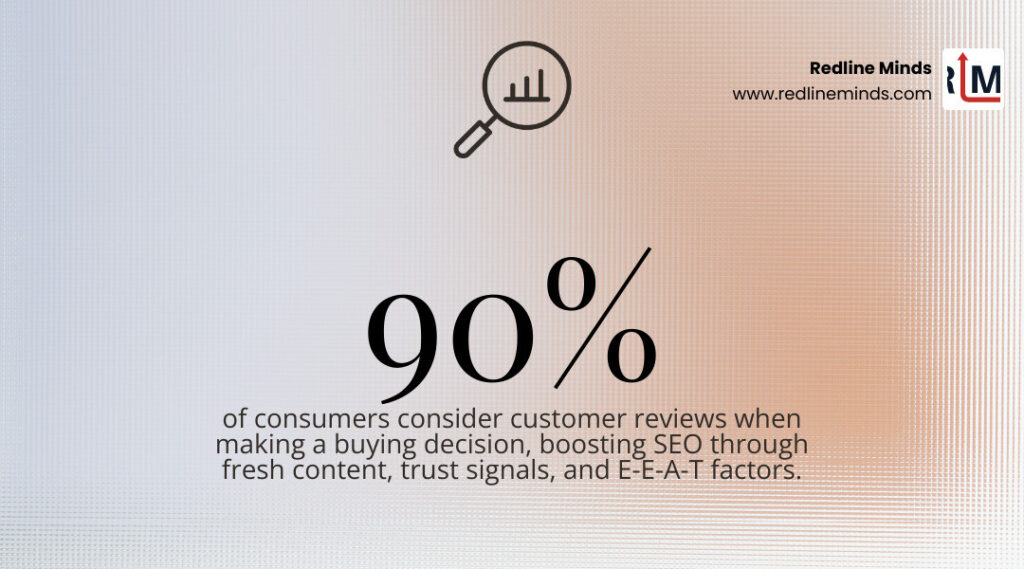
Reviews are SEO gold. They provide fresh content for your pages and naturally include long-tail keywords that real customers use. More importantly, they provide social proof and are a key signal for E-E-A-T (Experience, Expertise, Authoritativeness, and Trustworthiness)—something Google values highly.
Conclusion
At Redline Minds, we know that online store seo can feel overwhelming, especially for B2B and hybrid stores with complex catalogs. However, by focusing on a strong technical foundation, high-intent keywords, and helpful content, you can build a store that ranks well and sells even better.
If you’re ready to take the next step, check out our guide on How to Become an SEO Expert for Your Ecommerce Site or explore our full range of ecommerce services. Based in Jefferson City, TN, we are here to help you navigate the ever-changing world of e-commerce.
Share this article
Tap into years of experience and turn your site’s visitors into buyers.
Related Posts
-
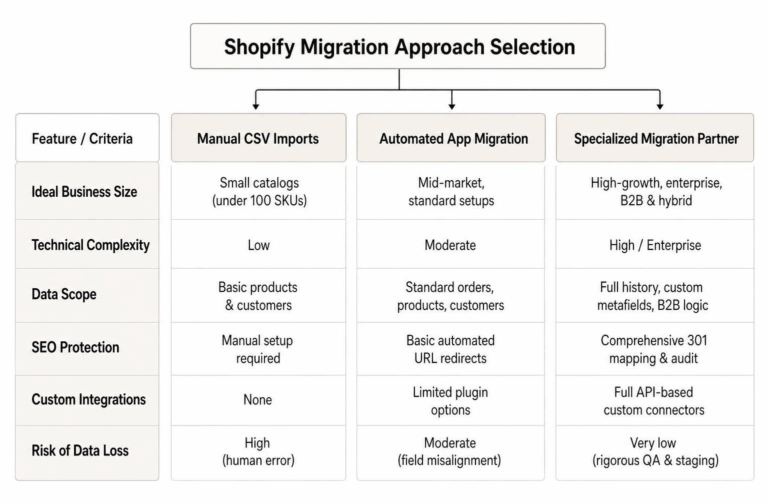
Compare Shopify Migration Services: Options Cheat Sheet
Compare Shopify migration services and find the right Shopify migration company for your store, from manual imports to…
-
Ultimate Checklist for Improving B2B Customer Experience
Ultimate Checklist for Improving B2B Customer Experience – Learn about b2b ecommerce customer experience
-

A Practical Guide to What to Sell Online for Profit
A Practical Guide to What to Sell Online for Profit – Learn about i don t know what…