
The Complete Guide to B2B Ecommerce Features

Why B2B Ecommerce Features Determine Whether Your Business Grows or Stalls
The B2B ecommerce features your platform supports will make or break your ability to compete in a market that hit $2.3 trillion in sales in 2024 — and is on track to surpass $3 trillion by 2028.
If you’re evaluating platforms or planning an upgrade, here are the core features every serious B2B ecommerce site needs:
| Feature Category | What It Does |
|---|---|
| Corporate account management | Multi-user access, parent-child hierarchies, approval workflows |
| Custom pricing and catalogs | Contract pricing, price books, tiered and volume discounts |
| Self-service portals | Order history, quotes, invoices, returns — without calling support |
| Bulk ordering and reordering | CSV uploads, quick order forms, saved shopping lists |
| Flexible payments | Purchase orders, net terms, credit limits, ACH transfers |
| ERP/CRM/PIM integrations | Real-time inventory, order sync, customer data accuracy |
| AI-powered search and personalization | Smart recommendations, natural language search, predictive reorders |
| Multi-org and global scalability | Multiple storefronts, regional pricing, multi-currency support |
B2B buying isn’t like consumer shopping. Your customers are professionals making large, recurring purchases. They have budgets, approval chains, and contract terms. They want to manage their account online — not pick up the phone.
According to research from TrustRadius and Gartner, 100% of B2B buyers prefer to self-serve at least part of their buying journey, and 83% favor digital self-service over traditional sales interactions. That’s not a trend. That’s a baseline expectation.
Yet many mid-sized businesses are still running on platforms built for B2C — or stitching together workarounds that slow down their teams and frustrate their customers.
This guide breaks down every major B2B ecommerce feature category, why each one matters, and what to look for when evaluating your options.
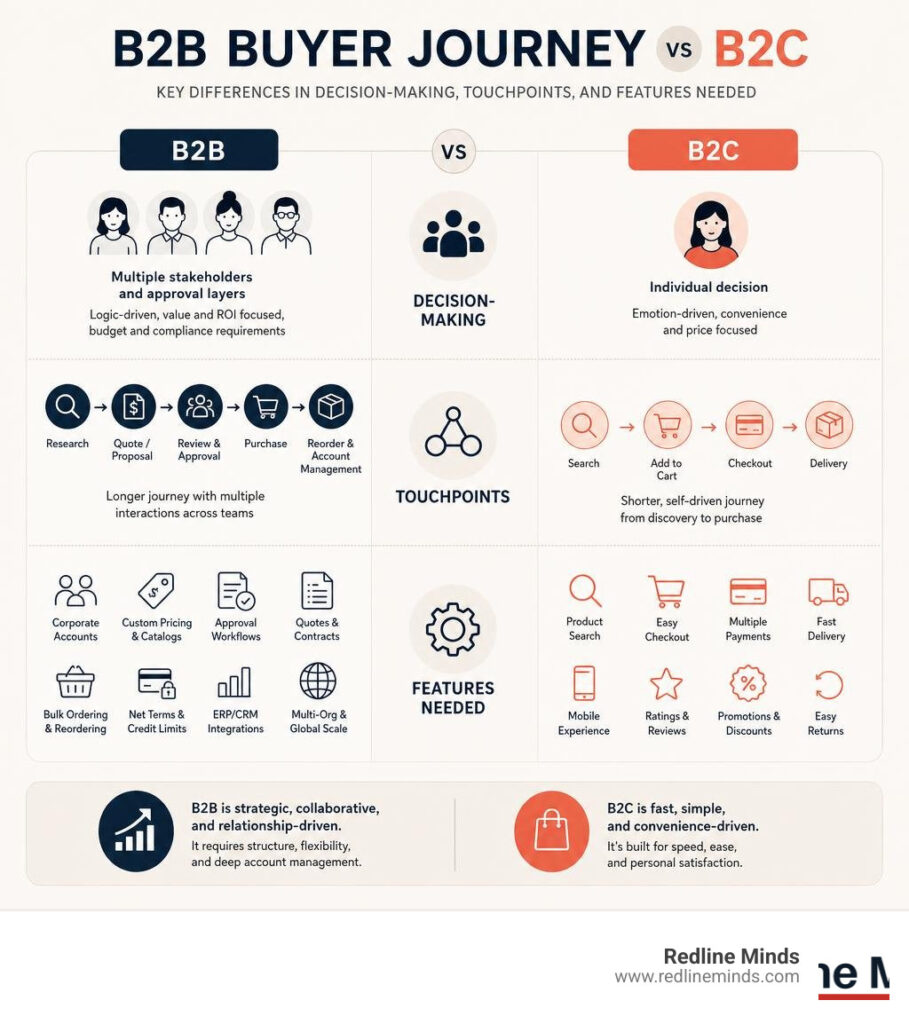
Terms related to b2b ecommerce features:
Essential B2B Ecommerce Features for Modern Platforms

When we transition a client from a basic consumer-facing store to a robust business-to-business ecosystem, the first thing we look at is how the platform structures data. In a standard B2C setup, one login equals one customer. In B2B, one customer is actually an entire company with dozens of buyers, regional offices, and varying levels of purchasing authority.
To see how different software options handle this underlying structure, you can check out The Ultimate B2B Online Store Comparison. The right platform doesn’t just display products; it mirrors your buyers’ real-world business structures.
Corporate Account Management and Multi-User Permissions
A major differentiator in b2b ecommerce features is how platforms manage corporate accounts. A business buyer shouldn’t have to share a single password across their procurement department. Modern platforms must support complex parent-child account structures. This allows a major corporate client to have a parent account that oversees multiple regional branches or subsidiaries (the “children”), each with its own localized shipping addresses, buyers, and budgets.
Within these company accounts, role-based access control (RBAC) is essential. Administrators should be able to assign specific roles to different employees:
- Purchaser: Can build carts and check out within a set budget.
- Approver: Must authorize orders that exceed a buyer’s spending limit.
- Account Administrator: Can add or remove users, manage payment terms, and view billing history.
By setting up automated purchase approval workflows, you eliminate manual email back-and-forth. If a buyer adds $10,000 worth of industrial valves to their cart but has a limit of $5,000, the platform automatically routes the order to their supervisor for a digital sign-off. This level of organization keeps your customers within their corporate budgets while making their buying experience friction-free. For a deeper look at optimizing these administrative setups, explore the capabilities highlighted in B2B commerce optimization | Adobe Commerce .
Custom Pricing and Personalized B2B Ecommerce Features
If there is one absolute truth in business-to-business sales, it is that almost nobody pays the “retail” price. Your relationships are built on negotiated contracts, volume discounts, and historic partnerships.
To manage this online, your platform needs to support customer-specific price books and personalized catalogs. When a buyer logs in, they shouldn’t see your default MSRP. They should see their negotiated contract pricing. Advanced platforms can handle millions of pricing permutations in real-time, pulling directly from your ERP to ensure accuracy.
Additionally, your pricing engine must support:
- Tiered Pricing: Offering discounts based on the quantity purchased (e.g., $10 per unit for 1-99 units, $8 per unit for 100+ units).
- Volume-Based Discounts: Encouraging larger orders by applying a percentage discount when the total cart reaches a certain threshold.
- Product Restrictions: Showing or hiding specific product categories based on the customer’s profile, industry, or geographic location.
This degree of personalization makes your buyers feel like they have a custom-tailored digital storefront built just for them. It also ensures you protect your margins while honoring every contract. To see how to align these custom features with a broader business plan, read our guide on How to Build a B2B Strategy That Actually Scales.
Self-Service Portals and Quote-to-Cash Workflows
Gone are the days when sales representatives spent their afternoons manually entering faxed orders or correcting typos from emailed purchase requests. Today’s sales teams must shift from order takers to strategic growth partners. This is where digital self-service portals shine.
A robust customer portal allows buyers to manage their entire relationship with you 24/7. They can track shipments, view past order history, download invoices, monitor credit balances, and initiate returns without ever having to call your office.
Equally important is the digital Request for Quote (RFQ) and Configure, Price, Quote (CPQ) workflow. Instead of calling to negotiate a deal, a buyer can build a cart and click “Request a Quote.” Your sales reps receive the digital request, adjust the pricing or suggest alternative items in their dashboard, and send it back to the customer.
The buyer can then convert that approved quote into a live order with a single click. This quote-to-cash speed keeps deals moving quickly. To understand why these self-service capabilities are reshaping wholesale networks, take a look at Why B2B Self-Service Portals Are the Future of Wholesale.
Streamlining the Buying Journey with Advanced Ordering and Payments
To successfully convert business buyers, your site’s checkout experience must adapt to professional purchasing habits. The checkout process is often where B2C platforms fall short because they assume a simple credit card transaction.
| B2C Checkout Requirements | B2B Checkout Requirements |
|---|---|
| Single-user checkout | Multi-user approval workflows |
| Credit card or digital wallet (Apple Pay, PayPal) | Purchase orders, Net terms, credit limits, ACH |
| Single shipping address | Split shipments to multiple job sites |
| Immediate payment capture | Invoiced billing, pay-on-account terms |
| Simple tax calculations | Tax-exempt certificates, complex localized tax rules |
Optimizing this flow is a technical puzzle, but solving it yields massive rewards in customer retention. Developers looking to build custom checkout logic can find technical insights in The Developer Guide to Custom Checkout Components for B2B Stores.
Bulk Ordering, Quick Reordering, and Flexible Checkout
Professional buyers are busy, and they frequently purchase the exact same list of SKUs week after week. They do not want to browse through pages of product listings, click “Add to Cart” fifty times, and select variants individually. They want speed and efficiency.
Your platform must offer advanced ordering tools to streamline this process:
- Quick Order Forms: A simple grid where buyers can type in a SKU and a quantity to quickly build a massive order on a single screen.
- CSV or Excel Uploads: Allowing procurement officers to upload a spreadsheet of SKUs and quantities to populate a cart instantly.
- Saved Shopping Lists & Requisition Lists: Enabling teams to save frequently ordered groups of products for fast reordering.
- One-Click Reordering: Allowing buyers to view their order history and immediately replicate a past purchase.
These b2b ecommerce features reduce the order placement process from a twenty-minute chore to a two-minute task. For a deeper discussion on setting up bulk systems that work, check out How to Build a B2B Empire with Custom Solutions and Bulk Ordering.
Flexible Payment Options and Credit Management
While credit cards are fine for small transactions, large B2B orders require payment methods that align with corporate accounting. If your site only accepts Visa and Mastercard, you are leaving substantial revenue on the table.
Your checkout must support:
- Purchase Orders (PO): Allowing buyers to enter their corporate PO number during checkout for internal tracking.
- Net Terms (Net 30/60/90): Extending credit terms to trusted accounts, allowing them to buy now and pay their monthly invoice later.
- Credit Limit Tracking: Automatically checking a buyer’s remaining credit balance before allowing them to place an order on account.
- ACH and Wire Transfers: Supporting direct bank-to-bank transfers for high-value transactions.
Managing these financial terms requires a secure, integrated system that updates in real-time as invoices are paid. To explore how platforms manage these payment architectures, you can review the solutions offered by B2B eCommerce Platform & Software Solutions – commercebuild .
Backend Integrations and Scalability for Global Operations

A beautiful website is useless if it is disconnected from your back-office systems. In B2B ecommerce, the website is merely the digital storefront of a highly complex logistical machine. If your inventory levels, contract pricing, and order histories do not sync automatically, your team will spend all their time manually copying data between systems. To learn how to select software that integrates cleanly, read Choosing the Right B2B Ecommerce Software.
ERP, CRM, and PIM Integrations for Real-Time Data
To achieve true operational efficiency, your B2B platform must integrate with your existing technology stack:
- ERP (Enterprise Resource Planning): The central brain of your business. Your ERP holds your master inventory counts, general ledger, and customer credit terms. Real-time ERP sync ensures that when a buyer checks stock levels or their credit limit, they see 100% accurate data.
- CRM (Customer Relationship Management): Syncing customer interactions helps your sales reps see what products their clients are viewing, what quotes are pending, and when they last ordered.
- PIM (Product Information Management): If you manage thousands of complex SKUs with highly technical specifications, a PIM ensures that accurate product data, dimensions, and manuals are pushed to your website consistently.
By leveraging an API-first, composable architecture, you can connect these systems seamlessly, eliminating manual data entry and reducing order fulfillment delays. For a look at how ERP-centric platforms manage this flow natively, see NetSuite SuiteCommerce: B2B | NetSuite .
Multi-Organization and Global Scalability Features
As your business grows, you may expand into new brands, regions, or business models. A scalable B2B platform must support multi-organization management from a single administrative panel.
This means you can launch multiple storefronts targeting different customer segments, industries, or countries while sharing the same backend catalog and inventory data. For global operations, your platform must support:
- Multi-Currency and Regional Pricing: Automatically displaying prices in Euros, Canadian Dollars, or US Dollars based on the buyer’s location.
- Localized Content and Multi-Language Support: Translating product descriptions and checkout fields to match regional preferences.
- International Tax and Compliance: Calculating complex VAT, GST, or regional sales taxes automatically at checkout.
Investing in a platform that scales globally prevents you from having to rebuild your site every time you enter a new market. For a list of platforms that excel at this level of growth, read The Best Platforms for Scaling Your B2B Ecommerce Operations.
The Role of AI and Unified Commerce in B2B
The digital landscape is evolving rapidly, and in 2026, artificial intelligence is no longer a futuristic buzzword — it is a standard expectation. According to industrial reports, 67% of B2B companies are already leveraging AI to drive business growth. AI is helping businesses automate routine tasks, personalize search results, and empower sales reps to close deals faster. To explore the foundational strategies of this modern approach, check out our hub on B2B Ecommerce.
AI-Driven Personalization and Search in B2B Ecommerce Features
In B2B, search is the most critical feature on your site. Unlike B2C shoppers who might browse casually, business buyers know exactly what they need. They often search using highly technical terms, manufacturer part numbers, or exact SKUs.
AI-driven vector search goes beyond simple keyword matching. It understands search intent, typo tolerance, and synonym recognition. If a buyer searches for a partial part number or uses a different industry term, the AI still surfaces the correct product.
Furthermore, AI-powered personalization can:
- Predict Reorder Times: Analyzing past buying patterns to send automated reminders when a customer is likely running low on a recurring supply.
- Deliver Smart Recommendations: Suggesting compatible parts, accessories, or bulk alternatives based on what is in their cart.
- Automate Quoting: Using generative AI to draft outbound proposal emails and respond to simple RFQs instantly.
To see how leading platforms are embedding these intelligent workflows into their core software, explore the insights in Boost your B2B business | BigCommerce .
Unifying B2B and B2C Operations on a Single Platform
Many manufacturers and distributors are adopting hybrid business models. They might sell wholesale to retail partners (B2B) while also selling directly to end consumers (D2C/B2C).
Historically, this required running two completely separate websites, leading to doubled software licensing fees, disjointed inventory tracking, and duplicated marketing efforts.
Modern platforms solve this by offering unified commerce. You can run your retail store and your password-protected wholesale portal on a single platform. This allows you to:
- Share Catalog Resources: Use the same master product database while applying different pricing engines and visibility rules for each customer type.
- Reduce Back-Office Costs: Consolidate your hosting, security compliance (like PCI DSS), and developer maintenance under one roof.
- Empower Sales Reps: Give your sales team “login-as-customer” (impersonation) features so they can troubleshoot issues, build carts, and place orders directly on behalf of their clients.
By unifying these operations, you gain a single source of truth for your entire business. To understand how a central portal unites these channels, read The Power of the B2B Customer Portal.
Frequently Asked Questions about B2B Website Functionality
What is the difference between B2B and B2C ecommerce features?
B2C ecommerce focuses on simplicity, emotional engagement, and fast checkout for individual shoppers. B2B ecommerce features are designed to handle complex business relationships. This includes multi-user corporate accounts, negotiated contract pricing, split shipments, purchase orders, approval workflows, and deep integrations with ERP systems.
How do B2B platforms handle custom contract pricing?
Advanced platforms assign buyers to specific “customer groups” or sync directly with your ERP’s price sheets. When a buyer logs in, the platform queries their account ID and displays their specific negotiated contract rates, tiered discounts, and product restrictions, rather than the public retail price.
Why is ERP integration critical for B2B ecommerce?
Your ERP is the single source of truth for your business’s financial and logistical data. Integrating it with your ecommerce platform ensures that inventory counts, customer credit limits, order statuses, and custom pricing are synchronized in real-time. This eliminates manual data entry, prevents out-of-stock orders, and streamlines your entire billing process.
Conclusion
Building a successful digital sales channel requires more than just launching a website; it requires a strategic digital transformation. The b2b ecommerce features you choose today will dictate how efficiently your business can scale, how productive your sales team will be, and how loyal your customers will remain.
At Redline Minds, we specialize in helping mid-market manufacturers, distributors, and hybrid brands navigate this complexity. Based in Jefferson City, Tennessee, our team of experts provides end-to-end ecommerce consulting, custom web development, and targeted digital marketing services designed to turn your website into a powerful growth engine.
Ready to upgrade your digital experience and streamline your operations? Redline Minds, 349 Nancy Drive, Jefferson City, TN 37760-4623, US is here to help.
Partner with Redline Minds for expert B2B ecommerce services today, and let’s build a scalable strategy that drives real business results.
Share this article
Tap into years of experience and turn your site’s visitors into buyers.
Related Posts
-
Compare Shopify Migration Services: Options Cheat Sheet
Compare Shopify migration services and find the right Shopify migration company for your store, from manual imports to…
-

Ultimate Checklist for Improving B2B Customer Experience
Ultimate Checklist for Improving B2B Customer Experience – Learn about b2b ecommerce customer experience
-

A Practical Guide to What to Sell Online for Profit
A Practical Guide to What to Sell Online for Profit – Learn about i don t know what…