
The Ultimate Guide to E-Commerce Retailing

Why E-Commerce Retailing Is Reshaping How Businesses Grow
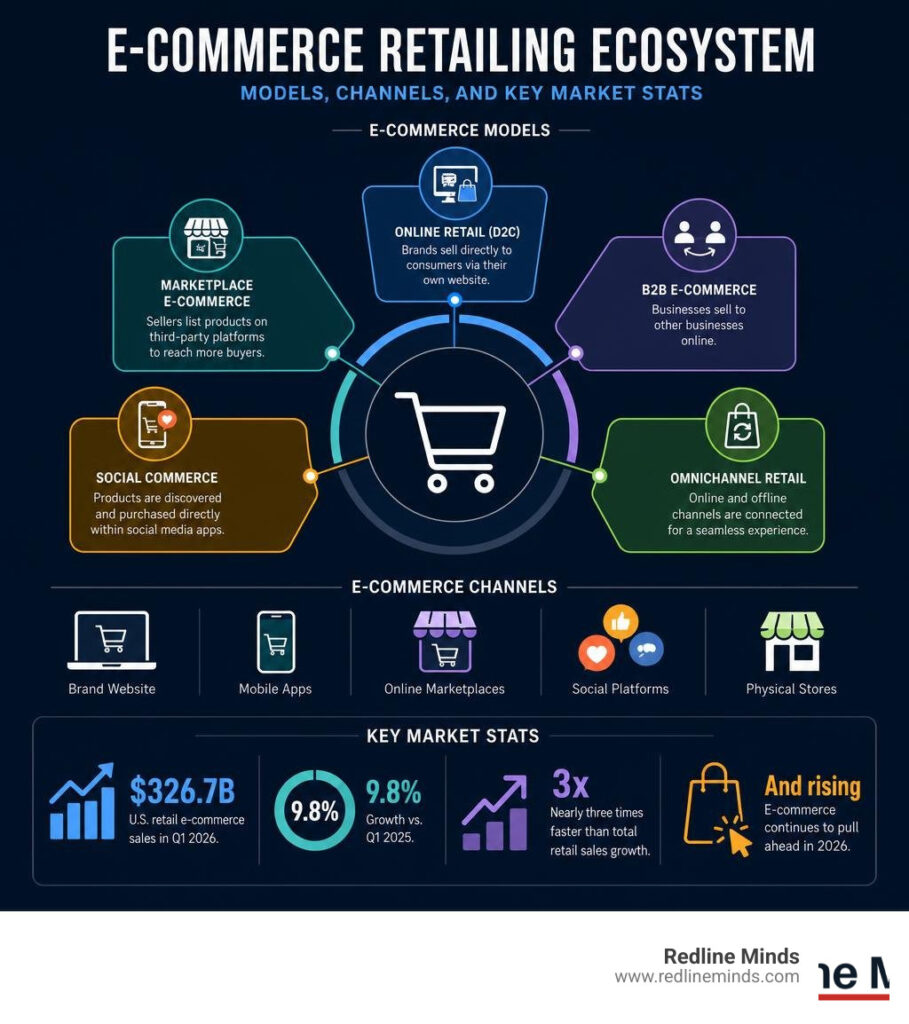
E-commerce retailing is the buying and selling of goods and services through online channels — including brand-owned websites, third-party marketplaces, and social platforms.
Here’s a quick breakdown of what it covers:
- Online retail (D2C): A brand sells directly to consumers through its own website
- Marketplace e-commerce: Sellers list products on platforms like Amazon or eBay
- B2B e-commerce: Businesses sell to other businesses online
- Social commerce: Products are discovered and purchased directly within social media apps
- Omnichannel retail: Online and offline channels are connected into one unified experience
If you’re running a mid-sized online store, you already know the basics. But knowing which model fits your business — and how to scale it efficiently — is where most retailers get stuck.
The numbers make the urgency clear. U.S. retail e-commerce hit $326.7 billion in Q1 2026 alone, up 9.8% from the same period a year earlier. That growth is nearly three times faster than total retail sales growth over the same period.
E-commerce isn’t just growing. It’s pulling ahead.
And yet, many retailers between $1M and $10M in annual sales are leaving money on the table — running on disconnected systems, unclear on which sales channels to prioritize, and unsure whether to double down on their own store or expand to marketplaces.
This guide cuts through the noise. We’ll break down every major e-commerce model, compare standalone stores against established platforms, and walk through what it actually takes to build a scalable, profitable online retail operation in 2026.
Online Retail vs. E-Commerce: Understanding the Core Differences
While many people use the terms “online retail” and “e-commerce” interchangeably, they represent different scopes of digital business. Understanding how they differ—and how they overlap—is essential for shaping your digital sales strategy.
Broadly speaking, e-commerce is the overarching umbrella. It encompasses any commercial transaction completed electronically over the internet. This includes online banking, digital auctions, business-to-business transactions, and even government administrative payments. Online retail, on the other hand, is a specific subset of e-commerce focused on selling consumer goods or services directly to individual end-users.
To help visualize these differences, we can look at the transaction types, business scopes, and digital infrastructures involved in each model. For a deeper dive into the foundational mechanics, you can read our What is Ecommerce: Comprehensive Guide to Online Retail.

| Capability / Feature | Online Retail (D2C / Brand Store) | E-Commerce (Marketplaces & Platforms) |
|---|---|---|
| Primary Audience | Direct-to-Consumer (B2C) | B2C, B2B, C2C, B2G |
| Brand Control | High (Complete ownership of UX/UI) | Low (Subject to platform rules and design) |
| Customer Data | Fully owned by the merchant | Owned or restricted by the marketplace |
| Profit Margins | Higher (No third-party transaction cuts) | Lower (Subject to platform fees and commissions) |
| Built-in Traffic | Low (Requires active marketing) | High (Immediate access to active buyers) |
Defining Online Retail and Direct-to-Consumer (D2C) Models
Online retail is defined by direct brand-to-consumer interaction. Under a Direct-to-Consumer (D2C) model, a company sells its products directly to the end customer through its proprietary online storefront. This setup gives us absolute control over the entire brand experience—from the way product images are optimized to the post-purchase email sequence.
In online retail, the customer experience is your primary differentiator. Because you aren’t competing side-by-side with rivals on a shared search results page, you have the space to tell your brand story and build genuine customer loyalty. However, this means you must invest heavily in creating intuitive, high-converting digital environments. Designing an interface that feels effortless is paramount; you can explore our best practices in The Ultimate Guide to Ecommerce UX That Actually Converts.
Defining E-Commerce and Multi-Seller Platforms
E-commerce covers a much broader digital infrastructure. When we discuss e-commerce in the context of multi-seller platforms, we are talking about third-party marketplaces like Amazon, eBay, or specialized business portals where multiple merchants list their wares. In these environments, the platform handles the core transaction processing, search algorithms, and sometimes even the physical fulfillment, while the individual sellers focus purely on inventory and pricing.
For many businesses, leveraging these massive platforms is a highly efficient way to scale. Global consulting firms like EY emphasize that e-commerce has evolved from a simple sales add-on into an essential, stand-alone business discipline across every sector of the economy. To learn more about how global organizations view this shift, check out the insights from E-commerce | EY – Global.
The Landscape of E-Commerce Retailing: Business Models and Market Trends
The digital economy is incredibly diverse, offering numerous pathways for brands to reach their target buyers. Whether you are a local manufacturer selling bulk parts or a boutique retailer shipping direct to consumers, choosing the right operational framework is the first step toward sustainable growth.
Core Business Models in E-Commerce Retailing
To position your business effectively, you must understand the six primary models that define modern digital commerce:
- Business-to-Consumer (B2C): The most common form of e-commerce retailing, where a business sells directly to individual shoppers. Platforms like B2C Commerce | Salesforce are built specifically to help brands power these high-scale, personalized consumer experiences.
- Business-to-Business (B2B): Businesses selling to other businesses. This model involves complex pricing tiers, bulk ordering, and custom integration with enterprise resource planning (ERP) systems.
- Consumer-to-Consumer (C2C): Individuals selling directly to other individuals, facilitated by platforms like eBay, Poshmark, or Facebook Marketplace.
- Consumer-to-Business (C2B): Individuals offering products or services to organizations (e.g., freelance platforms or influencer networks).
- Business-to-Administration (B2A) / Business-to-Government (B2G): Companies selling products, services, or software solutions to government agencies and public administrations.
- Consumer-to-Administration (C2A) / Consumer-to-Government (C2G): Citizens interacting with public authorities online, such as paying taxes or renewing passports.
For mid-market merchants, the most exciting frontier is the rise of hybrid stores. A hybrid model allows a single business to support both B2B and B2C transactions from a unified system. This is our core specialty at Redline Minds. We help retailers build platforms that serve retail shoppers while simultaneously providing secure, self-service portals with wholesale pricing for business clients. To plan your marketing approach for these models, see our Ecommerce Marketing Guide 2026.
The Evolution of Digital Retail Sales
The growth trajectory of e-commerce shows no signs of slowing down. According to the U.S. Census Bureau, retail e-commerce sales reached an incredible $326.7 billion in the first quarter of 2026. This represented a 2.7% increase from the fourth quarter of 2025 and an impressive 9.8% jump compared to Q1 2025. Today, e-commerce accounts for 16.9% of all retail sales in the United States.
This massive digital migration has reshaped the competitive landscape at the very top of the retail industry. In a historic milestone, Amazon’s annual revenue recently surpassed Walmart’s, fueled by its unstoppable digital marketplace, third-party merchant services, and cloud computing divisions. You can read the full breakdown of this monumental shift in the Amazon revenue passes Walmart after earnings reports article on CNBC.
Standalone Online Stores vs. E-Commerce Platforms: A Strategic Comparison
When establishing your online presence, one of the most critical decisions you will make is choosing where your store lives. Should you build a custom, standalone digital storefront from scratch, or should you build your business on an established, SaaS-based e-commerce platform?
For the vast majority of growing retail brands, leveraging an established platform is the smarter, more cost-effective choice. Building a custom store from the ground up requires massive upfront capital, dedicated development teams, and ongoing maintenance to keep up with security compliance. Modern commerce platforms drastically reduce these barriers to entry.
A prime example of this accessibility is Shopify: The All-in-One Commerce Platform for Businesses – Shopify. Shopify has democratized online retail by offering highly reliable hosting, drag-and-drop design tools, and a massive app ecosystem that allows brands to scale from their very first sale up to enterprise-level operations.
Key Features of Modern E-Commerce Platforms
If you are evaluating software to run your online business, a modern e-commerce platform must deliver capabilities far beyond a simple shopping cart. Look for platforms that excel in these three areas:
- Flexible Payment Gateways: Your checkout must be fast, secure, and frictionless. Offering diverse payment methods—including digital wallets and buy-now-pay-later solutions—is proven to boost conversion rates. Learn how to optimize your checkout flow in our guide to Ecommerce Payment Options.
- Robust Inventory Control: You need real-time tracking across all warehouses and sales channels to prevent stockouts and over-selling. For a comparison of the best systems, read about Ecommerce Inventory Control Options: Best Options.
- Mobile-First Design: With the majority of digital transactions now occurring on smartphones, your store must load instantly and adapt perfectly to any screen size.
Leveraging AI and Automation in E-Commerce Retailing
The latest evolution in e-commerce retailing is the rise of agentic commerce—the use of autonomous AI agents to manage store operations and assist shoppers. Rather than relying on simple, rule-based chatbots, modern platforms use AI to dynamically personalize product recommendations, automate customer service, and even manage inventory levels without human intervention.
A leader in this open-source and agentic AI space is Shopware. Their platform integrates built-in AI copilots designed to automate routine administrative tasks, analyze store data for anomalies, and deliver highly personalized shopping experiences. You can learn more about their vision for AI-driven retail by visiting The ecommerce platform to power your online business | Shopware.
Building a Seamless Omnichannel Experience: Integrating Online and Offline Channels
For modern retailers, the dividing line between “online” and “offline” shopping has completely dissolved. Customers expect a unified experience. They want to browse your products on their phones, check local store inventory in real-time, purchase the item online, and pick it up at a physical retail location an hour later.
This unified approach is known as omnichannel retail. Achieving it requires connecting your physical point-of-sale (POS) systems, digital storefronts, and back-office operations into a single, cohesive ecosystem.
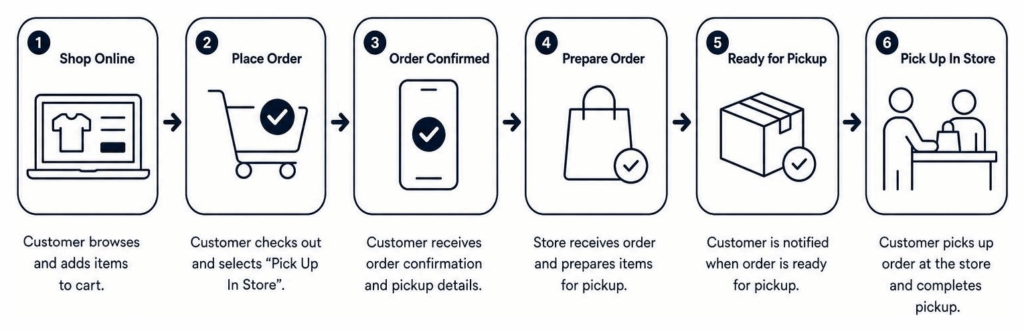
To build this seamless flow, many enterprise retailers rely on advanced software suites like Commerce | Microsoft Dynamics 365. This platform bridges the gap between physical stores and digital channels, enabling real-time data sharing across your entire business.
Inventory Management and Order Fulfillment
The backbone of any successful omnichannel strategy is unified inventory visibility. If your website says an item is in stock at a nearby store, but a local customer arrives to find empty shelves, you have broken their trust.
To prevent this, retailers must integrate their e-commerce platforms directly with their Enterprise Resource Planning (ERP) systems. This integration enables:
- Real-Time Stock Syncing: Automatically updates inventory counts across your website, marketplaces, and physical retail shelves.
- Distributed Order Management: Rules-based routing that automatically fulfills online orders from the optimal warehouse or physical store to minimize shipping times and costs.
- Endless Aisles: Allows in-store associates to order out-of-stock items directly from a warehouse and ship them to the customer’s home.
To explore how to set up these backend systems, refer to our comprehensive guide on Ecommerce Inventory Control Options: Best Options.
Marketing and Customer Relationship Management
Once your inventory and fulfillment systems are connected, you can leverage unified data to supercharge your marketing. An omnichannel Customer Relationship Management (CRM) system gathers customer interactions from every touchpoint—website visits, email clicks, social purchases, and in-store transactions—into a single profile.
With this unified profile, we can deliver highly personalized experiences. For example, if a customer buys a pair of boots at your physical store, your CRM can automatically trigger a personalized email sequence recommending matching boot socks. This level of personalization is critical for long-term customer retention. To understand why your technical teams must prioritize these marketing integrations, read our guide on Ecommerce Marketing Optimization and Why Your Product Team Needs to Care and learn how to manage these relationships with an Ecommerce CRM.
Frequently Asked Questions about Online Selling
What is the difference between online retail and e-commerce?
Online retail refers specifically to direct-to-consumer (B2C) sales of physical or digital goods through a brand’s own digital storefront. E-commerce is a much broader term that encompasses any electronic business transaction, including B2B wholesaling, online auctions, digital banking, and government administrative transactions.
Which e-commerce model is best for new businesses?
For most new businesses, starting with a Business-to-Consumer (B2C) model built on an established SaaS platform like Shopify is the most effective approach. This setup offers low upfront costs, user-friendly design tools, and built-in security, allowing you to launch quickly and test your products in the market without needing a large development team.
How do inventory management and order fulfillment differ in e-commerce?
In traditional retail, inventory is managed on-site and sold directly to customers walking through the door. In e-commerce, inventory is often spread across multiple regional warehouses, third-party logistics (3PL) providers, or physical retail stores. Order fulfillment in e-commerce requires automated, real-time tracking and rules-based routing to ensure that online orders are picked, packed, and shipped from the most efficient location.
Conclusion
The world of e-commerce retailing is moving faster than ever. From the rapid rise of AI-driven agentic shopping to the complex backend demands of omnichannel fulfillment, building a successful online store requires a strategic blend of the right technology, marketing, and operational workflows.
At Redline Minds, we specialize in helping mid-market retailers navigate this digital transformation. Based in Tennessee, our expert team focuses exclusively on e-commerce consulting, custom web development, and digital marketing. We specialize in building robust B2B portals and hybrid stores that seamlessly serve both retail shoppers and wholesale clients from a single, unified platform.
Ready to scale your online sales and build a future-proof commerce experience? Explore our More info about ecommerce services to see how we can help your business grow.
Share this article
Tap into years of experience and turn your site’s visitors into buyers.
Related Posts
-

The Ultimate Guide to Types of E-Commerce Payment Systems
Learn the types of e commerce payment system to boost sales and reduce cart abandonment in this complete…
-

A Practical Guide to AI Agent Integration Methods
Learn how AI agent integration connects enterprise systems with MCP, Unified APIs, and custom code for secure, real-time…
-

The Definitive Guide to AI Agent Commerce
Explore how AI agent commerce transforms shopping with autonomous agents, new protocols, and secure payments in this 2026…