
B2B Ecommerce Development: Everything You Need to Know

Why B2B Ecommerce Development is the Ultimate Growth Lever in 2026
Investing in b2b ecommerce development is the single most effective way for mid-sized wholesalers, manufacturers, and distributors to scale operations, eliminate costly order errors, and secure larger buyer accounts in 2026.
If you want to build a highly successful B2B online store, your development project must focus on five core pillars:
- Customer-Specific Pricing: Display unique negotiated rates and volume tiers instantly when a buyer logs in.
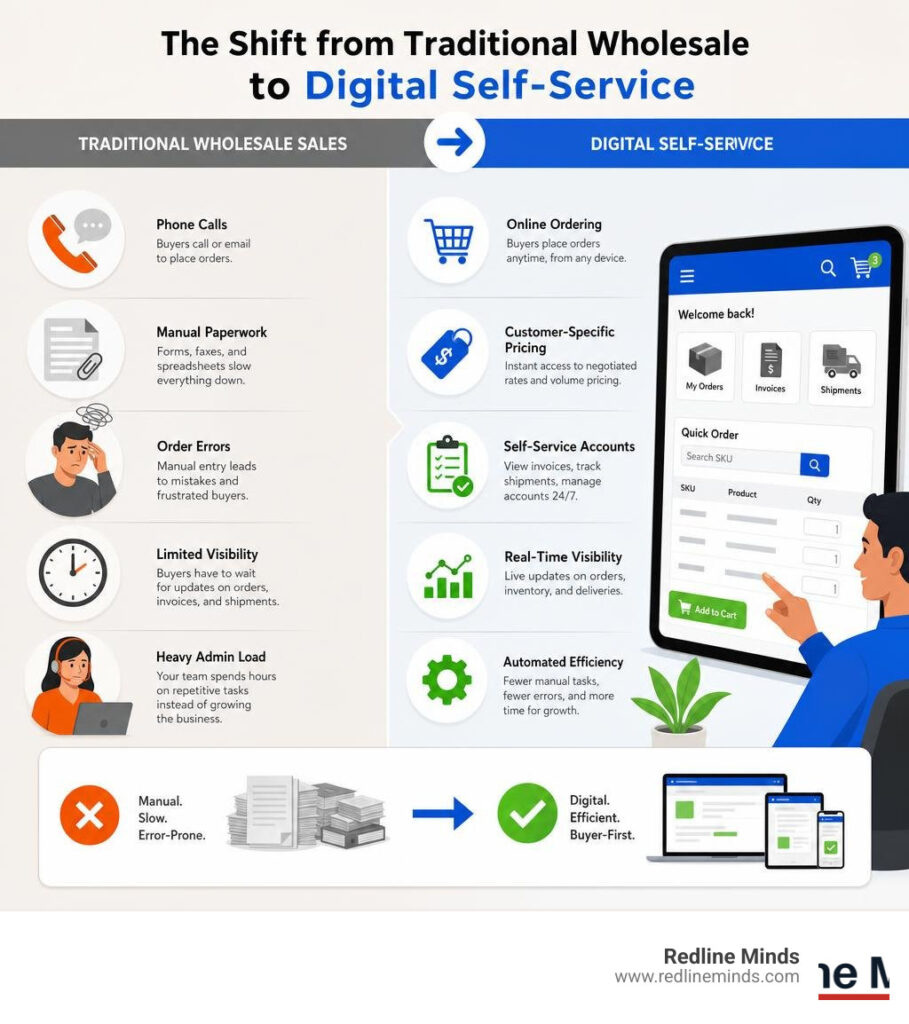
- Self-Service Portals: Allow buyers to manage their own accounts, view invoice history, track shipments, and request quotes 24/7.
- Bulk Ordering Tools: Provide quick-order forms, SKU searches, and CSV upload options for fast, high-volume purchasing.
- Backend System Integration: Connect your website directly to your ERP, CRM, and inventory management systems for real-time data flow.
- Flexible Payment Terms: Support purchase orders, credit limits, and custom payment terms alongside standard credit card processing.
Let’s be honest about the current state of wholesale.
Your business buyers do not want to call a sales representative just to place a routine order. They do not want to fill out paper forms, send faxes, or email back-and-forth spreadsheets. They expect the same fast, seamless, and mobile-friendly self-service experience online that they get when shopping as everyday consumers.
If your internal team is still spending hours manually keying orders into your system, you are burning valuable profit margins. Manual processes slow down your fulfillment times. Even worse, they lead to human errors that frustrate your most valuable accounts.
When you prioritize digital commerce development, you solve both sides of this equation. You give your buyers the modern, frictionless purchasing tools they demand. At the same exact time, you automate your backend operations—freeing up your sales team to focus on high-value strategy and relationship-building instead of routine administrative tasks.
B2b ecommerce development terms you need:
- b2b ecommerce portal
- b2b ecommerce strategy
- ecommerce b2b platform
What is B2B eCommerce and How Does It Differ From B2C?
At its core, Business-to-Business (B2B) eCommerce refers to the online sale of products or services between businesses—such as a manufacturer selling to a distributor, or a wholesaler selling to a retail brand. While Business-to-Consumer (B2C) retail focuses on quick, emotional, single-buyer transactions, B2B digital commerce deals with high-volume, relationship-driven buying cycles.
The average B2B buying journey is naturally more complex. Instead of a single consumer hitting a “Buy Now” button, B2B purchasing typically involves structured buying committees, corporate procurement policies, and multi-step approval workflows. This means your online store cannot simply offer a generic catalog with standard retail pricing.
To support these complex relationships, a B2B site must display custom catalogs and negotiated contract pricing unique to each logged-in business account. For a detailed breakdown of how B2B platforms stack up against retail-focused systems, take a look at our guide on The Ultimate B2B Online Store Comparison.
Key Differences in B2B Ecommerce Development Requirements
Building a B2B store requires a completely different architectural approach than standard B2C web development. To satisfy the demands of corporate procurement, your web development project must incorporate several complex backend functionalities:
- Complex Account Hierarchies: A single corporate account may have dozens of buyers spread across multiple locations. Your platform must support nested company profiles where administrators can assign specific user roles, purchasing limits, and regional shipping addresses.
- Custom Approval Workflows: If a junior buyer builds a cart that exceeds their assigned spending threshold, the system must automatically route the order to their procurement manager for approval before processing payment.
- Dynamic Pricing Engines: Unlike B2C stores with uniform prices, B2B platforms must calculate real-time pricing based on customer groups, negotiated contracts, and volume-based tier discounts.
To understand how developers construct these complex backend systems, check out The Developer Guide to Custom Checkout Components for B2B Stores for a technical look at checkout customization.
Why B2B Ecommerce Development is Critical in 2026
The digital marketplace has shifted permanently. Digital channels are no longer just a convenient alternative for B2B brands; they are now the primary engine driving enterprise revenue growth. Recent market studies reveal that B2B leaders expect more than half of their total revenue to come directly from digital channels over the next two years.
Furthermore, more than one-third of B2B buyers now complete their entire sales journey online without ever speaking to a sales representative. The scale of these online transactions is also skyrocketing, with high-value digital orders exceeding $500,000 growing faster than any other purchasing category. If your platform isn’t equipped to handle enterprise-level digital procurement, you are leaving massive amounts of revenue on the table.
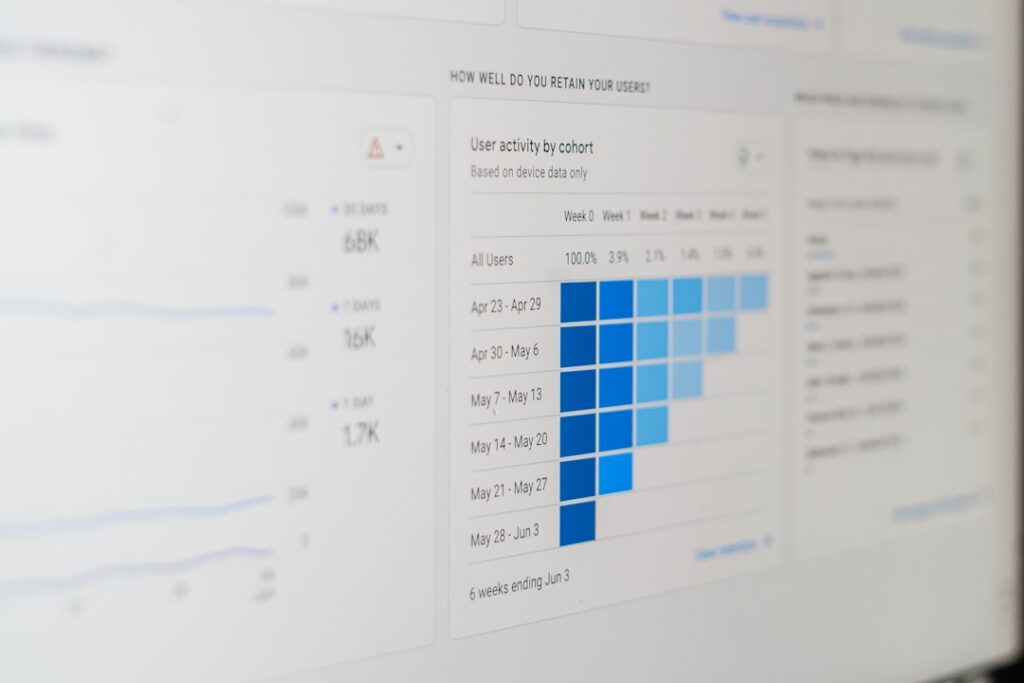
To capture this growing market share, manufacturers and distributors must design scalable platforms that accommodate complex buying behaviors. You can read more about building a future-proof roadmap in our article on How to Build a B2B Strategy That Actually Scales.
Reducing Operational Costs and Improving Efficiency
One of the most immediate benefits of professional b2b ecommerce development is the drastic reduction in operational overhead. When you transition your buyers from manual ordering methods to digital self-service portals, you eliminate the friction that eats away at your margins.
Manual order entry is slow, expensive, and highly prone to human error. By automating the order-taking process through a secure online portal, businesses routinely see up to an 87% reduction in order processing errors.
Additionally, self-service portals empower your buyers to retrieve their own invoices, track shipments, check real-time inventory, and request quotes without needing to call your customer support team. This dramatic reduction in administrative workload allows your staff to focus on proactive account management and business development. To explore how self-service portals can revolutionize your wholesale operations, read our deep dive on Why B2B Self-Service Portals Are the Future of Wholesale.
Key Features and Platform Selection for B2B Sites
A successful B2B storefront must be designed with the buyer’s efficiency in mind. Unlike retail shoppers who browse, business buyers are on a mission to find specific parts or products, verify availability, and complete their purchases as quickly as possible.
To facilitate this rapid purchasing behavior, your site should feature custom customer groups, quick-reorder buttons based on past purchase history, and streamlined bulk ordering tools.
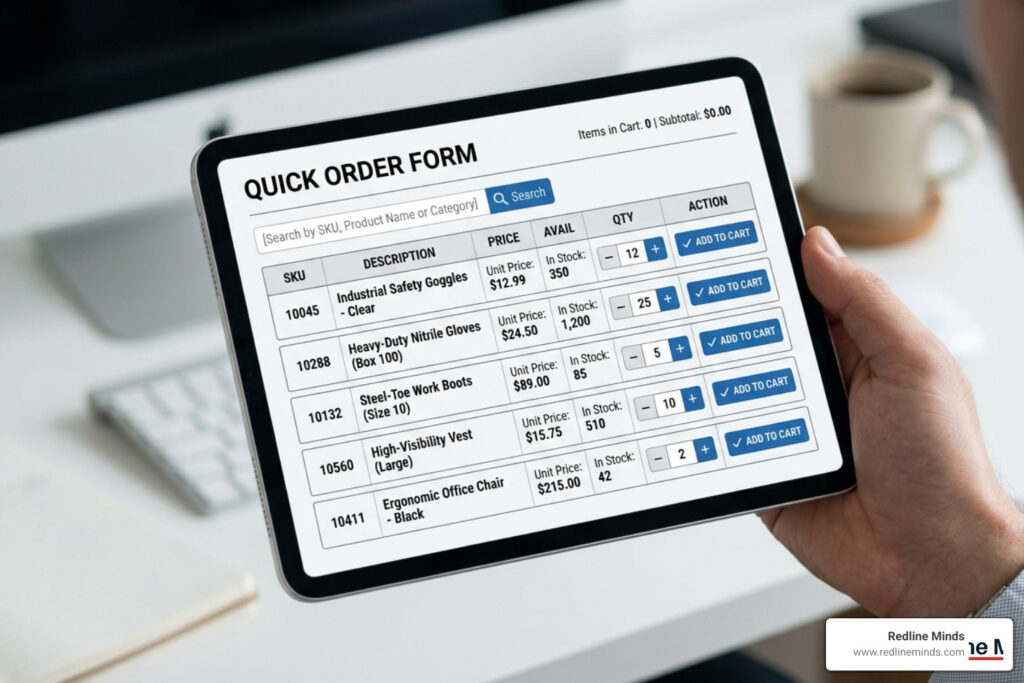
Providing tools like CSV upload forms and rapid SKU search bars transforms the purchasing process from a chore into a quick, pleasant task. To learn how to implement these bulk tools to scale your operations, read our guide on How to Build a B2B Empire with Custom Solutions and Bulk Ordering.
Essential Features for B2B Ecommerce Development Projects
When scoping out your development roadmap, there are several non-negotiable features that must be integrated to support professional business transactions:
- Role-Based Permissions: Enable customer administrators to create individual buyer logins, set custom monthly spending limits, and restrict access to certain product categories.
- Flexible Payment and Credit Terms: While credit cards are popular, B2B buyers require diverse options. Your platform must natively handle purchase orders (POs), net-30/60 credit terms, checks, and line-of-credit balances.
- Request for Quote (RFQ) Workflows: For large or custom orders, buyers should be able to submit a digital RFQ directly from their shopping cart. Your sales team can then review, adjust pricing, and send the quote back to the buyer’s dashboard for one-click checkout.
Implementing these robust features requires a secure, well-structured online space. You can read more about designing these spaces in our resource on The Power of the B2B Customer Portal.
Choosing the Right B2B eCommerce Platform
Selecting the right software foundation is one of the most critical decisions in your digital commerce journey. You must carefully weigh the pros and cons of Software-as-a-Service (SaaS) platforms against open-source solutions while calculating the true Total Cost of Ownership (TCO).
| Platform Feature | SaaS Platforms (e.g., BigCommerce, Shopify Plus) | Open-Source Platforms (e.g., Adobe Commerce) |
|---|---|---|
| Hosting & Security | Fully managed, PCI compliant out-of-the-box | Self-hosted, requires manual security audits |
| Customization | Highly flexible via APIs, but bound by platform limits | Unlimited customization of core code |
| Maintenance Cost | Low, predictable monthly subscription fees | High, requires ongoing developer support for updates |
| Time to Market | Fast deployment (typically 2 to 4 months) | Slower deployment (often 6 to 12 months) |
| Out-of-the-Box B2B | Strong native B2B suites (e.g., BigCommerce B2B Edition) | Robust enterprise features, but highly complex |
To help you make an informed decision based on your specific business goals, we have compiled an in-depth analysis: Choosing the Right B2B Ecommerce Software.
Top Platforms for Scaling Wholesale Operations
While there are many options on the market, three enterprise-grade platforms dominate the B2B space:
- BigCommerce B2B Edition: Known for its exceptionally low total cost of ownership, open APIs, and powerful native B2B features. BigCommerce is highly favored because its clients break even quickly—often in just eight months—and see a massive average ROI of 211% by the third year.
- Shopify Plus: A highly scalable, hosted solution that offers a user-friendly interface for hybrid businesses running both B2C and B2B stores from a single backend. Not a great fit for B2B with complex needs.
- ShopWare: The ultimate choice for massive enterprises requiring extreme customization, complex multi-region setups, and deep legacy integrations. Open source provides the maximum flexibility for design and function.
To see which of these platforms aligns best with your scaling goals, read The Best Platforms for Scaling Your B2B Ecommerce Operations.
The Role of Backend Integrations and Performance Optimization
A B2B storefront is only as powerful as the systems it connects to. To run a truly efficient wholesale business, your ecommerce platform must not exist as an isolated silo. It must be seamlessly integrated with your Enterprise Resource Planning (ERP), Customer Relationship Management (CRM), Product Information Management (PIM), and Order Management Systems (OMS).
Without these real-time integrations, your business will struggle with inaccurate inventory levels, outdated pricing lists, and manual data-entry bottlenecks. A professional integration ensures that when a buyer places an order online, it is instantly routed to your ERP for fulfillment, while inventory levels are updated across all sales channels in real time.
To learn how to master this backend balance, read our expert advice on The Secret Sauce of B2B Wholesale Inventory Management.
Best Practices for B2B UX, Design, and Performance
Modern business buyers expect a world-class online shopping experience. In fact, 90% of global B2B customers now expect an online shopping journey that is just as intuitive, fast, and responsive as a consumer-facing B2C retail site.
This means page speed and performance optimization are critical. Approximately 70% of online users state that page load speed heavily influences their purchasing decisions. On the flip side, slow site speeds are a major conversion killer: 60% of B2B buyers report that slow load times have stopped them from completing a purchase online.
To keep buyers engaged, your site must achieve excellent Core Web Vitals scores, feature intuitive faceted search filters, and offer a flawless mobile experience. Mobile optimization is no longer optional; 78% of global B2B buyers actively wish their suppliers offered a better mobile experience, as many procurement managers now place orders directly from warehouse floors or job sites.
To learn how to design a high-converting, lightning-fast B2B storefront, explore our core resources on B2B Ecommerce.
Overcoming Challenges and Future Trends in B2B Commerce
Transitioning to a digital-first sales model comes with its fair share of hurdles. Many established wholesalers struggle with technical debt—outdated legacy systems that were never designed to communicate with modern web APIs. Upgrading these systems requires careful data mapping, security validation, and a phased migration strategy to avoid costly business downtime.
Security is another major concern. Because B2B portals handle sensitive corporate data, contract pricing, and high-value financial transactions, your site must implement enterprise-grade security protocols. This includes robust data encryption, secure payment gateways, Single Sign-On (SSO) authentication, and strict compliance with global data protection regulations like GDPR and CCPA.
Future Trends Shaping B2B Digital Commerce
As we look toward the future, several major technological trends are rapidly reshaping how businesses buy and sell online:
- Artificial Intelligence (AI): AI is no longer a futuristic concept. Today, 48% of commerce leaders are actively experimenting with AI, and 29% have fully integrated it into their operations. AI powers personalized product recommendations, dynamic pricing algorithms, and smart search tools.
- Machine-to-Machine Commerce: By 2030, experts predict that up to one-third of all B2B ecommerce transactions could be completely automated via machine-to-machine communication, utilizing IoT sensors and automated inventory systems to reorder supplies without human intervention.
- Hyper-Personalization: Utilizing AI to analyze historical purchasing data allows platforms to offer hyper-personalized buying experiences, displaying bespoke catalogs and tailored content to individual buyers.
- Niche Marketplaces: Instead of trying to compete with massive general marketplaces like Amazon Business or Alibaba, many B2B brands are launching specialized, industry-specific niche marketplaces to connect buyers and sellers within highly targeted sectors.
Frequently Asked Questions About B2B Ecommerce
How long does a B2B ecommerce development project take?
A typical mid-market b2b ecommerce development project with ERP or PIM integrations generally takes between 4 to 8 months to launch. The timeline is heavily influenced by the complexity of your custom pricing rules, the quality of your existing product data, and the readiness of your backend systems for API integration. A thorough discovery and planning phase at the start of the project is essential to prevent scope creep and ensure a smooth, on-time launch.
What are the most common payment methods for B2B online stores?
B2B buyers expect a wide range of flexible payment options at checkout. According to industry surveys, the most preferred payment methods include:
- Credit Cards: Preferred by 94% of buyers for quick, convenient transactions.
- Net Payment Terms: Opted for by 53% of buyers who require trade credit (e.g., Net 30 or Net 60 terms).
- Checks: Still widely utilized, with 51% of buyers willing to pay via traditional paper or electronic checks.
- Purchase Orders (POs): Supported and utilized by 50% of corporate procurement departments.
How do you measure the ROI of a B2B ecommerce platform?
Measuring the success of your development project goes far beyond tracking online sales. To calculate true Return on Investment (ROI), you must look at key operational metrics, including:
- Digital Revenue Lift: The overall increase in sales volume driven by your digital channel.
- Average Order Value (AOV): Many brands see a significant increase in AOV (often around 19%) after launching a portal, thanks to automated upsell and cross-sell features.
- Order Error Reduction: The cost savings achieved by reducing manual entry errors and returns.
- Sales Team Efficiency: The amount of administrative time saved, allowing reps to focus on acquiring new accounts.
- Customer Retention & Order Frequency: Tracking how often existing accounts place repeat orders through the convenient self-service portal.
Conclusion
Building a high-performing B2B online store is a complex journey, but it is one of the most rewarding investments your business can make. By focusing on customer-specific personalization, robust backend integrations, and frictionless self-service features, you can transform your traditional wholesale operations into a highly scalable digital sales machine.
At Redline Minds, we specialize in helping wholesalers, manufacturers, and distributors navigate the complexities of digital commerce. Based in Jefferson City, Tennessee, our expert team provides comprehensive ecommerce consulting, strategic web development, UX/UI design, and specialized SEO services. We focus exclusively on building powerful B2B and hybrid stores that help you scale efficiently and grow your bottom line.
If you are ready to modernize your sales process, eliminate manual order entry, and deliver the seamless online experience your buyers expect, we are here to help.
- Connect with Redline Minds on LinkedIn to stay updated on the latest ecommerce strategies.
- Find our physical office in Tennessee via Redline Minds, 349 Nancy Drive, Jefferson City, TN 37760-4623, US .
- Ready to design a custom portal tailored to your unique business workflows? Partner with Redline Minds for Custom B2B Solutions and schedule your strategy consultation today.
- For more information on selecting platforms, check out our Beginner’s Guide to B2B Ecommerce Platforms – Redline Minds .
Share this article
Tap into years of experience and turn your site’s visitors into buyers.
Related Posts
-
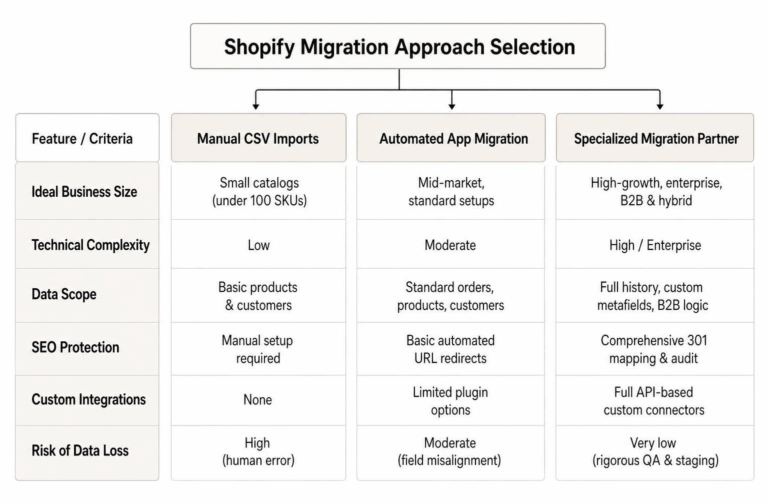
Compare Shopify Migration Services: Options Cheat Sheet
Compare Shopify migration services and find the right Shopify migration company for your store, from manual imports to…
-

Ultimate Checklist for Improving B2B Customer Experience
Ultimate Checklist for Improving B2B Customer Experience – Learn about b2b ecommerce customer experience
-

A Practical Guide to What to Sell Online for Profit
A Practical Guide to What to Sell Online for Profit – Learn about i don t know what…