
The Definitive Guide to AI Agent Commerce

AI Agent Commerce Is Changing Online Retail Forever
AI agent commerce refers to a new model of online shopping where autonomous AI agents handle the entire buying process on a customer’s behalf — from searching and comparing products to completing the purchase — with little to no human input.
Here’s what you need to know quickly:
- What it is: Software “agents” powered by AI that can browse, decide, and buy across multiple stores autonomously
- How it differs from chatbots: Chatbots answer questions; AI commerce agents take action and complete full transactions
- Who it affects: Every online retailer, regardless of size — agents are becoming the new gatekeepers of consumer spending
- Why it matters now: 63% of global retailers agree that businesses without AI agents will fall behind within two years
- The scale: By 2030, analysts project AI agents could drive up to $1 trillion in US retail revenue alone
Think about what it means to move your family across the country. You’d spend weeks researching neighborhoods, comparing moving quotes, selling furniture, and buying replacements. Now imagine delegating all of that to a single AI agent — one that handles every step while you focus on other things.
That’s the promise of agentic commerce. And it’s not a distant concept anymore.
In 2025, ChatGPT crossed 800 million weekly users. Google’s AI overviews now reach over 1.5 billion people per month. Half of all consumers now use AI when searching online. The way shoppers find and buy products is shifting fast — and retailers who aren’t ready risk becoming invisible to the agents making purchasing decisions on their customers’ behalf.
For mid-sized online retailers, this isn’t just a trend to watch. It’s a fundamental change in how demand gets created, routed, and fulfilled.
This guide breaks down exactly what AI agent commerce is, how it works, what protocols power it, and — most importantly — what you need to do to stay competitive.
What is AI Agent Commerce?
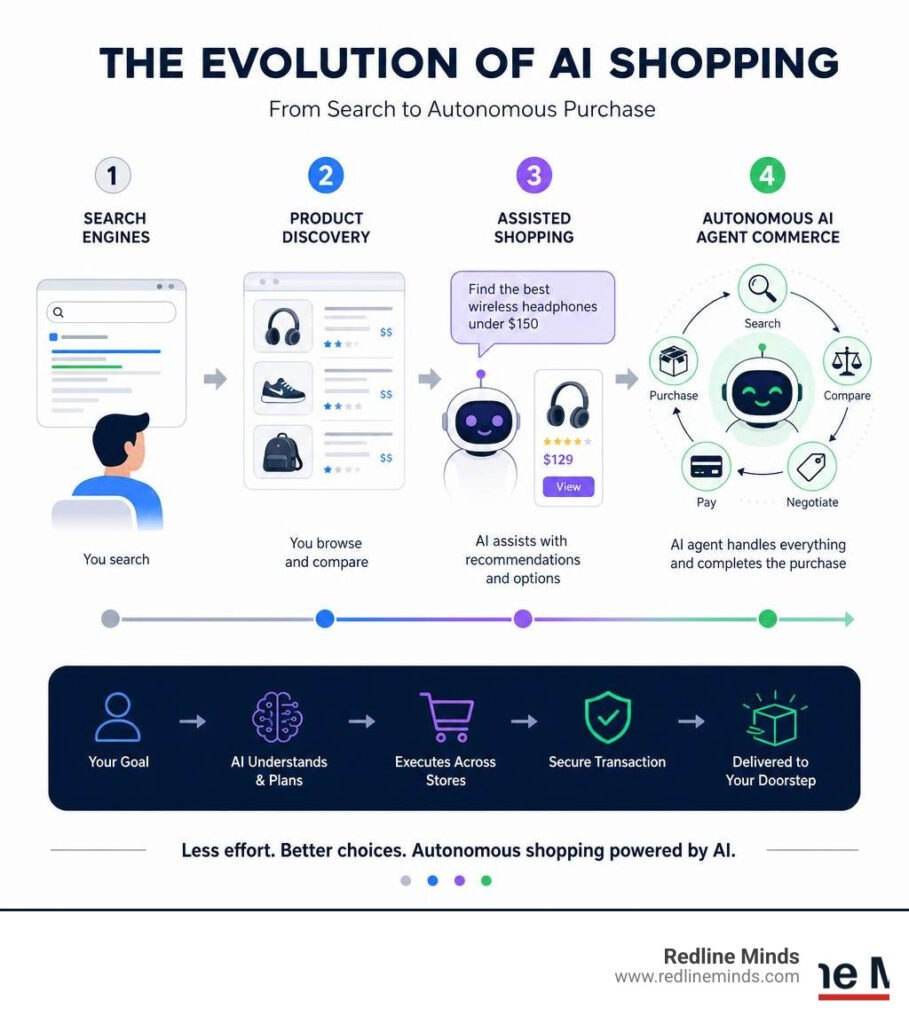
At its core, AI agent commerce is a structural shift in how transactions occur on the internet. For decades, e-commerce has relied on a human-to-site model: a person opens a browser, types in a search query, filters through results, adds items to a cart, and manually enters payment details.
Agentic commerce introduces a third party: the autonomous AI agent. Instead of browsing individual websites yourself, you instruct your personal AI agent to find the best product based on your past preferences, budget, and specific constraints. The agent then communicates directly with merchant systems, negotiates prices or promotions, and completes the transaction on your behalf.
This represents a transition from vertical search destinations (like typing “running shoes” into Amazon or Google) to horizontal, intent-driven agent ecosystems. The agent acts as an intermediary, de-verticalizing the shopping experience and compiling options from across the web into a single, cohesive decision path.
To understand how radical this shift is, let’s look at how traditional e-commerce compares to this new agentic model:
| Feature | Traditional E-commerce | AI Agent Commerce |
|---|---|---|
| Primary Actor | Human shopper navigating a web browser | Autonomous AI agent acting on user instructions |
| Interaction Model | Manual search, filtering, and comparison | Natural language intent translated into automated API calls |
| Discovery Channel | SEO, search engines, social media ads, and marketplaces | Standardized agent endpoints, product feeds, and LLM platforms |
| Decision Making | Human evaluates reviews, prices, and shipping options | AI agent processes data, reasons over constraints, and selects the best option |
| Checkout Process | Manual entry of shipping, billing, and credit card details | Programmatic checkout using secure tokens and delegated authorization |
| Merchant Role | Optimizing sites for human eyes (UX/UI, CRO) | Optimizing data structures and APIs for machine readability |
The Core Mechanics of AI Agent Commerce
How does an AI agent make complex purchasing decisions without a human constantly guiding it? The magic lies in three core components: memory, reasoning, and tools.
For a detailed exploration of these foundational mechanics, you can read What Is Agentic Commerce? The 2026 Guide – Fin AI.
- Memory: An agent retains persistent context about the user. It remembers your clothing sizes, dietary restrictions, preferred delivery times, brand loyalties, and budget limits. This is not just a cookie storing a session ID; it is a deep, evolving profile that understands your lifestyle.
- Reasoning: Armed with advanced LLM capabilities, the agent can break down complex, multi-step requests. If you ask it to “plan a family dinner for six this weekend with a mix of vegetarian and gluten-free options under $100,” the agent doesn’t just return a recipe. It reasons through the ingredients needed, checks local store inventories, compares prices, and structures an optimal purchase plan.
- Tools: Agents do not merely read text; they interact with the digital world. Through APIs and specialized protocols, agents are equipped with tools to browse product catalogs, add items to carts, apply discount codes, verify shipping times, and securely authorize payments.
How AI Agent Commerce Differs from Traditional E-commerce
Traditional e-commerce is inherently reactive. A merchant sets up a store, runs ads, and waits for a customer to visit. The customer must actively invest time and cognitive effort to find what they need.
Agentic commerce is proactive, predictive, and highly automated. Instead of waiting for a user to realize they are out of household goods, a replenishment agent can monitor usage patterns and automatically purchase the correct item before it runs out.
Furthermore, agentic commerce shifts the focus of retail from eye-catching web designs to data accessibility. When an agent is doing the shopping, it does not care about beautiful hero banners or clever copywriting. It cares about clean, structured data, real-time inventory accuracy, and frictionless checkout APIs.
As highlighted in the industry analysis by Agentic AI and the Not-So-Quiet Retail Revolution, this revolution is quietly restructuring the backend of retail. Merchants who fail to adapt their infrastructure to speak directly to these autonomous buyers will find themselves locked out of the consumer’s decision-making loop entirely.
Protocols and Standards Driving Agentic Commerce
For autonomous agents to navigate thousands of different online stores, compare products, and complete checkouts, the digital retail world requires common rules. We cannot expect developers to write custom integration code for every single merchant on the web.
This is where open standards and interoperability protocols come into play. They act as the universal language that allows AI agents, merchants, and payment networks to communicate seamlessly.
Model Context Protocol (MCP) and Agentic Commerce Protocol (ACP)
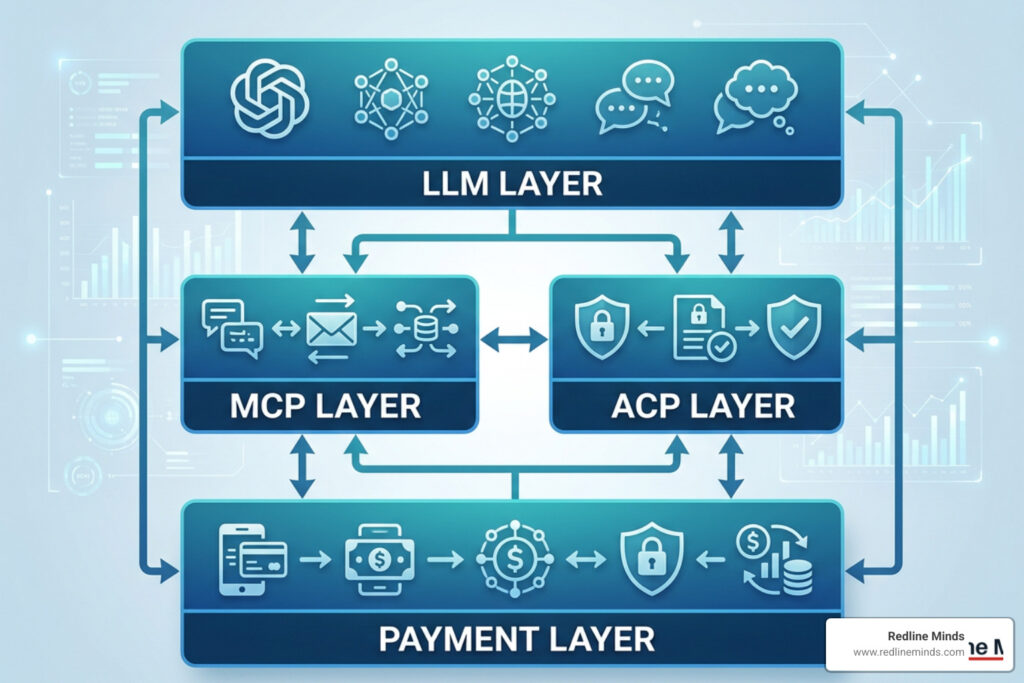
The technical foundation of agentic commerce relies heavily on two emerging standards: the Model Context Protocol (MCP) and the Agentic Commerce Protocol (ACP).
The Model Context Protocol (MCP) is an open standard that allows large language models (LLMs) to safely access external data sources and tools. MCP acts as a secure bridge, letting an AI agent pull real-time inventory levels, product details, and customer loyalty data directly from a merchant’s database without exposing sensitive backend systems.
Building on top of this is the Agentic Commerce Protocol (ACP). First introduced as a live standard to enable programmatic commerce flows, ACP provides a dedicated, hosted endpoint for businesses to share near real-time product, price, and availability information.
By implementing an ACP endpoint, a merchant makes their store instantly discoverable and readable to any AI agent. This eliminates the need for months of custom development. Instead of building unique integrations for every new AI platform, a merchant can use tools like Agorio — The Open-Source AI Commerce Agent Toolkit to deploy a standardized ACP interface in just a few lines of code, immediately opening their catalog to the agentic ecosystem.
Agent-to-Agent (A2A) and Agent Payments Protocol (AP2)
While ACP handles the relationship between an agent and a merchant site, complex transactions often require multiple agents to work together. This is governed by the Agent-to-Agent (A2A) protocol.
In an A2A scenario, a consumer’s personal shopping agent does not just browse a static website; it negotiates directly with a merchant’s selling agent. For example, your personal agent might say, “My user wants to buy this mechanical keyboard and a matching mouse. What bundle discount can you offer?” The merchant’s dynamic pricing agent can analyze inventory pressure, competitor pricing, and customer loyalty data to instantly propose a custom discount.
To see how these multi-agent systems coordinate in the real world, developers can explore the open-source reference implementation in the README.md repository, which demonstrates how specialized agents (such as Product Discovery, Pricing, and Inventory agents) collaborate via A2A protocols to fulfill complex user intents.
Finally, the Agent Payments Protocol (AP2) standardizes how money moves in these automated interactions. AP2 defines how payment credentials, spending limits, and transaction authorizations are passed from the user’s wallet to the agent, and ultimately to the merchant, ensuring that autonomous purchases remain secure and fully controlled by the human owner.
Transforming the Shopping Experience and Merchant Infrastructure
The rise of AI agent commerce is a double-edged sword. For consumers, it promises an era of unprecedented convenience. For merchants, it demands a complete overhaul of technical infrastructure and customer experience strategies.
To succeed in this new landscape, retailers must rethink their digital storefronts. While human shoppers will still appreciate an exceptional user experience, your site must now pull double duty as an optimized gateway for autonomous machines. To understand how to balance these dual needs, check out our comprehensive guide on The Ultimate Guide to Ecommerce UX That Actually Converts.
Hyper-Personalized Consumer Journeys
For consumers, the shopping journey is becoming completely decluttered. Instead of spending hours reading conflicting reviews and comparing shipping policies across five tabs, the consumer simply converses with their agent.
This behavior is already taking hold. Today, 44% of users who have tried AI-powered search say it has become their primary and preferred source for internet searching, compared to only 31% who still prefer traditional search engines. By 2030, analysts project that 55% of digital consumers will begin their product research directly on LLM platforms.
In this hyper-personalized model, the search experience is conversational and context-aware. If you ask an agent to find a winter jacket, it doesn’t just look for the keyword “jacket.” It looks at your location’s weather patterns, reviews your past purchases to understand your style, checks your calendar to see if you have an upcoming ski trip, and queries the web for jackets that match those exact parameters.
To visualize this future, watch the detailed breakdown in How AI Agents Will Change Shopping Forever – YouTube, which illustrates how traditional search engines are giving way to intelligent, agent-mediated discovery.
Overcoming Merchant Integration and B2B Challenges
To serve these highly informed AI agents, merchants must dismantle their legacy data silos. An AI agent will not recommend a product if it cannot verify real-time stock levels or accurate shipping times. If your inventory data is delayed by even a few hours, an agent will route the purchase to a competitor who offers real-time certainty.
This requirement is accelerating the adoption of headless and composable e-commerce architectures. By separating the frontend presentation layer from the backend commerce logic, merchants can expose clean, high-performing APIs that AI agents can query instantly.
These integration challenges are particularly acute in the B2B sector, where transactions involve complex pricing contracts, custom catalog permissions, and multi-stage approval workflows. At Redline Minds, we specialize in helping businesses navigate these complexities. Based in Jefferson City, Tennessee, we design and build robust B2B and hybrid e-commerce solutions that connect legacy ERP systems to modern, agent-ready API layers.
To learn more about preparing your wholesale or manufacturing business for this shift, read our deep dive into B2B Ecommerce Development: Everything You Need to Know.
Payments, Security, and Trust in the Agentic Era
Perhaps the most challenging aspect of AI agent commerce is payments. How do we allow a software agent to spend real money without exposing the user’s financial credentials to theft or abuse?
The traditional payment rails—built on the assumption that a human is always present to type in a CVV code or complete a 3D Secure face scan—are fundamentally incompatible with fully autonomous buying.
Redefining Fraud Detection and Tokenization
To enable safe, automated transactions, the financial industry is introducing specialized payment standards. A prime example is the use of Shared Payment Tokens (SPTs), a core feature of Stripe’s Agentic Commerce Suite.
Instead of giving an AI agent access to a raw credit card number, the user’s financial institution issues an SPT. This token is strictly scoped: it can only be used with a specific merchant, within a defined timeframe, and up to a maximum dollar amount. If a malicious actor intercepts the token, it is completely useless to them.
This shift requires a total reimagining of fraud detection. Traditional fraud systems flag transactions that lack human variability—such as instant form-filling or lightning-fast navigation—as malicious bots. In the agentic era, these exact behaviors represent legitimate, high-intent transactions.
Payment processors are updating their security models to differentiate between harmful scrapers and certified, high-intent shopping agents. To see how developers are implementing these secure, merchant-controlled payment flows in real-world applications, you can review the technical blueprints in the antoniomtz/Retail-Agentic-Commerce repository.
Establishing Trust and Governance Frameworks
Beyond tokenization, building a reliable agentic ecosystem requires robust governance. Industry leaders are developing Know-Your-Agent (KYA) standards, similar to the Know-Your-Customer (KYC) regulations used in banking. KYA allows merchants to verify the identity and authority of an incoming AI agent, ensuring it represents a real consumer with valid payment authorization rather than a rogue crawler.
Furthermore, merchants must maintain strict control over their business rules. A common concern among retailers is that autonomous agents might exploit pricing glitches or make unauthorized return requests.
To prevent this, businesses are adopting a three-layer hybrid architecture that combines LLM reasoning with deterministic computation. Under this model, the AI agent can negotiate and recommend actions, but the final calculation of prices, taxes, and shipping fees is handled by immutable, deterministic code. The LLM never directly writes to the database or alters financial calculations.
For a deep dive into the technical implementation of these safety guardrails and fail-closed validation systems, refer to the reference architecture in the src/agents/README.md at main · NVIDIA-AI-Blueprints/Retail-Agentic-Commerce documentation.
Economic Impact and Emerging Business Models
The economic implications of agentic commerce are staggering. As autonomous agents reduce transaction friction to near zero, the velocity of digital commerce is set to explode.
By 2030, the US B2C retail market alone is projected to see up to $1 trillion in orchestrated revenue driven by agentic commerce, with global projections reaching as high as $3 trillion to $5 trillion. Furthermore, analysts expect that 25% of all global e-commerce sales will be enabled or fully executed by AI agents by the end of the decade.
To capture a slice of this massive market, merchants must focus heavily on making their checkout flows as frictionless as possible. If an agent encounters a broken API or an unreadable catalog, it will immediately move to the next store. To ensure your site is optimized to convert both human and machine visitors, explore our resources on Conversion Rate Optimization (CRO).
Projected Market Growth and Adoption Rates
The transition to agentic systems is happening much faster than the historical shifts to mobile or web-based commerce. Because AI agents run on existing digital rails (APIs, cloud networks, and payment systems), they do not require consumers to buy new hardware.
Enterprise adoption is scaling rapidly. According to Gartner research, 33% of enterprises will include agentic AI in their operations by 2028, up from less than 1% today.
As detailed in the market report on Agentic Commerce, businesses that hesitate to build agent-friendly infrastructure risk losing market share. Once a consumer delegates their shopping to an agent, that agent becomes the exclusive gatekeeper of their brand loyalty. If your products are not readable by the agent, your brand ceases to exist for that consumer.
New Monetization and Clienteling Strategies
As AI agents take over the routine aspects of shopping, traditional advertising and marketing models must evolve. Pay-per-click search ads lose their effectiveness when a human is no longer looking at a search results page.
Instead, merchants are exploring new business models and monetization strategies:
- Dynamic Pricing and Inventory Liquidation: Merchants can deploy selling agents that actively look for shopping agents representing high-intent buyers, offering real-time, personalized bundle discounts to clear excess inventory.
- Retention and Automated Clienteling: Rather than sending generic email newsletters, retailers can use customer service agents to proactively reach out to a user’s personal agent, suggesting complementary products or offering early access to new arrivals based on past purchase history.
- Agent-to-Agent Loyalty Programs: Loyalty points and rewards can be exposed via APIs, allowing a customer’s shopping agent to automatically calculate and apply the best combination of points and discounts at checkout.
To understand how to restructure your marketing mix for this new programmatic era, take a look at our Ecommerce Marketing Guide 2026.
Frequently Asked Questions about Agentic Commerce
What is the difference between an AI chatbot and an AI commerce agent?
An AI chatbot is a reactive, passive assistant. It is designed to answer questions, provide basic product recommendations, or help retrieve order tracking numbers based on direct user prompts.
An AI commerce agent is an active, autonomous system. It has the authority to make decisions, plan multi-step workflows, negotiate with merchants, and execute financial transactions independently on behalf of the user, requiring minimal human intervention.
How do merchants make their products discoverable to AI agents?
Merchants can make their products discoverable by adopting standardized data formats and open protocols. This includes:
- Maintaining highly structured product data using Schema.org markup and GS1 standards.
- Exposing a dedicated, hosted Agentic Commerce Protocol (ACP) or Model Context Protocol (MCP) endpoint that provides real-time access to inventory, pricing, and product attributes.
- Ensuring product catalogs are integrated with major payment and discovery suites, such as Stripe’s Agentic Commerce Suite.
Is agentic commerce secure for automated payments?
Yes, when built on modern financial infrastructure. Agentic commerce does not share your actual credit card details. Instead, it utilizes secure technologies like Shared Payment Tokens (SPTs) that are strictly limited by merchant, time, and purchase amount. Combined with user-defined spending limits and multi-layer approval guardrails, these systems ensure that automated purchases remain safe and fully under your control.
Conclusion
The era of AI agent commerce is no longer a futuristic concept—it is a rapidly unfolding reality. As autonomous software agents become the primary shoppers of the digital world, the retailers who thrive will be those who prepare their data, systems, and APIs to welcome these machine buyers.
From building headless architectures and structuring clean product data to implementing secure, tokenized payment protocols, the technical demands of this transition can feel overwhelming. But you don’t have to navigate this digital revolution alone.
At Redline Minds, we bring years of specialized expertise in ecommerce consulting, web development, and digital strategy to help mid-market retailers, B2B brands, and hybrid stores future-proof their operations. Based in Jefferson City, Tennessee, our team is ready to help you design, build, and optimize an online store that appeals to both human shoppers and the AI agents of tomorrow.
Ready to prepare your business for the next generation of online retail? Explore our Redline Minds Services and let’s build an agent-ready future together.
Share this article
Tap into years of experience and turn your site’s visitors into buyers.
Related Posts
-
Compare Shopify Migration Services: Options Cheat Sheet
Compare Shopify migration services and find the right Shopify migration company for your store, from manual imports to…
-

Ultimate Checklist for Improving B2B Customer Experience
Ultimate Checklist for Improving B2B Customer Experience – Learn about b2b ecommerce customer experience
-

A Practical Guide to What to Sell Online for Profit
A Practical Guide to What to Sell Online for Profit – Learn about i don t know what…