
Beginner’s Guide to Agentic Commerce

Why Agentic Commerce Matters for Online Retailers
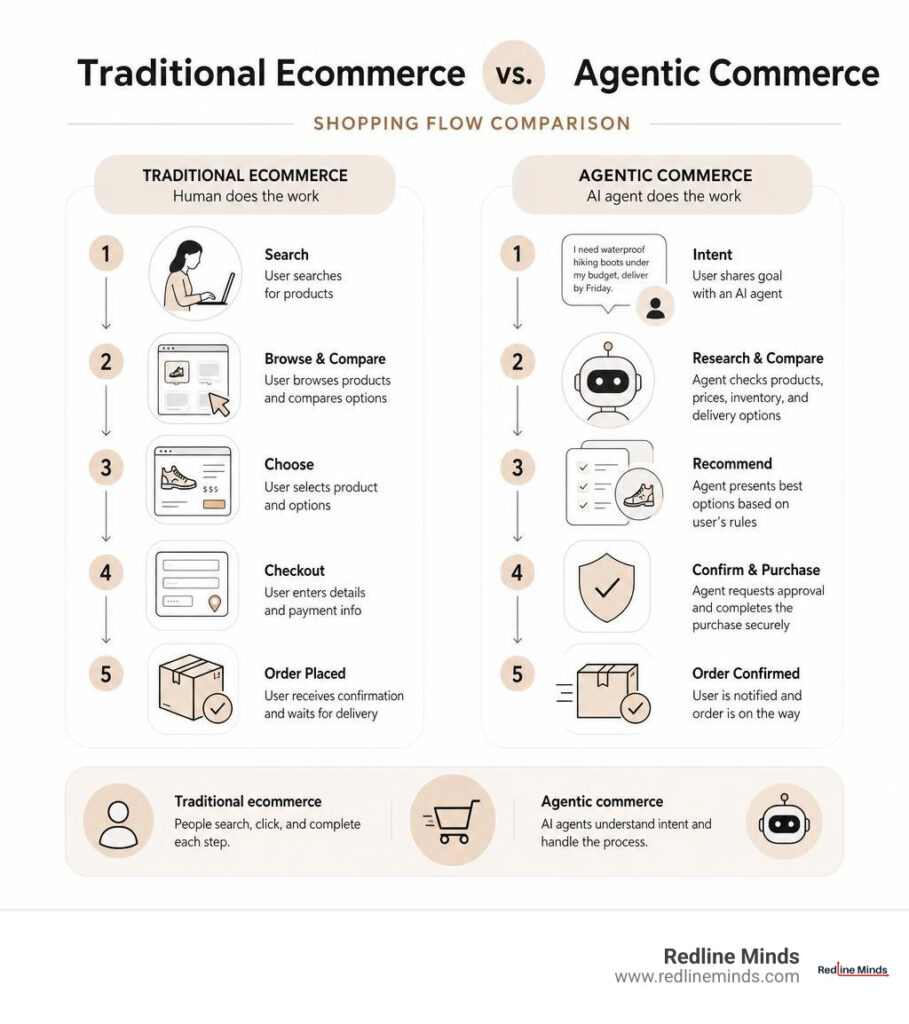
Agentic commerce is a way of buying and selling where AI agents can research products, compare options, and complete approved purchases for a customer. Instead of asking shoppers to search, click through product pages, and fill out checkout forms, the retailer’s systems give an AI agent the data and tools it needs to act on the shopper’s intent.
For example, a customer might ask an assistant to find waterproof hiking boots under a set budget, confirm delivery timing, and place the order. The agent can check relevant product data, compare choices, apply the customer’s rules, and request approval when needed.
This is a meaningful shift from traditional e-commerce:
- Traditional e-commerce is built around people navigating websites.
- Agentic commerce is built around machines understanding customer intent and using secure commerce systems.
- Retailers increasingly need accurate, machine-readable data for products, prices, inventory, shipping, and returns.
For a growing online retailer, this is not just another chatbot trend. AI agents may become a new source of qualified traffic and a new layer between your store and the customer. Being ready means making it easy for trusted agents to discover your products, verify what is available, and complete transactions safely.
Agentic commerce terms simplified:
- AI agent commerce
- AI agent integration
What Is Agentic Commerce and How Does It Work?
At its core, agentic commerce shifts the shopping paradigm from human browsing to decision delegation. When a consumer interacts with an autonomous system, they provide high-level goals through simple user prompts—such as “Restock my favorite espresso beans and find a matching grinder under $100.”
Behind the scenes, reasoning engines analyze these goals, evaluate user preferences, break the request into multi-step execution paths, and query merchant APIs for structured data. As outlined in the IBM overview of agentic commerce, this progression replaces manual filtering with intelligent, autonomous workflows. To explore the architecture behind these systems in depth, check out our AI agent commerce definitive guide.
The technology that powers this transition has accelerated dramatically. The duration of tasks that large language models can reliably complete with at least a 50% success rate has been doubling every seven months since 2019. In 2025, Anthropic’s Claude 3.7 Sonnet demonstrated a time horizon of 59 minutes, allowing systems to tackle complex, hour-long consumer research and procurement tasks autonomously.
Key Differences Between Traditional E-Commerce and Agentic Commerce
Traditional retail environments rely heavily on user interface (UI) interactions, requiring human eyes to parse menus, banners, and search results. Agentic shopping relies instead on protocol queries and continuous intent capture. Friction reduction is achieved because the agent eliminates form fills, repetitive logins, and manual payment entries.
| Feature / Dimension | Traditional E-Commerce | Agentic Commerce |
|---|---|---|
| Discovery Mechanism | Manual search bar, category filtering, display ads | Direct semantic queries, structured API calls, MCP endpoints |
| User Interface | Web storefronts, mobile applications | Natural language interfaces, background autonomous agents |
| Decision-Making | Human evaluation of product details and reviews | Autonomous multi-variable reasoning against user criteria |
| Transaction Flow | Multi-step checkout forms, manual cart reviews | Automated delegated authorization, tokenized checkout |
| Customer Retention | Email campaigns, retargeting ads, periodic discounts | Programmatic reordering, intent-triggered replenishment |
The Autonomous Buying Lifecycle: Research, Negotiation, and Execution
The lifecycle of an autonomous transaction unfolds through distinct stages:
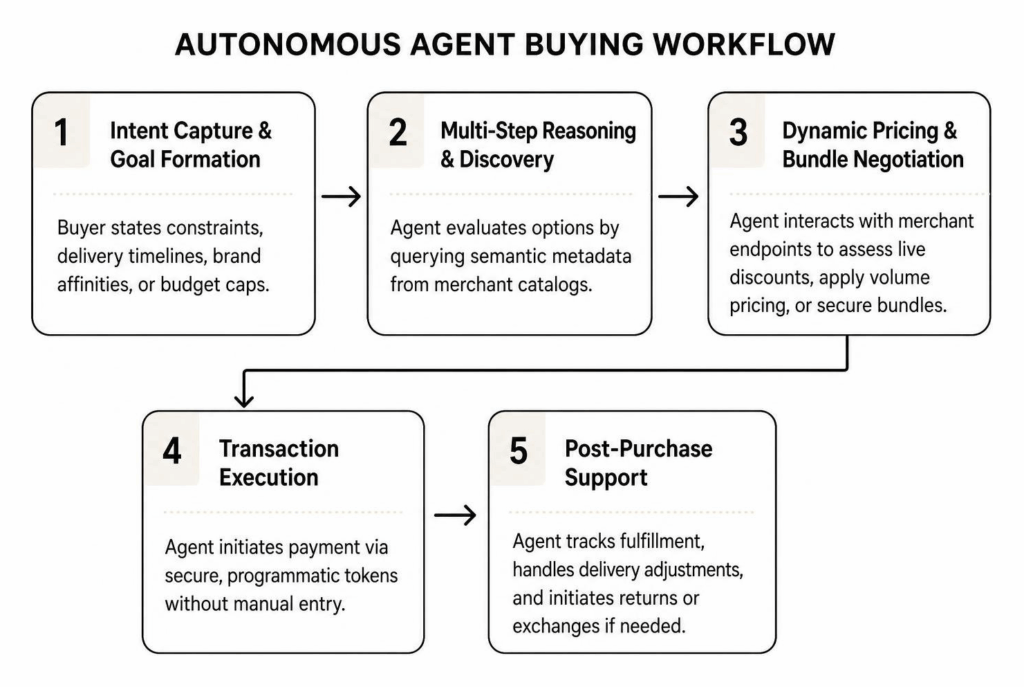
- Intent Capture & Goal Formation: The buyer states constraints, delivery timelines, brand affinities, or budget caps.
- Multi-Step Reasoning & Discovery: The agent evaluates product options by querying semantic metadata from various merchant catalogs.
- Dynamic Pricing & Bundle Negotiation: Software agents interact with merchant endpoints to assess live discounts, apply volume pricing, or secure bundle incentives.
- Transaction Execution: The agent initiates payment via secure, programmatic tokens without manual human entry.
- Post-Purchase Support: The agent tracks fulfillment, handles delivery adjustments, and initiates automated returns or exchanges if goods arrive damaged or fail specifications.
Technical Protocols Enabling Autonomous AI Shoppers

Connecting autonomous agents with merchant backends requires unified, standardized interoperability standards rather than fragile web scrapers. We are seeing a major shift toward API-first design that supports direct tool calling and deterministic data exchange.
Data Context and Agent Communication: MCP and A2A
The Model Context Protocol (MCP) functions as an open standard allowing agents to directly query live catalog discovery endpoints, pricing structures, and inventory levels. Rather than guessing the layout of a web page, the agent queries structured metadata.
Agent-to-Agent (A2A) protocols allow buyer-side purchasing assistants to converse directly with seller-side merchant agents. A seller agent can confirm inventory holds, negotiate custom configurations, and verify warranty policies programmatically.
Payment Execution and Tokenization: ACP and AP2
Executing an order without exposing raw customer card numbers requires sophisticated payment protocols. The Agentic Commerce Protocol (ACP), co-developed as an open standard under Apache 2.0, facilitates secure checkouts inside AI chat surfaces.
Similarly, Google’s Agent Payments Protocol (AP2) and payment frameworks from major networks allow systems to generate single-use payment tokens and delegated authorization rules. In the Stripe guide to agentic commerce, the role of machine-native payment issuance is detailed, illustrating how temporary virtual credentials grant purchasing autonomy while strictly enforcing user-defined budget caps.
Market Value, Strategic Benefits, and Industry Adoption
The economic impact of autonomous retail is substantial. By 2030, the US B2C retail market alone could see up to $1 trillion in orchestrated revenue from agentic commerce, with global projections reaching between $3 trillion and $5 trillion.
Today, 45% of consumers already use AI for part of their buying journey. Consumer search habits are changing rapidly: 44% of users who have tried AI-powered search say that it has become their primary and preferred source for internet searching, compared with 31% who prefer traditional search.
ChatGPT now commands more than 800 million weekly users, and Google’s AI overviews powered by Gemini reach more than 1.5 billion users per month. To maintain high store efficiency while these platforms capture consumer attention, merchants use specialized AI tools for conversion rate optimization to improve their back-end responsiveness and product matching.
Real-World Applications of Agentic Commerce in Retail and B2B
Autonomous transactions are transforming multiple business sectors:
- Grocery and Household Replenishment: Connected pantries and agentic assistants track usage rates and reorder essentials when inventory dips.
- Travel and Hospitality: Travel agents monitor flight price fluctuations, automatically rebooking itineraries when fares drop below predefined thresholds.
- Digital Subscription Management: Agents continuously track software utilization, downgrading idle accounts or renegotiating renewal terms.
- Automated B2B Procurement: In wholesale environments, corporate buying agents manage replenishment based on production schedules, evaluating dynamic vendor terms. For more insights on these market shifts, explore our analysis of modern B2B ecommerce trends.
Emerging Monetization Models and Ecosystem Revenue
Autonomous workflows enable distinct monetization strategies across the digital economy:
- API Access Fees: Retailers and data aggregators offer premium API tiers for real-time inventory queries.
- Transactional Splits: AI platforms capture small programmatic commission percentages on purchases confirmed directly within conversation interfaces.
- Machine-Mediated Affiliate Networks: Affiliate tracking moves from cookie-based browser links to cryptographic referral tokens embedded in agent payload calls.
- Programmatic Loyalty Incentives: Retailers offer dynamic discounts directly to buyer agents that demonstrate consistent order volume.
Overcoming Trust, Security, and Infrastructure Challenges

Despite rapid technical momentum, adoption hinges on trust. An IBM study indicates that 83% of consumers share overlapping worries about privacy, data misuse, and unsolicited marketing related to agentic commerce. Ensuring user sovereignty and transparent data practices is essential.
Generative Engine Optimization and Catalog Readiness
To be visible to autonomous shoppers, online merchants must embrace Generative Engine Optimization (GEO). This involves structuring product data with deep semantic schema markup, publishing real-time inventory endpoints, and maintaining clean product metadata.
If an agent cannot deterministically verify whether a product is in stock, it will simply route the buyer to a merchant whose data feeds are machine-readable and reliable.
Transaction Security, Fraud Prevention, and User Consent
Security frameworks must modernize to differentiate between authorized commercial agents and malicious scrapers. Payment providers like Stripe, Visa, and Mastercard are introducing AI-ready tokenized credentials and advanced behavioral fraud scoring. Stripe powers 78% of the Forbes AI 50, and over 700 AI agent startups launched on Stripe in 2024 alone.
To protect customer assets, merchants must implement robust online transaction security measures. These systems maintain detailed audit trails, enforce clear spend limits, and keep a “human-in-the-loop” for high-ticket or out-of-policy purchases. Utilizing modern ecommerce technology services ensures your store infrastructure can manage autonomous requests without risking data breaches or inventory manipulation. Many growing merchants also rely on virtual ecommerce directors to govern these autonomous workflows and maintain system compliance.
Frequently Asked Questions About Autonomous Retail
How do AI buying agents securely access payment credentials?
AI buying agents do not store or transmit raw credit card numbers. Instead, they operate through programmatic tokenization frameworks like the Agentic Commerce Protocol (ACP) and single-use virtual cards generated via services like Stripe Issuing. The consumer grants specific permissions (e.g., maximum dollar amount, approved merchants), and the payment platform delivers an encrypted, restricted-use token directly to the retailer’s payment gateway, maintaining strict PCI compliance.
What is the difference between conversational chatbots and agentic shopping?
Conversational chatbots are reactive interfaces that respond to simple customer service queries using rule-based scripts or basic text generation. Agentic shopping systems possess reasoning capabilities, persistent memory, and tool-use permissions. They autonomously complete complex, multi-step workflows—such as cross-merchant product research, inventory validation, price negotiation, and cart execution—without requiring the user to navigate the merchant’s website.
When is agent-driven commerce expected to reach mainstream adoption?
Early implementations of agent-driven commerce launched between 2024 and 2025 across platforms like ChatGPT, Google Gemini, and specialized retail apps. Mainstream adoption is projected to accelerate between 2027 and 2028 as open protocols like MCP and AP2 mature, with global transaction volumes reaching up to $5 trillion by 2030.
Conclusion
Agentic commerce represents a fundamental shift in digital retail, transitioning online shopping from manual interface navigation to automated, protocol-driven coordination. As autonomous agents become the primary gatekeepers of consumer intent, merchants must modernize their technical infrastructure, standardize catalog metadata, and support secure, programmatic checkout flows.
Preparing your online store for autonomous AI agents requires strategic planning, robust API integrations, and precise catalog optimization. At Redline Minds, we specialize in helping B2B and hybrid retail brands build future-ready commerce channels. Discover how our expert ecommerce consulting and technology services can help your business capture the next generation of automated growth.
Share this article
Tap into years of experience and turn your site’s visitors into buyers.
Related Posts
-

A Practical Guide to What to Sell Online for Profit
A Practical Guide to What to Sell Online for Profit – Learn about i don t know what…
-

A Quick Start Guide to Ecommerce Basics
Learn what is ecommerce in this quick start guide covering models, benefits, and trends for modern online retail…
-

The Complete Guide to Inventory Control Best Practices
Learn inventory control best practices for warehouse execution, cost reduction, and multi-channel automation in this complete guide.