
The Complete Guide to B2B Ecommerce Trends

B2B Ecommerce Trends That Are Reshaping How Businesses Buy and Sell in 2026
The most important B2B ecommerce trends in 2026 are:
- Agentic AI and automation – AI agents now handle search, reorders, and even negotiations without human reps
- Self-service portals – 67% of B2B buyers prefer placing reorders without contacting a sales rep
- Personalized pricing and account-based catalogs – Buyers expect to see their negotiated rates online, every time
- ERP and platform integration – Real-time inventory, pricing, and order sync is now a baseline expectation
- Composable/headless architecture – Replacing rigid legacy systems with flexible, modular platforms
- Mobile-first buying experiences – Over 60% of B2B buyers research on mobile; conversion gaps are closing fast
- B2B marketplace expansion – The number of B2B marketplaces grew from 75 to over 850 in five years
- Omnichannel and social commerce – B2B buyers now use an average of 10+ channels in their buying journey
- B2C-style buyer expectations – 80% of B2B buyers expect consumer-grade digital experiences
- Data governance and analytics – Companies using data to personalize journeys outperform those that don’t
B2B ecommerce is no longer a “nice to have.” It’s where the money is moving — fast.
B2B ecommerce site sales hit $2.297 trillion in 2024, growing 10.5% year over year. By 2028, that number is projected to reach $3.027 trillion. And in the U.S. alone, B2B ecommerce is expected to account for 24% of all B2B sales by 2027.
Here’s the part that might surprise you: B2B buyers aren’t waiting for sellers to catch up. Millennials now make up 73% of all B2B buyers — and they expect the same seamless, self-service experience they get as consumers. Seven out of ten B2B buyers already prefer purchasing online over traditional methods. And 83% of B2B decision-makers are comfortable making online transactions of $10 million or more.
The gap between what buyers expect and what most B2B storefronts actually deliver? That’s where market share is being won and lost right now.
This guide breaks down the trends driving that shift — and what mid-sized B2B sellers need to do about it.
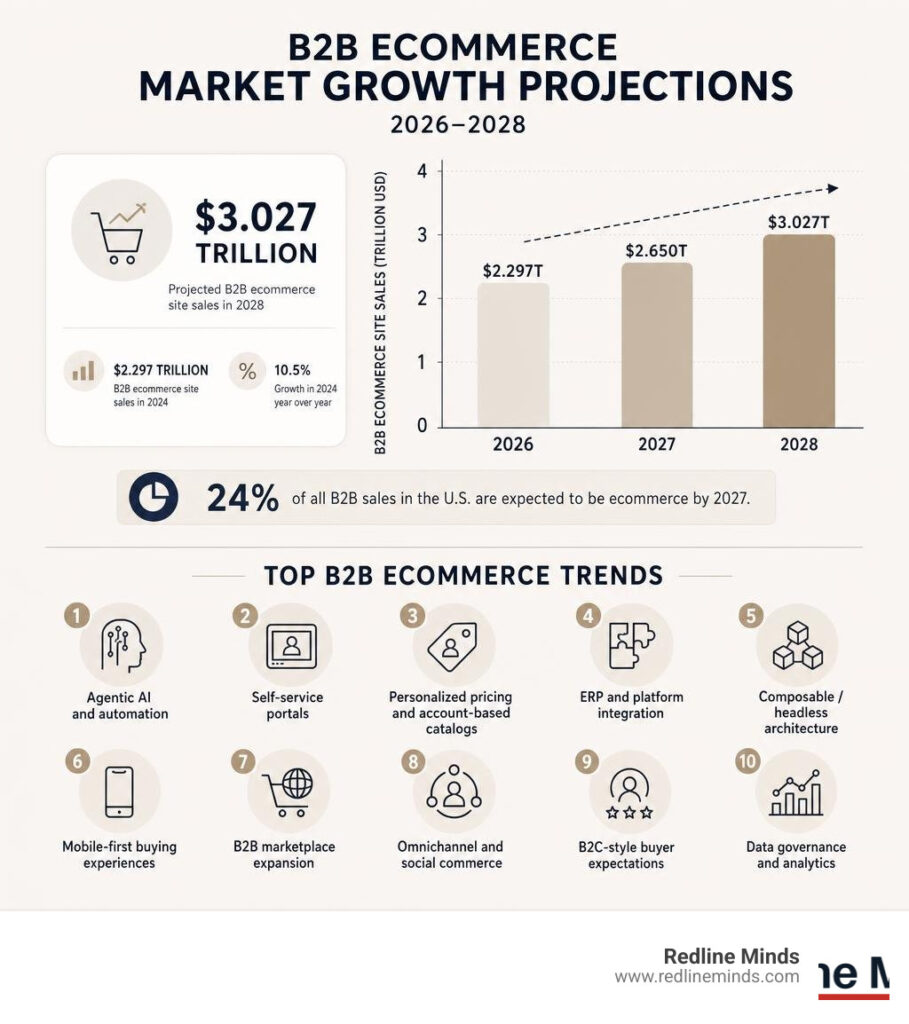
Simple guide to b2b ecommerce trends:
The Shift to Digital-First: Why B2B Buying Has Changed
The traditional B2B sales playbook — complete with golf course handshakes, thick printed catalogs, and endless games of phone tag — has officially retired. In its place is a digital-first reality driven by a massive generational shift.
With millennials and Gen Z making up 73% of B2B buying committees, the people holding the corporate credit cards today grew up with Amazon, Uber, and door-to-door delivery. They do not want to call a sales representative just to check inventory levels or request a basic price quote. In fact, studies show that in-person sales generated only 17% of B2B revenue recently, representing a steep 22% decline over a short two-year span.
This evolution is explored in depth in the article B2B E-Commerce Is Now a $3 Trillion Market — and DTC Brands Are Finally Paying Attention, which highlights how the lines between consumer shopping and business procurement have completely dissolved. B2B buyers now expect instant pricing, transparent lead times, and frictionless mobile checkouts.
If your digital storefront forces a buyer to click a “Contact Us” button just to find out if a part is in stock, they won’t fill out the form — they will simply find a competitor who displays that data openly. To survive, manufacturers, distributors, and wholesalers must understand How to Build a B2B Strategy That Actually Scales, putting digital self-service at the core of their operations.
Key B2B Ecommerce Trends Reshaping the Market in 2026
As we navigate mid-2026, the B2B landscape is undergoing a period of rapid technological maturity. It is no longer enough to just have a basic shopping cart on your website. The companies winning the market are those investing heavily in back-office automation, platform flexibility, and hyper-personalized customer portals.
According to research highlighted in B2B ecommerce trends mid-2026: AI agents and market growth, digital investments are directly tied to customer retention and overall sales growth. On average, deploying a modern ecommerce channel increases wholesale and supplier revenue by 49%.
Let’s look at the specific, high-impact trends that are driving these returns and defining the future of B2B digital commerce.
How AI and Agentic Commerce Drive B2B Ecommerce Trends
Artificial intelligence has moved far beyond the phase of basic customer service chatbots and generic product recommendations. Today, we are seeing the rise of agentic commerce — a paradigm shift where AI agents actively execute complex tasks within buying and selling workflows.
As predicted in B2B Digital Commerce 2026: 4 AI Trends Shaping the Future, AI is transforming ERP integration, search, and backend operations from simple utilities into major strategic weapons. Here is how AI is moving the needle for B2B sellers:
- Autonomous Purchasing Agents: In 2026, roughly 20% of B2B sellers are finding themselves interacting with AI-powered buyer bots. These procurement agents can autonomously evaluate suppliers, compare technical specifications, negotiate quotes based on pre-set parameters, and place high-value orders without human intervention.
- Intelligent Replenishment: Machine learning algorithms analyze historical purchase data, seasonal demand spikes, and real-time inventory levels to predict when a customer is running low on a product, automatically triggering reorder reminders or drafting purchase orders.
- Advanced Semantic Search: Traditional keyword search is being replaced by AI search engines that understand complex technical specifications, industry synonyms, and natural language queries. If a buyer types in “heavy-duty bracket for outdoor HVAC unit,” the AI instantly surfaces the exact, compatible part numbers.
This level of automation works. In fact, roughly 66% of B2B revenue teams report seeing a positive return on investment (ROI) within the very first year of adopting advanced AI tools.
The Rise of Self-Service Portals and Personalized Buying
If there is one thing modern business buyers value above all else, it is their time. They want the autonomy to manage their accounts on their own terms. This is why self-service now drives 34% of all B2B online sales revenue.
However, true self-service is much more than a simple checkout screen. To build a loyal customer base, wholesalers and manufacturers must understand Why B2B Self-Service Portals Are the Future of Wholesale. A modern portal must handle the inherent complexity of business relationships, which includes:
- Contract-Specific Pricing: Showing general retail pricing is a quick way to alienate wholesale clients. Portals must dynamically display negotiated, tiered, or contract-based pricing in real time based on the logged-in user’s corporate account.
- Account-Based Catalogs: If certain products require special certifications to purchase, or if a specific distributor only has rights to buy a subset of your inventory, your platform must restrict catalog visibility accordingly.
- Shared Corporate Accounts: Unlike B2C, B2B purchases involve multiple stakeholders. Portals need to support parent-child account structures where a procurement manager can build a cart, but a finance director must log in to approve the transaction.
By leveraging The Power of the B2B Customer Portal, you can give your clients the keys to their own data. They can download past invoices, track active shipments, and request custom quotes on their own schedule. When you combine these portals with tools to streamline bulk ordering, you learn How to Build a B2B Empire with Custom Solutions and Bulk Ordering, freeing your sales reps from manual data entry so they can focus on high-value relationship building.
Omnichannel Strategies, Mobile Apps, and Marketplaces
The modern B2B buying journey is rarely linear. On average, a B2B buyer uses 10.2 distinct channels during their research and purchasing process — up from just five channels a decade ago. They might start by researching a product on their smartphone during a site visit, view a detailed spec sheet on their desktop at the office, ask a question via a social platform, and ultimately place the order through an industry marketplace.
To capture these buyers, your business must meet them wherever they are. As detailed in the analysis of 11 B2B Ecommerce Trends Reshaping 2026, several key channels are converging:
- Mobile-First Experiences: Over 60% of B2B buyers use mobile devices for product research. Successful B2B brands are building progressive web apps (PWAs) or native mobile apps that feature barcode scanning for quick reorders right from the warehouse floor.
- Third-Party Marketplaces: The number of B2B marketplaces has exploded from 75 to over 850 in the last five years. While selling on platforms like Amazon Business or industry-specific marketplaces expands your reach, the ultimate goal should be using these channels for initial customer discovery, then migrating high-value buyers to your owned, highly personalized storefront.
- Social Commerce and Digital Sales Rooms: Roughly 70% of B2B decision-makers use social media to evaluate new vendors. Additionally, digital sales rooms — shared, persistent online spaces where sales reps and buying committees can collaborate asynchronously on contract drafts and custom quotes — are quickly replacing traditional slide decks and email threads.
Modern Architecture: Composable Commerce and ERP Integration
Under the hood, the biggest bottleneck to adopting these b2b ecommerce trends is legacy technology. Rigid, monolithic platforms make it incredibly difficult to launch new features, scale operations, or integrate with other vital business systems.
This is why mid-market B2B brands are rapidly shifting toward composable architecture (built on MACH principles: Microservices, API-first, Cloud-native, and Headless). By separating the frontend presentation layer from the backend commerce logic, headless commerce gives you the ultimate flexibility to design custom buyer journeys without disrupting your core business data.
But even the most beautiful frontend is useless without deep integration. Your ecommerce platform must talk directly to your Enterprise Resource Planning (ERP) system. Without this bridge, you cannot show accurate stock levels, process complex tax rules, or handle bulk shipping logistics. Managing this delicate balance is The Secret Sauce of B2B Wholesale Inventory Management.
To help you visualize the architectural shift, here is a quick comparison of the two approaches:
| Feature | Monolithic Architecture | Composable (MACH) Architecture |
|---|---|---|
| Customization | Limited to pre-built templates and rigid platform rules | Unlimited; customize any component independently |
| System Scaling | Must scale the entire system, raising hosting costs | Scale individual services (e.g., only search or checkout) |
| ERP/CRM Integration | Often requires complex, custom-coded middleware | API-first design makes integrations seamless and fast |
| Time to Market | Fast initial launch, but very slow to add new features | Faster deployment of specific features and updates |
| System Maintenance | Risk of downtime during upgrades and core updates | Zero-downtime microservice updates and maintenance |
Choosing the Right Platform to Support Modern B2B Ecommerce Trends
Selecting the foundation for your digital sales channel is one of the most critical decisions your business will make. The right platform must balance out-of-the-box B2B functionality with the flexibility to grow alongside your business.
When evaluating your options, you should start by Choosing the Right B2B Ecommerce Software based on your specific operational constraints. If you are a rapidly growing brand, you will want to look at The Best Platforms for Scaling Your B2B Ecommerce Operations, focusing on solutions that natively support multi-warehouse inventory, complex pricing structures, and custom checkout workflows.
For a side-by-side breakdown of the leading enterprise and mid-market systems, read The Ultimate B2B Online Store Comparison to determine whether an open SaaS model, a headless build, or a highly customized plug-in ecosystem fits your long-term roadmap.
Overcoming Implementation Challenges and Measuring ROI

Let’s be honest: digital transformation is hard work. The road to a modern B2B storefront is often paved with internal resistance, messy product data, and integration headaches.
The biggest mistake we see companies make is trying to boil the ocean all at once. Instead of trying to launch a massive, perfect system on day one, we recommend a phased approach. Start with a Minimum Viable Product (MVP) — perhaps launching a self-service portal just for your top 10% of customers or your most popular product line — and iterate based on real-world usage.
According to the implementation framework outlined in Top B2B Ecommerce Trends in 2026 (Transform Your Business), you should evaluate every potential trend through a five-step filter:
- Business Fit: Does this trend solve a real problem for our customers, or are we just chasing a shiny object?
- ROI Estimation: How will this impact our average order value (AOV), customer acquisition cost (CAC), and operational overhead?
- Risk Assessment: Will this disrupt our existing sales team workflows or cause inventory sync issues?
- Technical Readiness: Does our current platform, team skillset, and ERP infrastructure support this feature?
- Market Momentum: Are our direct competitors already using this technology to win market share?
By aligning your technology investments with a clear inbound marketing strategy, you can turn your digital storefront into an organic customer acquisition machine. To learn how to attract high-quality business leads to your new platform, explore The No-Nonsense Guide to B2B Lead Generation Strategies.
Frequently Asked Questions about B2B Ecommerce
What are the most critical B2B ecommerce trends for 2026?
The most critical trends are the rise of autonomous AI purchasing agents, highly personalized self-service customer portals with contract-specific pricing, and mobile-first buying experiences. B2B buyers now expect a seamless, consumer-grade digital shopping experience across all devices.
Why is ERP integration essential for B2B ecommerce?
ERP integration ensures that your online store displays real-time inventory levels, accurate contract pricing, and customer-specific account details. Without this seamless connection, you risk manual data entry errors, overselling out-of-stock items, and order fulfillment delays.
How do self-service portals improve B2B sales?
Self-service portals empower business buyers to place orders, track shipments, and download invoices 24/7 without needing to contact a sales representative. This reduces administrative overhead, speeds up the buying cycle, and frees your sales team to focus on proactive account growth rather than manual order entry.
Conclusion
The digital transformation of B2B commerce is no longer a future prediction — it is an active, fast-moving reality. As we navigate 2026, the gap between companies providing effortless, self-service experiences and those relying on legacy, manual processes continues to widen.
At Redline Minds, we specialize in helping manufacturers, distributors, and wholesalers bridge that gap. Based in the beautiful hills of East Tennessee, our team of ecommerce consulting, web development, and digital marketing experts knows exactly what it takes to build scalable, high-performing B2B and hybrid storefronts. Whether you are looking to migrate away from a clunky legacy system, build a custom customer portal, or implement a headless architecture, we can help you design a solution tailored to your unique operational workflows.
Ready to future-proof your sales channels and claim your share of the multi-trillion-dollar digital market?
- Learn more about our customized B2B Ecommerce solutions.
- Connect with our team on Redline Minds – LinkedIn.
- Find our physical offices at Redline Minds, 349 Nancy Drive, Jefferson City, TN 37760-4623, US.
- Take the first step toward strategic growth and Partner with Redline Minds to Scale Your B2B Operations today!
Share this article
Tap into years of experience and turn your site’s visitors into buyers.
Related Posts
-

The Complete Guide to Affiliate App for Shopify
Discover the best affiliate app for Shopify to grow sales, manage referrals, and boost merchant revenue in 2026.
-

The Ultimate Guide to Types of E-Commerce Payment Systems
Learn the types of e commerce payment system to boost sales and reduce cart abandonment in this complete…
-

A Practical Guide to AI Agent Integration Methods
Learn how AI agent integration connects enterprise systems with MCP, Unified APIs, and custom code for secure, real-time…