
The Complete Guide to Inventory Control Best Practices

Inventory Control vs. Inventory Management: Key Differences and Core Concepts
Implementing core inventory control best practices—including optimized warehouse slotting, standardized bin naming, real-time barcode scanning, and continuous ABC cycle counting—ensures physical stock matches digital records down to the exact unit and location. These operational disciplines prevent stockouts, reduce carrying costs, and streamline fulfillment across sales channels.
In supply chain and ecommerce operations, people often use the terms “inventory control” and “inventory management” interchangeably. While they work hand in hand, they serve two distinct operational purposes.
Inventory management represents the high-level strategic umbrella. It governs long-term resource planning, supplier sourcing, demand forecasting, procurement strategies, and financial budget allocation. In contrast, inventory control is the granular operational discipline that regulates stock already inside your warehouse or fulfillment centers. It ensures that the physical items sitting on your shelves match the digital records in your software down to the exact unit and location.
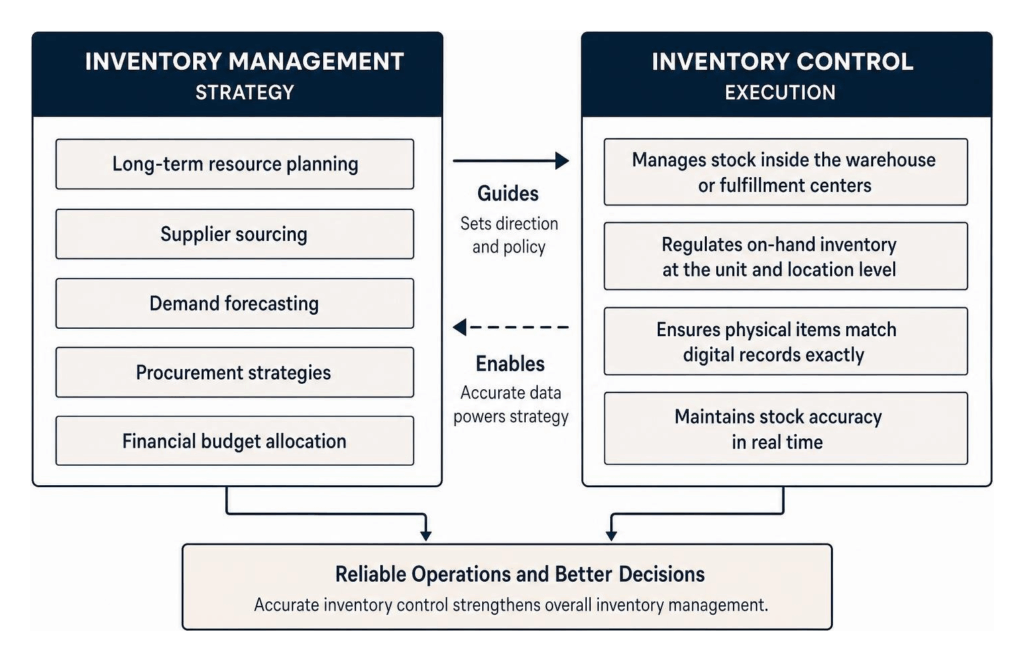
When stock control slips, your broader inventory management strategy breaks down. You cannot build reliable demand forecasts or place accurate replenishment orders if your baseline inventory records are distorted.
| Feature / Dimension | Periodic Inventory System | Perpetual Inventory System |
|---|---|---|
| Update Frequency | Scheduled intervals (e.g., weekly, monthly, annually) | Continuous, real-time with every transaction |
| Tracking Technology | Manual counts, spreadsheets, or physical ledgers | Barcode scanners, RFID, and automated software |
| Cost of Implementation | Minimal upfront cost and low technology overhead | Higher initial technology and hardware investment |
| Stock Visibility | Unknown between scheduled counting periods | Immediate, 24/7 visibility across all channels |
| Shrinkage Detection | Discrepancies discovered late during audits | Identified immediately at the transaction point |
| Best Suited For | Very small businesses with low SKU volumes | Growing ecommerce, B2B, and multichannel retailers |
Defining Inventory Control in Modern Operations
At its heart, inventory control tracks on-hand stock movements through every stage of daily operations. That means maintaining strict location control across aisles, racks, and bin locations, as well as enforcing rigorous transaction discipline.
Whenever an item is received, moved to secondary storage, picked for a customer order, or quarantined for return inspection, the system must log that change in real time. Maintaining clean item master data—such as locked units of measure (UoM), standardized stock-keeping units (SKUs), lot tracking codes, and serial numbers—ensures total end-to-end traceability across the entire warehouse floor.
Financial Impact of Inventory Distortion
Globally, inventory distortions—including out-of-stocks, overstocking, and shrinkage—cost businesses roughly $1.6 trillion every single year. When products run out of stock, the financial blow reaches far beyond a single missed transaction:
- Walmart estimated it missed out on $3 billion worth of sales in a single year because inadequate inventory control procedures led to widespread stockouts.
- Research shows that 62% of customers have stopped doing business with a brand whose customer service was poor, with frustration over out-of-stock or backordered items high on the list.
- Out-of-stocks could cause a store to lose one in every 100 customers completely.
- 55% of shoppers in any store would not purchase an alternate item when their regular product is out-of-stock.
On the other end of the spectrum, overstocking locks up vital working capital and inflates inventory carrying costs, which typically consume 20% to 30% of total inventory value each year in warehousing fees, insurance, depreciation, and obsolescence. Furthermore, Days of Inventory Outstanding (DIO) scores have increased in the past five years by 8.3%, meaning that companies across multiple industries have seen their stock sit idle longer due to inefficient control practices.
8 Essential Inventory Control Best Practices for Modern Commerce
Implementing disciplined inventory control best practices is the single fastest way to protect cash flow, stabilize order fulfillment, and eliminate the chaos of misplaced items. Whether you are scaling an online direct-to-consumer brand or refining your operations, mastering these practices gives you complete control over your stock. For specialized guidance on high-volume commercial supply chains, check out our guide on The Secret Sauce of B2B Wholesale Inventory Management.
Warehouse Execution and Inventory Control Best Practices
Physical order and clear visual standards form the backbone of accurate warehouse stock control. Without defined locations, items get misplaced, pickers waste precious minutes wandering aisles, and fulfillment errors multiply.
- Slotting Optimization: Place your fastest-moving products in the “golden zone”—the waist-to-shoulder height shelf areas closest to the packing and shipping stations. Optimizing your warehouse slotting can reduce picking travel times by 20% to 30%.
- Standardized Bin Naming: Implement a clear, intuitive alphanumeric labeling schema such as
Zone-Aisle-Rack-Shelf-Bin(e.g.,A-04-B-02-01). Every single SKU should have an intentional, dedicated storage location. - Dedicated Quarantine Zones: Create designated physical staging zones for damaged goods, uninspected returns, and incoming shipments awaiting verification so non-sellable units never mix with active inventory.
- Strict Standard Operating Procedures (SOPs): Document every operational handoff step-by-step, including dock-to-stock intake, putaway confirmation, and pick validation.
For a deeper dive into optimizing physical warehouse layouts and improving stock visibility, explore these warehouse inventory control strategies.
Multi-Channel Automation and Inventory Control Best Practices
Selling across your own website, digital marketplaces, and physical retail spaces creates immediate inventory sync challenges. If a customer buys your last three units on a marketplace while an in-store customer picks them off the shelf, you end up overselling and canceling orders.
Connecting your point-of-sale (POS) registers and ecommerce storefronts directly to a centralized inventory database ensures inventory counts adjust universally in real time. We also recommend establishing a 5% to 10% safety buffer for high-velocity SKUs to protect against third-party API synchronization lag during seasonal traffic surges. For a comprehensive walkthrough on orchestrating digital sales channels efficiently, see our guide to Running Your Online Store.
Data Capture and Tracking Hardware
Relying on manual clipboard tracking and spreadsheet updates introduces substantial human error. In fact, manual inventory tracking errors can cost businesses as much as 30% of their annual profits if left unaddressed. Manual data entry produces roughly 1 error per 300 keystrokes, whereas modern digital scanning reduces that error rate to 1 in 3 million transactions.
- 1D and 2D Barcodes: Barcode scanning is cost-effective, reliable, and more than sufficient for 90% of warehouse operations. Mobile picking devices validate SKU numbers, bin locations, and quantities on the fly.
- Radio Frequency Identification (RFID): RFID tags allow scanners to read entire pallets or bins without direct line-of-sight scanning. Passive RFID tags (operating up to 40 feet) and active battery-powered tags (operating up to 300 feet) provide rapid, hands-free tracking for high-value or highly regulated goods.
- Pick-to-Light Systems: Light-directed picking illuminates specific bins and indicates item quantities, guiding warehouse pickers rapidly through multi-item batch orders.
Routine Audits and Continuous Cycle Counting
The days of shutting down your entire warehouse for a painful, multi-day annual physical inventory count are over. Leading ecommerce brands rely on continuous cycle counting, auditing small, targeted subsets of stock every single day without interrupting fulfillment.
Adopt an ABC-stratified cycle counting program: count high-value “A” items weekly or bi-weekly, moderate “B” items monthly, and low-value “C” items quarterly. Pair this with opportunity-based counts, triggering an automatic recount whenever an item’s system balance reaches zero or before shipping a high-value order. Whenever discrepancies arise, perform a root-cause analysis to find out whether the error happened during receiving, picking, or data entry, and fix the underlying process rather than just overriding the count.
Lean Purchasing and Supplier Management
Effective stock control requires close coordination with your upstream suppliers. Blind purchasing based on habit rather than calculated demand leads to ballooning carrying costs and surplus inventory.
Establish automated reorder points tied to accurate supplier lead times and minimum order quantities (MOQs). Track your vendors using quarterly performance scorecards that evaluate on-time delivery rates, order fill rates, and defect percentages. To keep your procurement processes lean and disciplined, check out the Amazon Business smart inventory control guide for practical strategies on streamlining commercial purchasing.
Returns Processing and Reverse Logistics
A high volume of returns can quickly wreak havoc on inventory counts if items enter usable inventory before inspection. Customer returns must be received into an isolated quarantine zone, inspected for damage, authenticated, and assigned clear disposition reason codes (e.g., restock, refurbish, liquidate, or scrap).
Decoupling the physical return intake from available-to-promise inventory prevents defective products from being accidentally resold. Transparent handling of post-purchase logistics also builds buyer confidence, as detailed in our analysis of how Shipping and Return Policies Influence Sales.
Proven Inventory Control Techniques and Methodologies
Choosing the right inventory control methodology helps balance customer order fulfillment speed against holding costs. These proven frameworks allow you to systematically categorize, value, and replenish stock.

ABC Analysis and Selective Stock Control
ABC analysis applies Pareto’s 80/20 principle to inventory management. It categorizes your catalog based on annual consumption value and revenue contribution, allowing you to focus your attention where it matters most:
- Class A Items: Represent roughly 20% of your total SKU count but account for 70% to 80% of total revenue. These high-value items require daily or weekly tracking, strict security, tight reorder thresholds, and priority warehouse slotting.
- Class B Items: Make up roughly 30% of your SKUs and generate 15% to 20% of your revenue. These moderate-priority items require monthly reviews and standard reorder controls.
- Class C Items: Comprise approximately 50% of your total catalog but deliver only 5% of overall revenue. These low-value or slow-moving items can be managed with simple min-max thresholds and bulk periodic reorders.
Economic Order Quantity (EOQ) and Reorder Point (ROP) Formulas
To balance ordering fees against warehouse holding costs, businesses use the Economic Order Quantity (EOQ) formula. EOQ identifies the optimal batch size to purchase from suppliers:
$$\text{EOQ} = \sqrt{\frac{2 \times D \times S}{H}}$$
Where:
- $D$ = Annual demand in units
- $S$ = Ordering or setup cost per purchase order
- $H$ = Annual holding/carrying cost per unit
To know when to place that order, calculate your dynamic Reorder Point (ROP):
$$\text{ROP} = (\text{Average Daily Usage} \times \text{Lead Time in Days}) + \text{Safety Stock}$$
Safety stock acts as an operational buffer against supplier delivery delays and unexpected sales surges. It is calculated using your variance in demand and lead times:
$$\text{Safety Stock} = (\text{Max Daily Usage} \times \text{Max Lead Time}) – (\text{Average Daily Usage} \times \text{Average Lead Time})$$
Pairing accurate ROP thresholds with calculated EOQ batches prevents costly emergency freight and eliminates stockouts without bloating your warehouse footprint. For a deeper look at optimizing outbound delivery workflows, read our insights on Effective Shipping Management.
Inventory Valuation and Stock Rotation: FIFO vs. LIFO vs. FEFO
How you rotate and account for your physical stock impacts both tax liability and product freshness:
- FIFO (First-In, First-Out): Sells the oldest inventory first. This is the gold standard for standard retail, electronics, and consumer goods because it minimizes product obsolescence and aligns accounting records with the physical flow of goods.
- FEFO (First-Expired, First-Out): Essential for perishable goods, cosmetics, and pharmaceuticals. Products with the nearest expiration dates are picked and shipped first, regardless of when they physically arrived at the warehouse.
- LIFO (Last-In, First-Out): Assumes the newest inventory is sold first. While sometimes used in specific domestic accounting situations to match current revenues against rising acquisition costs during periods of high inflation, LIFO does not reflect physical product flow and is prohibited under International Financial Reporting Standards (IFRS).
Critical KPIs to Monitor Inventory Control Performance
You cannot optimize what you do not measure. Tracking key performance indicators (KPIs) ensures your inventory workflows remain fast, accurate, and profitable over time.
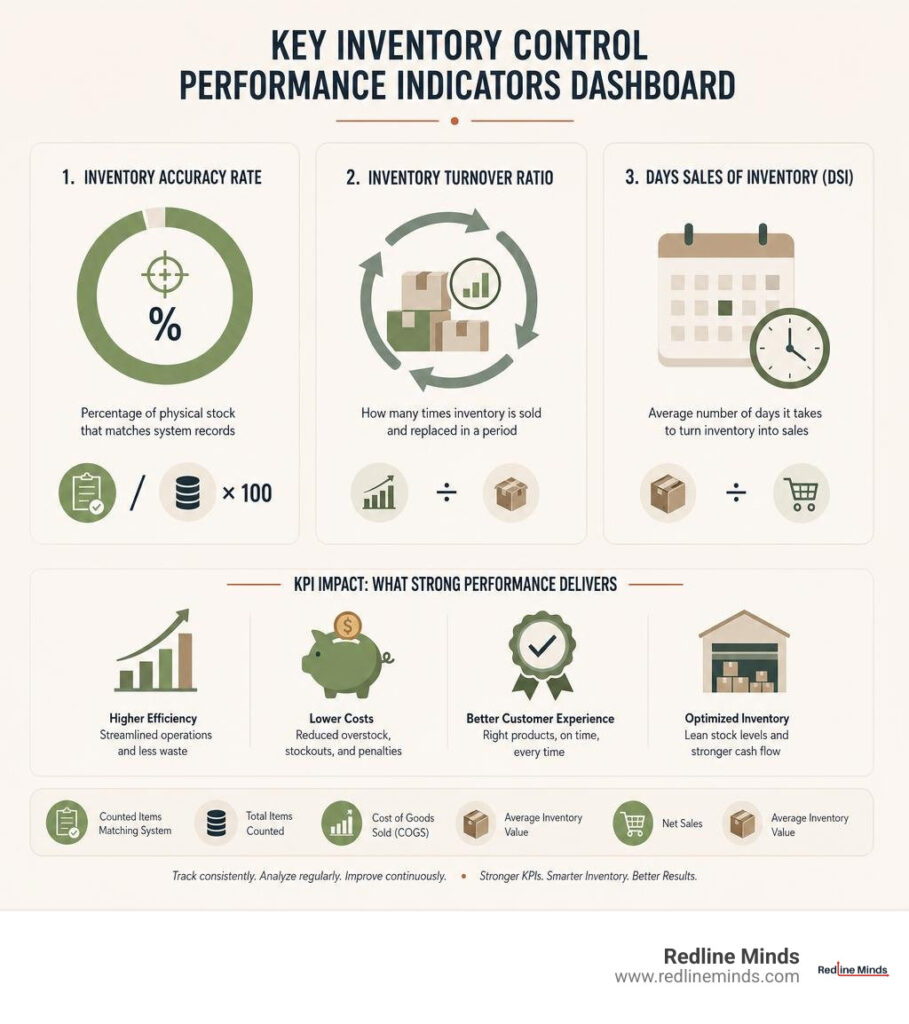
- Inventory Accuracy Rate: The percentage of physical stock that perfectly matches your system records. Top-performing facilities consistently maintain 99%+ accuracy.
$$\text{Inventory Accuracy} = \left(\frac{\text{Counted Items Matching System Records}}{\text{Total Items Counted}}\right) \times 100$$ - Inventory Turnover Ratio: Measures how many times a company sells and replaces its inventory over a given period. A higher number indicates strong sales and lean stock.
$$\text{Inventory Turnover} = \frac{\text{Cost of Goods Sold (COGS)}}{\text{Average Inventory Value}}$$ - Days Sales of Inventory (DSI / DIO): The average number of days it takes to turn inventory into sales. Lower DSI reflects efficient capital conversion.
$$\text{DSI} = \left(\frac{\text{Average Inventory}}{\text{COGS}}\right) \times 365$$ - Stockout Rate: The percentage of customer orders or line items that cannot be fulfilled due to lack of available inventory. World-class operations aim for < 2%.
$$\text{Stockout Rate} = \left(\frac{\text{Unfulfilled Out-of-Stock Orders}}{\text{Total Orders Placed}}\right) \times 100$$ - Order Fill Rate: The percentage of customer orders shipped completely on the initial delivery. The benchmark target is 98%+.
- Dead Stock Percentage: The proportion of total inventory that has generated zero sales over a 90- to 180-day window. Keeping dead stock below 3% prevents unnecessary carrying costs.
Frequently Asked Questions About Inventory Control
What is the most effective way to transition from periodic to perpetual inventory control?
The smoothest transition begins by standardizing your item master catalog and applying unique barcodes to every sellable SKU. Instead of attempting a massive, all-at-once overhaul, pilot perpetual tracking on a single product category or warehouse zone. Equip warehouse staff with mobile barcode scanners to record every intake, putaway, and pick. Once transaction discipline is proven in the pilot zone and system data updates cleanly in real time, roll the scanning workflows out across the rest of your facility.
How often should a business perform cycle counts?
Cycle count frequency should be determined using ABC classification. Class A (high-value) items should be counted weekly or bi-weekly, Class B items monthly, and Class C items quarterly. In addition, use opportunity-based counting: verify stock whenever a location reaches a zero system balance, or when pickers report a minor discrepancy. High-volume operations should aim to audit roughly 5% of their total catalog each day.
What is the difference between FIFO and FEFO inventory rotation?
FIFO (First-In, First-Out) moves items based strictly on arrival date, shipping out the oldest purchases first to reduce general shelf aging. FEFO (First-Expired, First-Out) routes items based on stamped product expiration dates, ensuring products closest to expiring are picked first regardless of their arrival sequence. FEFO is non-negotiable for food, beverage, health supplements, and beauty products.
Conclusion
Mastering inventory control is not just about keeping neat warehouse racks—it directly safeguards your operating margins, unlocks working capital, and ensures customers receive what they ordered every single time. By combining disciplined ABC cycle counting, automated reorder points, real-time barcode scanning, and unified multichannel synchronization, you can eliminate stockouts, curb excessive carrying costs, and build a resilient fulfillment engine.
At Redline Minds, we specialize in helping growing ecommerce brands, B2B wholesale merchants, and hybrid retailers build scalable operations from the ground up. Whether you need to streamline your warehouse data capture, integrate modern inventory software with your digital storefront, or optimize multi-channel order routing, our team provides the strategic consulting and hands-on technical development you need to succeed.
Ready to eliminate inventory discrepancies and modernize your fulfillment workflows? Explore our evaluation of the Best E-commerce Inventory Control Options 2024 to identify the best platforms, systems, and automation tools for your business.
Share this article
Tap into years of experience and turn your site’s visitors into buyers.
Related Posts
-

A Quick Start Guide to Ecommerce Basics
Learn what is ecommerce in this quick start guide covering models, benefits, and trends for modern online retail…
-

The Complete Guide to Affiliate App for Shopify
Discover the best affiliate app for Shopify to grow sales, manage referrals, and boost merchant revenue in 2026.
-

The Ultimate Guide to Types of E-Commerce Payment Systems
Learn the types of e commerce payment system to boost sales and reduce cart abandonment in this complete…